Bee-line from Virginia

Question: When is a beehive hairy? Answer: When it grows a beard.

A poor joke but it helps to kick-start a post about heating and air-conditioning.

For most of the year, worker bees struggle to maintain the brood chamber in the 90 degree Fahrenheit range (32-35°C) needed for larvae and pupae to thrive in the comb. “Heater bees” keep the hive warm by vibrating their body and wings, which needs energy from honey delivered by other workers. In cold winters, the queen bee stops laying eggs and the hive switches to survival mode by clustering around her in a tight ball to avoid freezing to death. If a tele-thermometer is inserted deep inside the brood chamber you can monitor bee hive breeding activity because the temperature rises to a stable level when she starts laying again in milder weather.

Recent hot weather in the Virginia Peninsular posed the opposite challenge – heat stress. Daytime temperatures peak around 100° (38°C) and the nights stay warm. At such times the brood can perish and their wax cells soften and start to melt. Beekeepers help their colonies to get through the ordeal in July and August by painting their hives white and propping open the top outer cover to encourage a flow of air, but the workers carry a larger share of the effort to keep cool.

If you see lots of bees collecting water from puddles or swimming pools you know they are hot. So intent are they that it’s hard to discourage the industry, but human swimmers have little to fear because they are rarely aggressive except when defending their hive (who can blame them?). They regurgitate water brought home, which evaporates more quickly in the draft created by “cooler bees” lining up to beat their wings near the entrance. Yet another amazing fact about bees.

bee hive

Bearded hives at 10 PM

And bearding? I haven’t seen it in daytime, but when foragers come home after a hot day many of them stay at the hive entrance instead of going inside. It reduces the heat load on the brood. This behavior startled me the first time I shone a flashlight on a hive after dark. The crush of bees climbing over each other in slow motion had avoided taking their heat

Smuttynose brewery

Two old geezers enjoy beer

inside. They looked like a goatee, and the fuzz of brown hair on thousands of heads and thoraxes can fairly be called a beard. Docile and hard to provoke, they ignore nosy neighbors like me who wonder what is going on in their collective brain. I think they are like old geezers I know who love sitting on their porch with a cold beer on a sultry night.

Next Post: Science Flaw and Fraud


Posted in Bee-line | Tagged , , | Comments Off on Bee-line from Virginia

Honey Health

A neighbor asked for local honey to treat her allergy so I gave her some from our hives. She wanted a natural alternative to anti-histamines.

South-east Virginia has a miserable reputation for hay fever sufferers, and pollen is suspect as soon as our cars are dusted apple-green from pine trees in early spring. Pollen levels remain high and in the 8 to 9 range throughout the summer because of a succession of grasses flowering after the pine. But some people are symptomatic the year round or mainly in the fall. Pollen sometimes gets the blame for culprits like dust mites, molds and animal scurf. Maybe our neighbor is wasting her time by self-medicating on honey.

But at least the theory of educating her immune system with antigens is sound, and obviously analogous to vaccination. Someone in our family has an allergy to birch pollen and is getting relief from graded doses of the same pollen by subcutaneous shots. Would it work if he took it orally, like her trial with honey? Perhaps!

Honey

Time for Medicine

The oral mucosa has a sophisticated immune system with Langerhans cells and patrolling dendritic cells involved in tolerance. A defense system is needed in the mouth because food and drink are not necessarily sterile until they are mixed with stomach acid. If honey lingers under the tongue before it is swallowed there may be time for its cargo of antigens to be presented to these cells. Whether pollen creates an immune response during passage through the gut is more dubious, because it encounters there a fury of enzymes, although pollen grains have been found in the evacuated products at the rear end. Ahem.

Since I was both ill-equipped and disinclined to test that theory, I decided to ask a more practicable question. Is there any pollen in our honey? I dusted off a microscope to focus on a glass slide where I smeared a sample.

Aha! I saw several types of grain. They were clear or dark spheres ranging in size from about 0.01 to 0.1 mm, but I had no idea what trees or herbs they came from. And I wondered if they were sufficiently abundant to alert the immune system, but that wasn’t the most serious doubt.

When a hay fever sufferer is tested for hypersensitivity, trees and grasses are top of the pollen list. Note: they are wind-pollinated species. I can’t discount them in our honey, but if any of their pollen is present it is an “accidental” minority because bees don’t visit those species. Insect-pollinated flowers rarely cause hay fever, but it is their pollen grains that rub off bees when depositing nectar in the comb to make honey. I haven’t expressed these doubts to my neighbor since there’s a chance that she will feel better from the placebo effect!

Honey has an ancient and honorable history in medicine: it was used to dress wounds and made foul tonics and potions palatable. Moreover, it doesn’t need refrigeration because it has natural antiseptic properties. The concentration of sugars is so high that bugs are dehydrated by osmosis, and without water there can be no life.  Archaeologists have even found edible honey in Egyptian tombs thousands of years old. One of the oldest elixirs, it is still useful.

I tested honey as an antiseptic barrier on a skin wound. Easy to apply and always in the pantry, I was excited when it seemed to be working – until my dog licked it off. She knows its other virtues.

Next Post: Notes from the hive

Posted in Bee-line | Tagged , , , , | 1 Comment

Virginia Nature Journal for June

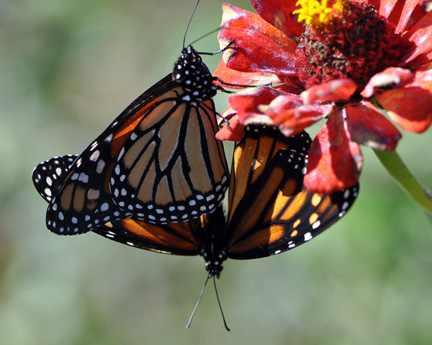
“Hey, look!” I exclaimed as a man rolled down a window of the truck he drove into our yard this morning. I think my hand was shaking as I pointed at a flower bed. “Over there! It’s our first monarch butterfly of the year. They’re rare now.”

A large butterfly fluttered around for a food plant. Its wings looked like a hinged pair of stained glass windows made of amber inside cames of black lead.  They dazzled me. And then I pondered the mystery of generations that make the long migration possible and the thousands of miles for the return journey in September. They astounded me.

“Where’s your broken pane?” the man asked. “You still want it fixed?” I guess he thought I was wasting time on a stupid butterfly. It’s harder to convert someone to care for nature when there’s business to be done.

Monarch butterfly

Making new monarchs

Neighbors told us that monarchs were common twenty years ago, but now we only catch sight of them a dozen times in a whole summer. The numbers are down by 90% in Virginia as well as elsewhere. Perhaps you have to live long enough to notice a difference, and that’s why it’s important to help children to care.

The fading of monarchs from the landscape has prompted lots of speculation. Is it climate change, or logging in their mountain fastness where they overwinter in Mexico, or pesticide exposure during their peregrinations, or food shortages as they traverse swathes of monoculture crops? Perhaps a little of all of them, but entomologists think the disappearance of the food plant for their caterpillars is the main reason. They only eat certain types of milkweed.

Milkweed species used to be ubiquitous, but intensive farming and mowing of fields and highway verges is stripping them across their range. Part of the problem is that we are less tolerant of “wastelands” and “weeds.” A little more “untidiness” might help them and the critters depending on them. Any creature like a monarch that depends on a single food source is more vulnerable than a less fussy eater.

It made evolutionary sense when the first monarchs laid eggs on milkweed. The plant is named for its milky sap which contains alkaloids that Native Americans used as folk remedies, and the scientific name for the genus is taken from the Greek god of healing (Asclepias). Since the alkaloids are distasteful to most birds, the caterpillars and the adult butterflies had an advantage, and prospered as long as milkweed was abundant.

There is a silver lining to this gloomy story. While agriculture and urban development are squeezing out milkweed, countless people across the country are running to save it.

The Internet is full of appeals by milkweed activists and ads from seed merchants. Some vendors even offer free milkweed seeds, bless their hearts. The US Fish and Wildlife Service are sufficiently concerned that grants are offered to help save the butterfly. And in our own county master naturalists are planting it in school gardens or rearing butterflies indoors or tagging them so researchers tracing their migration can discover the most vulnerable stages of their migration.

Milkweed

Swamp milkweed seedlings

Even tiny efforts can feel worthwhile when they are part of a larger endeavor. I bought swamp milkweed seeds in March. After germinating in trays of potting soil I planted them out, and they are now over a foot tall in damp corners around the yard. Perhaps the colorful visitor I had today has already found them and laid its eggs under the leaves. And maybe in a couple of weeks they will grow into a bunch of fat caterpillars with black, yellow and white stripes like pajamas. Of all the critters that feast on our vegetation, they are most welcome.

Red admiral butterfly

My red admiral friend. Photo: Judy Jones

Butterflies are wonderful ambassadors for nature, and monarchs are as fine symbols for conservation as giant pandas. I never heard anyone say they disliked them, except perhaps a gardener moaning about cabbage white butterflies on his brassicas. Butterflies are almost entirely harmless, and exquisitely beautiful. You can even make a friend of one if you hold out a finger very gently to offer salt in your pores.

Next Post: Honey for Health?


Posted in Nature | Tagged , , | Comments Off on Virginia Nature Journal for June

Milton’s Mulberry Tree

According to tradition, a mulberry tree was planted at Christ’s College in Cambridge the same year that John Milton was born (1608). The tree shaded the poet when he went up to university as an undergraduate, and survives in what is now the Fellow’s Garden.

I never visited the garden when I lived in Cambridge. At busy times in life, and in cities that offer much, it is easy to postpone the sights, but we move away before tomorrow arrives. So while I was staying in college last week, I took the opportunity to see the famous tree.

It is now a sprawling mass of shoots rising little more than fifteen feet. The trunk rotted away long ago and horizontal branches are propped up like the arms of old men leaning on canes. A less venerable tree would have been axed long ago to make way for a pretty flower bed.

Even in Victorian times when the tree was barely two centuries old there were worries that it would not last much longer. “Time’s effacing finger must at no distant season sweep it entirely away from its much honoured site. Serious apprehension is entertained of the tree not being able to survive through another winter” (Eliza Cook’s Journal, 1854).  But if you look closely, its shoots are still vigorous, foliage is free of disease, and there is a crop of fruit for another batch of mulberry jam. When trees grow old, they can still thrust up arms of youthful vigor.

Perhaps resveratrol flowing in its veins helped to preserve the tree. But no matter its age, if shoots are still healthy there are germs of longevity in their tips. They contain meristems like stem cells derived from animal embryos which can recreate a whole organism (think of clones or Adam’s rib). Most gardeners take the regenerative power for granted, but when I take cuttings to make a new rose I think of embryology. In 2008, on the four hundredth anniversary of Milton’s mulberry tree, shoots from the old stock were planted in Wales for the Hay Literary Festival.

Who dares to guess how long they will thrive there? The indefinite longevity of plants is a marvel denied to mortals. Perhaps Charles Darwin pondered the difference after seeing the mulberry tree when he was admitted to the college in 1827.

Five years after going down from college in 1632, Milton was contemplating the premature demise of Edward King in a shipwreck. He composed an elegy for his college chum, which ascends from pastoral life to a resurrected plain that an immortal mulberry tree has no need of.Lycidas

Next Post: Virginia Nature Journal for June

Posted in Academia, Nature | Tagged , , , , | Comments Off on Milton’s Mulberry Tree

Fertility owes Preservation to a Sheep

The journal Human Reproduction reported a 27-year old woman in Belgium has delivered a healthy baby boy. That would not be newsworthy if she had not been rendered sterile at 13 years old by a life-saving bone marrow transplant for sickle cell anemia.

This was neither conception with a donor egg, nor from a mature egg retrieved and frozen from her ovaries before chemotherapy. But it did involve one of her eggs, so she could become the birth mother and genetic mother. So how did it happen?

Shortly before curative treatment for sickle cell, her gynecologist harvested strips of tissue from her right ovary for frozen storage. In excellent health a decade later, her tissue was thawed and transplanted to the now sterile left ovary, as well as elsewhere. After 5 months, she had her first period, which confirmed that eggs had survived inside their follicles, and she continued having regular periods until conceiving naturally within two years. Yes, it gave her periods and fertility without any further medical help—naturally!

It’s a newsworthy case because she is first to deliver after transplanting an ovary stored from childhood. Girls undergoing sterilizing treatment are rarely offered fertility preservation, and this can be their only option. The first case of its kind was 20 years ago for a two-year-old Yorkshire infant called Harriet. We would never have suggested it except she had to undergo an operation to remove a kidney tumor, which gave us the chance to safeguard some of her ovaries “just in case.” I don’t know if she has requested the hospital to have her tissue back, but it is wise to wait until ready to start a family because we can’t predict how long a transplant will function before it fails and then plunges her back to a menopausal condition.

There have been about 40 births to women worldwide after a frozen ovary transplant, all of them healthy to my knowledge. And there is a further series of 11 women who received a fresh transplant donated by a sister at the Infertility Center of St. Louis led by my colleague, Sherman Silber, M.D. He recently reported in Reproductive BioMedicine Online that menstrual cycles have returned in every case. Two women are still cycling after 8 years, with 11 births in all. It has turned into a rather robust procedure.

While ovary transplants have been in the news for over a decade, there is no full account in public space of how they originated. The story depended on a sheep, but the idea was really a brainstorm in a blind alley. Science doesn’t always proceed linearly, and sometimes backs out of a cul-de-sac to find the main highway.

Around 25 years ago at Edinburgh University, I naively mentioned on a BBC TV science documentary that I was testing if fetal ovarian tissue can restore fertility in adult animals. This was before the era of egg donation and at a time when egg freezing was considered unsafe. Since there are more eggs in fetal ovaries than after birth, the prospects of a long functioning graft seemed high—provided the eggs were healthy for making babies. When the experiments were successful, women with premature menopause or Turner’s syndrome urged me forward, but it was an idea stillborn.

I was the target of huge opposition and not a little opprobrium from bioethicists, churches, politicians, and just about everyone else. A senior American scientist even warned me not to travel to the USA because people were saying the procedure would encourage abortion for donating tissue. Nothing was further from my mind than that horrific idea, because my research agenda was entirely pro-fertility! I had simply believed it is better to do some good with discarded tissue than no good at all, although I acknowledged there were issues about safety and consent.

The bumpy ride did, however, take me back to a new and much less controversial agenda. It was a time when cancer survival rates were starting to climb, especially for children, but sooner or later the highly toxic and aggressive treatment could make them sterile. Men had the option of semen freezing, but there was no equivalent chance of preserving fertility for children. I started to wonder if ovary banking for girls and testis banking for boys was the answer.

Roslin Institute

Frosty conceived after ovary freezing and transplantation in Scotland

We had modest hopes because freezing whole tissue is harder than single cells, but if it worked with sheep ovaries we were hopeful of the same for patients. I remember working with my colleague David Baird in a cold operating room at the experimental farm outside Edinburgh where Dolly the cloned sheep was born a few years later. We returned frozen ovarian tissue to the same ewes a month after a harvesting operation. Four to five months later the animals showed signs of graft activity, the same delay we have observed in patients. Not long afterwards, there was a pregnancy, and a little “Frosty” was born.
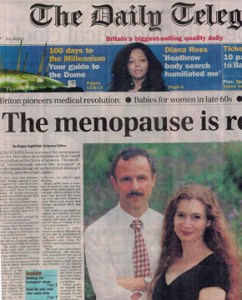
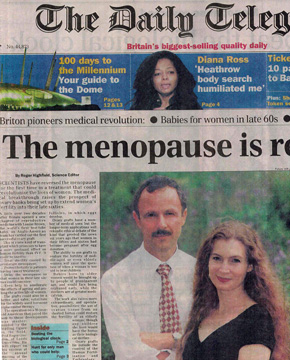
The Daily Telegraph September 23, 1999

The Daily Telegraph September 23, 1999

A research fellow who returned to the USA from my lab was first to transplant frozen tissue to a patient. It happened to be on my birthday in 1999 and the eve of emigration to a job at McGill University that the patient came to the UK and visited my lab. There was a huge splash in the media, perhaps because there was no other news that day!

Unfortunately for her, the graft was not successful. It had been frozen as minute fragments at an unknown center, but the attention she received encouraged others, and there was happier news for them. By 2004, the first birth was reported, and this too in Belgium.

Next Post: Naturalists, Snap that App


Posted in Biomedical, Fertility | Tagged , , , , | Comments Off on Fertility owes Preservation to a Sheep