Blackbird Migration

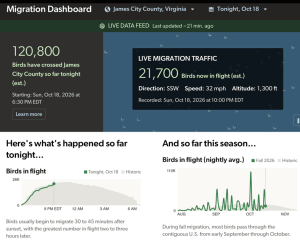
Bird migration
Screenshot

It is mid-February after the coldest weeks I can remember in south-east Virginia. Our summer visitors are still wintering in balmier latitudes; they won’t fly north for another month, but some locals are on the move.
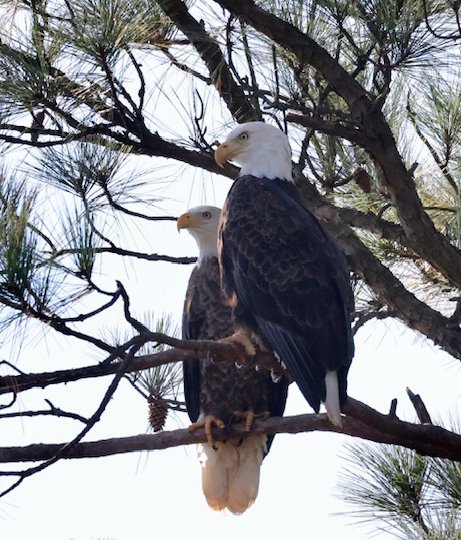
A cloud of Common Grackles and Red-winged Blackbirds often land to feed on our lawn and chase smaller visitors off the bird feeders. The noisy, boisterous flocks look Hitchcockian, numbering a few hundred, but when I walked the dogs, I heard a vast twittering flock approaching from the east, too high to land nearby or even identify. (The headline image is not either of these species)
They kept coming … and coming … and coming. It took three minutes for the flock to pass. I estimated the column at over fifty wide, but they flew so fast I couldn’t do more than guess at the total, certainly many tens of thousands, and likely ten times ten the number.
To use a hackneyed word – they were awesome. But they didn’t perform the kind of murmuration that Starlings are famous for, the collective acrobatics that forces a stop for watching the performance. The blackbird flock, probably a mixture of the two species plus some fellow travelers, flew in a steady stream toward an unknown roosting place under the setting sun. I saw a Sharp-shinned Hawk race after a straggler. There’s safety in numbers except for tail-end Charlie!

Red-winged Blackbird

Image credits, respectively: Pexels (Aleksandar Pasaric) and the late Inge Curtis

Posted in Birding, Nature | Tagged , , , | Leave a comment

The Chill of ICE

Icy scene
From Unsplash

I dash from the porch and promptly do battle with ice,
Stagger to join rows of bundled-up neighbors, gentle as mice,
They stamp frozen feet and wave with woolly mitts
Slogans on floppy placards, too chill to move lips,
And dream of springtime to melt the grip of ICE.

Image credit: Yuriy Bogdanov (Unsplash)

Posted in Nature, poetry | Tagged , | Leave a comment

The Afterlife of a Beekeeper – an ode

Beehive

I lost my beekeeper buddy a week ago and wondered how to leave a tribute for her. This is my timid offering, celebrating the continuity of life.

Honeybees on the comb

The brood snuggled down against the dark,
Since she sealed hive boxes tight as an Ark;
She barred the drafts, drew entrances tight,
Only a timid guard peeped out at the biting night;
She left them honey on the comb, a golden crown,
But they settled down to sleep, all spellbound,
While the beekeeper has gone to ground.

Christmas decorates the street with flame,
Bronzed beech leaves rattle, still the same;
Behind drawn blinds, children hold their breath,
Outside it is cold as a lingering death.
The hive has chilled, save where the queen is found,
Wrapped in a quilt of bodies, mound on mound.
No hum to stir the ear; all seems unbound,
And the beekeeper has gone to ground.

But wait awhile till frost yields as dew,
When something stirs where none would do;
The first to test its wings and lift into the air,
Lands on Mahonia stamens, sweet and fair.
“And all shall be well,” is the old mystic’s prayer,
“All manner of thing shall be well.”
The beekeeper soars with her brood in the air.

Honeybees

Explanation: Mahonia is the first plant to flower for the bees before the spring. The quotation is from the medieval English mystic, Lady Julian of Norwich. Line drawings from my book The Boy Who Could Bee

Posted in Nature | 2 Comments

Paying back Spain in kind with Red Kites

Red Kite
Image credit Don Coombez (Unsplash)

Red Kites were familiar sights in London in Shakespeare’s day. He mentioned them in several plays, but not always with compliments. The Winter’s Tale tells a complaint that “My traffic is sheets; when the kits builds, look to lesser linen.”
They fill the ecological niche in Britain and Europe that vultures occupy in other continents. The Tale refers to the habit of stealing clothes drying outside on washing lines to decorate their nests. Such mischievousness irritated people who forgot they were virtuous scavengers cleaning streets of rotting carcasses and other detritus that encourages disease, much as our two species of vultures clean roadkill to the bones.
Poisoning and shooting brought British kites to the verge of extinction. I went in student days to see the last holdouts in mid-Wales at Tregaron Bog (also known as Cors Caron). Recovery of the inbred residue looked doubtful at best.
Two conservation organizations a couple of decades later introduced young birds as potential breeders from Sweden and Spain, where they were still common. This has been an outstanding reintroduction program. Thousands of birds thrive now in suitable habitats up and down the country. With laundry safely stowed in tumble-dryers, the Tudor complaint is redundant. I haven’t seen them yet on my return trips, but family and friends have gushing compliments for the birds that hover over fields with shallow forked tails.
The story of Red Kites is circular. They have suffered a catastrophic decline in Spain from eating poisoned bait intended for varmints. It affected other raptors, but they are recovering. British fledglings have been returned to their ancestors’ country, where we hope they become successful breeders and won’t behave badly as they are wont to do in England, putting their reputation at stake again.
The Henley Standard published a story in 2023 of a Red Kite swooping for a sandwich a girl was about to eat while sitting on a bench beside the River Thames. When it dropped a slice, it beat her to pick it up. Other kites favor croissants, and one snatched a slice of pizza from a boy’s hand. This is the price the public pays for making birds too cocksure by befriending them with tidbits.

Posted in Birding, Nature | Tagged , , , , , , | Comments Off on Paying back Spain in kind with Red Kites

Job in the Whirlwind at the End of his World

Scottish National Gallery, Edinburgh

William Blake was a poet, painter, printmaker, mystic, and, I vouch, a protoenvironmentalist. His painting: Job Confessing his Presumption to God, who answers in a Whirlwind, represents the crisis of his life. Job had a great life with his large family and immense possessions until he lost everything. The folktale is usually taken as a parable that questions God for allowing suffering (or letting pesky Satan loose), but it can be read another way.
Job regards himself as an entitled master of all he owns. As a righteous man, he deserved it! But God, speaking out of the whirlwind, asks (in other words), “Where were you at the Big Bang, the Age of the Dinosaurs, and the start of the Agricultural Revolution?” Job is depicted as the shrunken figure crouching under the Godhead.
If Blake could look down from heaven today, over two centuries since the paint dried, he would see colossal results of arrogance as the species that regards Earth as its dominion despoils it in a blink of cosmic time.

Posted in Environment | Tagged , | Comments Off on Job in the Whirlwind at the End of his World