Drive, Text, and Let Die

A commuter in the Monday morning gridlock on the Washington beltway might well daydream about trips on open roads – the feeling of freedom and joie de vivre, and the expectation of a happy arrival at the end of a journey. But while they are at a standstill on the asphalt, they should remember the consolation of being safe from other drivers.

On such a road trip, driving at the speed limit (70 mph) along the I-64 West in Virginia, we are thrilled by the first sight of bumps on the horizon – the Blue Ridge. At the tipping point on top of the Blue, the highway runs down into the Shenandoah Valley giving us a glimpse of the distant Appalachian plateau where we plan to spend a peaceful weekend in the mountains. God willing!

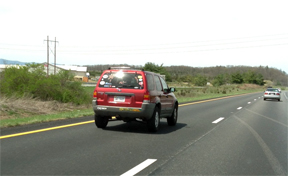
A red SUV passing us caught the corner of my eye, and I don’t know why but it made me glance aside. The sight put into low gear the reverie I had been enjoying about the weekend ahead.  The lone driver was a young man and he was driving with no hands. He was preoccupied typing a text or email message on his mobile device while he passed in the fast lane. You could say that neither the road ahead nor the vehicles he burned past were at the front of his mind.  Lucinda snapped a photo with her iPAD.Texting on I-64a

This isn’t the kind of story I like to write about. Everyone knows that using a mobile device while driving is common, risky, and now the main cause of road deaths and injuries for young people (3,000 and 300,000, respectively, each year in the USA). Only a day or two earlier while I was walking our dog, a lady with her cell phone held to one ear raised the other hand from the wheel to wave at the dog while she was turning a sharp corner. I jumped in the hedge, yanking Lilah after me.  Of course, teens are not the only ones who get distracted while driving, but those that feel invincible are more vulnerable. Texting goes hand-in-hand with other risky driving behaviors – not wearing a seat belt and being intoxicated.

According to the Centers for Disease Control, 45% of high school students reported texting behind the wheel in the past month.  The rates were no lower in states where it is already illegal, so enforcement has been useless so far.  It must be a hard habit to break if a campaign by Oprah Winfrey, the “world’s most powerful woman”, has been unable to dent road accident statistics. She calls it an “epidemic” across the entire country.Texting on I-64b

So when you are cruising along the highway, and maybe playing It’s a Wonderful World to put you at ease, spare a thought for other road-users. Driving more defensively might help to avoid someone careering into your back before they look up after typing LOL.

Next Post: The Good, the Bad, and the Cannibals

Posted in Other | Tagged , , , | Comments Off on Drive, Text, and Let Die

Bee Intelligent

I remember a biology lesson when our schoolteacher laid out a row of pickled brains.  The lids of some jars were leaking formaldehyde vapor into the classroom, an irritating odor that I had to get used to after I started working along the corridor from the anatomy dissecting room at the Edinburgh Medical School.  But that day we only saw brains from a sheep, rabbit, dog, and mouse, and nothing as mesmerizing as a human brain or as minute as a bee’s.

Honey bee brain

Honey bee brain

The class was asked to place the brains in order from the smartest to the dumbest. Everyone voted for dogs at the top spot, even though their brains are only half the size of a sheep’s. Dogs are quick learners and can round up a stupid flock: it’s never the other way round!  Evidently a larger brain is not always gain.

One of my classmates piped up trying to impress our teacher, “Sir, isn’t intelligence hard to define and measure?”

“Not at all…”, he replied.

I can’t remember now the definition he gave except it was so anthropocentric I found it hard to relate to animals. And he believed the only reliable way to measure intelligence was using an I.Q. test. In those days, boys were still slightly in awe of teachers so no one dared ask the impertinent question: what does an I.Q. test for a Border Collie look like?

After graduating from high school, the boy who asked the question went on to a roaring success, as we expected, but not all the bright students who performed well in examinations in our boys’ school fared as well at college or afterwards. I wondered why. Now I know there’s more than one kind of intelligence – at least nine, so they say, but I shall add another. My classmate was right after all – intelligence isn’t simple, and sometimes “simple” is smart.

Our species doesn’t always get straight A’s in tests: sometimes animals are streaks ahead of us. Chimpanzees have better short-term memories for numbers and their positions on a screen test, and my Golden Retriever beats me in emotional intelligence (call it what you will). Like others of her kind she has an amazing ability to anticipate my actions even before they come into my mind, presumably having learned subtle cues of which I am unconscious before, say, taking her for a walk or feeding her. Owning a pet gave me more respect for animals than anything I ever learned in a biology class.

Bees too are intelligent – really? A honey bee “brain” is merely a string of ganglia containing fewer than a million nerve cells. The average canine brain contains thousands of times more cells. But many people claim that bees are intelligent, and as a new beekeeper they certainly fill me with awe. I wonder what my classmate would think now: would he say their nervous system is capable of anything more than instinctive behavior?

Routine inspection

Routine inspection

When a guard bee attacks my bee-suit like a kamikaze pilot while I am inspecting its hive, it is obeying an instinct that has been honed during millions of years of evolution. Since it didn’t have to learn this behavior I can’t call it “intelligent” any more than a military drone, except when there’s a human controller behind it. To call bees smart there must be evidence that they can learn from experience, and they can – collectively. They have a social intelligence based on the thousands of workers, a few hundred drones, and the single queen in a colony. I like to compare a colony with a body in which all the necessary functions for health and survival are divided between organs – brain, heart, liver, et cetera. In a hive or swarm, the responsibilities are split between guards, nurses, foragers, and an egg-layer.

If you watch an active hive you will soon be impressed by its orderly life, like a healthy body at work. Such smooth running requires a lot of communication through smell, touch, and sight, of which the most famous example is the waggle dance. Bees returning from foraging for food pass information to others by “dancing” for them, which is a kind of sign language conveying information about the direction, distance, and even the quality of a source of nectar or pollen.  This behavior increases foraging efficiency for the whole colony which would otherwise have to search randomly for food. And when bees go out again to forage a cognitive map in their tiny brain remembers where the good stuff can be found, and the best time of day to go. As impressed as I am with my smart phone, no manufactured mobile device I will ever own will be as clever.

The latest buzz is that bees can use the waggle dance as coded information to advise the colony where to relocate. When accommodation in a hive or a natural nest has been fully occupied the colony swarms to search for a new home, taking lots of honey with them. This is a beekeeper’s nightmare at this time of year after we recently celebrated the survival of our hives through the winter.

Checking for queen cells (peanut-shaped cells at base of frame) before "splitting" a hive to discourage  swarming

Checking for queen cells (peanut-shaped cells at base of frame) before “splitting” a hive to discourage swarming

Tom Seeley of Cornell University wondered how a swarm decides where to hive off to.  He chose for his study an island several miles offshore from Boston where there were no existing bee colonies or natural nest sites (no trees). His research team marked hundreds of bees with a colored ink spot on the thorax so the peregrinations of scouts from several swarms could be traced around the island. Then he set up hives, but some of them were much more hospitable sites than others.

Scout bees, being the oldest and “wisest” workers, searched for nest sites all over the island. When they returned they started dancing a coded message for the swarm, but how did it decide which scout had found the best home for them? The researchers noticed that the scouts that danced the longest were proposing the best quality nest sites, and they almost always rendered honest advice.  The colony reached its decision where to nest by vox populi or “interviewing” all the scouts: it seems an incredible blow to our pride that bees invented democracy millions of years ahead of us. The upshot of the study was that 19 times out of 20 they wisely chose the best site.

Swarm intelligence enables honey bees to make the life-or-death decision of finding a home that is safe from critters and the elements. So bees are bright. A swarm weighs about the same as a human brain, but humans can be rather lacking in collective intelligence, and often in trying to make a decision our judgment is poor and we create chaos and strife.

Next Post: Drive and Text, and Let Die

Posted in Bee-line | Tagged , , , | 3 Comments

Robert Edwards (1925-2013)

A memorial service for Bob Edwards was held last weekend at Bourn Hall, near Cambridge, England. That is the Jacobean mansion house where he founded the world’s first in vitro clinic for fertility treatment (IVF) with Patrick Steptoe in 1980. Lying in its beautiful grounds, Patrick’s grave is often visited by grateful patients. On Saturday the ancient wooden front door swung open for Bob’s wife, five daughters, twelve grandchildren, and a troop of colleagues, friends, and admirers who came to give thanks for his life. He leaves a legacy with few parallels in science and reproductive health, and most of all he gave joy to parents of five million babies who owe their existence to his pioneering struggles for a medical revolution with Patrick and Bob’s assistant, Jean Purdy.

We miss him terribly. It seems impossible that anyone endowed with that much vigor is gone. We imagine him turning up at any minute when the angels push him out after disturbing the peace upstairs. Well into his eighties, Bob was still full of boundless energy and infectious enthusiasm. After retiring from Cambridge University and Bourn Hall, he was busy lecturing and collecting honors and awards around the globe, and he founded several new biomedical journals which soon attracted the best research papers. But, finally, time caught up and frailty captured him.

Bob needed lots of energy and a gritty Yorkshireness seasoned with humor for the hard journey to a controversial goal. The uproar that his research agenda caused between the 1960s and the 1980s is becoming a fading memory, and may even puzzle a younger generation for whom IVF is conventional treatment and knowing people who depended on it for building their family.  But for those who remember the old times it’s hard to understand how he endured so much professional antagonism, even personal animosity, that tried to stop him in his tracks.

Most people would have quit. He told us it was the appeals of childless couples and heart-rending stories that drove him on. A reactionary medical profession in those days had nothing much to offer for infertility and, too proud to admit defeat, often ignored the problem.  No one could have guessed that the boy who grew up in a northern mill town would become their champion and one of Britain’s greatest scientists, any more than we expected a grocer’s daughter from Lincolnshire would become the first woman Prime Minister and the Iron Lady.

Bob obtained his PhD in genetics and embryology at Edinburgh University in 1951 where he collaborated with Ruth Fowler, whom he later married. After short spells in the USA – at Caltech, Johns Hopkins, and Chapel Hill – he returned to London to take up contraception research, but it wasn’t long before he was studying his first love again – eggs and embryos. Ever boiling with ideas, he started to air dreams of launching IVF in medicine, but babies had only been born after IVF in rabbits and in no other species. He imagined how IVF could help women with blocked tubes and avoid children being born with cystic fibrosis, hemophilia and other inherited diseases. In the end, it had many more applications, but then almost everyone thought he was barmy. To be sure that he didn’t cause any trouble, a new director in London banned his work on human ovaries.

He moved to Cambridge University to join Sir Alan Parkes, whom I remember as a crusty old school chap, but who had an eye on the future. Bob flourished there, staying the rest of his career and ascending the academic ladder to full professor. For human IVF he needed help from medical doctors as gatekeepers to patients, but they were keeping the “maverick” at arm’s length.  In 1968, Bob met a gynecologist who not only welcomed collaboration but had developed a new technique, called laparoscopy, which he needed to collect eggs from patients’ ovaries. That man was Patrick Steptoe. He was based in the north of England, far from the seats of power, and he too was regarded as an outsider by the gynecology community.

They were the perfect pair as it would take a special chemistry to spark a medical revolution in a climate in which colleagues constantly poured water over them. One day their story will no doubt become one of those Hollywood movies that will make people who remember them and their times cringe to see the story crafted for the box office.

A year after starting together, Bob and Patrick reported a breakthrough – they had fertilized human eggs in the Petri dish (or test-tube, if you prefer). It would take almost a decade of flip-flopping between Cambridge and Patrick’s hospital, with many disappointing results and hostility along the way, until the next breakthrough. That was when they were rewarded with the birth of the world’s first test-tube baby, Louise Brown.

Back in the 1960s, few people took him seriously. He was regarded somewhat like a cranky Old Testament prophet, and the venom didn’t pour out until his research started to make traction. There were ghastly newspaper headlines demonizing the pair for creating human embryos in the lab. Being called Dr. Frankenstein was the least offensive. Perhaps hardest of all to bear was condemnation by so many in their own professions, as well as a good number of politicians, theologians, and even Nobel Prizewinners. After Louise’s birth, The Daily Mail ran the headline, “Baby of the Century”, and so the news echoed around the world. Had she been an unhealthy child, fertility treatment would be different today, but she was bonny and it seemed heartless to say an in vitro baby should never have been born.

I joined Bob’s lab to study for a PhD in 1970 when his work was starting to heat up. I thought it would be cool studying embryos, although it would mean I had to sacrifice a love of animal behavior which I could have studied in another lab. That post was taken up later by an American in my college, Dian Fossey, who, as you probably know, went off to Rwanda to study gorillas in the misty mountains. A decision made at a fork in the road when aged 21 often has a lifelong impact.

Bob was different to other Cambridge dons, perhaps because he hadn’t been born with privileges but had to earn them. He led his graduate students and fellows in a very egalitarian way, encouraging us to think and explore, teaching us to argue about data and theories, sometimes teasing us by playing the devil’s advocate. With the exception of Barry Bavister who had developed a culture medium for fertilizing eggs, we were hardly involved in the clinical program which was out of sight nearly 200 miles away. I have been asked why Bob didn’t draw on the growing expertise in his own group, but I think he was keeping us at arm’s length from a controversial program that might have been harmful at tender stages of our careers. Today, he might be criticized for supervising students so lightly because of frequent absences, but in those days Cambridge had an unofficial “sink or swim” policy. We could swim because he had built a strong team that provided mutual support,
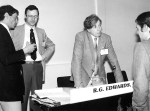
Bob and I chairing a scientific session. Helsinki, 1983

Bob and I chairing a scientific session. Helsinki, 1983

and I never again knew a happier workplace. Besides, we often felt happy to see the back of him to a conference or loading his station wagon for another trip to see Patrick. You would have to know Bob to understand what I mean, how maddening our beloved professor could be. Ideas poured out of him like newsprint from a press. When he proposed to us an exciting experiment, you feared that by the next morning the idea would be scrapped and he’d have a better one. I never encountered a more fertile scientific mind, and although most of his ideas were raw and forgettable, some were so precious that they have already been absorbed into mainstream medical practice or their implications are still being worked out.

My first project was to test his brilliant theory about the cause of Down’s syndrome, which is so much more common in babies of older moms. I labored over it for several years but, never able to prove it, grew more skeptical. Long after I had left Cambridge, he continued to rib me, “Haven’t you proven my theory yet, Roger?”  The supple balance between scientific seriousness and light-heartedness was so endearing.

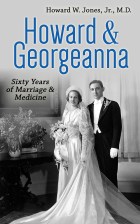
My wife, Lucinda, has fond recollections of his visits to Virginia when she was the embryologist for Drs. Howard and Georgeanna Jones’s team, which was the first in America to have an in vitro baby.  One day she gave him a tour of the lab of which they were so proud and had taken great pains to maintain a sterile work area. Not wishing to be impressed too easily, he stretched up to the top of a tall incubator to wipe a minute film of dust on his finger, before grinning like a Cheshire cat.

On another occasion when he was visiting my young family in Scotland, he took us out for dinner. After my boys turned up their noses at whole fish on the menu he ordered a plate piled high with whitebait, which he then started devouring, his eyes darting from one boy to the other to watch them wide-eyed with horror as he swallowed each little fish head-first. We cherish pictures of him sitting on the lawn at Bourn Hall in the middle of a crowd of children conceived by IVF.

If he had any disappointment at the end I think it would be that his gift of fertility treatment was too expensive for low income couples to afford, especially in the U.S.A. It had made some doctors, and now the companies behind them, rich, which seemed to run against his socialist principles. That’s how he styled himself, but he was impossible to label.

The last time I saw Bob and Ruth was over three years ago when I visited them at their mini-farm outside Cambridge with Kay, a doctor from Bourn Hall. His health had obviously deteriorated. Although Kay said he was having a good day, he seemed far-away, locked in an old memory or stewing over something.  He showed us his honors and awards that completely covered the wall of a side room, then explained them in turn – Legion d’Honneur (France), C.B.E. (UK), Fellow of the Royal Society (London), honorary degrees (Cambridge, York, Wales, Belgium, Greece, Romania, etc.), King Faisal Prize (Saudi Arabia), Lasker Award (USA), and many more that I can’t remember. But despite so many tributes I knew him well enough to see he was holding back a disappointment.

We were sorry he was passed over for the 2007 Nobel Prize which was awarded for stem cell research, something that he was pioneering as long ago as the 1960s. It seemed that his chance had passed and, unless a call came from Stockholm soon, time would run out. Nobel Prizes are not awarded posthumously, so Patrick was already out of the running, having died the day he was due to receive a C.B.E. with Bob from the Queen at Buckingham Palace. We knew there was Vatican pressure on the Nobel Committee to stop an award for IVF, so it was with a mixture of surprise and delight when the following year Bob did indeed receive that call. He won the 2010 Nobel Prize for Physiology or Medicine, the highest scientific accolade he could be given, and one to savor as it finally vindicated his work.

Sadly, he was too unwell to travel to Stockholm so one of his former students, now himself an emeritus Cambridge professor, accepted the Prize on his behalf. Two weeks ago in an obituary notice, the New York Times printed that Bob was “unable to appreciate the tribute”.  I am delighted to correct the writer – he knew and celebrated it.

Mrs. T's handbag

Mrs. T’s handbag

A few weeks before he died, I attended a conference in his honor at his college, Churchill.  Displayed in a glass cabinet next to his papers was Margaret Thatcher’s famous handbag. Wags have told a story that the bag was full of iron weights for swinging at her liberal opponents or at conservative “wets”.

Bob and Margaret were born and died within days of each other and, although from opposite political poles, they were both visionaries who drew immense loyalty and intense opposition in equal measure. The juxtaposition of their artifacts seemed odd until I recalled that she had never openly criticized IVF, as a good number of her party had, and, moreover, it was her government that had awarded his first public honor in 1988, albeit a ‘middling’ one. It would take another twenty years and the Nobel Prize before one of her successors as prime minister recommended him for a knighthood. But I guess he would still prefer to be remembered as just plain “Bob”, the family man who helped folks to have children.

************************************

Bob never belonged to a faith community and once told me he didn’t like “churchy music”. But there was an undefinable spiritual core in his heart, and he would have enjoyed the Gaelic Blessing on Saturday.   Composed by John Rutter, this rendering is sung by the Cambridge Singers. Click here. (Sorry I can’t cut the ads.)

Deep peace of the running wave to you

Deep peace of the flowing air to you

Deep peace of the quiet earth to you

Deep peace of the shining stars to you

Deep peace of the gentle night to you ….

This personal tribute to Bob was posted because copyright law prevents me from posting the obituary I authored in Nature or another I wrote for Fertility & Sterility with Dr. Howard Jones. Pdf copies are available by email after publication.

Next Post: Marvel in the hive

Posted in Memoir | Tagged , , , , , , , , , , , , , | 1 Comment

Appalachian Spring

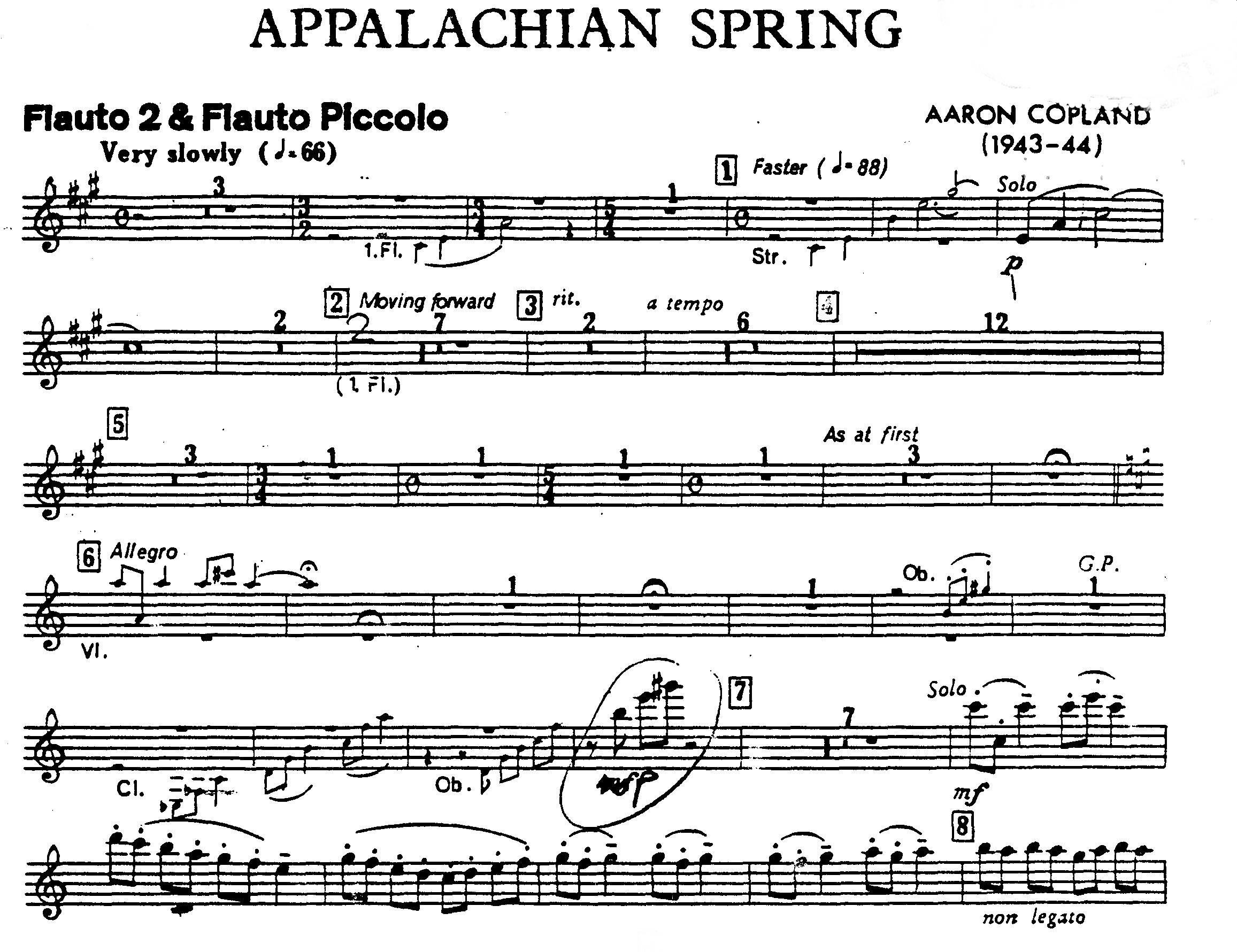
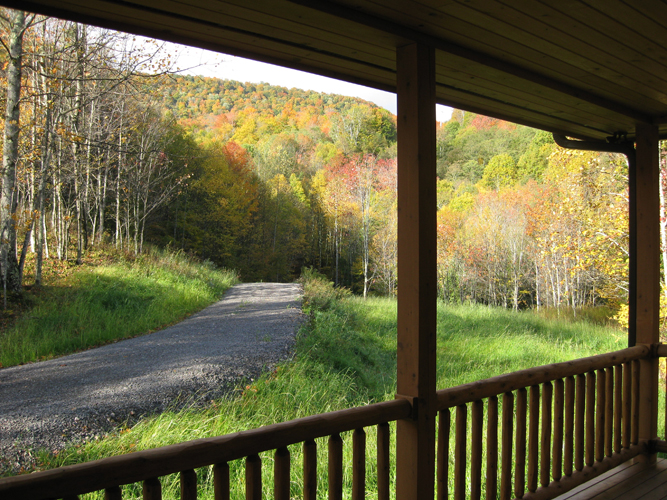
I took the title from Aaron Copland because his suite captures the very essence of my feelings about Appalachia at this time of year. Springtime arrives late, growing very slowly like the music until a major arpeggio bursts out of an allegro storm, like gods thundering around our West Virginia home, which squats timidly in a crook between dark mountains.  Later the music becomes tender again like the forest which, after long, melancholy winter months, now clothes itself in a fresh green mantle. I love it.Music score

For a long time, I thought the composer had the same images as were in my mind, and I was a touch disappointed when I read that the suite is a musical picture of a spring wedding in Pennsylvania. I got over it.  I realized it didn’t really matter if an abstraction has been inspired by something completely different, provided it means something to you. If you click this link, perhaps the music will carry you to somewhere special.

Ramps

Ramps

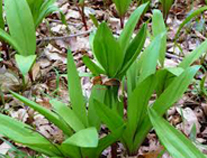
Last week I took a trip along the Appalachian mountain chain through four states. The season was a full two to three weeks behind the coastal plain of Virginia where we live most of the time. The roads were empty apart from an occasional truck parked in a country road, which in the fall is a sure sign that there’s a deer hunter in the woods. But now is the time when local folk gather ramps, black cohosh and, if they are really lucky, ginseng. I was not introduced to ramps (wild leeks) as a child, finding the odor as disagreeable as those uninitiated to Marmite (see my Post March 23, 2013), but mountain folk celebrate the arrival of spring with a ramp festival.

When touring the region, there is always an abandoned homestead just around a bend in the road.  Each harbors a story that will never be told about residents whom we will never know, yet each stirs my imagination. How proud the man who carried his wife across the threshold when the home was newly timbered, how jolly the voices of children playing in the garden, how happy when the children’s children arrived to help milk the cow and pull ramps in the woods. No doubt there were hard times too during the grip of long winters, or when corn and potato crops failed, or the eldest son left for the mines in McDowell County, and the youngest was called up for war.  They never wrote down their stories, and now the stone crosses in Mingo can never tell us.

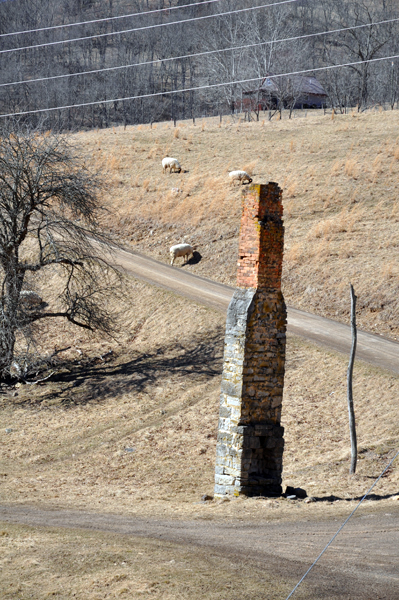
DSC_0130To a tidy mind, ruined houses ought to be cleared instead of left for nature to take its course. But real estate is cheap, and children who grew up in the hollers now find life in the cities easier, trading a better standard of living for rustic beauty, leaving the family home that pawpaw wanted them to inherit. In another generation, many of the old homes still standing now will be horizontal and barely visible as one drives past. When a lively home dies, it slips away gracefully. First the windows fall out to welcome the birds, next the creepers gain a stranglehold, a proud roof caves in, and finally wood is turned to mulch. Often all that remains is a chimney stack standing up like a lonely Lonely chimneymonument where it had warmed a family long ago. Although their history is buried with them, we try to photograph every empty home we see before it is too late. Perhaps these photographs accumulating on the hard drive of my computer will eventually be gathered into a book, and maybe that book will even be seasoned with poetry by an elderly country lady with memories.

I imagine a young couple hiking up our Middle Mountain to pause on a grassy knoll. There’s a long abandoned home there built of cedar sidings and a green metal roof. When the frame rotted out, the roof collapsed into a bowed heap. They muse how long it had been empty and wonder who had lived there in such different times back in the early 21st Century. Standing with his back to the ruin, the young man frames his wife against the mountain scenery with his camera – click. They continue to the mountain ridge by scrambling over boulders and clinging to trees to haul themselves up the gradient.

He had been standing on the time capsule I buried in a jar in front of where the door once stood, but he never looked down. Had they found it, they would have learned who had lived and loved there, about the dog that watched for wild turkeys, the friend who built their home, and the Old Time band that played to a small party to celebrate its opening. They might also have imagined the owner sitting in solitude on the deck with a pencil and paper on his lap, gazing into the forest. But they couldn’t have guessed that his mind was Rockwood fall 2009often cast back to imagine the others who preceded him there – a Shawnee hunting party, loggers carrying a long saw, and a pioneer family seeking a level patch to farm. His pencil scrawl becomes ever more illegible on the paper moldering in the jar, still undisturbed as unimagined new centuries roll by.

Next Post: Bob Edwards R.I.P.

Posted in Memoir | Tagged , | Comments Off on Appalachian Spring

The Red Gods Call

When I fly out of JFK airport and can look out from a window seat I gaze at the empty marsh below instead of the Manhattan skyline after our wheels lift off runway 4L.  I’m thinking about Bob Morris, the New York surgeon I wrote about last time, and imagine him stalking a raft of ducks. The T.S.A. would not be happy if our pilot reported him leveling a twelve gauge between the reeds. But Bob left the marsh long ago.

The Jo Co Marsh was his favorite hunting ground after arriving as a medical student in New York City in the 1880s. At the end of the day’s work at Bellevue Hospital or the Cornell Clinic or assisting with surgery on patients in their own homes (it was more risky in hospital early in his career) he would often catch a train from Penn Station in Midtown to Rockaway, the closest drop-off point for Jamaica Bay. He’d collect his firearm from a friend at the Atlantic Hotel before heading to the marsh.  When ducks and geese were not in season, he’d pick up fishing gear instead. There were plenty of striped bass, bluefish, porgies, flounders, and sheepsheads in the Broad Channel. Sometimes a friend helped to set lobster pots, catch soft shell crabs, or collect all the oysters they could cart back to the hotel for a roast. They had sea appetites and marine treasure to satisfy them.

The Bay was still quite productive by the 1930s, even as the metropolis was encroaching on his paradise. He now visited the marsh with a camera instead of a gun, and was a patron of the Audubon Society. He wanted the Jo Co to become a bird sanctuary, and its channels and little islands “forbidden to visitors.” Now that ninety airlines operate from the airport and the marsh is closed to the public he seems to have gotten his wish, if not all his hopes. The din of Rolls Royce engines a few hundred feet overhead is a better bird scarer than anything heard on a farm.

Reaching a more reflective age, he wrote, “When a man retires from the swift rapids of an active professional life he arrives at a long stillwater, but the banks of that stillwater are so alive that his days continue to be brimful.”  He had heard “the Red Gods calling him to go” to borrow an expression from his soul-mate, Rudyard Kipling. There was still time to pursue his love of nature after the years of work, but they would be spent elsewhere.

He retired to his own sanctuary which he had purchased serendipitously on a whim many years earlier.  It was a 440 acre estate near Stamford, Connecticut, and was rich in wildlife and virtually unspoiled. He was sanguine about leaving behind his career as a renowned surgeon, knowing how quickly fame fades. He was one of the first to bring aseptic surgery to America and had made many innovations in wound healing and in what today is called minimal access operations. He was comfortable, even anxious, to move on to the next phase of life, and would have cared little that along with a few others I had started to focus a light on his legacy.  He wrote, “I felt that I had been born for the woods, the rivers, the mountains, and the sea. Anyone who wanted New York might have it and all that was in it. My light heart was out of doors. Only my heavy feet remained in town.” He couldn’t resist the call of the Red Gods: it was as if the poetic right side of his brain had gotten the better of his professional left.

The estate, called Merribrooke, lay barely 18 miles from New York City limits.  While he couldn’t protect Jamaica Bay, at least he had more control over his own property and could dedicate his time there to conservation, writing, and horticulture. He even honed his grafting skills to try to bring back the American chestnut which had become almost extinct from an imported blight.

There can be little doubt from his memoirs that this was one of the happiest times of his life, blessed by the arrival of a daughter, Mary, in his graying years. There was a dark side. It wasn’t the burden of owning such a large estate, but the responsibility he felt for preserving a beautiful place for future enjoyment. He had plenty of run-ins with corporations and lawyers who wanted to develop the land or divert the Mianus River running through his property down to the sparkling Long Island Sound. “If succeeding owners can keep Merribrooke as a wild park for centuries to come with residences only on road frontage I shall ask these other people to be grateful to me for preserving a beauty spot intact near New York City at great personal effort and financial loss while “improvement” ogres stood about with snuffers all ready for putting out Nature’s light.” Those words, which we rediscovered among his papers, were scrubbed out of the original manuscript for his Fifty Years a Surgeon (1936).

Merribrooke largely survives today as the Mianus River Park, a fine woodland with public access.  A Park website gives no clue whether anyone knows how such a place avoided being swallowed up by developers, or at what personal cost. Bob would have shrugged his shoulders – we are all forgotten sooner or later.

I was musing about his life on a flight from JFK to Virginia. As we flew parallel to the East River I saw on its banks the gray stone edifice of the New York Presbyterian Hospital which houses Weill Cornell Medical College. My wife and I worked at the College until we took early retirement, so many decades after Morris.

I used to regularly attend Grand Rounds in the hospital to keep pace with advances in other specialties. The Rounds were generally full, but quite a number of seats were taken by doctors of advanced years, some so advanced they leaned on their canes or struggled on the stairs. They all wore freshly-laundered white coats. These were distinguished men whom, a generation earlier, you might have asked to care for a sick relative or for yourself, but now…? One of them, a former departmental chairman, confessed to me, “It’s pathetic that we can’t keep away … can’t give it up.”

Many people never hear the Red Gods calling, and some unfortunately can’t afford to go, but for the rest I urge them to go – go – go.  Abandoning the vocation you love is painful, but there is a time for grasping something you feel passionate about, that has been held in suspension for years, before the chance slips away forever – if not nature study, then golf or painting or DIY or growing bonsai trees, or anything else for the sake of heart’s ease. Women seem to be more successful in this than men.  The call came urgently to me because my father never had the chance to go, and Bob’s died a few months after finishing his heavy duties as the Governor of Connecticut.

He must go — go — go away from here!

On the other side the world he’s overdue.

‘Send your road is clear before you where the old Spring-fret comes o’er you,

And the Red Gods call for you!

From The Red Gods by Rudyard Kipling

Next Post: Appalachian Spring

Posted in Memoir | Tagged , , , , | 2 Comments