Appalachian Spring

I took the title from Aaron Copland because his suite captures the very essence of my feelings about Appalachia at this time of year. Springtime arrives late, growing very slowly like the music until a major arpeggio bursts out of an allegro storm, like gods thundering around our West Virginia home, which squats timidly in a crook between dark mountains.  Later the music becomes tender again like the forest which, after long, melancholy winter months, now clothes itself in a fresh green mantle. I love it.Music score

For a long time, I thought the composer had the same images as were in my mind, and I was a touch disappointed when I read that the suite is a musical picture of a spring wedding in Pennsylvania. I got over it.  I realized it didn’t really matter if an abstraction has been inspired by something completely different, provided it means something to you. If you click this link, perhaps the music will carry you to somewhere special.

Ramps

Ramps

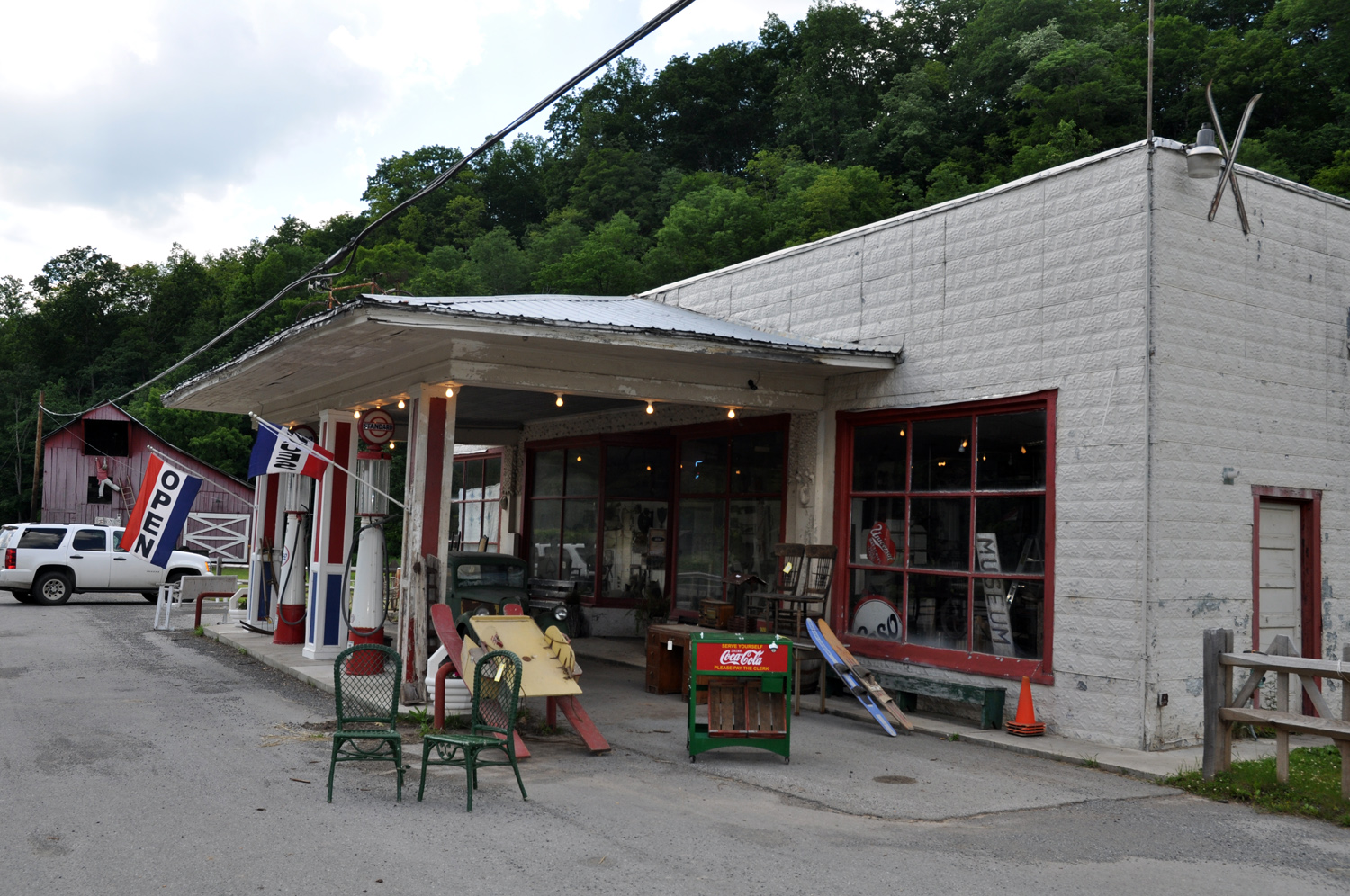
Last week I took a trip along the Appalachian mountain chain through four states. The season was a full two to three weeks behind the coastal plain of Virginia where we live most of the time. The roads were empty apart from an occasional truck parked in a country road, which in the fall is a sure sign that there’s a deer hunter in the woods. But now is the time when local folk gather ramps, black cohosh and, if they are really lucky, ginseng. I was not introduced to ramps (wild leeks) as a child, finding the odor as disagreeable as those uninitiated to Marmite (see my Post March 23, 2013), but mountain folk celebrate the arrival of spring with a ramp festival.

When touring the region, there is always an abandoned homestead just around a bend in the road.  Each harbors a story that will never be told about residents whom we will never know, yet each stirs my imagination. How proud the man who carried his wife across the threshold when the home was newly timbered, how jolly the voices of children playing in the garden, how happy when the children’s children arrived to help milk the cow and pull ramps in the woods. No doubt there were hard times too during the grip of long winters, or when corn and potato crops failed, or the eldest son left for the mines in McDowell County, and the youngest was called up for war.  They never wrote down their stories, and now the stone crosses in Mingo can never tell us.

DSC_0130To a tidy mind, ruined houses ought to be cleared instead of left for nature to take its course. But real estate is cheap, and children who grew up in the hollers now find life in the cities easier, trading a better standard of living for rustic beauty, leaving the family home that pawpaw wanted them to inherit. In another generation, many of the old homes still standing now will be horizontal and barely visible as one drives past. When a lively home dies, it slips away gracefully. First the windows fall out to welcome the birds, next the creepers gain a stranglehold, a proud roof caves in, and finally wood is turned to mulch. Often all that remains is a chimney stack standing up like a lonely Lonely chimneymonument where it had warmed a family long ago. Although their history is buried with them, we try to photograph every empty home we see before it is too late. Perhaps these photographs accumulating on the hard drive of my computer will eventually be gathered into a book, and maybe that book will even be seasoned with poetry by an elderly country lady with memories.

I imagine a young couple hiking up our Middle Mountain to pause on a grassy knoll. There’s a long abandoned home there built of cedar sidings and a green metal roof. When the frame rotted out, the roof collapsed into a bowed heap. They muse how long it had been empty and wonder who had lived there in such different times back in the early 21st Century. Standing with his back to the ruin, the young man frames his wife against the mountain scenery with his camera – click. They continue to the mountain ridge by scrambling over boulders and clinging to trees to haul themselves up the gradient.

He had been standing on the time capsule I buried in a jar in front of where the door once stood, but he never looked down. Had they found it, they would have learned who had lived and loved there, about the dog that watched for wild turkeys, the friend who built their home, and the Old Time band that played to a small party to celebrate its opening. They might also have imagined the owner sitting in solitude on the deck with a pencil and paper on his lap, gazing into the forest. But they couldn’t have guessed that his mind was Rockwood fall 2009often cast back to imagine the others who preceded him there – a Shawnee hunting party, loggers carrying a long saw, and a pioneer family seeking a level patch to farm. His pencil scrawl becomes ever more illegible on the paper moldering in the jar, still undisturbed as unimagined new centuries roll by.

Next Post: Bob Edwards R.I.P.

Posted in Memoir | Tagged , | Comments Off on Appalachian Spring

The Red Gods Call

When I fly out of JFK airport and can look out from a window seat I gaze at the empty marsh below instead of the Manhattan skyline after our wheels lift off runway 4L.  I’m thinking about Bob Morris, the New York surgeon I wrote about last time, and imagine him stalking a raft of ducks. The T.S.A. would not be happy if our pilot reported him leveling a twelve gauge between the reeds. But Bob left the marsh long ago.

The Jo Co Marsh was his favorite hunting ground after arriving as a medical student in New York City in the 1880s. At the end of the day’s work at Bellevue Hospital or the Cornell Clinic or assisting with surgery on patients in their own homes (it was more risky in hospital early in his career) he would often catch a train from Penn Station in Midtown to Rockaway, the closest drop-off point for Jamaica Bay. He’d collect his firearm from a friend at the Atlantic Hotel before heading to the marsh.  When ducks and geese were not in season, he’d pick up fishing gear instead. There were plenty of striped bass, bluefish, porgies, flounders, and sheepsheads in the Broad Channel. Sometimes a friend helped to set lobster pots, catch soft shell crabs, or collect all the oysters they could cart back to the hotel for a roast. They had sea appetites and marine treasure to satisfy them.

The Bay was still quite productive by the 1930s, even as the metropolis was encroaching on his paradise. He now visited the marsh with a camera instead of a gun, and was a patron of the Audubon Society. He wanted the Jo Co to become a bird sanctuary, and its channels and little islands “forbidden to visitors.” Now that ninety airlines operate from the airport and the marsh is closed to the public he seems to have gotten his wish, if not all his hopes. The din of Rolls Royce engines a few hundred feet overhead is a better bird scarer than anything heard on a farm.

Reaching a more reflective age, he wrote, “When a man retires from the swift rapids of an active professional life he arrives at a long stillwater, but the banks of that stillwater are so alive that his days continue to be brimful.”  He had heard “the Red Gods calling him to go” to borrow an expression from his soul-mate, Rudyard Kipling. There was still time to pursue his love of nature after the years of work, but they would be spent elsewhere.

He retired to his own sanctuary which he had purchased serendipitously on a whim many years earlier.  It was a 440 acre estate near Stamford, Connecticut, and was rich in wildlife and virtually unspoiled. He was sanguine about leaving behind his career as a renowned surgeon, knowing how quickly fame fades. He was one of the first to bring aseptic surgery to America and had made many innovations in wound healing and in what today is called minimal access operations. He was comfortable, even anxious, to move on to the next phase of life, and would have cared little that along with a few others I had started to focus a light on his legacy.  He wrote, “I felt that I had been born for the woods, the rivers, the mountains, and the sea. Anyone who wanted New York might have it and all that was in it. My light heart was out of doors. Only my heavy feet remained in town.” He couldn’t resist the call of the Red Gods: it was as if the poetic right side of his brain had gotten the better of his professional left.

The estate, called Merribrooke, lay barely 18 miles from New York City limits.  While he couldn’t protect Jamaica Bay, at least he had more control over his own property and could dedicate his time there to conservation, writing, and horticulture. He even honed his grafting skills to try to bring back the American chestnut which had become almost extinct from an imported blight.

There can be little doubt from his memoirs that this was one of the happiest times of his life, blessed by the arrival of a daughter, Mary, in his graying years. There was a dark side. It wasn’t the burden of owning such a large estate, but the responsibility he felt for preserving a beautiful place for future enjoyment. He had plenty of run-ins with corporations and lawyers who wanted to develop the land or divert the Mianus River running through his property down to the sparkling Long Island Sound. “If succeeding owners can keep Merribrooke as a wild park for centuries to come with residences only on road frontage I shall ask these other people to be grateful to me for preserving a beauty spot intact near New York City at great personal effort and financial loss while “improvement” ogres stood about with snuffers all ready for putting out Nature’s light.” Those words, which we rediscovered among his papers, were scrubbed out of the original manuscript for his Fifty Years a Surgeon (1936).

Merribrooke largely survives today as the Mianus River Park, a fine woodland with public access.  A Park website gives no clue whether anyone knows how such a place avoided being swallowed up by developers, or at what personal cost. Bob would have shrugged his shoulders – we are all forgotten sooner or later.

I was musing about his life on a flight from JFK to Virginia. As we flew parallel to the East River I saw on its banks the gray stone edifice of the New York Presbyterian Hospital which houses Weill Cornell Medical College. My wife and I worked at the College until we took early retirement, so many decades after Morris.

I used to regularly attend Grand Rounds in the hospital to keep pace with advances in other specialties. The Rounds were generally full, but quite a number of seats were taken by doctors of advanced years, some so advanced they leaned on their canes or struggled on the stairs. They all wore freshly-laundered white coats. These were distinguished men whom, a generation earlier, you might have asked to care for a sick relative or for yourself, but now…? One of them, a former departmental chairman, confessed to me, “It’s pathetic that we can’t keep away … can’t give it up.”

Many people never hear the Red Gods calling, and some unfortunately can’t afford to go, but for the rest I urge them to go – go – go.  Abandoning the vocation you love is painful, but there is a time for grasping something you feel passionate about, that has been held in suspension for years, before the chance slips away forever – if not nature study, then golf or painting or DIY or growing bonsai trees, or anything else for the sake of heart’s ease. Women seem to be more successful in this than men.  The call came urgently to me because my father never had the chance to go, and Bob’s died a few months after finishing his heavy duties as the Governor of Connecticut.

He must go — go — go away from here!

On the other side the world he’s overdue.

‘Send your road is clear before you where the old Spring-fret comes o’er you,

And the Red Gods call for you!

From The Red Gods by Rudyard Kipling

Next Post: Appalachian Spring

Posted in Memoir | Tagged , , , , | 2 Comments

Serendipity or Chance

The King of Serendip (Sri Lanka) sent his three sons away to a foreign country to experience life in the real world.  They got into trouble, as boys will, when a merchant accused them of stealing a camel he had lost.  Although they had never seen the beast, the boys came under suspicion after cleverly figuring clues from chance observations – it was lame, one-eyed, missing a tooth, and carrying a pregnant woman with a jar of honey.

The Three Princes of Serendip is a Persian fairy tale, like Aladdin and Sinbad of the One Thousand and One Nights. When Horace Walpole translated the story over two hundred years ago he coined the word “serendipity” which Webster’s dictionary defines as an aptitude for making happy discoveries by chance.Book- Three princes

The word did not become fashionable until the last century, so there is evidently more serendipity around now! I have heard scientists, including myself, declaring they had made a serendipitous discovery, so it does not necessarily imply anything superstitious. But I have also heard people say that a discovery coming by accident or out of the blue was a “miracle”. Whether that was meant to be taken literally I don’t know, but the mind of science has great difficulty understanding how anything can break the basic laws of physics. But I could call something that happens naturally a miracle if it comes most unexpectedly just when I needed it.  Timing was important for the three princes too, because someone stumbled on the lost camel just in time for them to be pardoned by the ruler of the country.

If readers of this post were asked to share their best serendipity stories I guess we could publish a book far more absorbing than the Three Princes (which I never finished).  Everyone I know has a cache of them.  I can’t explain why one I heard a while ago stays at the forefront of my mind, but I did find it arresting at the time.

It was a story of an old man in his final hours. His daughter seated at his bedside asked if there was anything she could get for him, perhaps thinking he was thirsty. The only thing he wanted was to hear once more the old hymn, Amazing Grace, but he didn’t have the CD or even a music player.  She said that barely a few minutes later they heard through the wall of the next apartment a choir singing that very hymn.  It is admittedly a popular piece, but the chance of a neighbor playing it at the “right” moment was astonishingly slight, and left her with a wonderful memory of the last moments shared with her father.

Serendipity popped into my mind because I have had a strange series of happy discoveries lately. The story started unassumingly twenty years ago in Edinburgh, Scotland. I was working on a new research project to test ovarian transplants in sheep (the very same flock that later produced Dolly the cloned sheep). When the newspapers ran the story I felt like scalding water had been poured over me, but the project turned out well in the end. The experiments helped to launch transplants for helping young women to conceive who would otherwise have remained sterile.

Unlike most of my peers who steadily ignore library archives and only access journals online from their desktops, I love to blow the dust off an old book.  I suppose there is something of an antiquarian inside me. One day, soon after completing my experiment, I was perusing the 1895 issue of the New York Medical Journal when I stumbled on a brief report by a New York surgeon, Robert T. Morris, M.D. He described two ovarian transplants he had recently performed with mixed success in women.  I had been scooped a century ago!  On the one hand, I felt delighted to have an opportunity to show off my scholarship by referring to his arcane paper when I came to publish my own work; on the other, I was disappointed to have been beaten.  Every young scientist wants to be first for something.

Bob Morris

Bob Morris

I got over the disappointment and in 2010 published a short biography of Dr. Morris in a medical journal. I thought nothing more about it until the day I received an unexpected email.

It was sent by his grand-daughter on behalf of her mother, Mary, who had been striving for years to bring more attention to her father’s achievements. Since neither of them had worked in medicine I was surprised they had noticed my work, and amazed that the daughter of a man born before the American Civil War had contacted me.

I corresponded with Mary until she passed away last autumn, but her mission continues as I work with her daughter to republish some of his work together with his unpublished manuscripts.  The deeper I probed the more spellbound I became by the man’s life story which reflected almost everything I cherished or ever wanted to do and be. Not only was he a famous surgeon with a rare scientific outlook for his day, but he was an explorer, a naturalist, a conservationist, and a gifted writer and poet.  The final serendipity, or should I call it irony, was the most affecting. I found that our families are related by marriage.

If Horace Walpole will be remembered down the ages for giving us the word “serendipity”, perhaps I can take credit for coining “super-serendipity” for a string of chance happenings.  Come on Mr. Webster, give me immortality!

Next Post: Bob Morris outdoors

Posted in Memoir | Tagged , , , | 1 Comment

About Redheads

Sandy was not only his name but his nature too. He was a Saunders, a name that came down from Scotland via Ireland, as it had for one of my grandparents.  He was also a blazing redhead, his hair as hot as the Red Sand Beach on Maui.  When Sandy wasn’t being called by his nickname he was a “ginger nut”.  Remembering our friendship in school, I wonder if we ever offended him, and hope that he knew that naming him after a favorite cookie (called ginger snaps in America) was a token of chumminess. I envied his handsome thatch, which stood out in a class of browneys.

According to ScotlandsDNA, a company that mines genetics for Scottish ancestry, redheads are more common in Scotland and Ireland than anywhere else, although greater numbers call America home.  The northern climate is kinder to people with light skins because they are less exposed to the damaging ultraviolet rays of sunlight. But the fewer rays that penetrate the “dreich” weather make vitamin D more efficiently in them than in darker-skinned folk who have a higher risk of vitamin deficiency and rickets, making them less fertile too. That seems a likely explanation for why redheads originated in north-western Europe, and perhaps for their occurrence among Neanderthal people.

I won’t venture to write much about other skins except that the bottom of a red Irishman looks the same color as a blonde Swede’s (that’s what I am told). But the similarity is deceptive because after they are both exposed to strong sunlight the Celtic posterior is much more likely to burn, matching his hair. The difference is in the genetics. For eons while they stayed at home, photosensitivity barely mattered for Celts, but after moving to sunnier climes or when skinny-dipping in Ireland’s new nudist beaches they’ve had to lather on SPF.

Skin is shielded from damage to its DNA by two types of melanin pigment: either brown-black or red-yellow, which is the more abundant type in redheads.  The dark stuff has a SPF of around 13 in African Americans, four times more effective as a sunscreen than in the average White. But a dark skin does not afford anyone absolute protection, and the sun’s rays are not the sole cause of melanoma, the most dangerous form of skin cancer. Bob Marley, the Jamaican reggae star, died with the disease, and so did my Indian friend in Edinburgh.

Skin pigmentation is controlled by the hormone melanocortin, or MSH for short. The hormone works by engaging a protein called MC1R on the surface of pigment cells which in turn sends a signal to fire up the internal machinery, rather like turning a key to start your car engine. These cells are called “incontinent” because they extrude pigment they manufacture for pick-up by neighboring cells, including those that grow hair.

The MC1R gene has over 10,000 DNA units (nucleotides).  If this genetic code is changed by only one unit there is usually no effect, but changing one of three specific units dramatically reduces the amount of dark melanin made, causing hair to be colored from red to gold.

Two reds, one brown and one blonde born to parents with red and brown hair

Two reds, one brown and one blonde born to parents with red and brown hair

These DNA variants are called SNPs (pronounced “snips”) which, genetically speaking, are mutations. I prefer to avoid the word “mutant” in sociological contexts because it can sound pejorative. Besides, SNPs are abundant in environments in which they are well-fitted, so we should regard those for hair color as “good genes”.  Red is the rarest natural color because the genes are recessive, meaning you need to inherit one from both parents to be a redhead.  Forty percent of Scots carry at least one of the SNPs, but only 13% have red hair. When cells have two copies of the gene the “key” doesn’t fully turn in the MC1R lock.  In most of us brown pigments hide the red; it is like green leaves whose reds and yellows are out of sight until the chlorophyll disappears in fall to give a wonderful display.

So much for biology, what about sociology?  Redheads have often gotten a raw deal, but there is absolutely no shortage of brains and beauty or star-power among them – Galileo, Thomas Jefferson, Winston Churchill, Lucille Ball, and Nicole Kidman to mention a few off the top of my head.  Artists love their hair, splashing canvases with red pigments to signal a subject’s beauty, passion, and heat.  Dazzling red hair is the first thing you notice in the painting by Dante Gabriel Rossetti of the mythical Lilith. It is a study of timeless

Lady Lilith by Dante Gabriel Rossetti of the Pre-Raphaelite Brotherhood

Lady Lilith by Dante Gabriel Rossetti of the Pre-Raphaelite Brotherhood @ http://www.metmuseum.org

concupiscence, modeled by his mistress, Fanny Cornforth, and the artist was so enamored that he composed a sonnet to celebrate Lilith:

…And her enchanted hair was the first gold.

And still she sits, young while the earth is old …

The opposite side of the coin for red hair reads like an ABC of prejudice – abuse, bullying, and condemnation.  Gingerism still stalks England’s streets, more often as a sour joke but sometimes violently. Some say that hard attitudes and feelings are the smoldering ends of ancient feuds.

Late Sixteenth Century England was becoming more cosmopolitan, and Londoners were growing more suspicious of foreigners.  Shakespeare shrewdly cast Othello as a noble and distinguished man of color who became bewildered by the malice of enemies he didn’t deserve in his adoptive country: …Then must you speak of one that loved not wisely but too well; of one not easily jealous, but being wrought, perplexed in the extreme…  The Bard never singled out redheads for persecution or mockery. Had he done so his own head might have been laid on the block because his queen was one of them and had made red hair fashionable in her life time.

Human color prejudice contrasts with colorblindness in animals. In our teens, Sandy and I would watch badgers when they emerged in the twilight from underground dens in the woods.  Occasionally, there was an adorable cub with a red coat (called erythristic) born in a litter of black and white cubs. The badger family was oblivious to the difference because its main sense organ lies at the end of a long snout. But I guess that a badger fed on garlic or sprayed with Chanel might, ahem, be badgered.

Emily is a seventeen-year-old family member who lives in Sewickley, PA. She told me that it is easier to be red in America than in England, and easier still as a girl.  She gets plenty of compliments about her flowing red tresses, and any other remarks she wisely shrugs off.  Red makes her feel special, and the color “pops”.  On the other hand, her Dad had to put up with school bullies because of his red hair, although old ladies fawned over the cherubic boy.

I sometimes wonder how Sandy feels about his hair now. If he was bullied at school, did he have the satisfaction later on of seeing redheads born into the families of those who formerly brow-beat him, because some of them were doubtless carriers of the red gene? Did a girl fall in love with his “ginger nut”, or did he marry a strawberry blonde and make more gingers together? I imagine he feels differently about his nut after passing a sixtieth birthday because it grows paler by the year. Perhaps he would even be happy if we called it an angel cake.

Next post: Serendipity or Chance

Posted in Biomedical | Tagged , , | Comments Off on About Redheads

Marmite – Love it or Loathe it

Marmite. I love it! But it divides people more than anything else. Yes, even more than congressional politics! You either love it or loathe it; no one stands between the poles of passion.

In case you haven’t tried it, or have only seen a little brown jar with a bright yellow cap on a grocery shelf, I had better explain. It’s something that Brits love to spread on buttered toast (Aussies have Vegemite instead, which tastes slightly less “raw”).  It is very savory and very salty and MUST be spread very thinly. I remember serving it to a naïve guest who coated it as thickly as he would peanut butter and jelly on a slice of bread.  I raised my hands in horror, standing back as if to distance myself from an imminent blast from a foghorn. The expression of pain on his face afterwards was awful to behold. We never saw him again.

Marmite looks like thick engine oil that hasn’t been changed for over 20,000 miles. Often confused with Bovril (boiled-down cow), it is actually wholesome vegetarian stuff.  A century ago, a Mr. Gilmour of Burton-on-Trent in the English Midlands had a brainwave. He had noticed the Bass Brewery in his town was carting away waste yeast cells (“lees”) for farmers to spread on their fields as fertilizer. He wondered if he could make something more profitable from the sludge. He did. By salting and cooking the cells by a secret process he created a brown goo, which his family declared delicious. Soon afterwards, a factory was raised in the town for manufacturing Marmite, whose name derives from the French name for an earthenware pot (depicted ever after on the label). It quickly became popular throughout the Empire.

During World War One, it was added to the rations of British troops serving on the Western Front. In World War Two, it was given with kindly intentions to German prisoners-of-war, but they probably believed their captors were subjecting them to cruel and unusual punishment.

To be a Marmite-lover you have to be exposed when you are very young. Growing up in Scotland, my sons were frequently served it on fingers of toast, which we called Marmite soldiers.  My mother had a craving for the stuff when she was pregnant with me. Most Marmite soldiers are made, but I was born one.  Others should only eat it disguised in stews and gravies.

I believe in a good diet, but I am not much of an enthusiast for so-called health foods which come and go in fashion as the latest research first extols then repudiates them.  But Marmite has striking virtues because yeast is a rich source of B vitamins, and manufacturers throw in extra vitamin B12 for good measure.  Regrettably, the Danish Government banned this ambrosia from Albion in 2011 because it is vitamin fortified. Perhaps the Danes don’t realize that Marmite should be consumed only in tiny servings, but they could have a point insisting on a label to warn people who are taking monoamine oxidase inhibitors (it’s the tyramine).

Marmite

Marmite soldiers – Yum!

Believe it or not, Marmite never goes off, even when it’s kept where it should be – on the pantry shelf. In the refrigerator it sets like a rock. This gave me an idea for a novel medical application. If nothing grows in it because it is very concentrated like honey, I wondered if it would block infections when spread over an open wound.  When I told my American wife I would try the experiment next time I injured myself in the garden, she said if I did so she would immediately serve me notice. Now my only ally is the dog, who is a marmaholic.

A most inspiring story on this subject starts with an intrepid young woman, Lucy Wills (1888-1964). She grew up in a middle class English family during the early decades of the last century, becoming one of the first women to graduate in medicine. In 1928, she left London to work among poor textile workers in Mumbai (then Bombay).  She soon noticed their high mortality, many dying with macrocytic anemia of pregnancy, especially during seasonal shortages of fruit and vegetables.

Since infection as a possible cause of this anemia was ruled out by the failure of arsenic treatment, she wondered if the women had a nutritional deficiency. That would have explained why higher caste women were generally free of the disease.  Since vitamin B12 didn’t help she also ruled out pernicious anemia, turning instead to test if a yeast supplement could reverse the problem in rats fed the same restricted diet. They survived, and the active agent became known as the “Wills factor”. She saved many lives by feeding women Marmite, then the cheapest source of the vitamin, until it was identified as folic acid and synthesized as a nutritional supplement.

Lucy_Wills

Lucy Wills

Since the virtues of Marmite are known globally, I will close this post with a story about Marmageddon in New Zealand.  While visiting the country a few months ago, kiwis begged me, “Got Marmite?” The earthquake that had hit Christchurch the year before had caused catastrophic damage to the cathedral and council buildings, but there was as much anguish about the destruction of the Marmite factory. Grocery store shelves were bare and rare jars of Marmite were being auctioned for much more than ten-fold their normal price. But investors, even those who loathed the stuff, could rub their hands with glee at the prospects for Marmite Futures.

Declarations

I have no investments in Marmite, apart from jars on the pantry shelf

No person or animal has been harmed by consuming it in this home

Next Post: About Redheads

Posted in Biomedical | Tagged , , , , | 10 Comments