Bee Swarm or Split

Beekeeping is like farming. All livestock—whether large animals with four feet or tiny ones with six—need food, water, shelter, and sometimes medication. Like an old farmer checking his herd in a meadow, I watch our ‘girls’ flying back and forth between their hive and the clover. But the parallels end there.

Modern farmers seldom have much cause for worrying about losing their stock unless there is a fence down or rumors of rustlers or the USDA issues an animal health alert. But beekeepers have to struggle with many insecurities, and the epidemic called colony collapse disorder is at the top of their list. But the most common loss of a bee colony is the most natural. Before running out of space the queen bee often abandons her hive in a swarm of thousands of workers.  That is the origin of hiving-off, a British expression for breaking away.

Shortly before exiting the hive, swarms gorge on honey to avoid starvation until scout bees have found a new home. Meanwhile, the workers that stayed behind in the hive prepare new queen cells by feeding a few of the youngest larvae with extra royal jelly. If swarming happens in early spring there is plenty of time for both the absconders and the home-buddies to build up their numbers and honey stores before winter, but if it happens in late summer the chances are poor.

A swarm in May
Is worth a load of hay.
A swarm in June
Is worth a silver spoon.
A swarm in July
Isn’t worth a fly.

18th Century English verse

When a swarm lands on a tree in a garden or on the side of a building the startled residents may be terrified, and someone calls a pest controller. What a pity! Beekeepers would love to take it away to start a new colony in an empty hive. A swarm is typically quite passive because the bees don’t need to protect their brood or honey in the comb. It can be gently transferred to a box for taking away.

We try to avoid bees hiving-off by ‘splitting’ the most fecund colonies in the spring. The only method I have tried is called a walkaway split because a busy beekeeper trusts nature to take its course.

Five frames of honeycomb, including pollen and nectar, capped honey, ‘capped brood’ (larvae), and very importantly one frame of eggs or very young larvae are transferred to a box for the new colony, or ‘nuc.’ Before closing the box thousands of bees are shaken off other frames to provide nursing services while guard bees buzz angrily around the beekeeper. Since the queen is left behind in the old hive and the workers in the nuc must create a new one, it is the opposite of swarming although both swarms and splits serve the same purpose of reproduction. If all goes well queen cups (larger cells) appear in the nuc a few days later, confirming that a royal succession is progressing.

bee hive

Queen bee cups (arrows)

To reduce the risk of swarming we split one of the strong colonies in the churchyard of Grace Church in Yorktown. Everything went according to plan. I sealed the lid and the entrance of the box with duct tape before loading it in the back of my SUV. Normally I transport bees in the trunk of a sedan car, but it had a flat battery that day. After stepping out of a hot bee-suit I could sigh with relief and look forward to getting the precious livestock home. But after driving only two miles and turning into Colonial Parkway something caught my attention in the rear-view mirror. There were bees crawling up the back window.

“Yikes, they’re getting out!” I mumbled (or something to that effect).

Luckily there was somewhere to safely pull off the highway. I jumped out of the car and dove into my bee-suit, getting the zip stuck when I pulled it too quickly. More and more bees were emerging as I continued to fumble. They were crawling off the window confused by the unfamiliar environment, but as they gained confidence they took off and some started dive-bombing. Now safely zippered in I wrapped so much duct tape around the box that it looked more like aluminum than wood. The escapees were eventually coaxed out of the car because I could never get them back in the box. They continued buzzing around after the door was closed and I hoped a guardian angel would lead them back to their hive.

Playing it safe, I kept my bee suit on for the remaining seventeen miles of the journey, although I folded the veil back for better vision. But after starting the car I noticed a police patrol car had pulled up behind me.

“Gracious! Have I been reported?” In the ten minutes I was standing in my voluminous white bee-suit dozens of cars had passed by. Perhaps someone was leery of me if they mistook my outfit for a hazmat suit and thought I was clearing up a chemical or radioactive spill at the roadside?

I waited for the officer to appear in my wing mirror. My finger was ready to lower the window for the expected interrogation. While I waited I wondered if there is a county ordinance requiring a special license for transporting livestock in a car? And if driving in a bee-suit is a traffic violation?  These seemed outlandish fears, but I know Virginia legislators are very imaginative.

However the officer stayed in his car with his head bowed either for reading notes or dozing off. So after a discreet interval I pulled out and drove away quite slowly with eyes flashing back and forth for a long time between the wing mirror, back window and road ahead. It was the longest journey home.

The following morning I wandered into the yard to check the nuc that was now in the apiary. After my perilous journey I glowed with satisfaction that the risk of swarming at the church hive was over and I would soon have a new colony. But perhaps I was too blasé and too close wearing only a t-shirt and pants because I felt something collide with my cheek and then a stabbing pain. Something was telling me to hive-off.

New Post: Peckers
Posted in Bee-line | Tagged , , | Comments Off on Bee Swarm or Split

Snake Hole

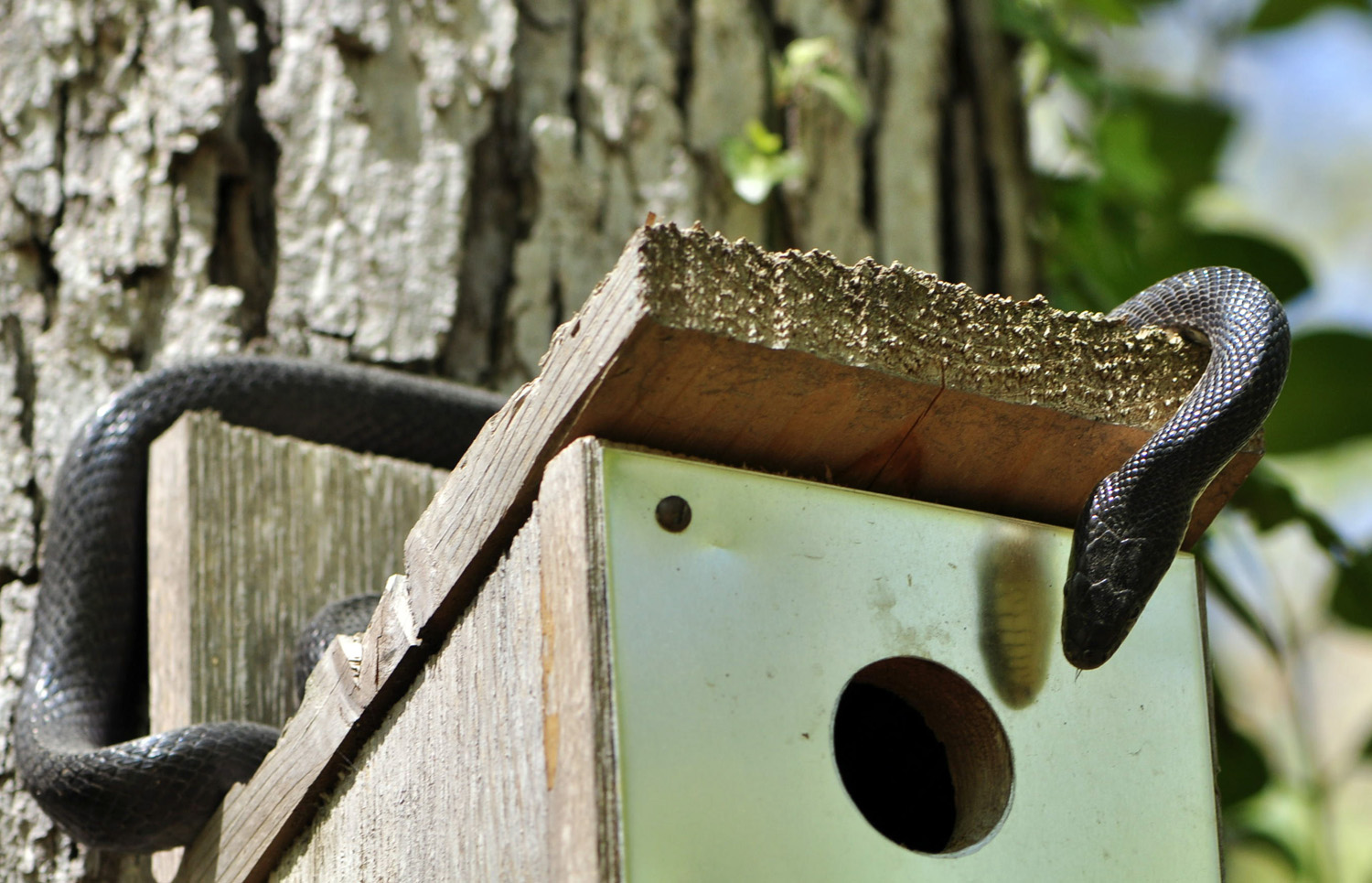
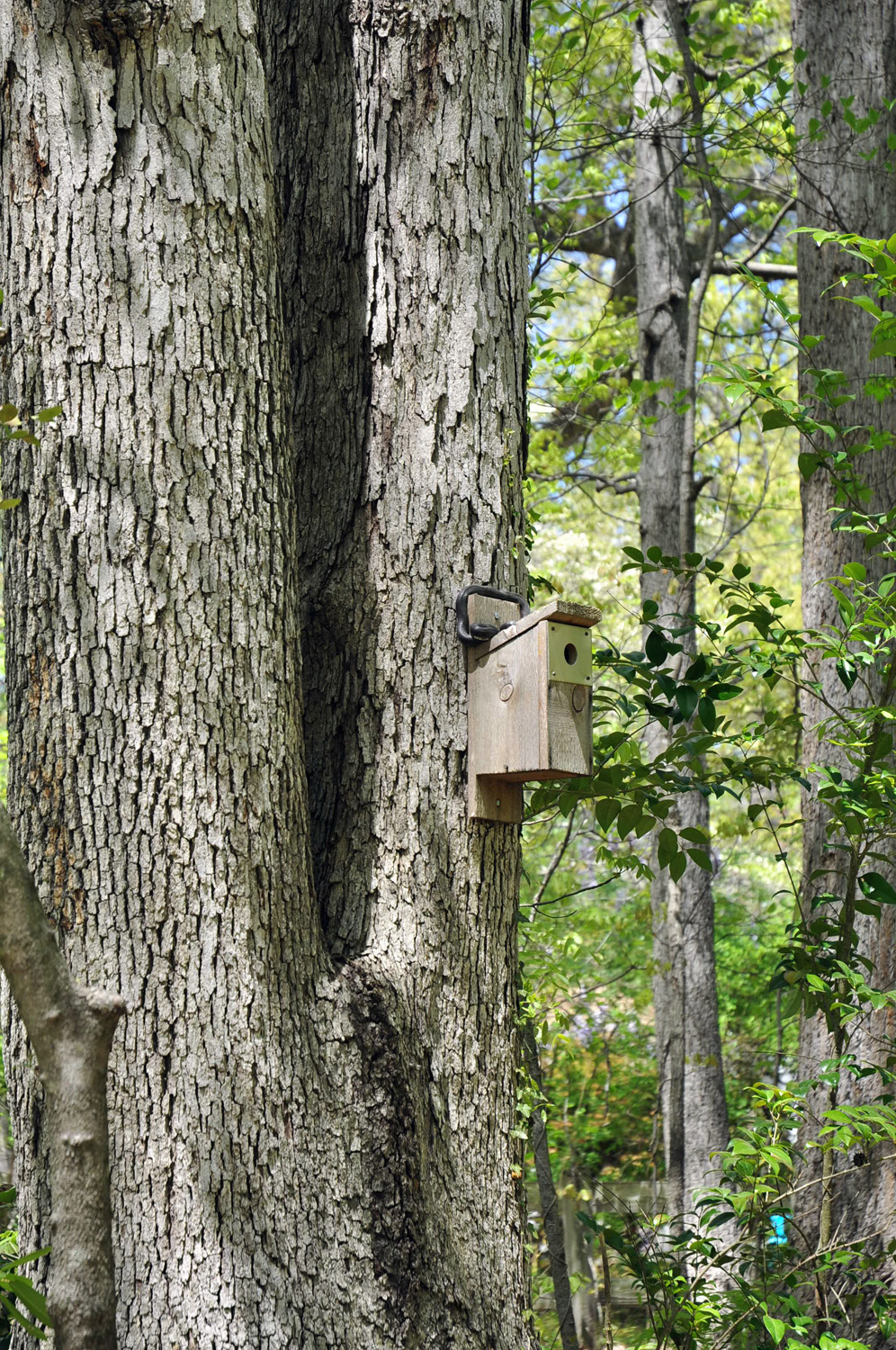
A snake has taken up residence in one of our bluebird boxes. Every morning three feet of coiled and blackened steel hose sunbathe on its roof.bluebird box with snake

Four species of snakes call our yard home. This one, the Eastern ratsnake, is the best climber and grows longer than garter or ring-necked snakes or the venomous copperhead. A six-foot ratsnake called George used to live in the woodshed owned an old lady next door. In one of our dry summers an itinerant garden worker knocked on her door asking for work. She wanted her parched lawn to be watered.

“Y’all find the hose in the shed,” Elspeth told him.

Next thing we heard the man screaming, and then watched him emerge from the shed and shake violently before running down the driveway. We never saw him again.

Eastern ratsnake

Home sweet home

Few people like snakes. Too few. The first impulse is to kill them and the second to summon their name when you need the most excoriating epithet. We curse with the names of all sorts of animals, but snake is reserved for the most despised and untrustworthy individuals, the lowest of the low. Don’t even check the Urban Dictionary for the meaning of ‘snakehole’.

The hole in our birdbox probably looked as homely to our snake as Bag End to Bilbo Baggins with its round, green door and brass knob—a cozy haven in an uncertain world. The snake may have found a clutch of blue eggs neatly laid out for supper in a twiggy nest, but I think it had been squatting there a long time. Either way, we leave it alone. It doesn’t bother us, although our species has been on bad terms with theirs for a long time.

“And I will put enmity between thee and the woman, and between thy seed and her seed; it shall bruise thy head, and thou shalt bruise his heel.” King James Bible.

Eastern ratsnake

Just a couple more feet to go

In the Jungle Book, Kaa (the snake) was one of the bad guys, although understandably grumpy when he was hit by Bagheera (the panther). He hissed:

“Ooh, my s-s-sinus. You have just made a s-s-serious mistake. And very s-s-stupid.”

Snakes prefer to avoid confrontation and are not aggressive by nature. In a court of law, they would not be condemned for defending themselves because most bites occur from our blunders—like poking or stepping on one, or testing fate in a snake-handling church. Over seven thousand snake bites from venomous species are reported in North America annually, of which only five or six become fatal. In Australia, home to the most venomous snakes, there are even fewer fatalities per head of population, but thousands of people die in India every year because medical care is insufficiently prompt or effective. We don’t have to exterminate snakes to save people from snakebites.

The only good snake is a live snake. A dead snake can no longer contribute to the good of the land as a slice of the food pyramid that dine on the lower orders while in turn being on the menu for top predators. They are friends to farmers and gardeners as ravenous predators of rodents that raid our crops and grain stores and which transmit Lyme disease, hantavirus, and plague in their fleas, ticks, and waste products. And for people with heart disease the venom of a rattlesnake has been used to engineer an antiplatelet drug (Eptifibatide).

We shouldn’t justify preserving snakes only when they help to satisfy our own needs. As wonders of nature, beautiful and mysterious, they deserve respect. But the sight of a snake more often triggers a tide of revulsion within us and the impulse to kill, as it did one hot day when a snake slither close to D.H. Lawrence who lay resting by a water trough.

And as he put his head into that dreadful hole,
And as he slowly drew up, snake-easing his shoulders, and entered farther,
A sort of horror, a sort of protest against his withdrawing into that horrid black hole,
Deliberately going into the blackness, and slowly drawing himself after,
Overcame me now his back was turned…

 Then Lawrence threw a log at it… But as the creature disappeared his heart started warming to it, and he realized he was enjoying its company.

… immediately I regretted it.
I thought how paltry, how vulgar, what a mean act!
I despised myself and the voices of my accursed human education.
And I thought of the albatross
And I wished he would come back, my snake.

For he seemed to me again like a king,
Like a king in exile, uncrowned in the underworld,
Now due to be crowned again.
And so, I missed my chance with one of the lords of life.
And I have something to expiate: A pettiness.

 Next Post: Beehive Split

Posted in Animalia | Tagged , , , , | 1 Comment

Citizen Science

Thomas Jefferson

Thomas Jefferson in Williamsburg, Virginia

At one time all scientists were amateurs. Most were gentlemen with private incomes like Charles Darwin or clergymen like the Rev. Gilbert White whose church stipend enabled him to spend spare time rambling in the Hampshire countryside. There was a rich crop of these men too among the founding fathers of America: Benjamin Franklin discovered electrical activity in thunderstorms by flying a kite, and Thomas Jefferson created an almanac by recording the weather for nearly fifty years. Today we call them citizen scientists, and after science became a paid profession they continue to flourish where many eyes are needed for collecting “big data.”

One of those sciences is astronomy, which was so memorably presented on BBC TV by Patrick Moore (1923-2012), and for which other amateurs are credited with discovering new exoplanets. Another is ornithology because birders supply tons of data to the Cornell Lab of Ornithology, the Audubon Society, and the British Trust for Ornithology. And the third—ever since Jefferson—is meteorology.

Years of recording temperatures and rainfall at Monticello helped him to plan the dates for planting crops in his garden. The data were also useful in the patriotic cause of proving the superiority of the Virginia climate compared to Paris where he lived at one time (there was no contest with London weather). In those times climate was thought to be fixed at a given place, just as the continents were believed to be immovable and species immutable.

Mark Twain wrote, Climate is what we expect, weather is what we get. But today the opposite is true because we no longer know what the future climate holds, and we have a firm expectation that weather will always be capricious. More than ever, climate scientists and weathermen/women depend on data from volunteers for modeling the atmosphere for days or even decades ahead.

Jefferson would have drooled at the equipment that is now available to backyard meteorologists. A starter weather station includes a thermometer, barometer, anemometer, hygrometer, and wind vane, but some really sophisticated equipment is affordable. The data can be uploaded to networks like Weather Underground which has more than 32,000 active stations worldwide. All data points are valuable because weather is local, and they contribute to a growing understanding of climate change.

rain gauge

Rain gauge for citizen scientists

You can join a network for the cost of a customized rain/ hail/ snow gauge ($30). This isn’t glamorous science like measuring glacier retreat, Arctic sea ice, or even sea levels and temperature, but data from your own backyard will be pooled with thousands of other observations for professional analysis.

Naturalists contribute data from monitoring wildlife and flora, which is called phenology. We are warned that if a warming trend continues the return dates of birds and butterflies that winter in warmer climes will be earlier, and they will breed further north. Hummingbirds arrived in Williamsburg today (April 12), but future generations may see them in March or even staying the year round.

Budburst is a phenology project for volunteers to record when trees and plants flower. A pollination by beesYoshino cherry tree in our yard bloomed the very same days this year as last, but we can’t assume the same in the future because this species is highly sensitive to temperature. Researchers in Seattle predict that cherry blossom will reach its peak 5-13 days earlier in Washington DC by 2050 than today (estimates vary depending on carbon emissions). If so, the National Cherry Blossom Festival and Parade will have to move forward to March.

It’s hard to say whether natural signs or physical measurements are the more reliable guides to the climate, but temperature and rainfall have the longest records.  The first frost dates in fall have been recorded in Williamsburg for over a century. Lately they have been getting later, and the growing season of frost-free days between spring and fall is correspondingly longer. The number of days when temperatures fell below freezing have declined by 20 days over the same period (notwithstanding the recent cold winter), which harmonizes with old stories when people drove across the frozen York River and skated on ponds.

first freeze

Date of first frost in Williamsburg, VA

It seems a contradiction then that average temperatures here in the hottest month of the year (July) are unchanged since records began in 1895 (78°F/ 25.5°C). Summer temperatures in Monticello (100 miles west) have also remained the same as when Jefferson recorded them, and it’s much the same story for rainfall. This leads people to wonder if the climate is really changing.

Jefferson as weatherman

Average annual temperatures in Virginia

But note the huge variances in the data. Our rainfall in July, which averaged 5 inches over the past 120 years, has a range of between 1 and 13 inches. You need data over a long period to prove a consistent trend in average temperature and rainfall with this statistical noise. But there have been more exceptionally hot days in summer here as elsewhere, and this may be the warning signal. We are so accustomed to paying attention to averages and medians (50 percentiles) that we can overlook the significance of outliers. I was reminded after an old cabin was taken down recently in the Allegheny Mountains when I was shown where the builder had scrawled in the joint between logs: June 6th 1878 frost killed beans.

Allegheny Mountains cabin

Frost killed beans 1878

Farmers and gardeners have always dreaded late freezes and heat waves, but if the climate becomes more dominated by freak weather we too will have something to groan about, and much more than scant snow on the piste or scorching sun on the barbecue. Amateur scientists today stand in a long tradition, but they are a different bunch to the gentlemen of yore who were led by private curiosity into the field. Today’s efforts by legions of volunteers are often propelled by a hope that through understanding nature we can better preserve it.

Next Post: Fertility Preservation

Posted in Environment | Tagged , , , , , , , , , , , , , | Comments Off on Citizen Science

Maungatautari

There’s an Isle, a green Isle, set in the sea…

If you guessed Jean Blewett wrote this poem for Ireland on St. Patrick’s Day you are right. But the first line is also a good fit to New Zealand’s green islands.

Before Maoris and Europeans arrived in the past thousand years, the two islands were covered with lush vegetation up to the tree line on the highest mountains.  Like the deep, fertile soils of the American Mid-West, New Zealand was too valuable to be left to nature. After the trees were felled, the rich volcanic sod created prime grazing land, and I have never seen a higher density of contented cattle and sheep. Virgin forest survives in the north only in tiny patches and on mountainous outcrops that discouraged farming and logging.  But one of those gems remains 30 minutes from Hamilton.

Called Maungatautari, it was owned by a Maori Queen whose opposition to land sale was respected after her death in 1927. But by then the patch was no longer primeval forest land; it had become invaded through stealth or deliberate introduction by non-native plants and varmints—goats, deer, possums, stoats, rats, mice, feral cats and dogs. New Zealand never had a native mammal because it separated from the southern supercontinent (Gondwana) 85 million years ago, before they evolved. With few predators, the country was a haven for birds, and many of them lost the power of flight. The giant moas disappeared rapidly into Maori cooking pots, and four-footed beasts hunted down the rest or robbed their nests. A few refugees hung on in remote offshore islands.

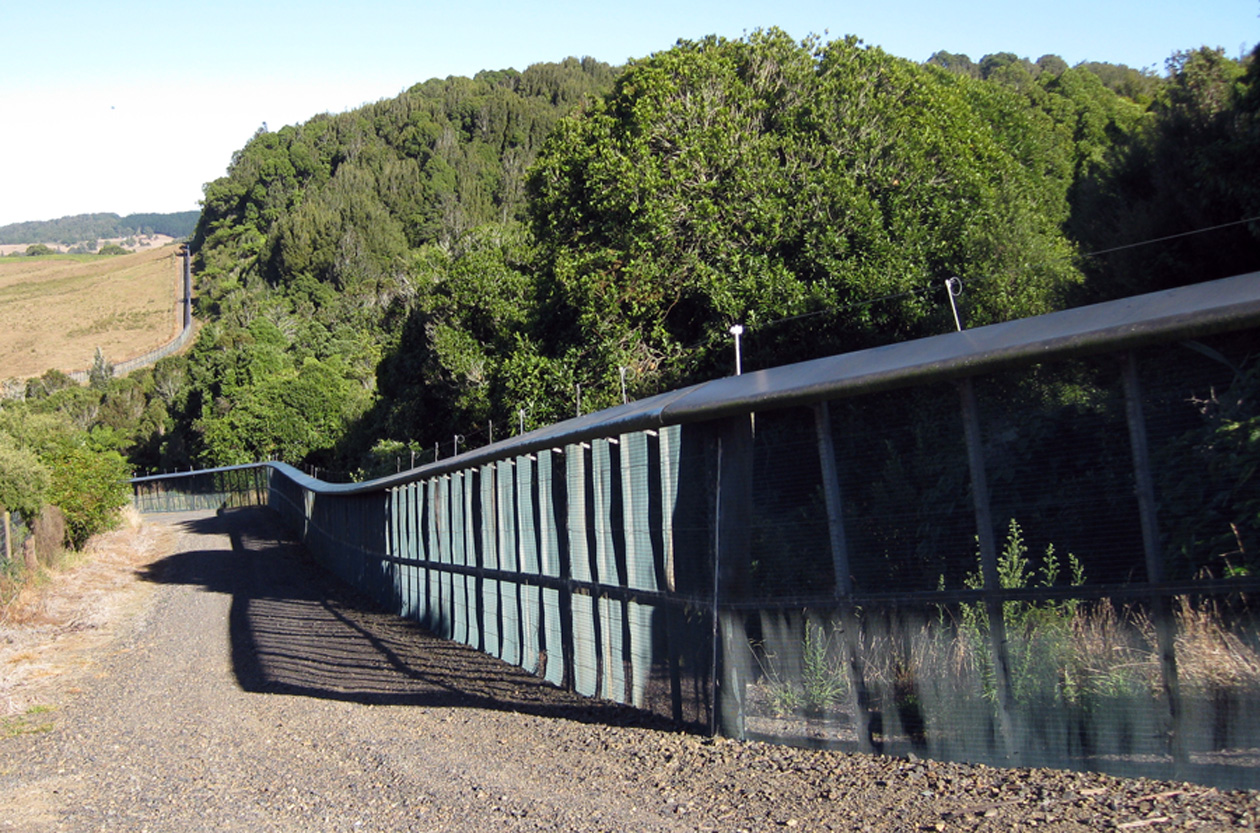
Maungatautara forest sanctuary

Maungatautara pest-proof fence

Then some unsung hero of conservation had the bold idea of creating an ‘island’ sanctuary for native species on the mainland. It inspired a community-driven project to encircle Maungatautari with a fence deep enough to discourage burrowers, strong enough to keep out marauders, and tall enough to deter climbers, including possums reaching a ‘live’ wire at the top. The fence encloses 3,400 hectares (over 8,000 acres) and stretches for 47 km (30 miles). Completed in 2004, it was paid for by public subscription and grants and is maintained by a bevy of volunteers working the equivalent of 37 full-time staff.

Maungatautari

Maungatautari foundation plaque

They probably had many discouraging moments and encountered plenty of doubters, as there always will be with pioneering endeavors, but their efforts are already paying off. Foreign predators and pests have been completely eliminated from within the enclosure, except for mice. The numbers of native vertebrate species have increased four-fold through a reintroduction program. There are kokopu (native fish), kaka (parrot), takahe (endangered species of rail), hihi (stichbird), karariki (parakeet), tieke (saddleback).  The tuatara (the world’s oldest lizard) and the weta (the largest insect) are there. The Maungatautari forest sanctuary is an experiment in recreating a natural forest, a laboratory for education, and an inspiring example of a community achievement.

kaka

Pippa’s introduction to kaka parrots

mamaku

mamaku tree fern

When you leave farmland behind to enter the sanctuary through double gates the forest gathers around you. The vegetation is luxuriant and the high canopy shields your skin from damaging ultra-violet rays pouring down through the ozone hole at that latitude. Boles of giant rimu trees are crowded with lianas ascending to the crown as thick as a man’s arm. Giant tree ferns look like relics from the Carboniferous Period (they are), creating spectacular patterns against the blueness at breaks in the canopy. Only the sound of trickling streams or the raucous call of a parrot breaks the silence of this natural cathedral.

brown kiwi

brown kiwi

But come at night and you will hear more—shy creatures going about their business. The brown kiwis are whistling a happy tune again after a century of absence. A warden who trained his dog to find nests discovered they had already started breeding again in 2007. The first chick was named Huatahi, meaning ‘first of the new fruits.’

The next time I visit the sanctuary I hope to hear the flightless kakapo which has been on the verge of extinction. I am told its nocturnal call will make my hair stand on end as I wait for the iconic bird in the darkness of that amazing forest. How appropriate that the kakapo is a symbol for conservation in New Zealand and Sirocco, an abandoned chick raised by hand, has over 30,000 likes on his Facebook page. He is a green parrot for a green movement on a green isle.

Next Post: Warmingsburg

Posted in Animalia | Tagged , , , , , | Comments Off on Maungatautari

Wings

NZAirThis post is scheduled to go online while I am flying over the Pacific Ocean from New Zealand to Los Angeles.  It is a journey of 10,500 kilometers (6,500 miles) and about 12 hours. That’s a long flight, although short of the record held by Qantas for the route from Sydney to Dallas, a distance of 13,880 km (8,500 miles) which takes 15 h 25 min by a Boeing 747-400.

Until fairly recently it was hard to imagine an airplane conveying more than 500 people so far in a single hop. Although marvels of engineering, modern aircraft are still nothing like as breathtaking as the tiny fliers created by nature.

A few weeks after I leave Auckland, thousands of bar-tailed godwits will be taking off from New Zealand for their breeding grounds near the Arctic Circle. They will stop once around the Yellow Sea to refuel on seafood for putting on fat for the second leg of the journey. Soon after their family duties in Alaska are over they will complete the circle by returning to New Zealand. No other creature migrates as far or faster or without stopping than godwits on their flight south.

These are wading birds weighing a little over 500 g (1 lb). You may see them probing mudflats on stilt-like legs with long bills that look as if they were dipped in black ink. Like long distance aircraft, including 747’s, godwits have large wings for their bulk.

During a long flight their brain shuts down one side at a time to ‘sleep,’ rather like a co-pilot taking turns at the controls of a jet to give the captain a break. And like a long-haul jet they pile fuel onboard with voracious appetites before setting off. Half their body weight is burned off on the trans-Pacific route, so they arrive at their destination with ‘tanks’ almost empty. Flying economy is critical for a bird that can’t stop to feed while crossing the Pacific, but at altitudes of 3-4 km they find favorable winds to save energy.

It is just as important for birds to avoid getting lost as for aircraft. Godwits fix their course from the sun, analyzing polarized light on cloudy days, and navigating by the stars at night. Crossing from northern to southern skies doesn’t confuse them. We might fly round in circles without our instruments.

whimbrel migration

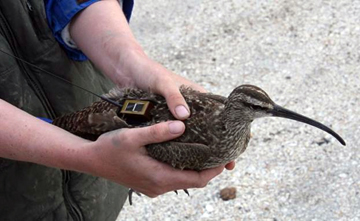
The whimbrel Hope fitted with a telemeter by Virginia ornthologists. Courtesy Fletcher Smith.

The migration routes and stopping places of godwits have been mapped by fitting them with feather-weight satellite telemeters on their backs. One of them, a female code-named E7, was tracked for nearly 30,000 km over six months. After waiting for a tailwind E7 departed Alaska on August 30 and arrived in New Zealand only 8 days later having traveled 11,700 km (7,270 miles) at average speeds of 50-60 km/ hour. She stayed there with 100,000 others throughout the warm southern spring and summer.

The same bird began her return journey to Alaska on March 17 of the following year. She arrived in China 7 days later after flying 10,300 km (6,400 miles). Six weeks later she was on her way again and arrived in Alaska on May 8 after a 6 day flight of 6,500 km (4,040 miles). Instead of collapsing with exhaustion and jet-lag as we might after a long journey, godwits are soon busy dating because raising a family in the short breeding season mustn’t be delayed.

While I waited in Auckland for my flight I was musing which of us was the more economical traveler, energy-wise.  Would it be the small bundle of fat and feathers or a passenger squeezed between others in a fuselage? I made some rough calculations on the back of an envelope (quite literally), to confirm my suspicions.

Birds and airplanes burn different types of fuel but their calorific values can be compared. Assuming the same as human adipose tissue, godwit fat has an energy value of 30 MJ/ kg. This is not so very different to jet fuel at 46 MJ/ kg.

If E7 lost half her weight on her longest journey by burning most of her fat, say 300 g, she would have consumed 9,000 KJ.

A Boeing 747 burning 70,000 kg of jet fuel on my route to L.A. consumes 3,220,000,000 KJ.  This is a rate of 20 liters or 5 gallons per mile, but much more at take-off.

This titanic energy looks more moderate when you divide it by the number of passengers onboard which is, conservatively, 500. Then it drops to 6,440,000 KJ per person. Although this still seems enormous, jets are in fact more economical with fuel for transporting a passenger than an automobile over the same distance (unless the car is fully-occupied when they are about the same).

But it still isn’t a fair comparison because an average passenger like myself weighs 70 kg (~160 lb), equivalent to about 150 birds. So, last of all, I divided energy by body weight to find—

godwits consume 460 J (1,900 cal) per kilogram per kilometer traveled,

whereas I burn 9,000 J (157,000 cal) for the same weight and distance.

We travel by airplane only 5% as efficiently as godwits. I never expected to outdo a bird that has perfected its flying machine over eons of natural selection. Feathers motored by muscles will always beat alloy propelled by aviation fuel, but what we lose in economy we gain in speed. Icarus take note.

Next Post: Warmingsburg

Posted in Animalia | Tagged , , , , | Comments Off on Wings