A Healthy Oil Change

Smoke curling out of an open window or from under a car hood is a bad omen, and smoky chimneys and cigarettes emit toxins. It often means bad news, and we made a metaphor of it, There’s no smoke without fire. But occasionally it seems almost wholesome.

I used to enjoy it gently billowing over a wok before I threw vegetables on the hot oil to stir-fry. Perhaps smoke from cooking is welcome because the kitchen is a sanus sanctuarium— provided the oil doesn’t catch fire! I wonder if different notions about smoke rarely cross-fertilize because they are processed in separate registers on the right and left sides of my brain. No doubt there’s a lot more mental subtlety involved, but one day when smoke from a wok on the kitchen hob made me cough my right brain woke up to ask why. Wasn’t it a healthy smoke? And, if not, what kind of chemical brew was I creating?

It’s a question that has been studied more by biological chemists than you might think from the few media reports, although some food warriors have posted smoke signals. When I started reading tidbits from scientific journals I understood why.

When any kind of vegetable oil is heated a chain reaction starts to evolve aldehydes like acrolein, 4-hydroxynonenal, and a bevy of other unfamiliar molecules. Heated above the ‘smoke point,’ the rates of reactive aldehyde formation climb ever higher. Some of these molecules are known mutagens that can form adducts with DNA, making them candidate carcinogens. Polyunsaturated fatty acids in oils recommended by the authorities are more vulnerable to oxidation than the monounsaturated types because they have more double bonds. Saturated fat, which by definition have none of them, are much more stable. Suddenly, it dawned on me that home cooking can make my home more polluted than the street at rush hour.
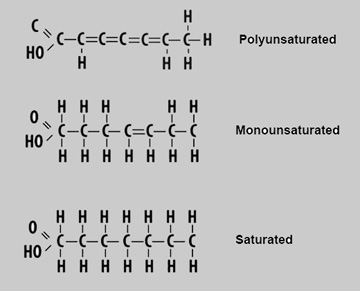
Healthy or unhealthy fats

Good, bad or ugly fats?

If vapor was the sole danger I could avoid it by turning up the extractor fan, but my meal was bathing in a toxic slush. Since higher temperatures and long cooking times increase the problem, I wondered how many times cooking oil is re-used at the fast food joint where I sometimes buy a burger and fries?  I also thought about my neighbor who saves oil from his deep fryer after cooking a Christmas turkey? Perhaps it’s safer dining at home.

Restaurant chains can reduce oil oxidation under a blanket of non-reactive nitrogen, or at least test the quality of any reused oil, but home cooks don’t have that option until there is a mass spectrometer for the kitchen countertop. Meantime, we blithely follow recipes regardless of chemistry, and have to rely on our senses and common sense for safe cooking.

The first precaution is to watch for smoke, which is a warning that the oil has spoiled and should be replaced. The second is to sniff over the pan because an acrid smell points to acrolein in the vapor. And the final test is to taste the oil.

smoke test for vegetable oils

Smokey wok

When I compared several cooking oils by heating them to 400 °F. (204 °C.), the extra virgin olive oil and walnut oil were smoking before they reached this temperature, and their fruity notes were gone and tasted bitter. These oils had already gone bad. But refined oils like canola had higher smoke points, and though they started tasteless they remained that way. Lastly, I opened a large bottle of olive oil which had just passed its sell-by date. Since it smelled rancid, oxidation was happening at room temperature and, reluctantly, it had to go. Vegetable oils are a kitchen doctor’s dilemma that Mum never had to worry about. How did it happen?

As heart disease grew to epidemic proportions, the American nutritionist, Ancel Keys, led a charge against saturated animal fat over fifty years ago. He was followed by an omnibus of researchers, medical societies, and government officials who transformed the national diet which we still have (but I won’t say enjoy). The arguments were based on apparently unassailable reason and facts—energy-rich fat makes us fat, and dietary cholesterol deposits in atheromatous plaques. Clinical surveys (occasionally) helped to prove the low fat revolution was sound.

vegetable oils

Which cooking oil?

But when animal fats were thrown out of the diet the food industry had to fill the gap. Where would the missing calories come from, and what would replace the fat needed as shortening for pastries, cookies, etc? The industry turned to vegetable oils rich in polyunsaturated fats. This decision seemed a safe bet, especially because they were already marketed as margarines created by chemical conversion of liquid oils to partially hydrogenated trans fats. These products had the dual virtues of remaining solid at room temperature (like butter) and having a high smoke point for deep-frying (like lard or beef tallow). As the demand for more vegetable oils bloomed, farmers sowed fields with ever larger crops of rapeseed and soybean. However the safety of trans fats was not sufficiently scrutinized until recently when were they banned in restaurants, food labeling was mandated and the F.D.A. posted a health warning. The complex mixture of unnatural isomers in trans fats are implicated in a wide range of diseases, and now it’s their turn to be condemned.

The food industry is reluctant to return to animal fat because of the legacy of research stretching back to Dr. Keys and the stamp of officialdom. Although a search for substitutes continues, refined vegetable oils have found a new role in deep frying. They are presented as a healthy choice because they don’t raise the ‘bad’ type of cholesterol (LDL), although a rather weak predictor of heart disease in most people. You seldom read about the downside.

The public continues to be subjected to a vast dietary experiment that fails to conquer cardiovascular disease, which still beats cancer to the top of the C.D.C. list of causes of mortality. Switching from animal fat to trans fat and from trans fat to refined vegetable oils have been hailed, in turn, as advances in public health, but we may have ended up with a new cancer risk, or at least a concern that deserves more research. Moreover, as dietary calories from fat have declined over the years they have been replaced by refined carbohydrates, which are now held responsible for obesity and diabetes emerging in children. It’s hard to grasp the scale of disease, disability, and death that can be traced back to dietary recommendations over the last two generations.

I hope people are thinking more about their diet, and listening less to official prescriptions. The relationship between our food and health is far more complicated than the experts were wont to believe. I hope that people fret less about fat in their diet than about the environment in which crops are grown and farm animals are husbanded. There are far too many vested interests in our food choices. Mum’s cooking probably wasn’t as unhealthy as the next generation assumed when they squirmed at the larded memory. I’m sure her pastry, cakes, and cookies tasted better than those served today.

I have turned the tables on cooking fats and oils at home. Margarine and polyunsaturated spreads are out, butter is in. Butter can be good even at high temperatures if the solids and water are removed by clarification. And if lard ever reappears on supermarket shelves I may pull out one of Mum’s old recipes.

For high temperature cooking, I often use refined oils, like safflower, which have high smoke points; olive oil and tasty nut oils are reserved for salad dressing and other cool uses. The pros and cons of different oils otherwise confuse me because the composition of healthy fatty acids (usually meaning omega-3s) and antioxidants vary with the source, season, and storage conditions. Of course, we choose those that taste best (the unprocessed kinds), but I am more focused now on safe cooking to avoid nasty radicals generated by oxidation. And I am more careful about storage conditions, meaning for shorter periods in the cool and dark. I even squeeze drops of vitamin E from capsules into bottles of vegetable oil to help preserve them.
Cheating TimeThese concerns about dietary fats are new to me, though they shouldn’t be. As long ago as the late 1950s, Denham Harman (1916-2014), a gerontologist at the University of Nebraska, was expressing doubts about the wholesale adoption of vegetable oils in the national diet. As a former chemist at Shell Oil, he knew that unsaturated fats are unstable and susceptible to oxidation. In one of my books published in the 1990s (Cheating Time), I mentioned his free radical theory of how oxidized lipids cause cell aging and disease. But the penny didn’t drop in a lifetime of cooking until I leaned over a smoky wok one day.

[In coming weeks  I will post about sugar and salt]

Next Post: Where the Bee Sucks
Posted in Biomedical | Tagged , , , | 2 Comments

A Zoo-to-Go

For kids growing up in London during the austere decade after WWII, it was a special treat to be taken to the zoo by parents or school teachers. The zoos were crowded. Children had to be hoisted on the shoulders of grown-ups to see the big cats pacing in their cages, and catch the eye of Guy the gorilla across the moat. We had no guilty feelings then about their cramped quarters, because we assumed the animals were there for our entertainment. Nor did we learn much about their wild nature or the habitats from which they were taken. We thought it would be cool to be zookeepers pushing joints of meat under the bars for tigers, tossing herrings for sea lions to catch, and locking our school ma’am in the reptile house at the close of day. But, in hindsight, there wasn’t much difference between the zoo and Wormwood Scrubs prison, except for the species incarcerated.

There were no parklands for those animals to roam, except outside London at Whipsnade.  But zoos have come a long way. The naturalist and author, Gerald Durrell (1925-1995), was regarded by the Establishment in those days as a maverick for calling on zoos to change into centers for captive breeding of endangered species instead of being public exhibitions of unhappy creatures. As is the way of pioneers, he is now celebrated as a visionary and memorialized at the Durrell Wildlife Park for conservation, but there was one thing he never changed. You still had to go to his zoo to see animals.

New Quarter Park, Virginia

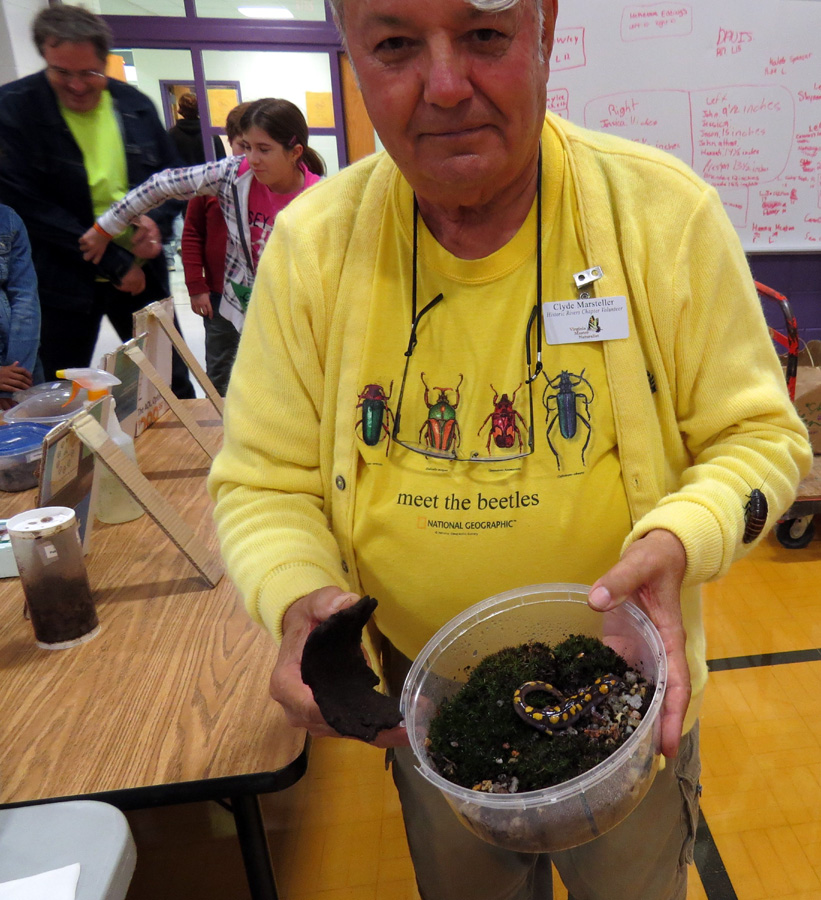
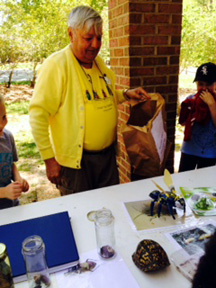
Clyde takes his traveling zoo to a public park

One of our master naturalist friends, Clyde, is also a zookeeper, but not the kind I ever imagined. He was more radical than Durrell when he created a portable zoo that could be taken to children in their classrooms and to public parks. The critters were collected in his neighborhood or the local churchyard under state collection and exhibition permits. Reptiles and amphibians were returned to where they were caught a few days earlier, while other creatures were cared for at home. His zoo is transported in shopping bags in his car trunk and, although none of the big predators and venomous snakes beloved by children can be included, his small critters have been tremendous hits. Since it was launched in 2007, he has entertained and educated over 13,000 children and adults across five school districts in south-east Virginia.

The mission of this zoo is education instead of conservation. Clyde was concerned that most children are less connected with nature nowadays than when he was growing up. Few of them grow up on farms or want to visit city zoos or are allowed to roam the countryside unsupervised, and their days are brimful of organized activities and screen time. The writer, George Monbiot, worries that, Without a feel for the texture and function of the natural world, without an intensity of engagement almost impossible in the absence of early experience, people will not devote their lives to its protection.

We can hope the newly-minted generation will be more caring about the environment than their predecessors, but I think the chances are much greater for those who have met Clyde and seen his menagerie. Watching how they respond to his lessons warms our hearts, the lower grades 2 through 5 especially. When Clyde and his “zoo cru” of helpers transfer critters from Tupperware boxes and glass jars to trays on the front desk, there is plenty shuffling as boys and girls strain to identify the collection of beasts—beetles and butterflies, mantises and millipedes, slugs and snails, salamanders and skinks, toads and turtles. There are a few skins, scales and shells for creatures that are too rare or too dangerous for live ones to be let loose. The boldest kid steps forward to ask if a giant hissing cockroach could rest on his sleeve. Even those who stood nervously behind the front row eventually want to tickle a roly-poly or poke the leaf litter to make a centipede scurry. Giggles and questions go in circles like whirligigs. Some questions from minds full of innocent curiosity are disarmingly penetrating.

Virginia Master Naturalists

“Want to stroke the spotted salamander in my bucket or the Madagascar hissing cockroach on my sleeve?”

Clyde explains that every species has its own life history, then tells their stories. One of his favorites is about the community that lives under logs, where he finds many of his critters. He asks the class what they expect to find when they roll a log over. A short arm shoots up with an answer, usually its “beetles” or “spiders.” He then spins nine yards of ecology, and I doubt any other lesson that day captures more attention.

Leaning forward to the class, he tells them dark secrets about beetles. They feed on the wood rotting on the underside of the log. He shows them a little bag containing brown, granular material. “It’s beetle poop,” he confides (more giggles). “It will be made into healthy soil particles by tiny things called decomposers.” But life under the log is not all rosy. There are predators just as voracious as on the African plain. Beetles, slugs, and spiders are eaten by salamanders, frogs and toads, and occasionally a long black racer winds under the log to gobble all of them up. “After we looked under the log, we must roll it back,” he tells them. “We have to care for nature because all things are connected, including ourselves.”

praying mantis

Amen – the praying mantis

Clyde loves to quote the wisdom of American Indians, but it was Rachel Carson who expressed his role, If a child is to keep alive his inborn sense of wonder … he needs the companionship of at least one adult who can share it, rediscovering with him the joy, excitement and mystery of the world we live in.

Most children in this district only have one opportunity to see his zoo, so you might wonder if they will remember his stories in the future. Surely, their memories will gradually sink in their unconscious minds and become overlaid with hosts of new stories and experiences. But they won’t die. I think they will linger underground, maybe for years or even decades, like fungal hyphae which, when fertilized by soil, season, and time, will suddenly sprout above ground into the light as toadstools full of fruitful spores.

Clyde is now a retired zookeeper, but others are continuing his mission.

Thank you, Clyde, for life lessons!

Next Post: A Healthy Oil Change

Posted in Animalia | Tagged , , , , | Comments Off on A Zoo-to-Go

Thanks given for Wild Turkey

Christmas has the sound of carols while July Fourth the sight of fireworks, but only one American holiday has an aroma. A breeze of savory turkey from the kitchen is the essence of Thanksgiving. How it came to be associated is something of a mystery, but it’s a nice compensation for losing the vote to bald eagles when America chose its national bird.

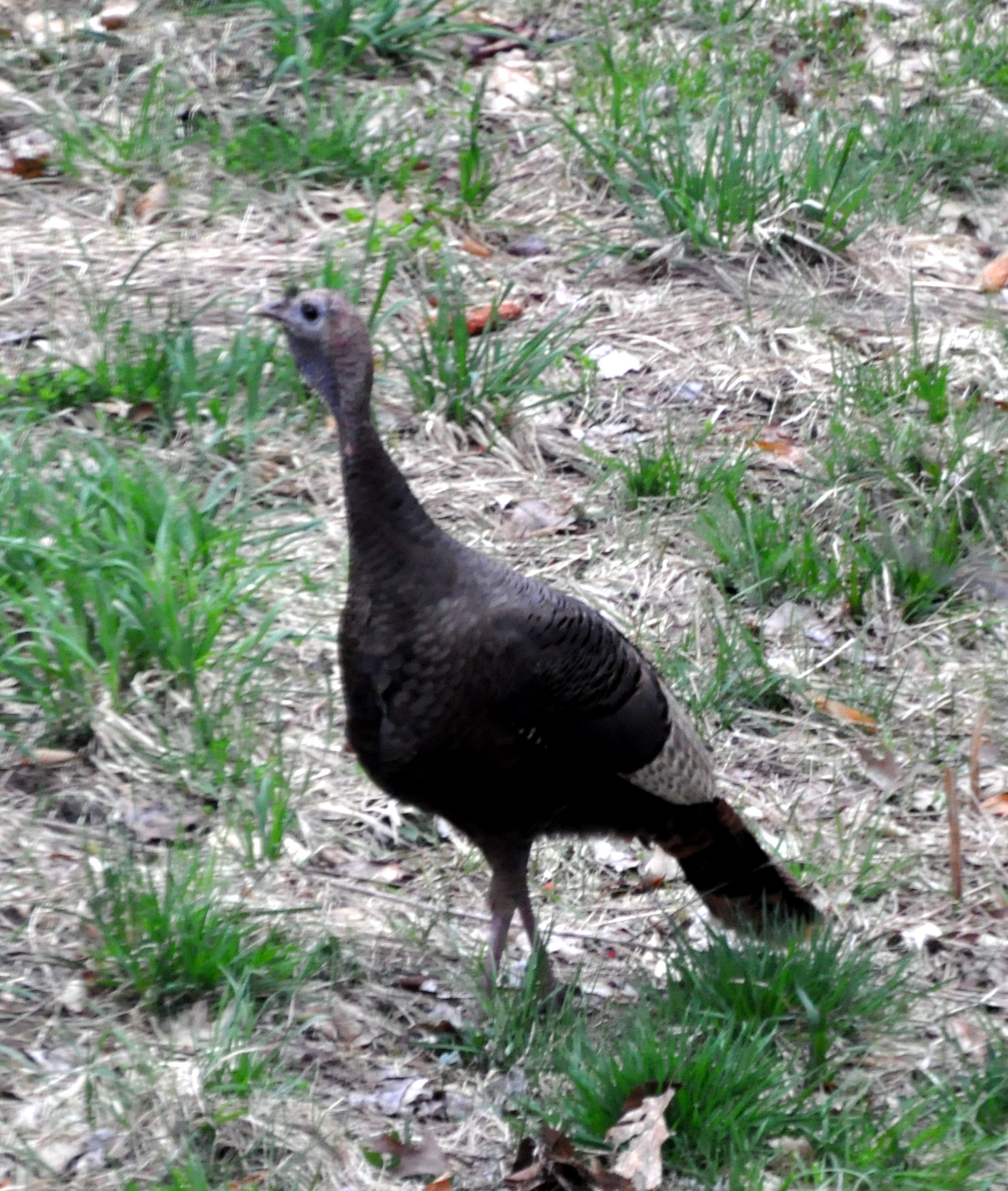
wild turkeyWe can’t be sure if they were on the menu at the very first Thanksgiving in the 1600s. Even the date and place of that celebration is contested. According to a tale often told, Thanksgiving began when persecuted Puritans arriving in God’s land from England celebrated their first harvest with new American Indian friends in Massachusetts. It is a story that nicely chimes with the proud national history we like to tell children.

But some twenty miles up the James River in Virginia, at the Berkeley Plantation (formerly Berkeley Hundred), a plaque commemorates a thanksgiving service in December 1619, a full year before the first Pilgrim Father stepped off the Mayflower.

Wee ordaine that the day of our ships arrival at the place assigned for plantation in the land of Virginia shall be yearly and perpetually kept holy as a day of thanksgiving to Almighty God.

The Berkeley bunch of rugged pioneers was more in tune with profit than piety, and they even had an entrepreneurial clergyman. According to legend, their Episcopal priest distilled the first bourbon whiskey from Indian corn in 1621—though the claim attracts a spirited rebuff from patriotic Kentuckians. But there can be no doubt that the colonists needed southern comfort, because the following year they were raided by Indians and the survivors had to be evacuated to the fort at Jamestown. Thanksgiving was suspended at Berkeley for some years, leaving the northern upstarts with the reputation of an honored meal in perpetuity.

The colonists would say that Thanksgiving turkeys today are a pale, vast, and grotesque transmogrification of their wild relatives that fatten naturally on mast in the fall woods. Wild turkey was daily fare for them, much as rabbit was for their relatives in England. I imagine children complaining when mothers served it for the umpteenth time. It requires rarity and high market price for us to value delicacies. Over-hunting brought a turnabout, although in the past century wild turkeys have become common again through conservation efforts and reintroduction to where they had been extirpated.

We see them rustling through leaf litter in woods, gleaning fields, and even waddling along roadsides, with their disproportionately tiny heads bobbing constantly. If you come within a couple of hundred feet of them, you may be surprised how shy they are and the speed with which they vanish in a racket of whirring feathers. Remember, they are flying carcasses with heavy payloads of breast meat.

They know when it is hunting season, and gather in small parties of adults and jakes because the more eyes the better. There were thirteen in our woods last week, but if they had bigger brains they would know it’s an unlucky number.

A Merry Thanksgiving to all my American readers.

Next Post: A Zoo to Go

Posted in Other | Tagged , , , , | Comments Off on Thanks given for Wild Turkey

My Big Fat Neanderthal Family Wedding

Was there a population that never experienced discrimination?  Prejudice has an ancient pedigree, perhaps wired into the human psyche. I was musing whether Neanderthal people bore it first and endured the stigma longest.  Thirty thousand years after they mysteriously disappeared, they are still regarded as oafish cavemen.

But at least we regard them as human, while ridiculing their long noses, brow-ridges, and prow-mouths. Besides the evidence of fossilized skeletons and DNA, I wonder if their humanity is also defined by our prejudicial attitudes, because we only look down on our own kind. We never hold animals in the same contempt as people, because even the great apes are subordinate beasts! It is not because other people are so different that we discriminate, but because they are too similar. When we look down our noses at other races, both archaic and modern, we reveal our deeper insecurities, and perhaps anxieties about losing superiority and being swamped.

Social scientists and anthropologists have not always been totally objective in their estimation of other tribes and races. I doubt there was ever a researcher who found his own race was inferior in character or intelligence to another, or if he did he never published it!

Sometimes people who know better don’t admit the facts. Over twenty years ago, my department hosted a distinguished British anatomist, who shall be nameless. He denied that Neanderthals had a slightly larger cranial volume (hence, brain size) than ourselves. It was useless arguing with him because he was a ‘Sir’ and a Fellow of the Royal Society. If he had admitted that their larger brain was merely in proportion to a larger body, we might have drawn a truce rather than ending the exchange in sulky silence. But he refused to discuss the hypothesis that they might have been our equals.

Neanderthal skull versus modern human skull

How much does size matter?

Poor Neanderthals need publicity agents to throw back slurs based on ignorance. There is so much we don’t know, and may never know. Did our first great encounter with these people begin with the exchange of gifts or at the point of a spear? According to a common fairy story, the dim Neanderthals were doomed when our brilliant ancestors arrived on the scene. We flatter ourselves with triumphal tales, even though this one is grotesquely reminiscent of the way we treated people when colonizing their lands, subjugating them in the name of civilizing inferior natives.

On the first world voyage of H.M.S. Beagle (1826-1830), FitzRoy captured three natives in Tierra del Fuego and took them home to England. The Fuegians were dressed up as English folk, taught the language, instructed in the Christian faith, and even presented to the Royal Family. On the second voyage, with Charles Darwin as ship’s naturalist, the three were returned to their homeland where they quickly reverted to custom by throwing away their clothes and painting their skin with pigments. FitzRoy thought this behavior vindicated his theory that the gulf with civilized nations is too deep to cross.  Savages will always be savages, and always inferior.

Charles Darwin

Charles Darwin’s cranium – Neo-anderthal?

On the other hand, Darwin, an old-fashioned Whig or liberal, was awed by the mystery, “Whence have they come?” He accepted a hierarchy of human races, but believed it was moveable. He disagreed with Captain Fitzroy about most things, including slavery, which must have been awkward on a long voyage in a shared cabin. After they sailed home, immigrants started colonizing the southern tip of the continent. They treated the natives as feral humans, and those that survived epidemic diseases were otherwise exterminated.

Years later, Darwin was shown a skull excavated from a cave in Gibraltar (and is now at the Natural History Museum in London). This was the first fossil of an adult Neanderthal, and it predates by eight years another find in the Neander Valley which gave the people their name. Instead of sharing the general opinion that it represented a primitive brute, he cautioned, “Light will be thrown on the origin of man and his history.”  Human genealogy has rolled out slowly since his day because our fossils are rare, but molecular genetics reveals branches on our family tree that challenge the stories we were told.

Recently, pure DNA was extracted from fossil bones to obtain a nearly complete sequence of the Neanderthal genome. I doubt if many people expected that between one and four per cent overlaps the genomes of modern Europeans and Asians. Today’s Africans have none of it though, which implies that the fraction possessed by the rest of humanity is not a residue from a common ancestor hundreds of thousands of years earlier. That Neanderthal DNA exists in us today is because our ancestors coming out of Africa about 50,000 years ago met Neanderthals living in the Middle East, with whom they intermarried (call the coupling what you will). Fossil evidence confirms that we did co-exist with them for 5,000 years, so there was plenty of time for integration, and our Neanderthal heritage is not the result of sporadic mating. I guess it was mostly consensual because I find it hard to imagine a Neanderthal woman being carted away unwillingly from her menfolk, who were like the beefiest NFL players you could imagine! But I digress.

Analysis of my own DNA reveals that I inherited 2.7% from Neanderthals. That is close to average for my ethnicity, and more than I share with my third cousins. The news amused me until I mused that it was ‘good DNA,’ for otherwise it would never have lasted so long after the weddings. Some bits of the genome have persisted more than others. We have acquired many genes associated with skin and hair, which implies that Neanderthal adaptations to cold were advantageous for our ancestors too when the next Ice Age arrived. However, we also hung on to genes linked with modern diseases, which seems perverse. Perhaps they were not so bad in the past before we adopted our current lifestyle and diet. Genes encouraging fat storage, but predisposing us to adult-type diabetes and obesity, might have helped us to survive cycles of feast and famine, perhaps thanks to ‘thrifty DNA’ from Neanderthals.

The number of generations separating races of modern people from our common African ancestors is like a twig on the evolutionary tree compared with the much older branches shared with Neanderthals from whom we separated over half a million years earlier. Neanderthals are our cousins, but mutations and natural selection caused genomes to drift so far apart that geneticists suspect that hybridization was barely viable. When crosses are made between closely-related species like horses and donkeys, the products are usually sterile if any offspring can be produced at all. That hybrid humans may have had fertility problems is suggested by the absence of Neanderthal DNA in our genes that control the manufacture of sperm in testes. Perhaps it didn’t ‘fit’ there, and maybe absorption of Neanderthals into the new society contributed to their disappearance.

If the image of a Neanderthal man courting your beautiful greatetc-grandmother is repulsive, look at sculptures by the American paleo-artist, John Gurche. His art is based on careful studies of the physiognomy of archaic humans. He created a Neanderthal profile which is imposing, almost handsome, even noble.

phrenology

The Phrenological magazine

Appearance matters, but intelligence often carries greater weight in our estimation of others. In the Victorian Age, phrenology was in vogue and its adherents trotted around the globe measuring the size and shape of skulls of rich and poor, saints and sinners, civilized nations and primitive tribes. They expected these measurements would predict people who were inferior in character and intellect, who always turned out to be the most disadvantaged in their studies. The discovery of Neanderthal bones gave them a new opportunity for skullduggery. In 1880, The Phrenological magazine declared, “The Cro-Magnon skull is superior to the Neanderthal skull in regard to intellectual and moral development … he was indeed a savage.” We may never know for sure, but I doubt that Neanderthals were dim people, or less bright than ourselves. That may seem contrary to signs that their tools and culture hardly evolved over eons, but neither did those of our ancestors advance much until the recent Agricultural Revolution. Could Neanderthals have struck a smarter deal, opting for a more stable relationship with nature than we have?

The German lion of Darwinism, Ernst Haeckel (1834-1919), would be flustered by modern research and scholarship because he suggested that Neanderthals should be called Homo stupidus to distinguish them from our brilliant selves, Homo sapiens (literally, ‘wise man’). It was a proposal that revealed prejudice, but our cousins had fortunately been named already, and precedent counts in taxonomy. They were designated a new species, Homo neanderthalensis, although taxonomists continue to argue whether they were a distinct species or the subspecies, Homo sapiens neanderthalensis. I don’t understand the debate. To be a separate species, two populations must be reproductively isolated, either genetically (they can’t mate with each other) or geographically (they can’t hang out with each other). Since Neanderthal DNA exists in our genome, they ought to be regarded as a sub-species: more different than modern races are from each other, but inside the species fence.

The popular image of Neanderthals is gradually being turned upside down by advances in traditional and molecular paleontology. Contrary to the stereotypes, we now know they were fair-skinned with reddish hair, not strict carnivores but ate a mixed diet with cooked vegetables, probably had a language, and evidently created symbolic art on stone walls and decorated their bodies. Most touching of all is the suggestion of a tender humanity, and that they were not emotional icebergs. Since some of their skeletons have badly worn joints and are almost toothless, these people probably needed carers to help them to survive with disabilities. After death, their bodies were not discarded like carcasses of game animals, but given a respectful burial. Can you imagine last rites performed by a Neanderthal shaman?

This revisionary anthropology throws refreshing light on a maligned people, although over a century ago a Danish anthropologist, Hans Peter Steensby, rejected the impression of Neanderthals as ape-like, inferior beings. But prejudice is deeply imbedded, and despite efforts to exorcize the demon we easily express it unconsciously. The other day, I caught myself joking that I have less Neanderthal DNA than the rest of my family!

Next Post: Thanks given for Wild Turkeys

Posted in Other | Tagged , , , , , , , , , , | 2 Comments

Rehabilitating Rabbit

I lifted a sodden fur ball out of the pool skimmer one morning. It lay motionless in my hand with its life almost burned out. But when I peeled back an eyelid to check for the glazed eye of death, it winked.

It was a cottontail bunny, barely a month old, yet already independent of its mom. After falling into the pool overnight, it had scrambled (or swam, as rabbits can) to hold its head on a ledge above the cold water.

Cottontail rabbit

Drying out

Wrapping him in a towel, I laid Peter in a warm cardboard box with the lid folded over to cover him in darkness. All wild bunnies at our home are called ‘Peter’ for sentiment’s sake, notwithstanding my doubts about his sex. As a boy, I learned the distinction is tricky, and once (but never again) made the mistake of keeping two ‘brothers’ together in the same hutch.

Hours later, when Peter had dried out, he still looked lifeless. My wife started to nurse the bundle, hoping that her own body heat would revive him. But his adrenal glands had been pouring out corticosteroids and epinephrine in a shrinking effort to generate energy for thermoregulation, and he was tipping towards hypoglycemia, heart block, and ventricular fibrillation. What should one do with a hypothermic rabbit?

In Beatrix Potter’s story, “Peter Rabbit was not very well during the evening. His mother put him to bed, and made some camomile tea; and she gave a dose of it to Peter. One table-spoonful to be taken at bed-time.”

Peter was unconscious. I had to gently prize his mouth open to insert a dropper for feeding him a little honey diluted in warm water. I hoped it would strengthen him, but didn’t expect to find him alive the next morning.

What a strange species that cares for varmints (vermin)! Most days, the sight of rabbits grazing in the garden can bring on murderous thoughts. Herbaceous borders and veggie beds are cultivated for our benefit, not as help-yourself salad bars for plunderers. There are no free lunches in our yard, not if we can help it, though there are exceptions. If a critter is promoted to become a patient or a pet, it is fed bounteously, and, if necessary, we even dig in our pockets for a vet bill.

Luckless rabbits are not the only creatures that win the generosity of strangers. The same week, I disentangled a garter snake caught by its windings in a garden net. And, a day later, I screeched to a halt after narrowly driving past something crawling across the road, but I was too late to rescue it from becoming turtle soup under the wheels of a following vehicle.

Our ambiguous relationship to nature is deeply puzzling. We want to control wild nature, yet celebrate wildness. Despite our predatory instincts, it feels good to be merciful to animal casualties from road accidents and window strikes as well as orphans and victims of domestic pet attacks. We even adopt wild animals as if we had the duty of parents. Notwithstanding strange myths like Romulus and Remus, it is unlikely that role-reversal ever happened where an animal became the carer of a human dependent.

Our hearts are touched by the individual creature that falls into misfortune, but rarely by a herd or swarm or shoal. I can’t feel the same compassion for the anonymous rabbits in a whole warren as I did for Peter. We spare the individual and shoot the masses. When wee Peter plunged into our lives, his fluttering existence called on our compassion, and we happily submitted by welcoming him into our care for a few days. It seemed so natural and attractive to behave mercifully, even though it was against our nature to rescue a garden raider, and an edible one at that. Perhaps Peter was lucky to have his accident in our yard, and not next door in Mr. McGregor’s.

The Tale of Peter Rabbit by Beatrix Potter

First edition 1902, Frederick Warne & Co.

“Now my dears,” said old Mrs. Rabbit one morning (to the young bunnies), “you may go into the fields or down the lane, but don’t go into Mr. McGregor’s garden; your Father had an accident there; he was put in a pie by Mrs. McGregor” (The Tale of Peter Rabbit).

Our kindliness to animals is partly owing to our peculiar tendency to anthropomorphize them, and this may account for the greater tenderness shown them by young children. Peter Rabbit in Beatrix Potter’s Tales, and Hazel, Bigwig, and Cowslip in Watership Down, are all sympathetic characters modeled on our better selves. On the other hand, Napoleon, the Stalinist tyrant of Animal Farm, is a caricature of our grotesque side, which should greatly offend the civil porcine community.

St. Francis of Assisi

St. Francis: Sermon to the Birds (c. 1298) Formerly attributed to Giotto [Public domain], via Wikimedia Commons

Dreamers and writers have told utopian stories of making peace with the animal kingdom. Isaiah dreamt of the wolf living with the lamb, and the leopard lying with the kid; St. Francis delivered a sermon to the birds; we grow up with stories of animals who were friends of Tarzan, Mowgli and other heroes; and a bevy of cartoon animals living with humans have entertained us.

Maybe there is an even deeper reason why our sentimental selves are roused by the sight of a sick or dying animal? Perhaps Mr. Lockley in Watership Down put his finger on it. “Rabbits are like human beings in many ways. One of these is certainly their staunch ability to withstand disaster and to let the stream of their life carry them along, past reaches of terror and loss. They have … an intuitive feeling that Life is Now. A foraging wild creature, intent above all upon survival, is as strong as the grass.” When tragedy strikes, we share the mystery of mortality.

But returning to practical, if not legal, matters, as a law-abiding Virginia resident I ought to have handed Peter over for professional care. According to Virginia code, All persons caring for sick, injured, orphaned, or displaced wild animals are required to have a permit from the Virginia Department of Game and Inland Fisheries. It is illegal here to raise and treat wildlife without a permit. It seems odd that a critter that can be shot or poisoned with impunity cannot be cared for and rehabilitated except by authorization of the DGIF. Admittedly, there is a public safety argument (even rabbits can carry rabies), and it understandable for rare and endangered species, but for bunnies?

In fact, rabbits are among the most common species transferred to licensed ‘rehabbers.’ Across the state, there are over 300 trained rehabbers who care for injured, sick, orphaned and displaced wild animals with the goal of returning them to wild, or euthanizing those beyond help. These remarkable folk work for the love of animals at their own cost, with veterinary backup when surgery or medications are needed. Every species has its specific dietary and accommodation needs, so rehabbers can’t offer an ‘Ark’ service for every critter presented on their doorstep by the gentle public. Some specialize in hawks, owls and eagles; others care for reptiles and amphibians; some are devoted to the furry kind. And when large creatures need long-term care or cannot be released, they are transferred to specialized centers. The Wildlife Center of Virginia in Waynesboro has cared for 65,000 patients of many types since 1982.

Peter needed gentle handling because rabbits are high stress animals that easily die from shock. The fictitious Bigwig was less sentimental about the mortality of his relatives than we were for Peter. He thought that extreme measures to save them are not necessary because “a wild animal that feels that it no longer has any reason to live reaches in the end a point when its remaining energies may actually be directed toward dying.” Perhaps that’s why a live prey carried away in the gape of a fox or the claws of a hawk seems to give up the struggle by going limp before its death throes.

Peter Rabbit

Peter the Rabbit ready to run

Perhaps our Peter had already given up when I fished him out the pool. But, if he was yielding, I refused to accept his fate, and that brought his story to a happy ending. Maybe it was the warmth of strangers or the taste of honey, but something we did revived him. And, later that week, he could scamper off to the veggie bed and disappear among his kind.

Next Post: My Big Fat Neanderthal Family Wedding

Posted in Animalia | Tagged , , , , , , | 3 Comments