There are compensations of being cooped up indoors in wintertime. Bilbo Baggins looked forward to the long evenings in his hole at Bag End when he could relax in an armchair toasting his feet in front of a blazing fire. It’s a time of greater idleness and harder to rouse oneself even for a few steps from a comfort zone to the pantry for a snack. And bee colonies are likewise.
As the outside temperature falls below freezing, they huddle deep inside their hive to maintain a remarkable 90 °F. (32°C.). The workers who labored so hard on warm days earlier in the year are now idlers that rarely bother to snack, and no longer share their precious honey stores with drones that died off in the fall. The queen is at the quiet center of the bee-ball. She has stopped laying eggs, and won’t resume until February when the colony must expand rapidly for the coming nectar flow.
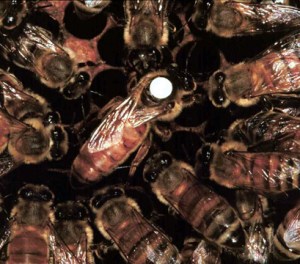
Cosy-up in the comb
Honey stores gradually run down over the cold season. On warm days, a few workers head out to forage for the few hours before sundown, but it is a risky business because if nectar and pollen are scarce the flights may have a negative energy balance. Bee colonies often perish from starvation at the end of winter, just a few days or weeks before food is plentiful again.
The beekeeper who stole most of the honey hoarded last summer must replace it. Trading sugar for honey seems good to him. But the sugar-water that was welcome in warmer months needs lots of energy from beating wings to evaporate it, and can increase the danger of condensation inside the hive. So we give candy to the bees, and why not at Christmas?
On a warm Christmas Day like today there was no danger of chilling the bee-ball when I lifted the inner cover to check the girls. I took a bar of candy out of Santa’s sack and rested it on the frames of empty honeycomb. The candy was home-made by boiling concentrated sugar with a few drops of essential oils until it caramelized and set into solid bars. It’s toffee for bees. A few lethargic workers crawled from their warm place to inspect the treat. Last year, I tested whether they could tell the difference between refined sugar and non-caloric artificial sweetener, because some people find it difficult. Of course bees aren’t so easily fooled. They know that real sugar is vital for survival, but it’s a different story for our species.
Next Post: Pure and Poisonous
A Merry Christmas to my readers