Our dear friend and mentor died today in Norfolk after a short illness. Lucinda and I were able to exchange a few words and smiles with him in the hospital yesterday. He asked how our children are doing—so typical of him.
Howard Jones will be remembered as one of the “Greats” of American medicine because of his pioneering work in reproductive surgery and in vitro fertilization (IVF). He was an inspirational figure for his students and fellows and beloved by everyone who knew him. He had a wonderful blend of humanity, dignity and generosity of heart. Modest and conservative in his own habits, he was indefatigable at work, progressive in outlook and a charismatic speaker. His laugh was infectious.
Some of this character and strength came from his matrimonial and professional partnership with Georgeanna Seegar Jones, a brilliant reproductive endocrinologist. They were a perfect team, sharing an office for most of their careers, co-editing books and journals, and co-supervising junior medical staff and research projects. He said they never had angry words.
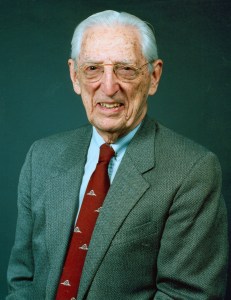
Howard W. Jones Jr., M.D.
Howard was born in Baltimore, Maryland, and graduated cum laude from Amherst College in 1931 and M.D. from Johns Hopkins University in 1935. After military service as a surgeon in France during World War II, he returned to Hopkins where he switched to gynecological surgery and was involved in developing cervical screening services (Pap test) and immortal cancer cells (HeLa cells) from Henrietta Lacks, who was his patient. He remained a surgeon and member of staff at Johns Hopkins until retirement age when they moved to Norfolk and created America’s first successful in vitro program.
When I asked him recently which breakthrough was most important in his career, he replied without hesitation: it was IVF because infertility had been a “great unsolved problem” and the technology has had “a big impact on society.” He became deeply engaged in the ethics of reproductive medicine as an author and committee chairman. Howard and Georgeanna were the sole American doctors invited to Rome in 1984 to advise the Holy See about the new reproductive technologies. I guess that IVF in America was lucky because a controversial technology would surely have drawn greater resistance if it had not been launched by a doctor duo looking like wise and kindly grandparents. Unfortunately, their powers of persuasion did not sway the Vatican, although Howard still hoped for change.
We expected he would lose heart after the death of his beloved Georgeanna in 2005, but he was soon back in his office and flourishing again. New books were published, lecture invitations were accepted when mobility allowed, and young researchers and visitors were welcomed. Work gave meaning and continuity to life, and resonated with memories of his English teacher at Amherst, who wrote:

The last time I heard him recite the poem was at a conference here in Williamsburg. He was then only 93 years old. We were blessed to have him for more than another decade until he fell ill last week shortly after finishing another book, titled Howard and Georgeanna.
Next Post: Virginia Nature Journal for July