Here Be Dragons

Butterfly numbers are down this year in Tidewater Virginia. Since 1999 when local naturalists began annual surveys there have been large fluctuations from year-to-year, but the numbers recorded this year on a hot July day were almost half the reckoning of last year, although most of the same species were seen (29 in all).

This scarcity was obvious from the moment surveyors set off for butterfly-favored habitats across the counties of Surry and James City. We had a hunch that a cold winter had killed the adults and pupae during their hibernation, but why then had so many other insects and arachnids fared okay? The only other reported paucity—and a welcome one—was the impression that there were fewer mosquitoes around. But the dragonfly population had soared. The abundance of golden-winged skimmers was astonishing. You could see hundreds (countless) at a time and in many locations throughout the study area buzzing hither and thither in frenzy. They were probably searching with their large, bulbous eyes to catch a fly or a date. But there was an Aha! moment when we saw another species on a branch munching an orange sulphur butterfly.
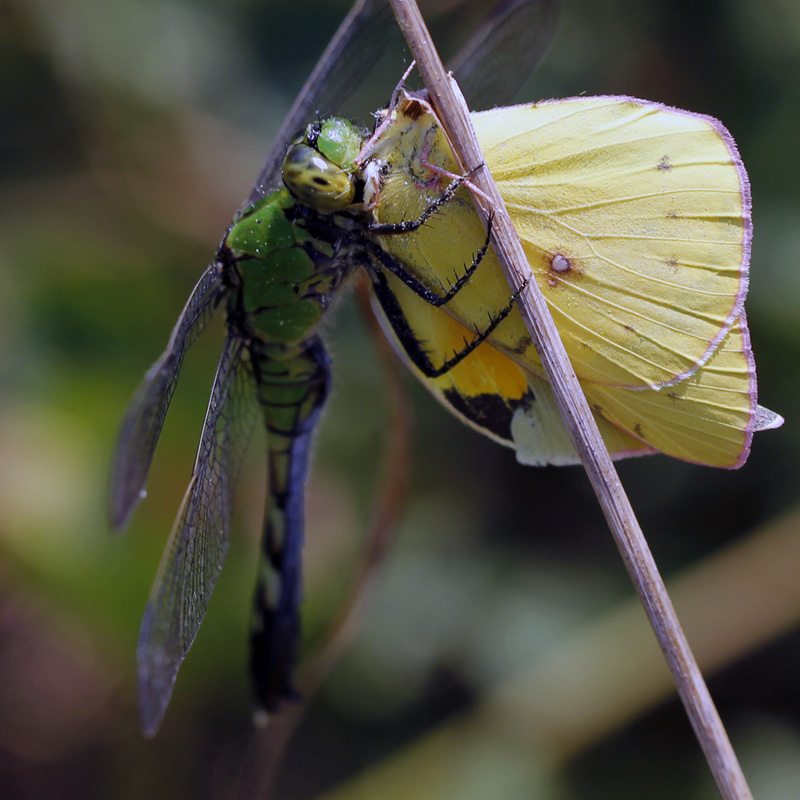
dragonfly & butterfly

Dragonfly eating an orange sulphur. Courtesy of Teta Kain

There is not much in common between a dragonfly and the serpentine, fire-breathing dragon of fables, but they are both voracious carnivores. Dragonflies have complete mastery of the air—they can fly forwards, backwards, sideways, even upside down, at over 30 mph after prey, and can eat as much as their own body weight in a day. With such aerobatic skills and all-round vision they should be the inspiration of drone modelers at the Pentagon. We wondered if dragonflies were responsible for the dearth of butterflies. Maybe.

As I write this post in the Allegheny Mountains of West Virginia butterflies are as common as they were a year ago. In a fifteen minute walk across a meadow I spotted two species of swallowtails, two of fritillaries, American coppers, wood satyrs, sulphurs, whites, a bevy of skipper species, and others too fast-flying to identify. All were plentiful, but there were no dragonflies. I saw none throughout the district because there is no standing water for them to breed.
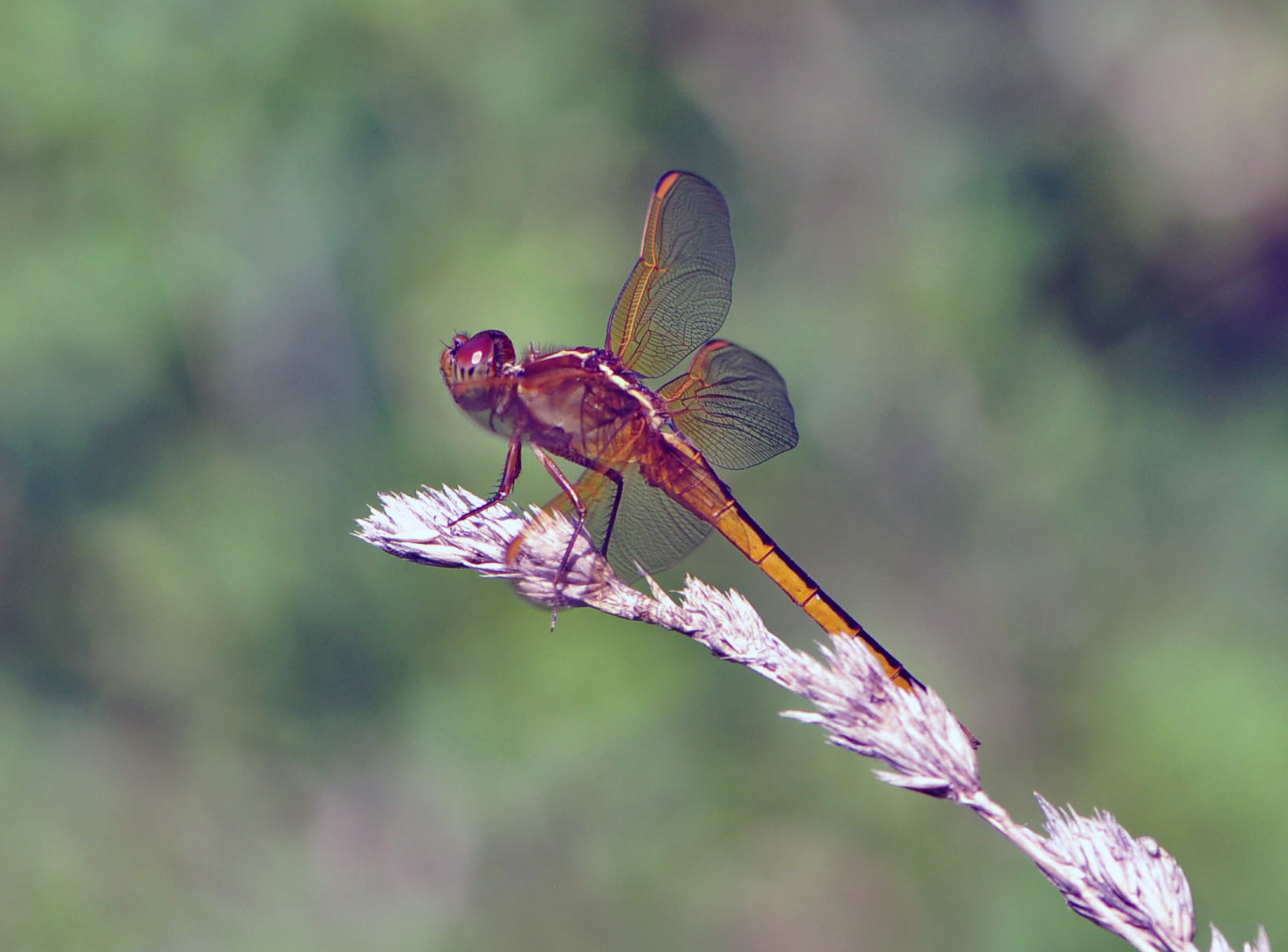
Dragonfly

Golden-winged skimmer (Libellula auripennis)

These observations seemed to clinch a simple explanation—one of cause and effect. When prey species were abundant in Tidewater last year the dragonflies produced a bumper brood that emerged as adults in 2014 to consume all the insects they could catch. They are highly efficient predators, even more so than lions and tigers, capturing prey 95 times out of 100 attempts.  The butterfly population may take a few years to recover and, unless they are a minor fraction of the diet, dragonflies will go hungry next year and not peak again until after a good butterfly year.

It’s a neat story and a familiar one of population cycles that Charles Elton (1900-1991) pioneered. He was an Oxford biologist who, as much as anyone, transformed the craft of the naturalist to the science of ecology. He was fascinated by the 3-5 year cycles of Arctic lemmings; he found their numbers rose year after year until they ate out their food supply and died in a Malthusian catastrophe of starvation (not by jumping off cliffs). Bringing the lemming story up to date, there was an irruption of snowy owls as far south as the Carolinas in the 2013-14 winter, which may be explained by a crash in the lemming population after the 2012 summer of plenty.

Neat explanations are sometimes true, but history records that after the first simple hypothesis is planted a thicket of other explanations grow up as scientists probe deeper, and not only in ecology.

When I was a newly-minted faculty member in Edinburgh, Professor L. Mary Pickford (1902-2002) casually made a remark in the common room one day that I have never forgotten. She had a retired as an eminent neurophysiologist who would have known Elton as a contemporary Fellow of the Royal Society (Britain’s national academy of sciences). You can imagine her like a twin of the old movie star, the very English Margaret Rutherford. Mary said that of all the changes she had witnessed in a long career in medical science one of the most dramatic was the replacement of single causes and effects by multiples. She probably had in mind her favorite research subject, the pituitary gland, for which textbooks in her youth listed a function, mostly only one, for each of its hormones. But nothing is so simple today. Prolactin, to take one example, is now claimed to have over a hundred different actions in various animals. And for another example, oxytocin has been found since that conversation with Mary to be involved in maternal behavior, anxiety, and sexual orgasm, and can no longer be considered as just a ‘birth and milking hormone.’

Likewise, Elton’s theory that lemmings periodically eat out their food supply has been extended to include complex prey-predator relationships. And, moreover, ecologists predict that their population cycles will lengthen in future as Arctic warming affects snow pack and vegetation.  Nature appears more complicated and expansive the closer we examine it and on every scale—from the menagerie of sub-atomic particles through the structure and biochemistry of cells to galaxies at the known edge of the universe.

As a student cramming for exams I remember craving for simple stories in physiology, and found the deepening and broadening of knowledge to be frustrating, if not annoying, jolts to work harder! But I now think that complexity is something to celebrate, and if it seems bottomless perhaps we ought to approach it with reverent awe.  And so I am musing whether our hunch about dragonflies is too simplistic, although I suspect we will never be sure. I hope we are becoming a little more humble in claiming knowledge and cast off the certainties that old cartographers had when they printed on the far side of oceans, Here Be Dragons.
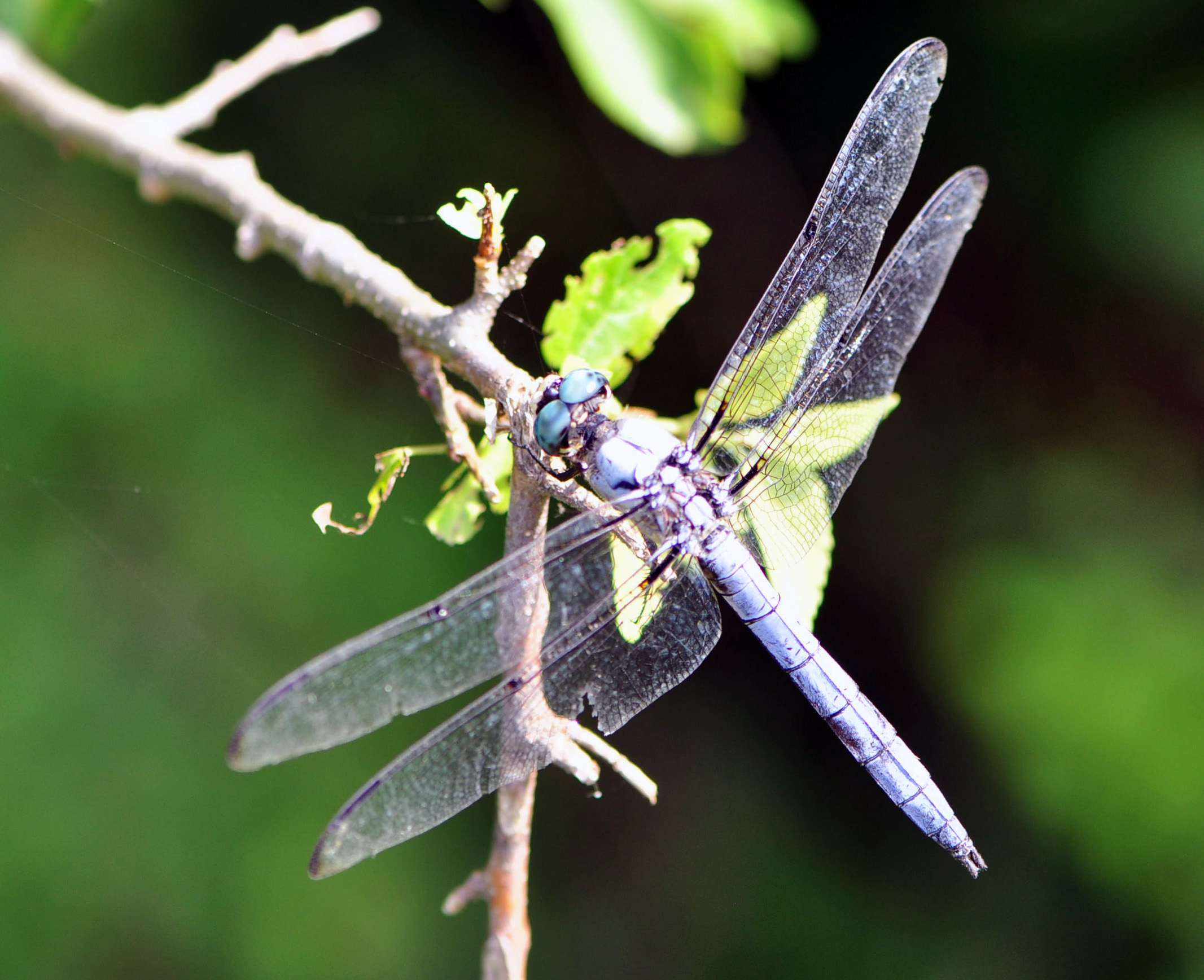
Dragonfly

Blue dasher (Pachydiplax longipennis)

Next Post: Doc Bamboo


Posted in Animalia | Tagged , , , , , , | Comments Off on Here Be Dragons

Badger Bother

Some years ago while following a wide trail through a Yorkshire wood I came across a bunch of roughnecks in muddy boots who were offloading shovels and pickaxes from the back of a rusty van. Terriers were barking furiously in the back of an adjacent truck. I was surprised that none of the little dogs jumped over the tailgate because they have a reputation for valor, and they were there for a cruel ‘sport.’

I remember the confrontation, for which I was scolded later for being stupid. I asked one of the men, “You’re not digging for badgers, are you?” If he scowled after turning to his mates I couldn’t see, but his back made me feel uncomfortable.  There was no other reason why men who had come prepared for digging would be there, and a few yards away was the circumstantial evidence. Outside the yawning entrance holes of a badger sett there were fresh scrapings that proved it was occupied.

“’eck no!” he grinned when turned to me. “What’s yer business ‘ere? You’re no tyke (Yorkshireman)?”

I pretended the land owner was friend and wildlife lover who often watched these badgers. This confused the men who went into a huddle, but I took the opportunity to beat a diplomatic retreat.

Badger

I flash-photographed this English badger returning to its sett in 1968


Great Seal of Wisconsin, Badger State

Great Seal of the Badger State

The Eurasian badger (Meles meles) looks like a distant relative of the American species (Taxidea taxus) and though both have head stripes it is, I think, a more handsome beast. Wisconsin is known as the Badger State, although more for historical reasons than any special affection for the animal. Lead miners were called ‘badgers’ in the early days when they lived in caves cut out of hillsides. The nickname wasn’t a compliment, but much later on a badger was depicted on the Great Seal of the state over the shield and a pile of pig lead.

Badgers have rarely fared well when they encountered our species, but were probably better off in North America than in Europe where we have bothered these shy animals for centuries. Since 1835, badger baiting has been banned in the UK, and the species now has the distinction of its own law, the Protection of Badgers Act, 1992, which carries a maximum 6-month prison sentence for interfering with them. After digging an unlucky animal out of its sett, the badger men would put it in a pit with a dog to bet on which would survive the contest. Dogs were often mortally wounded because badgers are great fighters with a tremendous bite because their jawbone can’t be dislocated, but a winning badger was always dispatched by clubbing afterwards. Animal welfare organizations suspect badger baiting is on the rise again.

badger, Meles meles

Badgers have a mighty bite because the lower jaw is firmly articulated under the zygomatic arch and jaw muscles are attached to a thick sagittal crest

Although related to polecats, badgers are said to be tasty, which is another misfortune. Badger hams were served in West County restaurants (perhaps still are, covertly), and in some regions of France blaireau au sang is a sett menu.

For a species as nocturnal as the badger, it is currently getting a lot of limelight. Like foxes, white-tailed deer and many other mammals, it can be infected with the bovine tubercle bacillus, but badgers are disproportionately blamed for outbreaks of tuberculosis in English cattle herds. The story goes back to 1971 when the first case was reported, which was presumably because a badger had been foraging in a pasture where an infected cow was exhaling or voiding bacilli. From that time badgers have been blamed for outbreaks of tuberculosis in herds, and a tremendous economic loss for farmers. Infected wildlife suffers too, although the disease is chronic and mainly respiratory in badgers. Humans rarely develop the bovine form of TB because livestock that tests positive are slaughtered and our milk is pasteurized.

As an influential lobby, the farming community has been on the backs of the British Government to do something. Successive administrations set up inquiries which concluded that badgers are at least partly responsible through recycling the disease, and so began a controversial control program. In the first cull thousands of badgers were gassed in their underground homes with hydrogen cyanide, but after the practice was criticized for being inhumane they were shot. The cull outraged a nation of animal-lovers who hold the badger as an icon of the British countryside and voted it the first or second most popular native animal. Objectors petitioned the government to stop the killing, marched through farming country to protest, and formed badger patrols to find and care for animals wounded by marksmen.

Politicians and policy wonks plead that decisions guided by science must be rational, honest, and transparent. But if there is still leeway in data to argue different viewpoints about big issues like climate change, uses of antibiotics, renewable energy, and stem cells we might expect the same with badgers.

Science started commanding enormous authority in World War II, especially in the USA under the inspiring genius of Vannevar Bush (1890-1974), an engineering visionary who became presidential science advisor to FDR and the leading administrator of the Manhattan Project. In his book, Science, The Endless Frontier (1945), he wrote “…without scientific progress no amount of achievement in other directions can insure our health, prosperity, and security as a nation in the modern world.” The physicist Robert Oppenheimer shared Bush’s optimism, but in hoping that scientists would keep control of discoveries, including the atom bomb, he became a symbol of how clever scientists can fall into folly. Over two thousand years ago, the philosopher-ruler was one of Socrates’ fine ideas but it fatally ignored realpolitik.

Some British scientists have felt a similar disappointment that politics has trumped scientific evidence in the Randomised Badger Culling Trial. They may design the trial and analyze the data, but don’t own the interpretation and can only complain when a government minister offers his explanation and justification for culling. One animal ecology expert was so exasperated that he mocked a ministerial announcement by paraphrasing it, “It is not scientific, we cannot conclude anything, but it is sufficient for policy…” When the minister was challenged in a BBC interview about the failure of the badger cull he famously replied that, “the badgers have moved the goalposts.” The Prime Minister replaced him last week and the cull has been trimmed down to a couple of counties.

So far as I understand, the results are ambiguous. Infection rates in cattle herds are lower at the center of a killing zone, but they are higher at the periphery. When setts lose their occupants they are quickly adopted by immigrating animals, which possibly carry TB, and so culling may aggravate the distribution of disease. Some people argue that improvements in health of livestock have happened too soon to be explained by reducing the badger population, and might be due instead to changes in animal husbandry that reduce cattle-to-cattle transmission. Differences in husbandry may indeed help to explain some of the regional differences in bovine TB. Overall, it’s a very confusing picture. For someone like me whose affection for badgers was nurtured by watching for hundreds of hours as they went about their private lives in the countryside it is a tragic destruction of life with no benefit to show.

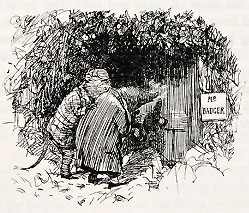
Perhaps new attempts to create a more effective vaccine for both cattle and wildlife will bring a truce between warring farmers and conservationists, and cause politicians to sigh with relief. Under the full protection of law again, the police force may then be re-energized for prosecuting badger-baiters. And then badgers will have the quiet life again that they enjoy, as their friend Rat once described: “Badger hates society, and invitations, and dinner, and all that sort of thing” (Wind in the Willows, 1908).

Wind in the Willows

Rat and Mole visit Mr. Badger in the Wild Wood. From first edition of Wind in the Willows (1908)

Next Post: Here be Dragons


Posted in Animalia | Tagged , , , , , , | 1 Comment

The Genius of Charles Darwin

The gleam of a great idea often glows first and fiercest in an unknown eye and out of a dark corner. How many college dropouts and loners tinkering in their garages have become celebrated silicon entrepreneurs? How many great writers, poets, painters, and composers created their finest works in obscurity?  Even in the sciences the most elemental factor for a breakthrough is a roving and penetrating mind rather than a large, well-funded research lab. Prestigious schools and universities are not nurseries of genius: academies value absorption, conservation, and transmission of knowledge and may even discourage radical thinking. Perhaps it is so difficult to predict scientific revolutions because they start with individuals and outsiders. I was taught neat explanations of how science advances, but Paul Feyerabend offered a seductive alternative: the Berkeley philosopher caused a furor by arguing the narrative is often “anarchistic.”

While visiting Charles Darwin’s home last month I was of course musing about his theory of evolution. That’s why people go there! Down House is a quaint Georgian property outside a village near London. It was walking distance from my childhood home, and on my last visit I was a teenager pondering a career in biology and arguing with a school buddy about biodiversity from natural selection. I thought it was incontestable, but he snapped with the certainty that only a sixteen-year-old can have, “the Bible and The Origin of Species can’t both be right: you have to choose one or the other!” It is still argued over in America, but I think a false choice.

That summer I flipped through The Origin to be sure of my answers for our next spat. But how could I summarize the ocean of data that Darwin had meticulously marshalled for his heavy tome? Had I known at the time I would have simply quoted to my friend from Theodosius Dobzhansky: Nothing in biology makes sense except in the light of evolution. I might have cheekily added that he wasn’t only a great biologist but a lifelong member of the Orthodox Church too.  Maybe I was close to Feyerabend when he wrote, Human life is guided by many ideas. Truth is one of them.

Stepping across the threshold at Down House I wondered how much had changed in fifty years. When I was last there, Charles Darwin had already been dead for the better part of a century, and recall when standing in his home I imagined the owner had just stepped outside for an hour, perhaps to check experiments in his garden or stroll down his “thinking path,” the Sandwalk. But since my childhood, Down House and its acres have evolved from a hallowed place on a shoestring budget for a few scientific pilgrims to something of a tourist destination since it was adopted by English Heritage and nominated as a World Heritage site.

Instead of ringing the doorbell for the custodian to appear like a Victorian butler, the visitor is now received with a cheerful welcome from the ticket desk and invited to peruse glossy Darwiniana on sale. Down House still looks like a large family home, but most of its rooms are loaded (I won’t say ‘graced’) with information boards and even dioramas. I prefer the more authentic if dowdy interior from my memory. But I wasn’t disappointed with the Old Study, the room that always mattered most and has hardly changed.

The Study feels heavy with dark mahogany and dreary wallpaper. It could make an atmospheric setting for a Charles Dickens story. Daylight struggles to penetrate the windows and the air has the musty odor of an old stone church. At center-stage a table is strewn with old books, stamped envelopes, and yellowed papers; a feather quill stands in a dry inkwell; a glass goblet is inverted out of service; and books are crammed in a locked cabinet. It may look like a reconstruction in a museum, but is in fact fairly authentic.

Down House

The black chair in Darwin’s Old Study

A black leather chair with horsehair poking through its arms rests on castors askew to the table as if waiting for a sitter to return. I imagine a Victorian parson might have taken a break from preparing his homily there or a writer who put down his pen to walk outside and smoke for inspiration. Only the magnifying lens, a few dissecting instruments, and portraits hanging over the marble fireplace hint that a man of science once lived there. The piles of pillboxes point to an apothecary or a hypochondriac (as Darwin was), but you would only find dried beetles and butterflies if you took the lids off. Naturalists have little need of equipment to pursue their passion en plein air where they depend on sharp eyes and a curiosity that fermented when heads rest in comfy chairs. And what a head Charles Darwin had!

He had none of the obvious qualifications for scientific greatness. He never displayed intellectual fireworks as a young man, and his father, Dr. Robert Darwin, thought his lackadaisical attitude to studies and a love of hunting, dogs, and horse-riding would make his son a worthless loafer. Charles was prodded towards the family profession until he dropped out of the Edinburgh Medical School, and no one expected much after enrolling at Cambridge University with the vague intent of training as a Church of England parson. Joining the Beagle expedition changed all that, and arguably launched the greatest modern revolution in the way we understand the world.

Darwin had a different kind of genius to Newton, Pascal or Einstein, and we struggle to find its origins.

First, he came from a radical intellectual tradition through his grandfather Erasmus and by marrying into the Wedgwood family. They were influential figures of the Enlightenment who embraced scientific progress, opposed slavery, and backed grumbling American colonies before the Revolution. When Charles returned from his voyage in 1836 he settled down to family life in London and as a country gentleman for the next forty years at Down House. But even during the distracted years of his youth he was never idle, and a Whiggish background fortified awkward thoughts that later offended staid Victorian society. Unlike Grandpa Erasmus he never sought the limelight and said that expressing doubts about species being immutable was like “confessing a murder.” It helped that he had chronic ill health as an excuse for keeping his head below the parapet when the storm over Darwinism broke.

The Sandwalk at Down House

The Sandwalk

Second, he was painstaking and cautious at work and never felt the pressures that contemporary scientists endure who must focus on minutiae and hurry to be first into print with their discoveries and join ferocious competition for research grants. He had time to exhaustively validate data and ideas. From an early interest in beetles his curiosity expanded to the whole of nature, both living and extinct. He spent years studying barnacles, converted his lawn to experimental beds for studying earthworms and weeds, inquired about artificial selection of domestic animal breeds, and maintained a vast correspondence with other naturalists. All this knowledge built on his seminal observations from the Beagle was distilled for the theory of natural selection. It took time and a lot of shoe leather on the Sandwalk. He depicted his hunch that all living things are related in a sketch of tree-like branches linking species together. That was twenty years before the Origin, and on the same page he scrawled a note, “I think.” It took an abrupt convergence of ideas with Alfred Russel Wallace to force his hand into publishing. But his glacial pace of progress had prepared him for the resistance to come from the establishment. He had left no stone unturned and no detail was too small or arcane to be cast aside. Even barnacles helped to rock the world. In the end there was no risk of being forced into a disgraceful retreat, like some recent “discoveries” in stem cell science.

Third, Darwin was able to tinker at his fireside, though more in head than hands as inventors do in lonely garages. Unencumbered by employment and with servants to help care for his beloved family he withdrew from society for long periods, like St. Jerome in his cave. It was quality time to ponder and speculate. Charles would never have the same peace today with electronic gadgets constantly beeping for attention. Thinking is such a natural process that we hardly give it much thought or any training, and and if our attention spans are shortening we are feebler thinkers in consequence.

Darwin’s chair is still a source of wonder for me. As an ordinary object you would ignore it in the window of a cheap antique store—as you would driving past some unprepossessing garage in Silicon Valley—but it became the seat of something extraordinary. The revolution that began in the sitter’s mind long ago continues to roll forward and explain what had been inexplicable—fossils embedded in mountain tops, elaborate plumage of male birds, vestiges like the appendix, why many genes are similar from flies and worms to humans, and much, much more.

Once upon a time a gauche student was tempted to leap over the security cord at Down House to sit in Darwin’s chair. Others have dreamt of plonking themselves in the Coronation Chair at Westminster Abbey to feel a royal moment before a cop hauled them away. But the student realized the famous chair would never inspire great thoughts again because revolutionary ideas emerge from obscurity.

Next Post: Badger bother


Posted in Academia | Tagged , , , , , , , , , , , | Comments Off on The Genius of Charles Darwin

Girdling the Maple

Consider the consequences if your largest blood vessels were coursing under surface of the skin instead of deep inside the body. I know it’s hard to imagine. But if the aorta ran the length of your back, branching out to limbs and major organs, the pulse wave might be visible and certainly palpable over the spine. The vena cava would return blood along the midline from belly to chest where it would plunge inside to the heart.  In a lean body this great vein would look like a bluish canal through the skin. Such a vascular anatomy offers no obvious advantages but there are several disadvantages, including a greater risk of hemorrhage. It wouldn’t take a deep wound to release a fatal gusher from either of these vessels; even a bruise might cause enough swelling to seriously affect returning venous blood.

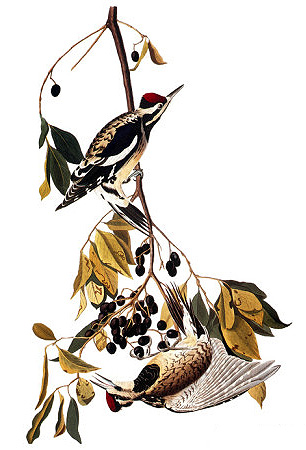
sapsucker bore holesMy crazy musing began when I noticed rows of shallow, neatly-drilled holes encircling the trunk of our prized Japanese maple tree. This was the unmistakable signature of a yellow-bellied sapsucker which visits us in winter. Besides licking the sap, the bird finds insects that are attracted to the weeping holes so that its work generates carbohydrates and proteins for its diet. By springtime the sapsucker had left for its northern breeding grounds and the holes had dried up, but the fresh foliage was far less luxuriant than in previous years. Since I couldn’t find any signs of the tree being attacked by insects, molds or viruses I assumed the woodpecker had damaged its conducting vessels which, like the vascular anatomy in my imaginary person, lie just under the surface.

Yellow-bellied sapsucker by John James Audubon: Birds of America

Yellow-bellied sapsucker by John James Audubon: Birds of America

Although there is no circulatory system in plants the vascular tubes are somewhat analogous to blood vessels. Xylem carries water and minerals up from the root system, while phloem shifts the products of photosynthesis in the foliage to other parts. Between these two great highways lies the cambium consisting of a stem cell type (meristem) which generates new xylem and heartwood on one side and new phloem and tree bark on the other.

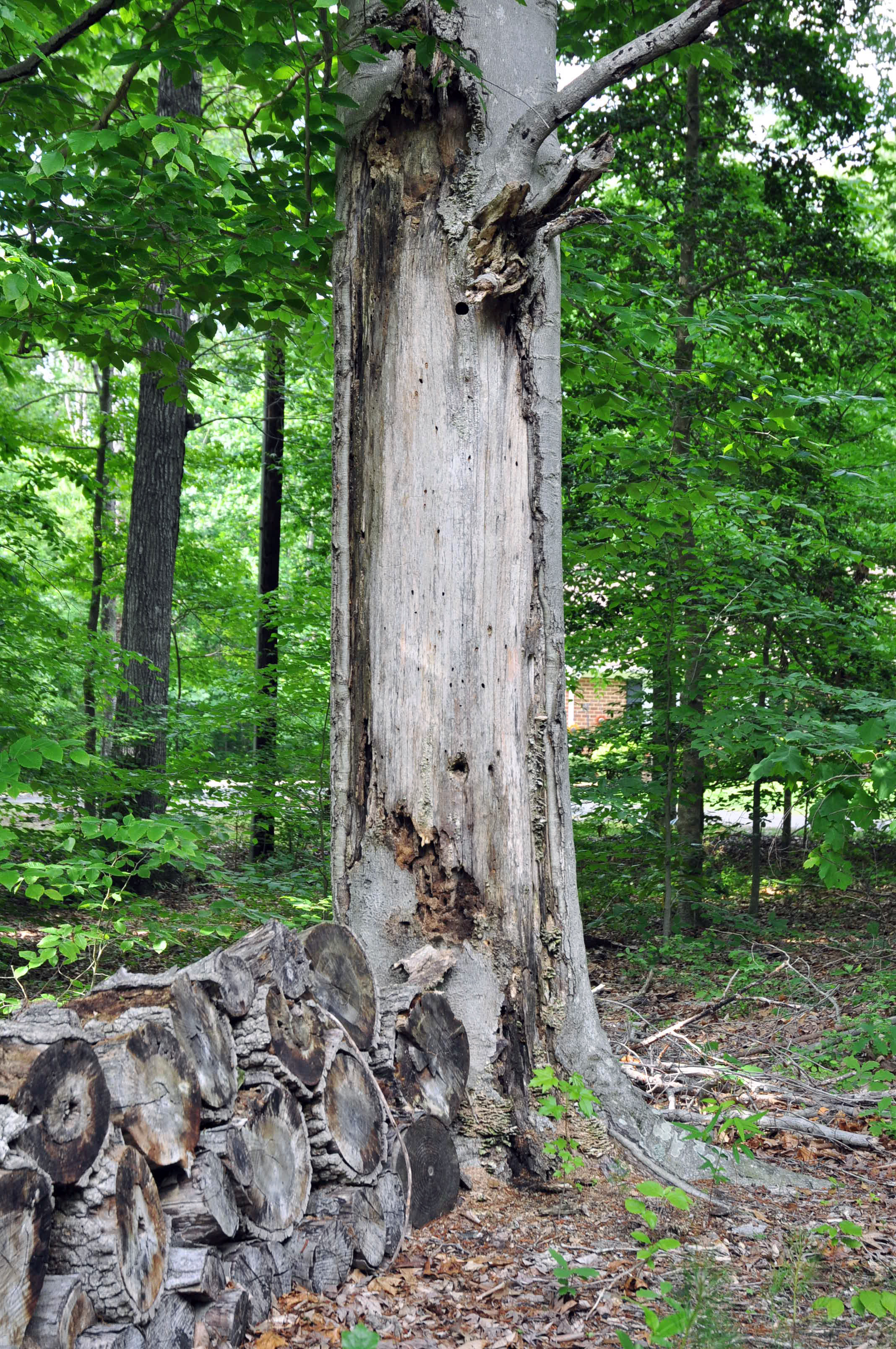
Trees could not have evolved conducting vessels deep in their boles because the inert heartwood would prevent their girth from increasing. But the price paid for this superficial distribution under the bark is a greater vulnerability to traumatic injury and infection. Where the sapsucker had been drilling the xylem and phloem was permanently damaged because cambium is not replaceable. Fortunately the harm to our tree is not fatal or as serious as lesions to

Frost damage in tree

Beech tree with frost lesion

others in our yard caused by frost or insect borers which expose heartwood to the elements and disease. Only by complete girdling, as American pioneers often did when clearing the eastern forests for farming, is a tree condemned slowly to an early death.

One day while hiking in l’Estrie when I lived in Quebec I came across a tiny shack with a lopsided metal chimney poking out of its roof.  I could have easily missed it deep in the maple forest, but curiosity forced by legs to follow the snow tracks of someone who had branched off from the beaten trail. I ended up at the front door, and because it was unlocked I stepped inside.

It was a dream house for a child. Every surface I touched felt sticky like cotton candy (candy floss). It was a sugar shack where maple syrup was still being made in the traditional way. There was a huge boiler in the corner standing over an open fireplace from which a chimney pipe ascended to the ceiling. This was where sap would soon be slowly evaporating to produce one gallon of amber syrup from every 40 gallons of thin fluid tapped from maple trees outside.

I didn’t have to look far to find those trees. Many of those more than nine inches in diameter had holes now vacant but which in previous seasons had held a spile from which sap would drain into a bucket. Some of them had multiple holes a few inches apart and often arranged in a spiral pattern. The harvesters had been more careful than my sapsucker to avoid harming the trees, but I can’t blame it when pancake days come round.maple syrup

Next Post: Doc Bamboo

Posted in Environment | Tagged , , , , | Comments Off on Girdling the Maple

Candid about Cats

When a gray cat started prowling around our yard I assumed it was a new neighbor. I was wrong, she was a new resident!

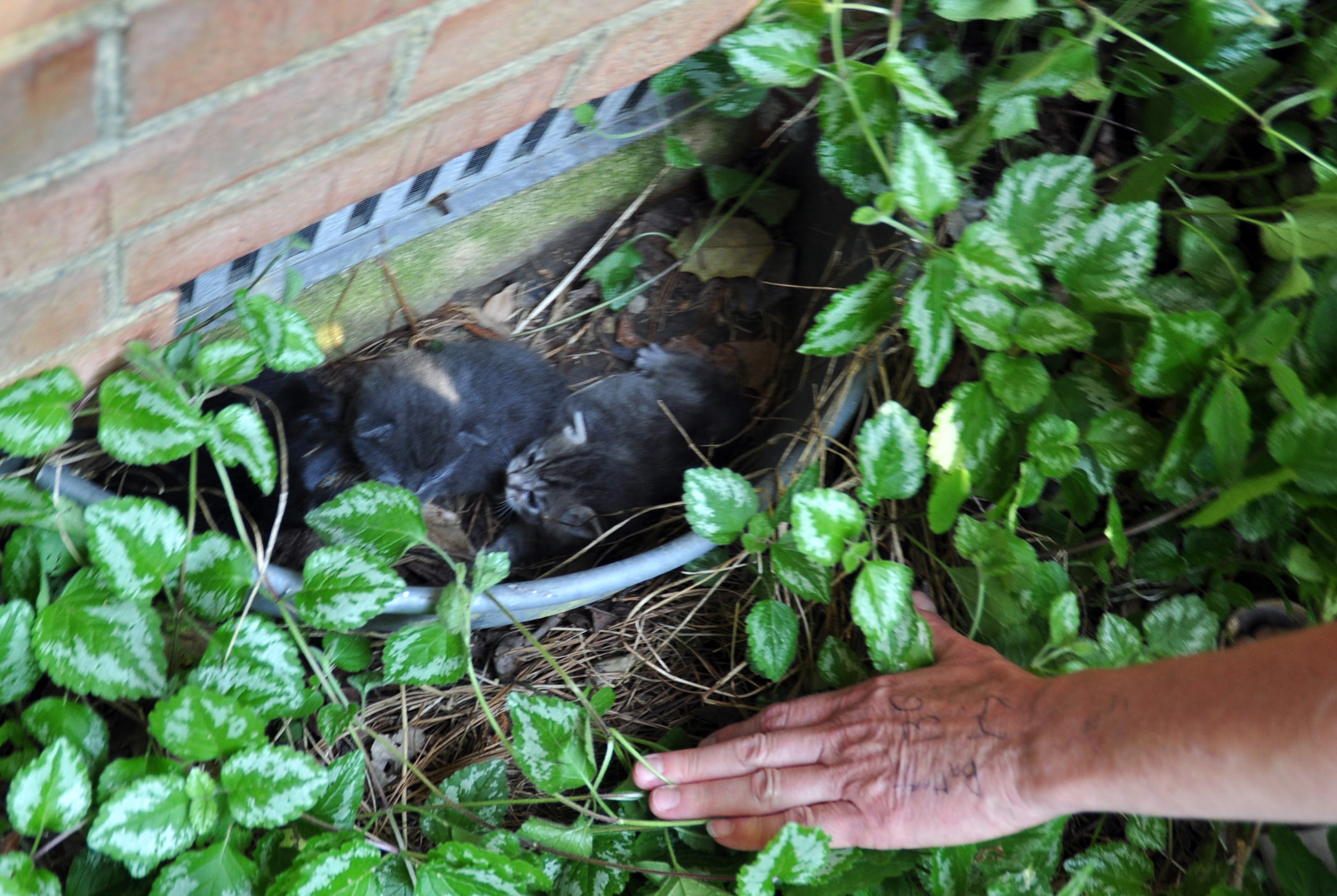
I stumbled on her nest by chance a few days later. It was sheltered against the brick side of our house, and after scooting off from under my feet I noticed there were three tiny kittens in the nest. I guessed because their eyes were open that they were over ten days old, but not much more. The cutest kitty was tabby, another black as soot, and the third gray like their mother. She had chosen a safe place to nurse and hadn’t left a trail through the groundcover to attract attention.

cat nest

Nest of kittens

Soon afterwards a lady arrived from a non-profit rescue service with a pet carrier and a trap in the back of her SUV. She gets calls most days to abandoned cats, so collecting my family was routine. I greeted this dedicated volunteer with a cheer.

The queen was away from her nest when we returned, but the furry ball of kittens was still huddled inside. They didn’t object when we gently lifted them into the carrier.

But we had to play on their mother’s instinct to catch her. She was too shy to be enticed back while we were there, and much too wild to capture in our arms. So we set the trap back-to-back with the carrier and draped them with a cloth, leaving the entrance open. After crossing the threshold she would step on a pedal to make the door slam behind her. We waited indoors listening beside an open window.

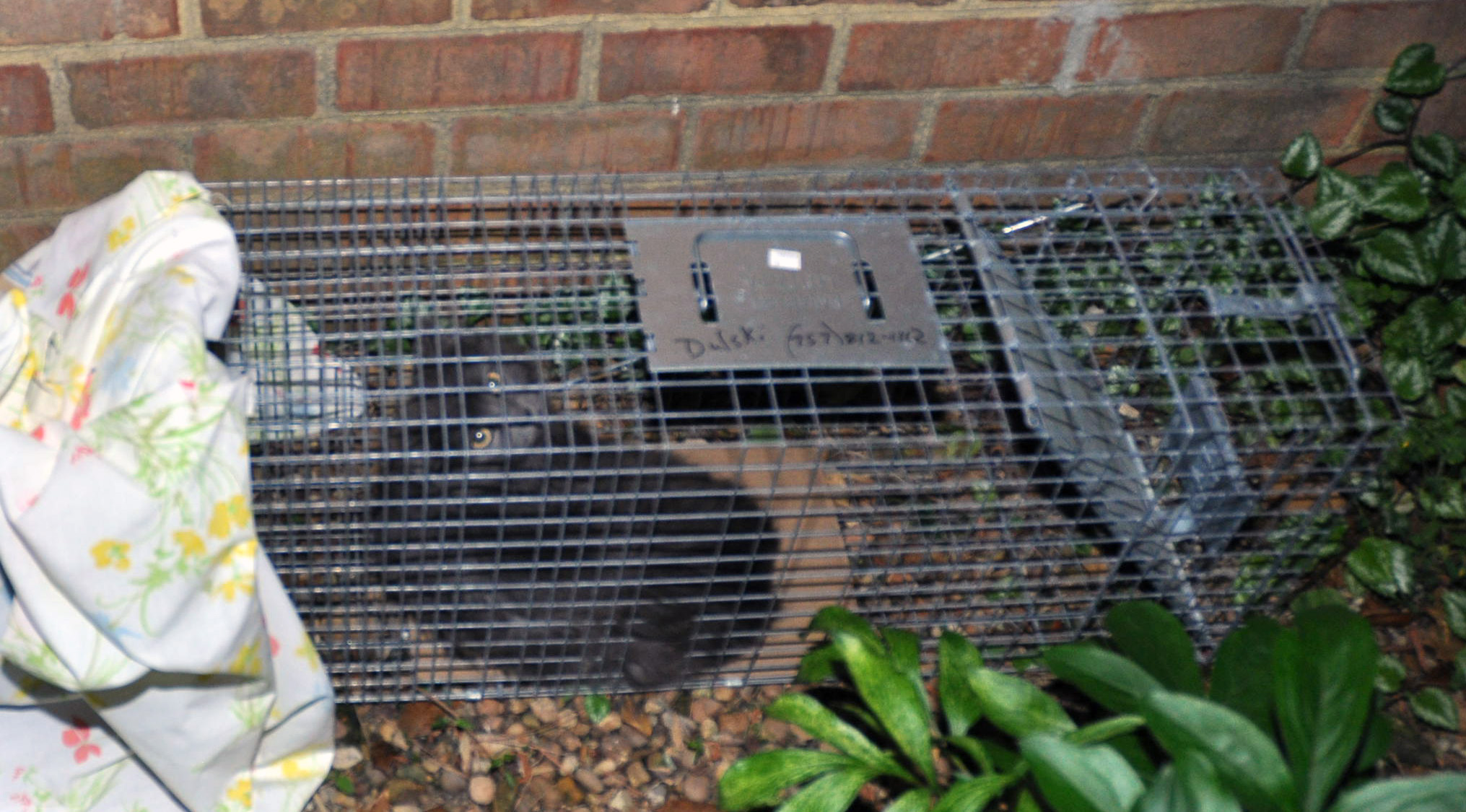
I imagined her stealthily returning to peer through the tunnel to her babies in the carrier. Their cries would surely bring her back and overcome anxiety.  Three hours later in the gloaming we found her snarling in the trap.  Soon enough the family would be reunited in a large crate at the volunteer’s home.

queen cat

Queen in the trap

Before driving away the volunteer explained that healthy kittens are put up for adoption. Despite a rude start in life they would turn into fine home cats. But what about their mother—no one would adopt her? I presumed she would be euthanized.

Then I was told that she would be treated for parasites and tested for rabies and feline leukemia virus.  She would indeed be destroyed after weaning her litter if the tests were positive, but if not she would be spayed and vaccinated and released in our yard.

“NO…not in my backyard!”

There are many rescue organizations around the country that have a ‘trap-neuter-return’ policy. I suppose that preserving lives of unwanted animals helps to ease our collective guilt for the way that society maltreats and abandons them. Besides most people are appalled that millions of cats and dogs are euthanized, and we are moved by images of furry faces staring through the bars in animal shelters with faint chances of adoption. Who could find any satisfaction in dispatching an animal except for serious injury or chronic pain?

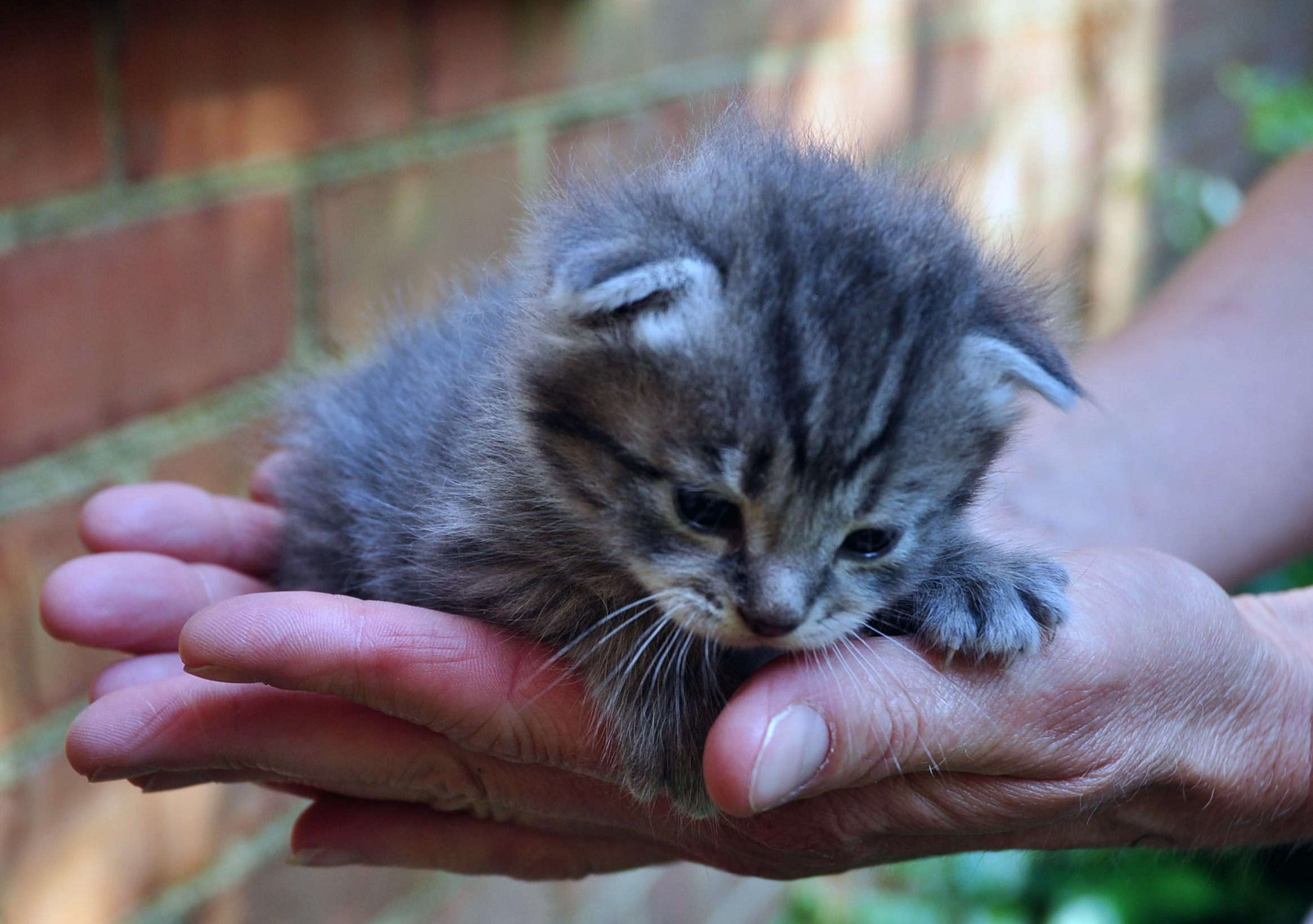
Tabby kitten

Tabby kitten

Some think it is unconscionable to kill any so-called feral animal that escaped from domestication or its wild descendants if a rescue shelter is available or it can be returned to a familiar place (like my backyard). I wish the same vehemence was expressed against hunting or trapping our native bobcat, because a dozen can be legally taken each year in Virginia. On the opposite side of the argument others believe it is imperative to cull cats that have gone wild, and persuade pet owners to keep all cats indoors. Municipal animal control officers have been very effective in keeping stray dogs off the streets. Roaming cats receive less attention because they rarely pose a danger to us and are better at fending for themselves than dogs. At least there is agreement between these two camps for promoting responsible ownership and sterilizing animals, apart from the genetically fittest for breeding. But because the numbers of feral and stray cats continue to soar there is a debate about culling them.

I understand that slaughtering unwanted members of a species that we chose as our companions seems a betrayal of trust. We might also feel sympathy for farm animals reared for food, but it is nothing like the bond between good owners and affectionate pets that depend on them. Moreover, it is easy for our warm feelings to diffuse over to the entire species, particularly for Anglos raised on a sentimental literary diet of Wind in the Willows and Watership Down. When I found a feral family in our yard I felt an acute conflict between as a pet owner on the one hand and a naturalist on the other, but the volunteer had no such dilemma. For her, life is always better than the alternative.

black kitten

Sooty kitten

When I protested that the gray cat would menace our wild birds, she replied: “For every fifty mice, voles, and baby bunnies brought home by my cats they only catch one bird.” There are of course many reasons why her cats are virtuous—they may prefer red meat to white or have heavy paws or the birds have plenty of cover in her yard, et cetera. But there is no longer any doubt about the national toll since the Smithsonian Conservation Biology Institute reported in a prestigious Nature journal. It found that outdoor cats killed 2.4 billion wild birds annually, including many of the most popular and beneficial species—cardinals, wrens, thrushes, bluebirds, and hummingbirds. In addition, they take 12.3 billion small mammals, but few rats. Feral animals and strays were responsible for more than half of the kills as they must hunt to eat, and domesticated outdoor cats can’t curb their instinct even on a full stomach. This stunning scale of butchery is contributing to the decline in common birds across North America and Europe and accounts for the extinction of several dozen species. The impact of cats and other introduced predators on native marsupials and flightless birds in Australasia is even better known.

The threat to so many native species should be sufficient reason for keeping cats indoors and curbing the rest, but welfare is another. Feral animals live in a shadow land between domestication and wild nature. Cats have evolved by human selection over eons and their behavior is no longer so well-adapted for life in the wild, especially far from their native range.  Given the opportunity cats wander outdoors, and often into jeopardy. The pitiful sight of a feline corpse by the highway is the most obvious reminder, but when researchers fitted cats with ‘Kitty Cams’ in suburban Georgia they were astonished at the sheer volume of hazards they face outdoors. The lives of semi-wild cats are even riskier and much shorter. They are burdened with parasites, threatened by coyotes, persecuted by people, exposed to wild weather and the threat of starvation, and lack any humane veterinary care. Pictures of a condemned animal in shelters pull our heartstrings, but there are millions of others in our cities and woods that suffer and perish out of sight.

I wonder if the consciences of people against culling feral animals could be appeased if we draw a mental boundary between them and Fluffy at home. Of course they look alike as members of the same species with indistinguishable genomes, even after generations of separation. The proof was also before my eyes since the kittens in our yard can become perfect pets. Isn’t it prejudicial to count the life of their wild mother as inferior, and call for termination? Is that a kind of catism?

gray kitten

Scary kitten

I remember as a kid worrying whether animals had souls, but grown-ups never gave me a satisfactory answer when I asked, “Do pets go to heaven?” I still think it’s a good question, though I’d frame it differently now. It would have helped if they had given me C.S. Lewis’s book The Problem of Pain. In a nutshell, he argues that if we have a personal relationship to God then our pets can be ‘ensouled’ through us. This is a strictly theological perspective and far from the biological view that humans are merely the most advanced model in organic evolution instead of a special creation. But leaving biology aside I venture some metaphysical inklings, although I admit they are speculative and our relationship to pets and their generous spirit remains deeply mysterious to me.

Lewis wrote, “in so far as the tame animal has a real self or personality, it owes this almost entirely to its master. If a ‘good sheepdog’ seems almost human that is because a good shepherd has made it so.” I too wonder if the ineffable bond with its owner gives a pet a deeper sense of its own self than their wild cousins ever have. Until recently, most animal behaviorists even denied that apes have much self-awareness, and I predict that research will challenge our thinking about other animals too.

To suggest that pets raised in a human home develop greater self-consciousness is skating on the thinnest ice and puts the writer at risk of being regarded as an anthropomorph, which is the cruelest label for a biologist. But while musing on ice a little longer I wonder if our animals can actually share crumbs of what we call ‘humanity.’  If so they might be able to share some kinds of mental suffering, like grief, that most scientists thought were strictly human. Skating even more dangerously near the melt zone I wonder if a greater sense of selfhood even increases their perception of physical pain. Pain is a subjective experience that is hard to explain to others and impossible to share compared to our five basic senses (seeing, hearing, touching, smelling, and tasting). We already know that pain is not always experienced the same by everybody: spinal mechanisms gate the ascending nervous pathways to the brain so that perceptions can be altered by states of mind. Perhaps our pets can suffer more than untamed beasts, and maybe I dismissed foxhunters too lightly for claiming their quarry hardly suffers at all. Of course this theorizing should never be used to justify maltreatment of animals which is always abhorrent and shameful.

We adopted a young stray cat. We called her Thursday and she lived with us indoors like a pampered princess for fourteen years, and for half of her lifetime in a Fifth Avenue apartment in New York. But she never returned affection, except with the threat of tooth or claw. It was my wife’s compassion that brought her home, but looking back I don’t think the cat ever had a soul!  Unlike the kittens we rescued Thursday was already too old to be imprinted by human kindliness. Taking her off the street had probably saved hundreds of birds and prevented her from making more of her kind, but it didn’t make a civil cat that deserved a place in heaven alongside our other house cat, John Henry. Cats are all the same, but are not all equal. If I see that gray mother cat prowling around our bird feeder again I will feel prejudicial, and hope my wife won’t sneak out to feed it.

Postscript: When the animal rescuer called a few weeks later we were told the cat was so ferocious that she had to be separated from her kittens. But since the viral tests were negative she had been spayed and released in our yard. We were told, not asked!

Next Post: Girdling the Maple

Posted in Animalia | Tagged , , , , , , , , | Comments Off on Candid about Cats