Explore your Longevity with UbbLE

Two Swedish biostatisticians drawing data from the UK Biobank have created a test accessible online for estimating your “age” and chances of surviving the next five years. It’s published in The Lancet medical journal. I couldn’t wait to try it!

The test has an odd name, “UbbLE,” for UK Biobank Longevity Explorer, yet easy to remember because it rhymes with “Hubble” the telescope. The Biobank is a database of half a million British volunteers who answered a detailed questionnaire about their health history and habits and underwent a physical exam and a battery of tests. Their health is being monitored for the rest of their lives.

The UbbLE test requires answers to 13 or 11 questions for men or women, respectively. They have been condensed from a grand total of 655 variables in the database to a bunch that is most predictive of five-year mortality and “UbbLE age.”

To qualify for the test you must be 40 to 70 years old and have lived permanently in the British Isles. Having lived there for almost five decades and continuing a similar (or better) lifestyle in the USA I think I qualify. So what did I find?

My UbbLE age is a full 12 years lower than my chronological age. That implies I have the mortality risk of a 54-year-old. Secondly, I have a 3% risk of dying in the next five years. There will be cynics who doubt this post and would love to burst my UbbLE: “It must be a lousy test”/ “He lied about the answers”/ “He screwed up”/  “He’d never say if results went the other way” (TRUE).

It takes luck to have a greater life expectancy, and it’s helpful to be young! But, more seriously, it helps to have a low BMI (weight for height) and a brisk walking pace, to be a non-smoker and free of any history of cancer, diabetes and mental illness, and better not to be poor.

UbbLE doesn’t predict longevity more than five years ahead. So it is no substitute for the MetLife longevity predictor used by insurers and investors, but it’s the best test of its kind to date.

Rembrandt

Says more about longevity than a thousand words or statistics

I was curious how my UbbLE age and mortality risk would change if I played with the answers. The second most predictive factor (after walking pace) is smoking, so I re-ran the test by pretending to be a current smoker. It lifted my UbbLE age from 54 to 62, and my five-year mortality climbed from 3 to 6%. The estimated loss of eight years of my life is enormous, and there are smoking-related disabilities that the test ignores. Everyone knows that smoking is bad for us, but we can kid ourselves that we are in the short and lucky percentile at the healthy end of the spectrum of probability. Since the risk of a fatal smoking-related disease is statistical there is enough wiggle room in the spectrum for smokers to believe “it won’t happen to me,“ as a friend once told me after smoking two packs a day for 72 years. Perhaps the test will help a few more people give up the habit.

I don’t take much comfort in my own results because of a superstitious fear of being hit by a bolt of lightning. You can never be really sure in the longevity stakes. But they have nudged me to consider if my investments for retirement are too conservative for my UbbLE age. Will they provide enough income through equity growth to cover me if I survive deep into my nineties before I am struck down?

People in possession of a few facts about others can play the UbbLE game to satisfy their curiosity. They might put the geezer next-door secretly to the test after he threatens their dog for running in his yard, hoping he will drop dead before Max. And someone grumbling about alimony might want to know the chances of natural causes ending payments to an EX in the next five years. UbbLE can make statistics fun!

One of the main attractions of the test is its simplicity, and another is the authority of a huge database behind it. In future, it will be refined for testing people younger than 40 and older than 70. But we should be glad that the science of predicting when we will die is never going to be highly precise, otherwise we would have some hard choices and feelings. For healthy people of any age predictions will always be blurred, and even those in failing health often fool a doctor who offers a precise forecast. It’s much better that way.

Next Post: Nature versus Nurture


Posted in Biomedical, Other | Tagged , , | Comments Off on Explore your Longevity with UbbLE

Last Flight of the Dough Bird (Eskimo curlew)

Everyone knows the most abundant bird in North America was driven to extinction a century ago by market hunting and habitat destruction. The very last passenger pigeon, called Martha, died in Cincinnati Zoo in 1914. But few people know the story of the Eskimo curlew that suffered the same fate.

This was a shore and wetland species that bred in the Canadian tundra but wintered in South America. Vast flocks headed south to escape the Arctic chill, but stopped to refuel on crowberries in the peat bogs of the Maritime Provinces, and stop again in the southern U.S. before the final wing home.

They were easy targets for hunters, and very profitable. A reporter noted 2,000 birds hanging at the Hudson’s Bay Company in Labrador that had been shot the same day in the late 19th Century. They were so plump from overfeeding for the journey that when a victim fell from the air it sometimes split open showing the white fat that gave their name, “dough bird.” Their meat was a delicacy served in eastern cities and even as far away as London after shipment in barrels and cans. But they had become rare by the end of the century, and the last one was sighted in 1963.

Dough bird

Eskimo curlew by John James Audubon

Over-hunting before the Migratory Bird Treaty Act of 1918 put the species into an irreversible tail-spin towards extinction, and ruined hunting income. Local people missed the wheeling and calling of flocks that visited them seasonally. And Robert Morris, a surgeon-naturalist from New York, celebrated a memory of them in prose and poetry from his exploring days in the wilds of eastern Canada.

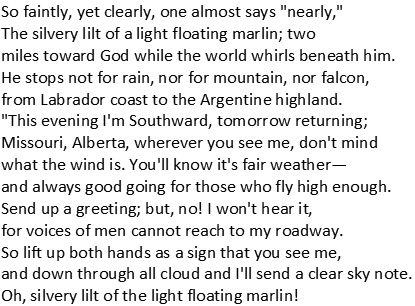
“One day in August when standing on a bold crag in the mountains of Labrador, I listened to the lilt of marlins (Eskimo curlews) almost out of sight in the clear blue sky and leaving that day for Argentina on a non-stop flight. A whale was playing in the distant sunlit heaving sea that sent but a passing puff of its thunder up to the heights where I stood. The heavy rumble of a sundering iceberg moving in colorful majesty and flashing dignity down its lane of deep ocean current could not drown out the exultant note in voices of carefree birds that were bound for somewhere of joyful memory for them. The thought was so overwhelming that I sat down on the soft white caribou moss and began to pencil in my notebook some lines that were later published in Surgeon’s Philosophy. I had to stand up to finish the note feeling reverence for a scene that made sitting down in its presence a profanation. In an atmosphere so clear that one could look straight up to infinity the birds rose high before heading south. They became mere specks in the sky and were then lost to view while their voices still came faintly back. The measure of the lines corresponds to that of the wing-beat of the birds otherwise I could not have remained in tune with nature.

RTM poem

When men’s hands point toward him, they’re lifted up toward Heaven. On the homeward bound steamer from the North that year a group of travelers in the cabin asked me to read extracts from my notebook, but these lines to the marlin seemed to have been “written for myself only.” No one referred to them in the subsequent conversation that evening, but there were plenty of questions about wolves and bears. In the audience there had been a rough old seasoned captain who sailed the seven seas on roving commission. He had recently lost his ship in the ice and was getting himself and survivors of his crew back to a port. Next morning he stopped me as we were passing on the deck, and said, “Them words that you read about the dough-birds (marlins) last night was about right. I wish you would let me see that log of yours again if you don’t mind.” He had doubtless put many a cask of stewed dough-birds in his larder aboard ship, and I was astonished at any sentimental interest in the big gentle birds as it came from that old salt.

Perhaps I was one of the last men to witness a flight of the marlins that were so delicious for the table. Subjected to murderous massacre at both ends of their flight and on the spring return journey by way of the Mississippi Valley they melted away like the passenger pigeon, and only a little later on.” (Extracted from A Surgeon’s Story by Roger Gosden and Pam Walker).

Bryan Watts, an ornithologist at the College of William and Mary, has recently written a beautiful and impassioned vignette about the dough birds. It illustrates how quickly we can shrink biodiversity and rob ourselves of natural wonder.

“The extinction of the dough birds was driven by the tragedy of the commons, a force that stretches back before human civilization itself and that is still alive and well today. The market hunters that encountered the birds in different places throughout their annual cycle were more concerned about their own profits and enjoyment than they were about the future of the birds or about the other hunters along the Great Circle.  We may legislate hunting regulations, but what about the destruction of critical habitat, the consumption of coastal resource or human-caused climate change?  Until we are all able to rise above our own self-centered concerns to see a future beyond our own and recognize that cooperation is not merely a kind gesture but an imperative for the future, no species is secure, not even our own.”

Next Post: Science fraud

Posted in Animalia, Environment | Tagged , , , | 1 Comment

Virginia Nature Journal for May

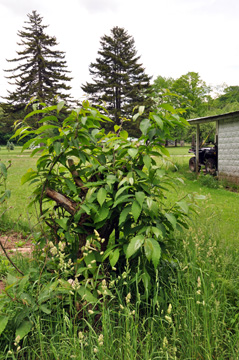
The virtual extinction of the American chestnut across its range is like the story of the sack and burning of Troy. A few old timers can still remember when it was the dominant canopy tree both sides of the Appalachian mountain chain, although even then it was in retreat. In a few decades from 1904, entire regiments of trees were killed by a blight, and just a few old soldiers survived underground to sprout like ghosts in spring. There is an example in a friend’s yard.

Long before we were born, it was probably a giant over one hundred feet tall with broad spreading limbs providing shade over his family home. But when it cankered after being attacked by blight its ring of cambium died and the old fellow rotted. Only its roots survived, and they are wearing out.

American chestnut tree

An old chestnut tree regenerates in my friend’s yard

For years it has struggled to grow shoots and branches, and last year managed to reach 20 feet and produce flowers for green burrs in fall, but it cankered again and was cut down to knee height. The cycle is repeated over and over, but each time the root system is less able to regenerate because there is insufficient nourishment from leaves. A Virginia forester who loves chestnuts told me that cankers can be stopped by rubbing them with dirt, because it contains antibiotics. But a remedy that depends on our helping hands will never work across a forest, and is impractical when a tree grows up.

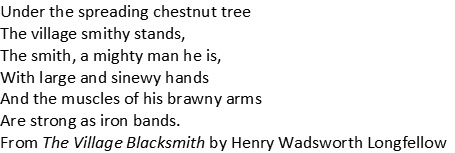
There were still three or four billion American chestnuts in Longfellow’s time. A specimen he depicted in a poem grew in Cambridge MA until 1876 when it was cut down and some of the timber rescued to make a chair for his 72nd birthday.

Longfellow

The chestnut has been called “the perfect tree” because it can produce a huge harvest of nutritious nuts and wonderful timber that won’t rot, and it is ornamental. The strong arms of the hard-working blacksmith are like the bows of the productive tree, and his virtuous life like the generosity of the forest giant. The loss was said to bring tears to the eyes of old-timers who treasured and depended on chestnuts, but have they gone forever?

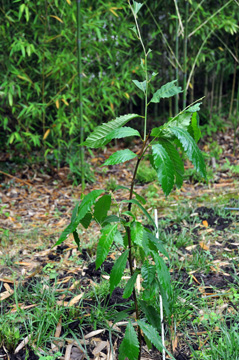
My wee Restoration Chestnut

My wee Restoration Chestnut

As an iconic tree, they still have friends and admirers today. Researchers have been laboring to create a transgenic chestnut and hybrids that are blight resistant from backcrossing and intercrossing to incorporate genes that were evolved by the Chinese chestnut over eons for protection where the blight was endemic. The latest generation of Restoration Chestnut from the American Chestnut Foundation is nearly 95% American and groves of them are being planted in Virginia and other eastern states. I care for one I planted in my yard last year from seed. Will it survive? Only time will tell. But blight is not the only threat—a marauding deer munched its crown last week.

Next Post: Dough birds


Posted in Environment, Memoir | Tagged , , , | Comments Off on Virginia Nature Journal for May

Make Meat Special

Feeling carnivorous or vegetarian, or somewhere in-between?

Is it okay to be carnivorous? Is it natural (whatever that means)?

I asked these questions when I was a teenager, like many other people who love animals. For a while I half-heartedly courted vegetarianism as an ideal, but it would be hard for Mum to prepare separate meals for a lettuce-loafer. Grown-ups never replied to my questions, except with blank looks. I still think they are good questions.  Had I asked Aristotle’s pupil, the Father of Botany Theophrastus, he would have declared that eating animals is immoral, but I can’t fully agree. There are health concerns and spiritual reasons for becoming vegetarian, but it is not for everyone.

Rich man, Poor man

Meat used to be a luxury only the rich and powerful could afford. Royalty and noblemen kept hunting preserves and woe betide the peasant who turned poacher to put venison or rabbit on his family table. The greater the amount and variety of meat consumed the higher the status of the eater. On April 4, 1662, the diarist Samuel Pepys proudly recorded: “We had a fricassee of rabbits and chickens, a leg of mutton boiled, three carps in a dish, a great dish of a side of lamb, a dish or roasted pigeons, a dish of four lobsters, three tarts, a lamprey pie (a most rare pie), a dish of anchovies … to my great content.” This was not a banquet but a feast shared with a few friends, and it took a massacre to prepare.

Meat is no longer the privilege of the few, but still a luxury in many places. In the New Guinea Highlands friends subsist on sweet potatoes and other vegetables while pigs, their most valuable possessions, are reserved for eating at weddings and other special occasions. But where animals and birds are now raised for food industrially and the fishing industry can efficiently hoover whole shoals of fish, flesh has become plentiful, cheap, and ordinary. Then it is undervalued.

Carnivores and calories

Average Americans eat a half-pound of meat per day. That represents a larger fraction of protein and calories than eaten by bears, badgers and raccoons, which are all members of the order Carnivora.  Animal classification looks wonky when you consider that orders are defined by a trunk, hoof, blow-hole, egg-laying, brain size and opposable thumb. For carnivores, it’s the presence of butcher’s teeth that matters. Dracula apart, our dentition excludes us from the Carnivora, but neither is there an order called Vegetaria nor Omnivora which would fit us better. Taxonomy has no traction with the diet of our species.

Yards of gut

But you can tell if an animal is a true carnivore by looking in its mouth and along its gut. It will have:

  • long canines for grabbing prey and carnassial teeth for shearing meat
  • a gaping mouth and large throat for swallowing food unchewed
  • a large stomach with very acidic gastric juice for sterilizing raw meat
  • a relatively short small intestine
  • and a small colon

On the other hand, a strict herbivore will have:

  • small, stumpy canines and flattened, tightly-packed molars for chewing fiber
  • sideways movement of the jaws for chewing
  • an enzyme in saliva for starting to digest starch
  • a stomach of variable size with up to four chambers
  • less acidic gastric juice, especially in ungulates for allowing microbial fermentation
  • a long small intestine
  • a voluminous and baggy colon and cecum where cellulose is digested

The contrast is most obvious when guts are measured. The small intestine of carnivores is no more than three times as long as the body (head plus trunk), whereas in herbivores it is ten times the length. A short, simple tube is adequate for digesting meat, whereas cellulose takes much longer to break down to sugar available for absorption. Since the rabbit’s gut is not long enough for this process it swallows “soft pellets” as soon as they are evacuated from the rectum for a second pass through the system.

Our anatomy is closer to herbivores, though lacking the specialization in ungulates for a fiber-rich diet. We call ourselves omnivores because of a mixed diet, but frugivore is a more accurate rendering of our origin. Our early ancestors probably subsisted on tropical fruits and berries with some animal protein when available. Our primate cousins still enjoy the same. But when and how did we acquire a large appetite for flesh?

Paleo diet

Fred Flintstone was more carnivore than trail-mix muncher, although the opposite may be closer to reality in the deep past. There was more big game in Paleolithic times, some now extinct, but hunting with spears was inefficient and dangerous before bows and arrows were invented (maybe 60k years ago). Our diet was then plant-based. The controlled use of fire goes back further (most authorities estimate since 500k years ago), and cooking followed. Red meat was probably a rare meal before cooking was discovered because we are poorly equipped for eating and digesting it raw.

Early humans were of course locavores. As they fanned across the world, they had to adapt to unfamiliar local foods in different climates and environments. As the plant foods changed so did the animal populations they supported. Animal protein and fat came from fish, shellfish, bird eggs, and insects (yes!), supplying essential fatty acids and vitamin B12 before serious hunting was able to garner more meat and offal. Animal domestication arrived only around 400 generations ago and changed everything.

It is surely one of the mysteries of human evolution how our species was pre-adapted to subsist on a wide variety of diets, for without that flexibility our story would be different.

It should be no surprise that that herbivore can manage a meat meal. Chimpanzees do; after inquiries into the cause of mad cow disease we know that cows can too. But carnivores don’t have the specialized gut needed for tackling plant fiber, except in the world imagined by Isaiah where: “The lion shall eat straw like the ox.”

Our physiology is flexible but urges modest amounts of meat, if any. Being designed for fruits and green leaves, our stomachs are not sufficiently acidic to kill Salmonella and other bugs in raw meat. And when the diet is rich in protein, and particularly purines, our lack of an active uricase gene can lead to painful joints if uric acid crystals accumulate. Carnivorous animals have active copies of the gene, so it is surprisingly that “Sue”, a T. rex from Cheyenne River Indian Reservation, had a touch of gout.

I guess that meat-eating was a necessary adjustment when people migrated to northern lands. Seasonally abundant vegetables disappeared in winter whereas most native wildlife remained, and some were good to eat. Much later, herds of sheep, goats and reindeer provided more food security than by hunting, although further north nomads depended on meat and blubber from marine mammals.

The modern paleo diet claims to bring food choices in line with our genes, which are assumed to have changed little since Paleolithic times. But there was no standard caveman diet across the world, and contemporary hunter-gatherers in Africa and South America eat only what they can catch, according to where they live. Besides, a standard can’t be offered without a matching lifestyle and age span. Early humans have to live strenuously to survive, and few lived to what we now call middle age. Backers of the paleo diet can’t insist on those changes. Some plants eaten in the past have come down to us as crops but they have been genetically altered by selective breeding or even genetic modification, and the microbes in our guts have probably changed too.

It’s a fallacy to believe we can copy the nutrition from bygone eras, but a more cogent reason for rejecting the paleo diet is that it aggravates the environment by reinforcing or even promoting more meat consumption.

The Price of Meat

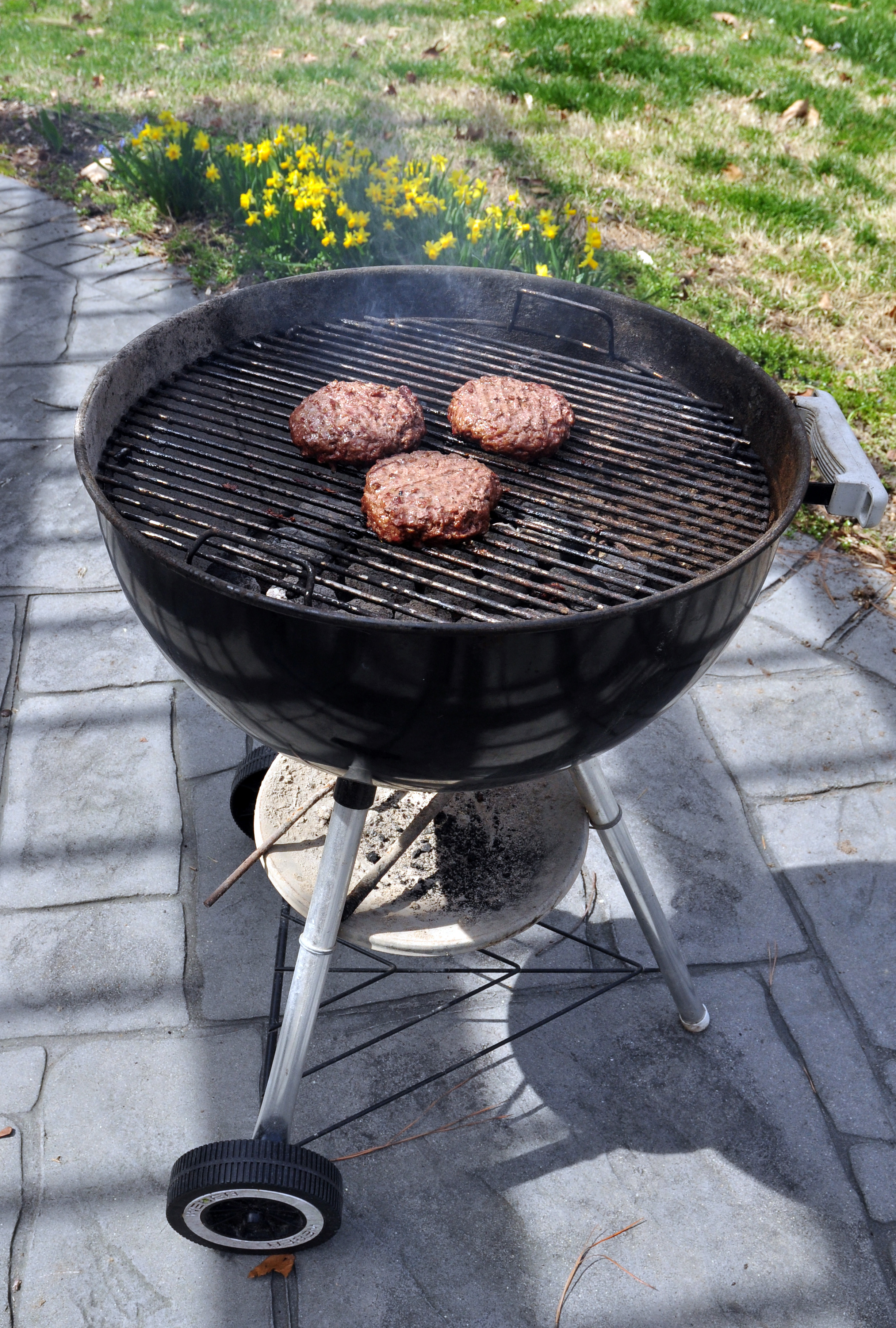
MeatongrillIn a world of soaring population where 30 % of usable land is already devoted either directly or indirectly to raising livestock the meat industry is on an unsustainable trajectory. Our appetite for red meat impacts virgin rainforests which are converted to ranches, production of greenhouse gases, vast subsidized cornfields, water consumption and pollution, and antibiotic abuse for animals confined to feedlots. Cattle are not the only species to beef about, but the growing middle class in Asia has a greater appetite for white meat which is produced more efficiently. Fish farming helps to relieve pressure from ocean harvests, although not without its own problems.

Our ability to produce ever larger quantities of animal protein will finally be capped by the carrying capacity of the environment and the unchallengeable Laws of Thermodynamics. The problem is illustrated by a pyramid representing an ecosystem where energy is transferred from bottom to top by a thermodynamic “hand-shake:”

  1. At the base plants absorb solar energy for growing
  2. Herbivores occupy an intermediate level where they gain energy from plants
  3. Carnivores on top of the pyramid dine on herbivores below

The biomass diminishes sharply higher up because energy is transferred between levels with only 10% efficiency.  Sometimes, there is a fourth level of super-carnivores (sharks, tuna, and T. rex) feeding on lower carnivores, but there can be no more because less than 0.01% of the original energy remains.

We don’t eat carnivores because they are relatively rare and considered unpalatable. But herbivores taste good to us, and we eat lots of them. There are perhaps 1.5 billion cattle in the world today, and countless other beasts and birds farmed for meat. But if crops grown to feed animals were switched for direct human consumption much larger numbers of people could receive their daily ration of 2,000 Calories.

For example, the 10% rule-of-thumb predicts that 20,000 Calories of corn has a net yield of only 2,000 Calories of cow because most energy is lost. The same amount of corn could support several people, though perhaps not quite as many as ten. Beef has higher quality protein than in corn, but the example stands an argument for swaying food choices and policy. One government actually took a swipe at national food consumption.

Less is More

In World War Two, German U-boats blockaded shipments of food from North America to British ports triggering a fear of hunger because the country was not self-sufficient in food. The British Government secretly commissioned two Cambridge nutritionists to find out how many home-grown Brussel sprouts and sausages the public needed to keep in good health (no Bratwurst, only patriotic British sausages.)

Elsie Widdowson and Robert McCance fed subjects in their clinical trial 1 lb of meat, 1 egg, and 4 oz of fish per week, plus 5 fluid oz of milk a day, and unlimited amounts of vegetables and wholemeal bread, which together would meet dietary requirements. After the subjects w remained in excellent health months later, the meager rations were rolled out as government policy with only a fraction of the meat consumed in Britain today. Family health was said never to be better; infant mortality fell and life expectancy rose (discounting deaths from hostilities), and the only downside was a “remarkable” increase in flatulence.

Since then, Britons have been eating more and more meat, following the prosperous example of America. There are plenty of sound reasons for cutting back on meat consumption, and some people are, but short of a national catastrophe or an environmental calamity policy-makers won’t go further than offering bland health advisories. The only other potential check on growth is the market, and producers won’t forgo sales while demand exists. So it remains for individuals to make up their own minds and hope to make a difference.

Cutting back may be the first step to cutting out, but often the hardest to make. A trade-off can make a step easier, and there is none better than trading quantity for quality. They generally pull in opposite directions. Forcing the productivity of farm animals, like the breeding of high-yielding fruit and vegetables, pleases shoppers by lowering prices but comes at a cost. The cost is mainly elsewhere and unseen (on land and water), but we notice differences in flavor, and wonder if the host of biochemical differences have consequences for our health.

Away then with factory farming, away with corn feedlots. Bring back more grass-fed beef; bring back pastured chickens and eggs from happier animals; bring back flavors that old-timers still remember.

It would help if instead of casually tossing packs of steak, pork or chicken in our trolley as mundane shopping, we remember that meat is special. It costs the earth more, and it demands the sacrifice of animal lives. Eating less but better seems an excellent exchange for the half-pound steak that never inspired any note in a diary. Samuel Pepys was inspired to celebrate tasty food, but he might have curbed the temptation to eat to excess had he known it contributed to his gout.

But cutting back seems to run counter to the America tradition as a land of plenty where self-denial can appear eccentric. A 16 oz steak, or even a Flintstone-sized 32 oz, is emblematic of that life, but maybe carnivores can be satisfied with less. I dream of a new Marlboro ad on a billboard showing a man standing beside a barbecue grill, beckoning to us, “Come to Where the Flavor Is.” Outsized steaks have been vaped. He turns over with his fork a smoking nugget of grass-fed beef.

Next Post:  Virginia Nature Journal for May

Posted in Biomedical, Environment | Tagged , , , , , | Comments Off on Make Meat Special

Virginia Nature Journal for April

Algernon Swinburne

Smells arouse old memories, good and bad. The coconut bouquet of prickly gorse bushes evokes memories of ranks of jasmine blossom on the chalky downs of the Isle of Wight where I was born and Algy Swinburne grew up. Oh, to be in England, now that April’s there (Robert Browning). But here in Tidewater Virginia, the scent of pine resin at this season conveys no particular emotion for me, nor can it trigger flashbacks.

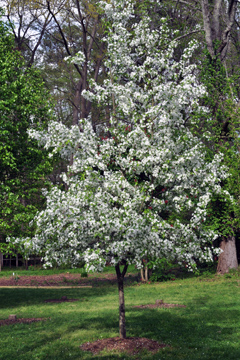
Crabapple tree blooming in April

Crabapple tree blooming in April

I read that memory is less aroused by sound than by smell which owes its potency to a handshake between our olfactory bulbs and the hippocampus. But when I hear the lazy phrases of a blackbird, my mind is transported to a remembered English garden where one sang every afternoon announcing its territory from a perch in apple blossom. But here, where brown thrashers, wood thrushes and mocking birds are better musicians, the chorus of woodland songsters never evokes the same emotion, perhaps because some neural networks close after childhood.

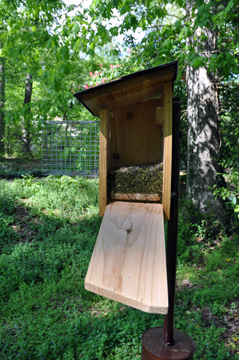
And yet less emotion does not mean less care for the birds that choose to make a home in our yard. In a landscape where native plants of Virginia are retreating before the advance of so many inedible aliens, they need us when food supplies reach a nadir. The bird feeder was not full for very long and never empty during the winter. Long before our neighborhood birds started looking for nesting sites I made a batch of boxes for them, one for every acre. They are luxury condos made of durable white cedar with green shingle roofs and a critter-guard against snakes, raccoons and squirrels.

WelcomeEggs_smallThe boxes were designed for bluebirds, which are surely in the top ten for popularity. Cavity nesters depend on these artificial homes because cautious park officers and yard owners fell dead trees which might have offered them a home. Apart from untold numbers of nest-boxes in gardens, there are 230 boxes around public trails and golf courses in James City and York counties that are monitored weekly by local naturalists. It is exciting to find a clutch of 4 or 5 bluebird eggs (sky blue, of course), and experts assure us that a brief inspection does not affect breeding success.

The program has reversed the steady decline in their population, and now there are more bluebirds in the area than at any time in living memory. Over 700 of them fledged from these boxes alone last year. The Virginia Bluebird Society collects breeding data from across the state, and at summer’s end we will know what impact the hard winter had on their population.

Chickadee nesting in bluebird box

Chickadee nesting in bluebird box

There were bluebirds in our yard until the deep freeze started in February, but we saw few afterwards. There are reports of birds found dead in nest-boxes where they were roosting. Drinking water was frozen for several weeks, and there were few berries or other natural foods at the end of winter. Perhaps the hard weather explains why a chickadee took up residence in one of our bluebird boxes, a tufted titmouse in another, and Carolina wren is building a nest in a third. One box is vacant where a pair of bluebirds raised two broods last year.

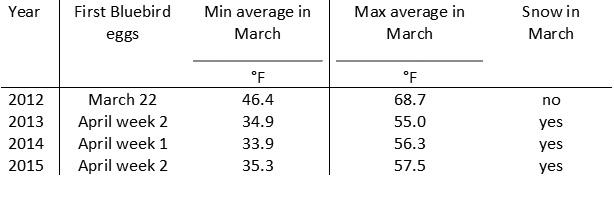
Bluebird laying recordBluebirds are nesting elsewhere, but they started late this year, although no later than in the past two years. Our records for 2012-15 suggest their breeding schedule is flexible, so that hungry fledglings are not hatched before insects are abundant again. In the warm spring of 2012, the first eggs were laid three weeks early.

The great horned owls breeding on Jamestown Island don’t have to be respecters of temperature and weather because their prey is ever present. They were sitting on eggs in January, and their owlets were almost ready to fly when the bluebirds were starting to gather straw and down to line their nests.

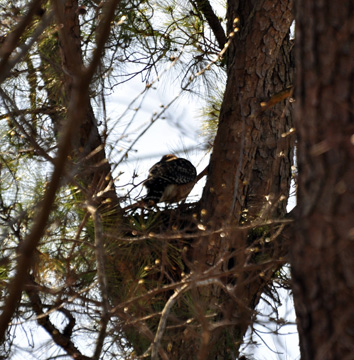
Red-shouldered hawk on nest

Red-shouldered hawk on nest

Besides the vagaries of weather, bluebirds face the daily challenge of evading predators. They have little to fear from nocturnal species like owls, but a pair of red-shouldered hawks has taken up residence in our woodlot, and I guess they have chicks sitting on the untidy matt of sticks in the fork of a loblolly pine. Their breeding schedule coincides with the re-appearance of frogs and reptiles and when baby rodents set foot out of the nest and naïve baby birds flutter out of theirs. We hear the hawks screaming kee-rah all day long to scare birds out of cover or before taking a dive at them on the bird feeder. I feel no special sympathy for an English sparrow in yellow talons, but there would be a rush of emotion if I noticed a splash of blue on prey feathers.

Next Post: Cuisine for Carnivores


Posted in Other, Seasons in Virginia | Tagged , , , , | Comments Off on Virginia Nature Journal for April