Are Bats So Scary?

Some animals have few human friends, like bats. We had a little brown bat tucked inside folded wings, like dead leaves, hanging over a rocker in our porch. It was a welcome guest. But ask the public about the most despised animals and bats come near the top of the list, whether in myth or fact—they give people creeps at Halloween, they hang out with witches, they are revenants haunting graveyards, they drink blood, and the latest accusation is they gave us the Ebola virus. So this week I’m defending bats but mostly writing about zoonoses (What?). I’ll try to explain…bat
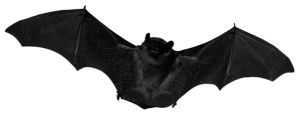
There’s no smoking gun that would convict bats in a fair court of law. It’s true that maps for bat density and infectious diseases are closely matched, and fruit bats can be found roasting on charcoal fires in Guinea where the first cases of Ebola were reported. Circumstantial evidence is usually sufficient for prejudice when a creature is ugly, loathsome, and gets tangled in your hair (sic)! It matters not that “nice” animals like antelopes and chimpanzees harbor the same virus, and likely many other mammals too when the research is done. At one time, rabies was believed to be confined to canids, but we now know that every mammal can transmit the virus. It seems that every species that was crowded onto the Ark is a potential vector for a zoonosis that Noah’s family might have caught. Yes, there’s a microbial zoo in furry animals, the ones we think are cute and the others we loathe. All this said, I admit we can’t let bats off the hook, but we should agree the culprit for Ebola is still unknown.

Bats carry a menagerie of over thirty viruses, probably not a record load and certainly not all harmful to us, but alien to human hosts. Bats tolerate most of them without harm to themselves (they succumb to rabies) because microbes have piggy-backed their hosts for eons, time enough for host and pathogen to adapt through mutation and natural selection for virulence to taper off. This biology is a brilliant challenge for evolution deniers to deny. It’s not in the interest of a piggy-backer to break the back of the one carrying them, because when that one dies so does the other. And that is why new host-pathogen associations are so much more dangerous than old ones.

There are historical precedents where the introduction of a pathogen to an immunologically naïve population was devastating. Take the story of measles and smallpox brought by Europeans to the Americas, or Americans building the Panama Canal in the jungle who brought yellow fever home, or when raccoons deliberately moved across state lines in the 1970s transferred rabies to local wildlife. The history of HIV crossing to humans is still unsettled, although the retrovirus evidently has progenitors in healthy chimpanzees today. I published a speculation that it jumped species in the 1920s during human surgery involving grafted organs from chimpanzees, although that theory is dangling. The likelihood of hosting a foreign microbe is much greater between closely related species like mammals and to a lesser extent birds, than, say, reptiles or amphibians. Certainly, the reservoir of potential pathogens in animals will never run dry, but their abundance is not as alarming as the opportunities for exposure.

Some two decades ago, Laurie Garrett wrote The Coming Plague as a reaction to the complacent belief that infectious diseases had been largely overcome (smallpox, etc.), and the redirection of research endeavor to degenerative diseases. She was running with the tide because while drafting her book the HIV-AIDS epidemic kicked in, TB became resurgent, Legionnaire’s disease grabbed headlines, Lyme was discovered, and Ebola, etc. Tellingly, she chose as her subtitle, Newly Emerging Diseases in a World out of Balance.

There was a time when our distant ancestors were “in balance with nature” in the sense that their relationship with nature hardly changed over eons, except for the strains of climate. When microbes jumped on hunter-gatherers from another species (perhaps their prey food), the infection probably fizzled out without triggering an epidemic, either because their immune system quenched the invaders or the microbes slew them. The new diseases were unlikely to be transmitted between the small bands of thinly dispersed people, and large parts of the world were uninhabited until recent millennia. How different today! Our species has grown enormously in number and now extends its reach into every corner of the world, except the depths of the ocean which are much safer from pathogens. We are climbing a gradient of risk as rural populations move into crowded cities, as tropical rainforest destruction brings new exposures, as climate changes encourage migration of tropical diseases, as air circulating in airplanes efficiently spreads airborne infections, and in so many other ways. A perfect storm.

Well over 300 new infectious diseases have been recorded in my lifetime—SARS, HIV-AIDS, West Nile, MRSA, Ebola, Nipah, Hanta, and you name them—as well as countless others that are not yet attributed to a specific pathogen or go unnoticed in rural obscurity or poverty stricken regions.

Optimists look forward to the conquest of heart disease and cancer, but the tide of infectious diseases will continue to run over the feet of scientific Canutes for ages to come. They will wash up on the shores of human communities so long as we share habitats and have farm animals. To adapt a famous quotation, the price of biosecurity is eternal vigilance. New infections need to be nipped in the bud before they become runaway epidemics. As new diseases steal up on us, it is hard for public health bodies like the WHO and CDC to prepare for new threats, and to strike a tolerable balance between public risk and individual liberty. I have a personal example of how overreaction follows a feeble response to a threat.

Courtesy of HSE, UK

Courtesy of HSE, UK

In the 1990s, a few dozen unlucky people in the UK and one in France received the awful news that they had contracted “mad cow disease,” which is caused by a prion protein. This new variant of Creutzfeldt-Jakob disease was introduced to the human food chain when up to a million cows were fed rendered products of dead cows. I remember when the then Minister of Agriculture, John Gummer, declared on TV, “There is nothing wrong with British beef!” between nibbles of hamburger with his daughter. What a bummer! The burger didn’t kill him, but public ridicule destroyed his political career. The lesson learned, American authorities were far more cautious, as I discovered after moving to the States. I had lived in the UK in the years when egregious farm practices still existed. In consequence, I am officially deemed to be an unsafe blood donor, which is a pity for someone with the universal donor blood group. I am still waiting for my mad cow diagnosis.

I find cycles of public anxiety about Ebola rather ironic while our attitudes towards the otherwise beneficial and marvelous bat family are consistently grim. Rather, they should be reversed. We ought to worry whenever we hear news of a bat species in trouble, and be constantly alert for ill news of a new zoonosis of whatever origin. New pathogens are far more threatening to national security than terrorism which is currently gripping the public imagination, or at least until a sophisticated bioterrorist has the know-how to manipulate a pathogen for causing a pandemic. Perhaps then the word zoonosis will emerge from its obscurity at the back of the dictionary.

Posted in Animalia, Health | Tagged , , , , , , , | Comments Off on Are Bats So Scary?

Mastodon in Our Town

Not Mastodon the heavy metal band from Atlanta, but a heavy, leathery mastodon from Virginia. It is the first found east of the Blue Ridge. A local bricklayer was hunting on private land one day in 1983 when he found a strange object near a muddy creek. As he couldn’t identify it, he asked the geologist Jerre Johnson who realized it was the tooth of an elephant. An elephant in America—had Barnum & Bailey’s Circus been in town? But this animal was quite different to African and Indian elephants today, from a line that became extinct about 11,000 years ago. They are related species, but mastodons split early from a common Proboscidea ancestor, presumably trekking across a land bridge between Asia and Alaska ahead of mammoths that came later.

The private owners of the land forbad excavation, but when they sold it the new owners gave permission for excavation by Dr. Johnson, now Emeritus Professor at the College of William & Mary. He led a dig involving dozens of volunteers, including archeologists, Eagle Scouts, and many members of our chapter of the Virginia Master Naturalist program. It became a triumph for citizen science.

A breakthrough came after ten days of fruitless digging when the dirt started to yield its fossil treasure, including more teeth, ribs, limb bones, and broken tusks seven feet long and six inches wide at the base. The beast was old judging by its molars which were worn down by a rough diet. This was not a grazing species like modern elephants, but a browser of tree branches and leaves.

Mastodon fossil

A tusk in protective plaster

Fossils in the coastal plain are not living matter turned to rock, they are the real thing. In eroded outcrops of this region, you can find strata of mussel shells inches thick. They look as fresh as if they were washed up from the rivers or Chesapeake Bay by recent storms, but may be a few million years old. Likewise, we had real mammoth bones, not rocks, although they no longer had the gleaming white freshness of shells. Dr. Johnson distributed them for his volunteers to wash and dry, and I was given a hefty chunk of what I guessed was the head of a humerus. The tusks were coated in plaster to protect them on their journey for display at the Virginia Living Museum (humorists take note), but unfortunately not enough of them were preserved for assembling a skeleton.

Mastodon tooth

See the nipples on the molar

I was curious how mastodons got their name. Was it from the huge muscles needed for mastication? When the first fossils were discovered two centuries ago they mystified geologists who called the new species, ‘Incognitum.’ It was the French geologist George Cuvier who coined the name mastodon, although this was later dropped by taxonomists for the more ponderous, Mammut americanum. I previously blogged about the curious names chosen for new animals to science, sometimes they are more whimsical than biologically meaningful. Cuvier chose mastodon, which means ‘milk tooth,’ because the crowns of the molar teeth looked like nipples. You can see on this picture why he chose a quirky name. The teeth don’t resemble those of any other kind of elephant, extant or extinct, which is why they can tell a mastodon from a mammoth.

The discovery was so unusual that it interested the Smithsonian Institution and the Washington Post. One day soon, carbon dating will reveal the fossil’s age, and perhaps museum conservators will deduce whether score marks on the ribs were made by the claws of a saber-toothed cat or a dire wolf.

We know that mastodons died out at the end of the last Ice Age with other megafauna, but was their extinction caused by climate change or Clovis hunters? I guess it was an irresistible convergence of the two, which are the same threats facing elephants today and so many other species of animals and plants. Central Africa has lost 100,000 (64%) to poachers and habitat loss in the past decade alone. I missed live mastodons in our town by a whisker of geological time, and dearly hope that future generations will have more than elephant bones to marvel at.

Next Post: Why bats  scare us

Posted in Animalia, Nature | Tagged , , , , , , , | 2 Comments

SNPs are Us

It won’t be long before snp is added to the pantheon of approved English words in the OED. It will sit among those rarest of words, those that lack a vowel like the crafty Welsh invented—cwm (a mountain hollow), crwth (kind of violin), and cwtch (cubby hole or cuddle). We do of course insert an invisible i to make the word easier to say, but there will still be confusion for a word that began life as an abbreviation (single nucleotide polymorphism) and is the same as SNP (Scottish National Party). There is room for misunderstanding too, like the occasion when a woman asks a man if he got the results for his snps (meaning DNA) which he mishears as snips (and interprets as vasectomy). Language is wonderful, and so is modern genetics.

In the last post, I described my experience with DNA ancestry testing, and this time I’ll mention the health data that can be obtained. In 2013, the US Food and Drug Administration stalled the delivery of personalized genomic information, although that relaxed this month and 23andme have released potentially sensitive information to consumers. But we can dig much deeper after sending raw data file from our DNA chip analysis to another service.

The curious customer only has to invest $5 on top of the $100-200 already paid by uploading data to Promethease, a company that takes its name from the Greek deity that stole fire from the gods (customer beware!). Your results are delivered as a zip file a few minutes after uploading your genomics data, enough to pore over for hours. My file contains 17,844 annotated genotypes or snps which are doublets from the four-letter DNA code (A,T, G & C) for which there are about ten million variants across our 23 pairs of chromosomes in the population, most in the non-coding region (i.e. not in a gene sequence). Sometimes, a switch from, say, a G to a C in a DNA strand has a deadly or life-altering impact, but more often it is neutral or only predicts a certain kind of trait or disease with a percentage probability. I was eager for my data, and maybe the experience I describe will encourage others.

The large file received from Promethease was divided into categories, each with a list of snps in descending order of significance. Those highly associated with a trait were highlighted in red for scanning the good/ bad stuff quickly. The snps and genosets (snp combinations that have a more proven connection with traits) near the bottom of the lists were boring because the associations were so weak (just a few % + or -).

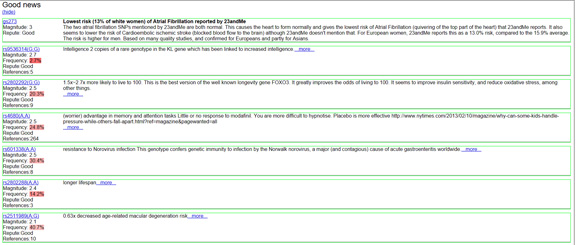
Let’s start with the GOOD category. This is how the first page appears.

Promethease DNA analysis

My Good News

With so much information I have to write telegraphically and hope I don’t lose the gist for readers. I was informed that I am male, white and probably of European ancestry (well, yes!). I have snps for dark eyes and blood group O (Y), a big head and higher IQ (of course), able to digest milk lactose (Y), tolerant of caffeine and my face doesn’t flush after alcohol (YY), can smell asparagus metabolites in my urine (Y), have mixed muscle types like a sprinter (eh?), won’t go completely bald (yea), have longer telomeres for long life (yipee), less endometriosis (well!), protected from headhunters’ prion disease (phew),have  lower risk of macular degeneration, diabetes, AF, obesity, various cancers (thankfully), and restless legs syndrome (mother’s problem). A lot to be thankful for until I read the next category.

Now here’s the BAD news, and an example from that first page.

Promethease DNA

My Bad Stuff

I have snps that put me at risk of cancer, diabetes, AF, lower IQ, shorter lifespan, baldness, and macular degeneration (do they cancel the good marks above). I have a 3x risk of obesity (really!), am less empathetic (I am sorry), a later menopause (phew), and have a 4x risk of sexual dysfunction if I take SSRIs (don’t ask).

Some of the little details were telling, like the results for caffeine, asparagus and the taste of cilantro/ coriander (it doesn’t taste of soap to me), as well as my earwax and body odor which I assure you are fine! I was also correctly predicted not to have a cleft chin, hairy back, unibrow or widow’s peak, and was amazed to read that my second toe is longer than my big toe. How could they know when I don’t upload my mug and feet on my Facebook page! But occasionally a result really jarred. I am proud of the dimples they missed, and with a BMI of 21 surely I can’t be obese! Other results smudged from Good to Bad, particularly heart disease, and cancers because there are so many snps. Their magnitudes were rarely more than 3x and mostly a lot lower than 2x, not much to worry about if you take the broad picture rather than lingering on one “bad” result.

I was particularly interested in the newly released information on carrier status. It is estimated that on average we all have a copy of a recessive lethal gene. One copy is quite tolerable unless you plan to be a parent and your partner is found to have a matching mutation. 23andme provides a report on 36 genetic diseases, most of them very rare but also cystic fibrosis and Tay-Sachs. You have to go elsewhere to check status for the rather too common mutations that cause breast cancer, heart and Alzheimer diseases at early ages. Not everyone wants to know, and a positive result should lead to the door of a health professional for advice.

As health and genetics data are mined more deeply and integratively I will return to my data to see how interpretations have changed. I wrote last time that genetics is not destiny. Possessing one or even a bunch of undesirable snps is not necessarily bad news because most of the traits that worry us involve hundreds of genes. Besides, they are affected by lifestyle and environment as well as our genotype. We no longer think of nature versus nurture, but nature and nurture. In a recent Australian twin study of 18,000 traits the ratio of responsibility was close to 50:50. Tragically, however, there are single gene defects where one letter of the DNA alphabet has devastating effects, and diseases affecting nerves, eyes, and bones are more affected by genetics (bipolar disease at 70%), but mental attitudes are hardly affected at all.

Snp may be a short word with a specific meaning, but it doesn’t always make genetic sense. Nevertheless, surfing snps can fill your evening with entertainment and, unless you are a hypochondriac, is a lot less scary than checking your stocks on the Dow or FTSE Index this week.

Any Comments about your experiences with these tests?

Next Post: A Mastodon in Our Town


Posted in Biomedical, Health | Tagged , , , , , , | Comments Off on SNPs are Us

From DNA to New Cousins & Ancestry

The back of a Cornflakes box is a good deal more absorbing than another person’s family tree. Genealogy is a rather personal game of history. Our interest seems to gain momentum with age, which may unfortunately mean we are too late for an older generation to explain gaps in our family history.

Surveys show the majority don’t know or remember or care about the names of our great grandparents or further back; perhaps we need to put a face on an ancestor for a name to mean something. As one of that majority, I knew little about my background or where my ancestors lived and are buried. But searching for records through online ancestry services and discovering remote cousins using DNA hooked me in a way that poring over parish records or deciphering gravestones never could. Technology is making genealogy into a new craze and for absorbing TV, like Finding Your Roots and Who Do You Think You Are? This post is mainly for people who want to dig up their ancestors but haven’t yet gotten started. It won’t say much about my family tree (I promise), but aims to convey what I found interesting or worrying after enrolling in Ancestry, 23andme, and Family Tree DNA. Yes, I signed up for all three because they are not exactly the same services, and I wanted to check if results were the same.

After paying the one-off sign-up fee or subscription, each company mails the customer a specimen pack to be returned with a cheek swab or spittle sample for DNA analysis. You have the option of contributing your data to the company’s genetic diversity studies (I did) and keeping your data private from other subscribers (I didn’t because I wanted unknown relatives to find me). A few weeks later an email announces your results are ready for perusal online.

If asked, I would probably say ethnicity doesn’t matter a whole lot to me. That sounds virtuous, doesn’t it, but I admit it was the first result I checked, along with predictions of my physical characteristics. Perhaps deep down there was a sliver of anxiety in case I was never told my full story, but DNA would be truthful. The data showed I am 98% Northern European. It predicted brown eyes, undetached earlobes, no cleft in my chin or wet earwax, and that I can smell sulfurous metabolites in my urine after eating asparagus. I didn’t need to spend a hundred bucks to learn what I already knew, but these confirmations gave me confidence in the other results.

Aside from 263 genetic variants handed down from my Neanderthal ancestors (blogpost of November 18, 2014), I found the mix of European origins that made me was rather interesting. I am like one of my mother’s cake recipes, made of every kind of fruit and nut plus a smack of Oriental spice. That’s common for Brits. I have an admixture of DNA from the British Isles and Ireland, a fair amount from Scandinavia (those Vikings and Danes), a little Western European (French and German), and a dab of Southern European (2%) and Middle Eastern, probably Ashkenazi Jewish (<2%).

Map my origins

Map my origins

Although all three tests confirmed European ancestry (98-100%), there was a lot of variation within that category, especially for the British Isles (14/52/69%) and Scandinavia (6/7/27%). The differences definitely reflected the haplotypes selected for testing by the companies, but also perhaps the definition of what a national origin means. It’s hard to define what it takes to be 100% “British.” Would that imply an ancestry strictly prior to the Norman Conquest (not much French), or before the Scandinavian and Saxon invasions (no Norwegian, Swedish, Danish or German heritage), or afore the Roman Conquest (no Italians or their allies)? If so, only an Ancient Briton or Celt would qualify, and I very much doubt any exist today. Besides, a strict definition might exclude that most glorious “English” king, Alfred. The companies are silent on this question, so you can choose what you want to think. If your roots are in America, north or south, you will probably have an even larger smorgasbord of origins. Congratulations!

A mixed origin is biologically reassuring and makes nonsense of some kinds of ethnic pride. There was a time and place in history when ethnicity was undiluted by recent immigration, but hard to find today.

Mum_and_Dad_headstone_1Ancestry research using DNA is greatly helped if you have data from both parents, although even if they are not available your own results can say something about their backgrounds. The mitochondrial genome is a tiny ring of DNA inherited from our mothers, and we share it with our brothers and sisters. My maternal haplogroup is K1a11 which originates in the Middle East and traveled to Europe through the relatives of Otzi the Ice Man. My brothers and I inherit our father’s haplogroup I1 from his Y chromosome, which is common in Scandinavia. None of us is blond and blue-eyed, and none have the financial sagacity of Warren Buffett who has the same haplotype. It’s not surprising.

Genetics is not destiny, not really. Scientific or artistic genius very rarely run in families, and hardly ever more than two generations. And consider Bill Maher and Bill O’Reilly, one a leftish political satirist and the other a host on Fox News Channel. They are at opposite poles of the political spectrum, yet have a common Irish ancestor way back. No surprise there either, but I digress.

The longer you are an active subscriber to a genealogical service the more information that rolls in because other people join and some become sharers. If you go public with data, you will soon see your DNA matching other people’s and learn the strength of the match (%) and the corresponding segments (in cM). Your parent or child should of course have a 50% DNA match with you, but after gaining that reassurance it’s most interesting to scroll through the lower entries. There are likely to be hundreds of other matches in descending order of relatedness. Some of them provide a picture and short bio, and even an email for contacting them, but most on your list are likely to be anonymous or never reply to your inquiries. I suspect they don’t have anything to hide: they enrolled mainly for the health data that can be downloaded (next post) or never return to the page for updating DNA relatives.

You will undoubtedly have some surprises. For me it was the large number of American matches, more than any other nationality, because I had no idea about any ancestors migrating ahead of me. As for the British people expected to be on my list, perhaps they are more wary of sharing details in case they reach a nosy government or genetic stalkers.

My wife had the happy discovery of an unknown third cousin through a DNA match. She lives only an hour away from us and owns property that their common ancestor farmed in the early days of Colonial America. She is a super cousin because they share over 1% of their DNA, meaning they might be doubly descended from their ancestor. Lucinda is also distantly related to her daughter-in-law’s family. My surprise was to find my wife’s half-sister and brothers in Texas are my remote cousins, probably through an Irish ancestor I never knew about.

You have to be ready for a jolt when you delve into history, and I’m still waiting for one. Luckily, I haven’t found any felons or slave-owners in my family tree, nor relatives of that man with a black toothbrush mustache who died in 1945. Phew! But be prepared to hear from people trying to find living relatives. Two women who were adopted as children have contacted me, but I couldn’t give them any leads to a living parent or sibling because we are too distantly related. Another contact has been trying to establish a link between us and a billionaire hedge-fund owner; thankfully, that inquiry has gone silent. No doubt some people have used these services instead of standard paternity testing, and I have reason to believe an oral sample doesn’t need as much scrubbing as the instructions recommend. Padlock your toothbrush if that worries you.

Besides filling the missing names on a family tree, tracing ancestors back for say seven generations to the 17th century reveals many interesting details and documents. For example, registrations of births, marriages and deaths, military records, census data, ocean crossings and immigration data, not to mention convictions for felonies, are represented online from scanning of original documents. Perusing these materials was a moving experience because it personalized those who had contributed to my existence by revealing the little details I would never have known otherwise. There is a risk, however, that family stories that have grown fonder in the telling through the generations can turn out to be flawed or fanciful, so prepare for dissonant emotions.

One person who contacted me was searching for a royal connection, so I was glad I couldn’t help her. She left me wondering why anyone wants to be connected to a lineage that is marred by an unhealthy degree of inbreeding in the past. Remember hemophilia was passed down by Victoria, and the famous jaw of the Royal House of Habsburg? European royal families constantly intermarried. Queen Victoria married her first cousin, Prince Albert of Saxe-Coburg, an admirable and brilliant man whom anyone would be proud to call a relative. But whatever parts of the genome contributing to his gifts (probably minor) were mixed and diluted in the following generations. A dynasty endures through its heirs, but not by passing down a founder’s peculiar genetic merits.

Lastly, I was musing about King Richard III, the last of the Plantagenet kings of England who was killed at the Battle of Bosworth Field in 1485. The grave was excavated in a Leicester carpark in 2013 and his identity was confirmed from DNA and spinal curvature. Ricardians strive to repair his reputation brought down by Shakespeare, and in some circles there is a cachet if you can prove descent from Good King Richard.

Think about it. He lived over 21 generations ago. If you can trace your branches back to the trunk that connects to his close relatives (he had no children) you have a claim to the Plantagenet crown, but it’s vanishingly slender. DNA is diluted by half at every new generation, so if we assume no interference by intermarriage or asymmetric recombination or medieval milkman (some assumptions!), you share 221 of his DNA, or less than one part in a million. It is meaningless to feel honored by descent from some bigwig if he or she is that remote. But there is a wonderful conclusion here: ancestry research reminds us we are all connected, and if we need to boast we can all claim a relationship to our greatest heroes in history. It’s all a matter of degree, because we are all cousins.

Next Post: What Price Genetic Privacy?


Posted in Biomedical, Health | Tagged , , , , , , , , , | Comments Off on From DNA to New Cousins & Ancestry

Peace in 2016

Tennyson message for New Year 16 font

Inner Hebrides, Scotland

Isle of Rhum

Posted in Memoir, Other, Seasons in Virginia | Tagged , , | Comments Off on Peace in 2016