A Third Parent contributes her Mighty Mites (Mitochondria)

Two biological parents are enough for any baby, aren’t they? Maybe not: sometimes it’s better to have two mamas.

The media have hyped a story that broke in September about a boy who was conceived by “mitochondrial replacement therapy.” His parents had lost two previous children to Leigh syndrome, a rare but severe condition affecting the brain, nerves and muscles caused by mutations in mitochondria, the mites that energize every cell inherited from our mothers’ egg (never from our fathers’ sperm). Less than 2% of the boy’s mitochondria were damaged, which was well below the 18% threshold for disease. An anonymous egg donor has given him the prospect of a full and healthy life.
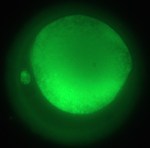
Mitochondrial transfer

Thousands of tiny mitochondria fluorescing brightly in a human egg and its moon-like polar body

John Zhang, whom I knew when I worked in NYC, led the clinical team and is director of a fertility service that is popular there among Asian Americans. But he carried out the procedure in Mexico where, according to reports of his words, there are “no rules (for assisted reproduction).” That statement was as responsible for the media furor as the procedure itself, and he may regret playing into the polemics of conservatives at a time when Mexico is considering legislation for assisted reproduction. Ahem!

His “breakthough” probably put noses out of joint in a Newcastle team in my mother country because they have done the painstaking research work. The UK has often been at the forefront of reproductive technology (clinical IVF, Dolly the cloned sheep, etc.), and has a well-respected system for ethical review (HFEA) which, admittedly, delays the launch of new treatments such as this projected to help 10-20 British families annually. The Geordies should have been first, but were scooped.

Two methods exist for switching mitochondria when a prospective mother carries a harmful load of mutations in her mitochondria. Zhang chose the spindle method in which maternal DNA is transferred to replace the nuclear DNA removed from a healthy donor egg before it is fertilized with her husband’s sperm. Only one of the five embryos thrived in vitro, but after placing in the uterus it conceived a healthy pregnancy.

In the 1990s, a New Jersey clinic transferred small fractions of cytoplasm from donor eggs to improve the quality of eggs for patients who repeatedly failed with IVF treatment. None of the women were carrying mitochondrial mutations, but the clinical team had a hunch that eggs often fail to develop if they are under-energized, but can be boosted with an infusion of fresh mitochondria. After treatment resulting in 17 viable pregnancies with two of the girls missing an X chromosome (Turner’s syndrome), the FDA set a bar too high for the program to continue.

There are now reports from other countries of imminent births after mitochondrial transfer, and these too are said to aim at improving embryo quality instead of correcting a genetic fault. And in Boston a company is offering an expensive treatment (‘Augment’) for improving fertility by transferring mitochondria from a type of ovarian stem cell that some of us doubt exists (my recent critique is available on request).

These therapies have been called ‘eugenic,’ which is a word that makes us shiver, but if they are safe and effective and purely aim to restore a healthy population of mitochondria, need we worry? Some commentators have called the boy in Mexico a GMO baby, but that’s strictly inaccurate, because the mitochondrial genome containing a mere 37 genes and 0.0005% of the nuclear DNA was switched, not chemically altered. Moreover, there is no basis for concern about transmitting his new mixture of mitochondria to future children, although a girl treated likewise could and that possibility requires deeper study. We can’t be sure how her mitochondria would segregate in the bottleneck when eggs inherit tiny numbers of them, possibly creating a very different mix compared to her grandmother and donor, even the remote possibility of bringing back the former disease to her descendants.

Robert Hughes coined the expression Shock of the New for a TV documentary about modern art, but it is an apt expression for public responses to the ongoing revolution in fertility treatment. I imagine hands lifted in horror after every new development is announced, but it would be a hard person who condemns joyful parents by saying their healthy children “should never have been born!” The arrival of healthy babies quenched most opposition to IVF in the 1980s, and I predict the same for the next generation of therapies provided they meet the same standard of ethics and safety.

Human fertility has been said to be the prerogative of God or the gods. The Ancient Greeks had a hoard of myths, and woe betide gods or mortals who broke the reproductive code! Hera was the patron of marriage and childbirth, yet she covered the shame of being raped by Zeus by marrying him. She ate lettuce to improve her fertility, probably because its white sap resembles semen, which is something to think about next time you are served a salad.

One of her sons was Hephaestus. The virgin goddess Athena fled when he lusted after her (he was ugly), but spilled his seed on the ground, which caused Gaia, the Mother of the Earth, to conceive Erichthonius (“Eric” for shorthand). Athena made no biological contribution to Eric, but she was the object of desire and necessary for his conception, and afterwards she helped to bring him up. She was the third parent, and no less for that.

Eric looked so monstrous that he alarmed people and they tried to conceal him (depicted by Peter Paul Rubens). The Greeks were pondering extraordinary conceptions long before we added a third parent by  surrogate pregnancies with IVF or mitochondrial transfer. They posed the question whether a parent is defined by nature or nurture, but the answer is, of course, nature and nurture, and three parents can be better than two.

Next Post: Rock Carving for the Ages

 

Posted in Assisted reproductive technology, Fertility, Health, Other | Tagged , , , , , , , , , , | Comments Off on A Third Parent contributes her Mighty Mites (Mitochondria)

Feast of the Animals

The Feast is held today, October 4. I don’t mean a feast of animals like a medieval banquet crammed with meaty dishes, but an ecclesiastical “feast” offered for animals, for blessing them and wishing them health and longevity. It commemorates Francis of Assisi.

Ah, there’s a saint worth the name! Even non-Roman Catholics like me will bow reverently to that Voice of the Poor and Patron Saint of Animals.

saintfrancis_openclipartAlthough today is the official saint’s day, it was celebrated by congregations last Sunday. Brave clergymen (or clergywomen in some denominations) allowed pets to be paraded along the naves of their churches or cathedrals to a station for blessing, praying silently there will be no dog fights or “accidents.” The scene we imagine is rather droll but has a serious intent. Whatever our religious beliefs and observances, if any, it’s a ritual worthy of the calendar to remember the services animals render to us, and be thankful for the ineffable beauty of nature that inspired Francis:

canticle

Pet parades are as much for the children as for their animals. Children open their hearts more to animals than we adults, or at least until we reach out to them again for companionship in our graying years. Parents give pets to kids for many reasons, but rarely for the life lessons that animals can teach them.

The first lesson they taught me was to leave wild animals be. As we didn’t have a dog or cat, I created a “zoo” with rodents, reptiles and beetles captured in local woods and fields, and threw in some exotic insects to impress my friends. It was a far less ambitious collection than the menagerie Gerald Durrell kept on the Island of Confu when he was growing up in the 1930s (My Family and Other Animals). But the baby tortoise I brought home from Greece (when it was still legal) died soon afterwards, and we buried it in the pet graveyard at the bottom of the garden. I felt guilty for shortening a life that might have continued for many years, even to this day, but its death was sacrificial for others because I never kept a wild animal again. A tortoise was one of Gerry’s first casualties too, and although he launched a famous zoo it was founded on the principle of conserving endangered animals rather than for entertaining humans.

The next lesson was far more subtle and is seldom taught at home or in school because words for the hardest fact come thick and slow. A child’s dilated sense of time gives her or him a false scale on which to gauge life’s arrow: Grandpa and other elders seem to have existed forever, or from the remotest dot beyond the ken of the very young. Measuring the arc of time for growing up and growing old is impossible without experience, but a pet’s lifespan can be observed from beginning to end (unless it is a donkey).  A puppy or kitten given to a child in infancy has traveled its entire existence before the end of grade school, and a hamster races through life in barely two years. Knowledge of the compressed lives of animals offers a scale for comparing with human histories, and gathering the uncomfortable realization that we too have an expiration date. When the natural lifespan of other species is apprehended, a death “full of years” is understood as the way of nature, and neither a tragedy nor a cause to Rage, rage against the dying of the light (Dylan Thomas).

The last lesson was about that final passage, which of course we dread anyone should confront prematurely like my little tortoise. Our anticipation of reaching the end of life’s arc is a price we pay for a rich cognitive life, and, although some people have faith that the rainbow reaches down to gold in the earth, it is mostly regarded otherwise. Animals are spared that anxiety, except perhaps at the final moment.

My favorite saint passed away after completing his life’s work at a ripe age for his era and, I like to think, without pangs of anger and regret. There is a story that the closing words of his famous canticle praising “Sister Death” were added on his deathbed while singing with two of his closest brother friars. I wonder if he chose the feminine adjective as a comfort word to convey the peace of a tender sister instead of fighting the passage from life, as if it were an adversary. As far as we know, he yielded to nature like the animals he loved, and went gentle into that good night.

New Post: Two Biological Mums but One Dad


Posted in Animalia | Tagged , , , , , | Comments Off on Feast of the Animals

A Root to Cure Evils (Ginseng)

A police informant reported a horde of vegetable roots drying in the sun outside a home in Randolph County, WV. This is not the kind of news that makes headlines or pricks up ears, but to our friend, a law enforcement officer at the Department of Natural Resources, it was a vital piece of intelligence. That was in the 1980s, soon after the West Virginia Legislature passed a law banning the harvest of wild ginseng except between September and November by permit or with the landowner’s agreement. The officer flew a helicopter to spy with binoculars over the backyard of the suspect’s home. Sure enough, there was a golden heap of uncertified roots and rhizomes two months ahead of the “seng” season. The ginseng buyer busted, he had his booty confiscated and was charged with a heavy fine, but the sengers (poachers) who dug in the forest laid low.

If you watch Appalachian Outlaws (The History Channel, 2014) you might imagine our forest tracks blink with red and blue lights and the mountains echo to sirens and gunfire. In the first episode of the series (all I had patience for between incessant ads), a poor mountain man, Greg Shook, heads out of Georgia for the moist, rich soils on the north sides of West Virginia’s mountains where he heard there is plenty of seng. He evades landowners in private woods and stalks federal lands, stumbling into an illegal grove of cannabis where he narrowly avoids getting shot. With luck, he will dig enough seng to sell to kingpin Tony Coffman or the incomer Corby “The General” Patton. If the story convinces you that outlaw sengers lead thrilling lives fleeing from threat to peril, you will be disappointed to hear from our friend who told me it is a gross perversion of reality, even by the low standards of reality TV.

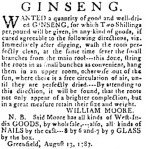
Hampshire Gazette, 1787. Historic Deerfield Library

Hampshire Gazette, 1787. Historic Deerfield Library

Seng has been harvested from American forests since colonial days, and for time immemorial by native tribes. It supported a thriving export industry to China in the 19th century, and still supplements local incomes. Since Asian ginseng became virtually extinct in the wild, the variety growing along the Appalachian chain is now heavily picked. In our county alone (Pocahontas) 259 lb was declared last year (2015) out of 8,103 lb throughout the state. The average price that year was $410 per lb, and in some years it rises above $700.

No wonder our neighbors keep secret the whereabouts of ginseng. It crouches low on the woodland floor with four or five of five “prongs” reminiscent of beech leaves, and now, in the midst of seng season, a small bunch of red berries catch the eye at the center of the rosette. When sengers dig up swollen rhizomes and filamentous roots they discard the green top and bury the berries under leaf litter to generate new plants. But they never come back the next year because ginseng takes a long time to mature, and harvesting plants under five years old is illegal. I know of no other small woodland plant that is longer-lived: those evading the senger can outlive him, and their longevity is not much less than some trees. As a general rule of nature, plants or animals that grow slowly, mature late and age gradually are not very productive—they don’t need to produce seeds quickly or abundantly to sow posterity because time is on their side. Their strategy worked well until human harvesters came along and stripped entire slopes of these precious vegetables.

Ginseng’s reputation for promoting human longevity, endurance and sexual potency started in China, like so many other ancient notions and philosophies. But does it hold up in an age of science? Hard evidence is hard to find, although there are over 7,000 research/ review articles listed in PubMed. Admittedly, most papers are published in obscure journals based on animal studies or in vitro experiments, and the rare clinical trials of any worth struggle to raise ginseng out of the basket of “alternative therapies” to the shelves of conventional medicine. Like research on other “botanicals,” there is too little attention to batch variation and potential toxicity.

Most serious scientific attention on this plant is focused on saponins (“ginsengosides”), complex, steroid-like molecules which are so-called because shaken in water they make froth. The anti-oxidant, anti-inflammatory and immunostimulatory activity found under lab conditions suggest that ginseng might render some beneficial effects on our physiology and pathology after eating it fresh or steamed, and at the very least I expect it blesses the hearts that believe in it. Its very name has a healthy glow, even at the end of a “ginseng cigarette” (though healthy cigarettes sound like an oxymoron and may not contain the said herbal).

Ginseng. Courtesy C.C. Flinn

Ginseng. Courtesy C.C. Flinn

It takes its name from Schinseng, meaning in Chinese “essence of the earth in the form of man.” If you stretch your imagination, the baggy rhizomes look somewhat like the body and legs of a man. Many old cultures have interpreted in nature divine signs created for our good, like red centaury (for purifying the blood), toothwort (looking like a tooth for toothache), and so on. Dr. Paracelsus popularized these beliefs handed down from Galen, and they persist as folk remedies and in alternative medicine. All I can say after quickly reviewing the science is that ginseng probably does no harm, which is the elementary ethic of healthcare (primum non nocere), but as for doing good and extending our lifespan, the jury is out.

I saw an old man climbing our slopes towards a plateau on Middle Mountain carrying a trowel and a knapsack under his arm. As he bent to dig in the soil, his shaggy, grey beard flowed over the collar of a heavy green coat which had a hole under an arm. I stood watching, wondering.

There are three categories of needs and wants in our lives. First and foremost is the need for something to love, which should be free, and I pondered whether the old man’s love was for our woods and mountains where he roamed as a boy. The second is our need for water and healthy food, which should always be available and affordable, and I guessed from his appearance that he was poor, if not starving. Last and of least importance is our want for luxuries, which are more expensive than the rest but unneeded, and I mused that the forest-gatherer hoped to make a little profit to bring some joy home, perhaps for a nip of whiskey before bedtime or a cheap gift for his family. I could have challenged him because he was trespassing in our woods when the season for ginseng was out, but instead I waved.

Posted in Health, Nature | Tagged , , , , , , , , | Comments Off on A Root to Cure Evils (Ginseng)

Who’s seen a Thylacine?

Only Aussies born more than 90 years ago can make a plausible claim to have seen a living thylacine: according to official records, the last of them died in Hobart Zoo in 1936. And, yet, thylacines still live! Few “extinct” animals cling so doggedly to public consciousness or attain cult status as the so-called Tasmanian tiger/wolf.

Thylacines feature on the Tasmanian coat of arms where two of them support a shield depicting their favorite prey (a sheep). They have been adopted by a pop group and are emblems on car registration plates. They are cartoon characters in children’s stories. They are mascots of the Tassie cricket team. They have a huge following on Facebook, and are pursued by a Tasmanian research team which is struggling to verify sightings of these shy animals. They are regularly seen or captured as fuzzy images looking like yellow labs darting into cover after the sun has gone down and cocktail hour is over. And where else, apart from Australia, would a government choose to humor motorists by erecting signs warning about extinct animals crossing the road?

Watch out for thylacines

Watch out for thylacines

I doubt thylacines would be so beloved today if they were not hated yesterday. Perhaps we feel guilty for having pushed a species over when it was already on the brink of extinction. A bounty of ₤1 per head was offered on behalf of 19th century farmers when thylacines were already rare. But who should blame a predator for supplementing its diet with mutton when hunters were thinning out its natural prey?  They also attracted attention for having the stripes of a tiger, the gape of a wolf, and the habits of a hyena. And they had cachet as genuine Australian natives with pouches like other marsupials, but unlike other species they were worn by both sexes, which is a rare example of political correctness among Aussie males.

Why else would thylacines attract attention? Every continent except Antarctica is inhabited by at least one cryptid species. There is the Sasquatch (Bigfoot) in North America, Mapinguari in South America, Yeren in China, Yowie in the Australian Outback, etc. As we tame the shrinking tracts of wilderness and clear jungles for our own wants, we are still wont to preserve some mysteries passed down by tradition and from folklore. We aspire to all knowledge of the universe and strive for all control of our environment, yet still harbor a love of mystery and curiosity about the unknown, for a world in which everything is known would indeed be dull. Ape-like critters on two feet fit the bill, and for the merest shard of plausibility they require a large territory for cryptids to hide in. But a small, highly-populated island like Britain does not have enough cover for them so they must keep their heads discreetly under water in Loch Ness. As for Tasmania, it still preserves old forestland, enough to conceal a critter the size of a dog, providing it never prowls after daybreak.

Thylacine-a portrait

Thylacine-a portrait

Thylacine hunting is a serious endeavor and a mighty passion for its followers. It stirs emotions like watching for ghosts or stalking for Bigfoot, but these animals are in a class of their own because they were never phantoms. More than a fading memory, evidence of their existence stands on all fours in museums today, and they may even hold out in tiny numbers. If Bactrian deer can come back from “extinction” in the wilds of Afghanistan, why not thylacines in Tasmania’s quiet forests or somewhere else?

Australia was originally part of a continental land mass combined with the huge island of New Guinea. The fauna and flora could come and go within the same ecozone, where they evolved differently to animals in mainland Asia north of the “Wallace Line.” New Guinea preserves descendants of a common marsupial stock, including some kinds of kangaroo that adapted to a life in trees. Perhaps thylacines still survive in its tropical forests. On my first trip to West Papua nearly twenty years ago, the western half of the island colonized by Indonesia and then called Irian Jaya, I met a man who was the provincial medical director and a keen naturalist. His brother in the Merauke area had recently seen in good light a critter looking like a thylacine. I didn’t know until recently that around the same time missionaries reported sightings by tribesmen in the Puncak Jaya region, although they had no idea it was a sensational claim. May the mystery endure, and thylacines hiding in the woods keep their heads down.

Next Post: A root to cure all


Posted in Animalia, Environment, Nature | Tagged , , , , , , | Comments Off on Who’s seen a Thylacine?

Who’s Afraid of Artificial Gametes (Eggs and Sperm)?

In the dystopic Brave New World of Aldous Huxley, he did not add artificial gametes to the bevy of reproductive technologies for replacing natural fertility in his future World State. Nevertheless, they might find a place one day for helping people build their families. I get stares when I ask what others think about artificial eggs and sperm. Perhaps they darkly imagine “Frankensperm” as DNA packages propelled by miniature motors, or “Frankeneggs” with DNA coiled around a silicon chip with a door to admit sperm. But biologists are not that creative!

The technology I have in mind, and which I addressed this week at a meeting in Israel, will only be judged successful if engineered gametes are biologically indistinguishable from “wild types” in normal ovaries and testes. This prospect may seem an odd subject to post from here (pictured), but it will never be a lasting controversy compared to the likes of theology and politics.

City of Jerusalem

Jerusalem by Berthold Werner (Own work) [Public domain], via Wikimedia Commons

Artificial gametes are a huge step towards the total conquest of infertility. They will bypass the deficiency of eggs and sperm in people unlucky to be born sterile, or rendered sterile by surgery and cancer drugs, and many others who are sterilized by age and an early menopause. The first revolutionary treatment for infertility (IVF) was received with a mixture of joy by childless couples and horror by people believing it would harm children and be an affront to “human dignity.” The record has been very positive for millions of IVF babies, and the harshest critics of IVF have mellowed. For who can be so hard to say a child should never have been born?

I suspect after a bumpy ride through sensationalist headlines, artificial gametes will follow a similar course, and possibly help to damp down the demographic anxiety now sweeping the globe. Back in the 1960s, there was a panic about spiraling population growth (The Population Bomb by Paul Ehrlich), but, although our numbers are still climbing from the momentum of high fertility in recent past, fertility rates are declining almost everywhere. Women have fewer babies and start their families later or not at all. Conception is more a matter of choice than chance, and smaller family sizes are desirable because raising children is expensive.

Such private decisions have public consequences, and nervous governments are encouraging parenthood again. Some countries offer free childcare and longer maternity leave. China has relaxed its one-child policy. Japan is in the vanguard of the demographic implosion, but not alone in having a birth rate below replacement levels. And in all but one Western country polled by The Economist (August 27, 2016), the expected average family size was lower than people aspired to as ideal. This reversal of attitudes to family building encourages services almost everywhere for folk who are involuntarily childless. There are now over 1,000 fertility clinics in India, a country long depicted as the epitome of overpopulation. If depopulation of young, working age people continues, surely we will see even more sympathy for these folks, and a greater welcome for the next revolution in fertility treatment than for the first.

Creation of gametes for those who have none would be such a revolution, and would surely bring joy to those who have no rosy options. At present, they may adopt a child or opt for gamete or embryo donation, but neither is an automatic entitlement and comes with financial and social obstacles. Moreover, the desire to have a genetically-related child is compelling because it is biologically grounded. But creating gametes de novo from patients’ own somatic cells is not a light undertaking as it is a turning back to a competence that was lost hundreds of millions of years ago in our evolutionary history.

The chief difficulty is that eggs and sperm are the end-products of slow, complicated processes that first started in our days as embryonic balls of cells. The germ cell lineage that leads to a mature gamete starts with a special type of cell which is “pluripotential,” meaning it is the stem of every cell in the body—brain, bone, blood and so on. It is like a joker in a card game, because it is not a member of a suit but can join any of them. But once a germ cell sets off on its journey of development it doesn’t look back—it loses the pluripotency of its parent cell and can’t switch to another “suit.” Neither can a nerve cell or red blood cell become a germ cell after they have differentiated. At least, they couldn’t until discovery of the trick of injecting nuclei into egg cells, which have “juices” for turning DNA back into thinking it is pluripotent again. That was the amazing lesson Dolly taught us.

When we engineer somatic cells (say, skin cells) to make clones or artificial gametes, both have reversed developmental time to the pluripotent state, but the goals are entirely different. The purpose of reproductive cloning is to duplicate individuals with genomes that are identical to the parent cell. On the other hand, making artificial gametes requires the parent cell to undergo a reduction division for halving its DNA so that it has a genome complementary to a gamete of the opposite sex with which the full chromosome complement is restored at fertilization. And before that division occurs the cell must go through a process of genetic recombination to generate daughter cells with different combinations of genes. Generating diversity is the game of normal reproduction, while uniformity is the hallmark of cloning. Artificial gametes are welcome in theory, but clones are scary.

Although it is very difficult to reverse a somatic cell into pluripotency and then drive it forward make a gamete (among the most specialized cells), two routes are open, although one is guarded by a traffic stop light.

The first involves injecting a nucleus from one of the patient’s somatic cells (e.g., skin) into an egg, which divides to create a ball of cloned cells looking very much like an embryo. It has to be killed, however, if the pluripotent stem cells are to be extracted for making germ cells and, hence, gametes. The moral uncertainty of these embryonic entities and debate about their rights to protection as “human” may never be resolved, thus I believe embryo stem cells are a route to nowhere.

The more attractive candidates by far are the famous iPS cells (induced pluripotent stem cells). They earned the head of a Kyoto University lab the 2012 Nobel Prize for Physiology and Medicine because iPS cells can be made from almost every type of cell in our body, and they are equally pluripotent as embryo stem cells.

In a nutshell, their story is that when a somatic cell is infused with special bunch of molecular transcription factors that are involved in the ground state of pluripotency, its nucleus will “think” it’s inside an embryo stem cell. Once an iPS cell is created it multiplies over and over to make millions of copies, and these daughter cells can be induced to differentiate outside the body along the developmental pathways of all other cell types in the body, including germ cells. The original molecular cocktail was only four factors, but two of them have oncogenic capacity. Oops! Shakespeare would mutter, The course of true science never did run smooth! Researchers are busy replacing them with less threatening ones, and the prospects are good. But there is another challenge for safeguarding health.

When differentiated cells are turned back to become pluripotent they express a different set of genes, which are said to be “epigenetically” controlled. The switches for gene activity lie in the cloud of proteins and methyl groups surrounding the DNA molecule, but what happens if this reprogramming process is incomplete? Is this why iPS cell development is inefficient and can go awry? Almost certainly it is. More to the point of this post, some iPS cells can’t make germ cells, although there is proof of principle.

Another lab at Kyoto University generated gametes from iPS cells made from fibroblast cells. When they were fertilized in vitro with gametes from healthy animals the embryos were transferred to surrogate mother mice which delivered healthy pups. This gold standard for proof is, however, a very long way from a technology for helping patients to conceive with their own gametes, but it does signal the path of progress, just as pioneering IVF studies with mice in the 1960s laid the groundwork for the first revolution in fertility treatment two decades later. It may take that long to bring iPS cells to clinical practice, as the Japanese scientists warn. There are not only technical hurdles to cross, but potential hazards to negotiate, the known and the known unknown.

And yet, there is already some progress towards making sperm from human iPS cells. Once a male germ cell has reached the stage of halving its chromosome number (to haploid), it is potentially ready for fertilization, which can be accomplished by the sperm injection technique (ICSI) before it becomes a motile cell. It is easier to make a sperm than an egg possessing a complex and voluminous cytoplasm, so the problem of equity between the sexes even exists at the cellular level.

A sensational technology that can revolutionize reproductive care is bound to attract huge publicity and suffer from the temptation of a few to push it ahead of biological understanding. The rewards in science go to the first at the finish line. A few years after Dolly was born, the Raëlian cult claimed to have cloned a human baby called Eve which, of course, was never confirmed. No doubt we will hear more stories of reproductive technology gone feral that were first inspired by Huxley. Such stories create anxieties that can arrest progress, and without the resolute pioneers of IVF technology the fertility treatments we now take for granted would have been delayed. Perhaps there are more justifiable concerns about artificial gametes than I have mentioned. Perhaps they will open the door to germline therapy, which is widely feared. And perhaps Huxley was prescient in anticipating human cloning and growing babies in bottles by the “Bokanovsky process!” To put those alarming thoughts to rest and sleep peacefully at night, I put my faith in future generations to make good decisions that we have no need of making as yet.


Posted in Assisted reproductive technology, Fertility, Health | Tagged , , , , , , , , | 1 Comment