The constant gardener lives in an uneasy relationship with nature. Sometimes they are friends, sometimes allies, and at other times enemies.
There is nothing natural about a traditional English cottage garden, however beautiful it may look. Nor is there anything natural about a perfect lawn, however much it helps a realtor sell your home. Both are expressions of our culture and our desire to impose order, not necessarily of our love of nature.
So does keeping a wild garden make the gardener more virtuous?
Letting nature rip can soon get you into trouble with the neighbors, especially if a residents’ association expects yards to be kept neat. But tidiness is anathema to much of nature. A riot of vegetation sends up flowers for pollinators and berries for birds. Dense undergrowth gives rabbits and rodents somewhere to scurry, while in English gardens hedgehogs skulk beneath it in pursuit of slugs and snails.
My wild garden occupies a corner hidden from the view of neighbors. By early fall, the bed of milkweed has little left to offer a passing Monarch, but a lanky stand of Yellow Crownbeard provides late-season meals for bees and beetles among its masses of golden flowers.
Yet even this wild garden is not what nature intended.
Left entirely alone, it is invaded by Japanese stiltgrass and privet. It needs a constant gardener to prevent aggressive newcomers from swamping the natives. I become nature’s infantryman, fighting an endless rearguard action against invasives—though it was humans who created the battlefield in the first place. We altered the land, first for a Southern plantation and later for a semi-suburban garden, while importing alien plants prized for their beauty or usefulness before we cursed them.
Remember kudzu, the plant said to have “eaten the South.”
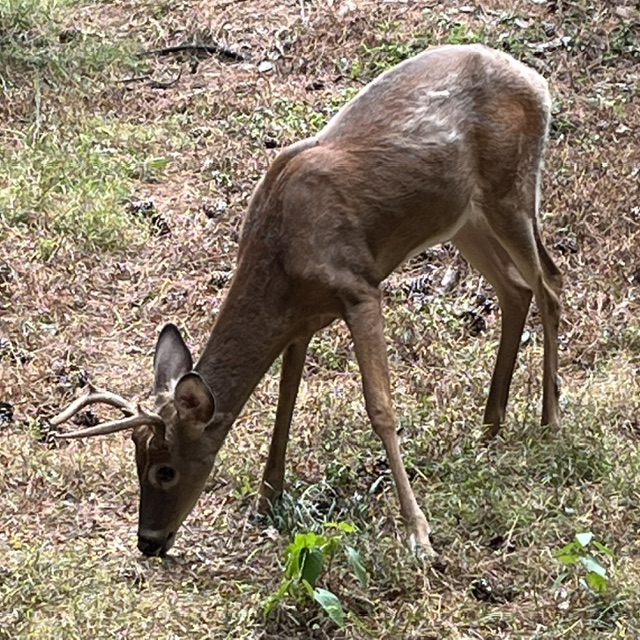
Then there are the White-tailed Deer.
Natives. They belong here. Surely they are welcome?
We are happy enough to watch them nibbling the grass and saving us a little mowing. Unfortunately, the same animals are more efficient than string trimmers at clearing groundcover and better than hedge trimmers at stripping shrubs and young trees to browsing height. Their selective appetites can put additional pressure on native vegetation while leaving some unpalatable invasive plants comparatively untouched.
We blame their abundance after eliminating predators while continuing to create the landscapes in which they flourish. We have a resident “herd” of as many as eight on most days, including four fawns this year, some born in the garden itself. Only tall fences or electric ones reliably persuade them that our plants are not theirs.
This past summer was torrid. The deer ate almost everything they considered edible. We stopped mowing the lawn so they would at least have some fescue to graze, while elsewhere lawns and golf courses continued to be clipped almost to the depth of a carpet pile.
The deer became tame again, as they had during the previous winter when thick ice sealed away much of their food. Over the past few weeks, one fawn has tagged pathetically behind its mother, its haunches hollow and ribs showing.
After years of wondering how to rid the garden of these four-footed locusts, the sight pricked my conscience.
I started giving them corn.
Now they arrive every day, making me feel like a repentant saint.
The buck stops here—literally. Still splendidly muscled, he has no intention of sharing and grabs whatever he can. We call him Horny Boy and, with the rut approaching, he appears ready to reward our generosity by providing us with still more fawns next year.
So much for solving the problem.
A relationship with nature is difficult for a gardener to cultivate. Perhaps that is because gardening itself is a contradiction: we cherish nature while constantly deciding which parts of it should flourish and which must be cut, pulled, fenced out or driven away.
It is rather like living with a relative you dearly love but whose manners you sometimes detest.
And, like family, nature refuses to be managed quite as neatly as we would like.