It all started from Wordsworth when I realized there are more reasons to connect with nature than enjoying the scenery and wildlife.
His poems protested the industrialization of wild and beautiful landscapes, but how much greater would his fury be today, two centuries later, if he saw their degradation under acres of asphalt and concrete, sterile lawns, and industrial agriculture? He believed we have lost something deeper than just green.
Consider “Lines Composed a Few Miles Above Tintern Abbey”
The anchor of my purest thoughts, the nurse,
The guide, the guardian of my heart, and soul
Of all my moral being.
And lines from “The Tables Turned”
Come forth into the light of things,
Let Nature be your teacher…
One impulse from a vernal wood
May teach you more of man…
Than all the sages can.
And “The World Is Too Much with Us”
Little we see in Nature that is ours;
We have given our hearts away, a sordid boon!
The bliss Wordsworth found wandering the fells and valleys of the Lake District exists today under different names: forest bathing, medical prescriptions for time in nature, therapeutic gardening, wilderness recreation, and biophilic architecture. We have a new vocabulary for something Wordsworth understood intuitively.
What was once dismissed as mere sentiment or pseudoscience is now studied scientifically. Researchers have found that time spent in forests and other green spaces can reduce stress and improve mental well-being. Forest chemistry may be partly responsible.
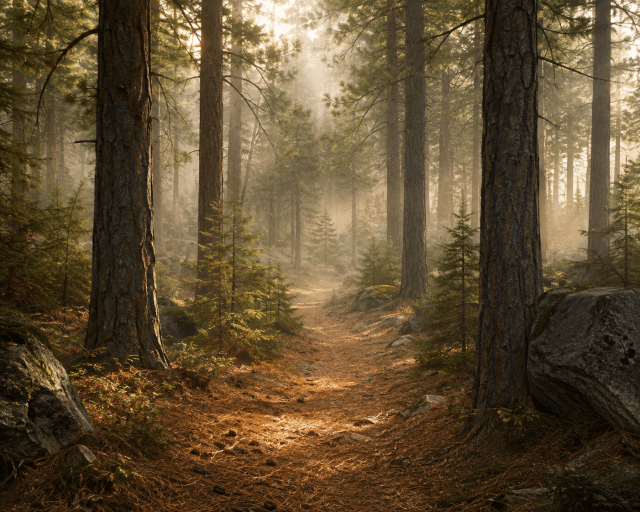
On a warm day, trees release a complex mixture of volatile organic compounds into the air. Among them are terpenes and other chemicals for defense against boring insects, responses to heat and wounds. If you walk along an avenue of pines on a hot day you might smell the chemistry: a resinous fragrance hanging in the air.
The evidence for physiological effects is still tentative. It is subtle compared to the spirit-lifting experiences of outdoor exercise, hearing and watching birds, the marvel of sunlight filtered through fall leaves, and solitude.
Perhaps from living in natural environments for countless thousands of years, our brains became more receptive to these signals. Wordsworth didn’t have our word for being drawn to these places and their wild inhabitants – biophilia. He didn’t know the molecules possibly responsible for cause and effects – terpenes and stress hormones. He didn’t know the theory of our primeval history – evolution. But he knew the effect.
And then my heart with pleasure fills,
And dances with the daffodils.







It always amazes me how people will travel to the ends of the earth to see and be close to a “foreign” natural world…yet in their own yards and communities pay little heed to what is disappearing around them or how much they can do (or VOTE to do) to make it better.
LikeLike