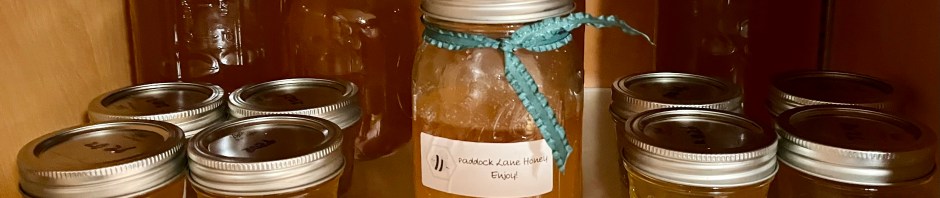
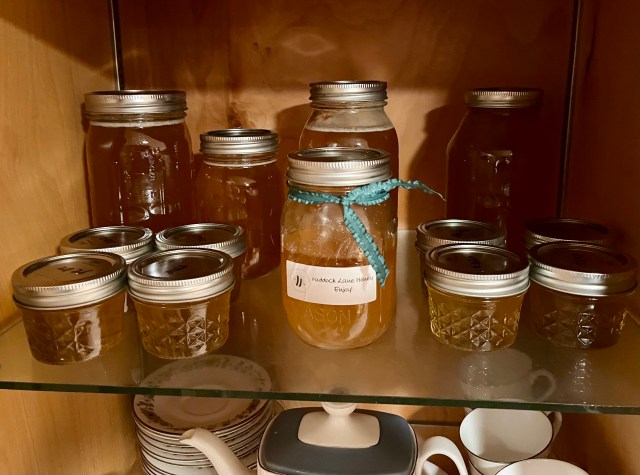
The top boxes in my hives felt heavy during an inspection, so it was time to harvest honey on Saturday. I only have two hives, more as a hobby than for honey that’s mostly used as gifts. Imported honey brings down the price in stores, one of the most adulterated products on the market because it is hard to detect dilution with sugar water. Trust local honey.
After extraction, I return the wet frames for bees to clean in the hive. I don’t take the comb because they invest more energy in making wax than honey (7:1).
Honey was the only sweetener available in medieval Europe, but beeswax was more valuable for making candles in churches and monasteries, and so much brighter and cleaner than tallow candles.
Before harvesting a frame of honey, it should have every cell in the comb capped with white wax. Frames are left in the hive if they have any brown caps that mean larvae inside.
After perforating caps with a prickly roller, the frames spin for each side using a motorized honey extractor (centrifuge) or, if you have few frames and like the exercise, a hand crank. Honey oozes out of a port in the cylinder’s base through a fine mesh to filter scraps of wax before decanting into jars. If honey is too runny in a humid spring, it may develop mold. No problem this year in a drought. Our product came out deep golden and viscous, not needing to be dried to concentrate it.
Bees hate to see (or smell) a beekeeper coming to rob their store, although I only take a fraction. My PEP protected me while a cloud of insects buzzed around. I didn’t get stung. But two days later, in another part of the garden, they found me out of my beesuit and got their revenge!









Hi Roger,
I wish I liked honey, but the process of caring for bees and extracting the golden liquid is fun to watch. I’m sorry they got you.. ha ha ha.
Have a great day.
Sonja, from Alabama.
LikeLike
Thanks Sonja. World Bee Day is Saturday!
LikeLike