-

After the merry Christmas holidays and the high spirits of Hogmanay and Ne’er Day in Scotland, January stretches out, dark, drab and driech. February too promises precious few fine days, although the longer daylight hours are cheering.
It is time for those at work and home to hunker down, and for snowbirds to fly out of blizzard-blasted northern states and Canada, past chilly Virginia to the warm blanket of southern Florida.
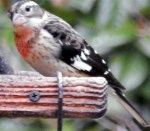
Young Rose-breasted Grosbeak. Courtesy Geoff Giles
Birds too are on the move. The neotropicals headed further south several months ago, although a few hardy individuals stayed on in our Williamsburg area through the light snows and recent ice-storm. How would they manage without the hospitality of feeder stations in gardens and yards? Every year, there are reports of a hummingbird and a tanager lingering here in mid-winter, and a Rose-breasted Grosbeak visited a friend’s garden this month. I wonder if these vagrants are seasonally disoriented or knowingly hanging around avian soup kitchens, but they are thrilling sights for being among our most colorful birds.
A flock descending in the backyard like a sudden squall can lift a brow leaning at the computer for a welcome moment of respite from concentrated work. Mostly American Robins and occasionally Red-winged blackbirds or grackles, they are probably not the residents of other times of year for those birds have temporarily gone to more southerly neighborhoods. The winter relatives have come down from the north to feast on left-over berries of holly, wax myrtle, and red cedar. Why the locals moved away before emptying their larder puzzles me, but the policy helps the migrants who replace them. The wrens, nuthatches and chickadees seen at this time of year may also be newcomers, but I like to think my special friends, the cardinals and bluebirds, stay with us the year round. But how could I know unless I banded them?
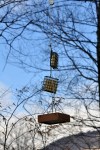
Small bird feeder – fat, grain and seeds
We only see White-throated Sparrows and Dark-eyed Juncos in the coastal plain in winter. They skulk around the shrubbery, ignoring the gardener at work nearby, and take turns to peck suet on the feeder. Juncos are nick-named ‘snowbirds’ because they are regarded as harbingers of hard weather. In the mountains above 3,000 feet, they are the only birds you can count on seeing throughout January. The deer have no choice but to stay the year round, and many animals perished of starvation in the very hard winter five years ago. Bears are safe from the elements while torpid in their dens. Most other birds and critters move down the valleys to better pickings around creeks or to even further afield. But you can tempt some of them to stay.

The Big Feeder
Last fall, I hauled 200 pounds of whole corn and chicken scratch in a barrel 20 feet up in the low canopy between two trees. The job needed a hand winch and a block and tackle. Under a hole in the base of the barrel, a small propeller spins automatically every 12 hours, scattering grain in a 50 foot radius for six seconds. A gamecam monitors the area and a motion detector rings in the house 100 feet away to tell me when to grab binoculars. But the hefty feeder was not installed for the benefit of viewers; it feeds the hungry while I am away, and only needs replenishing every two months.
Winter trees are wisely bare and silent, but this helps me to see further into the woods. The season is not dead; wildlife are coming to their Time Square.
In the past few hours, several deer came to nibble grain. Four ruffed grouse in cuddly feather balls strutted around, and two fox squirrels, so much larger and more handsome than gray relatives, darted back and forth with grain to a hiding place. And there was rarely a moment when small birds were absent. There was no fighting over food and, despite the bitter cold, most visitors were in mated pairs. A pineal gland tells them the time of year. I recorded a mother bear grubbing under the feeder with two adorable cubs, but now she may be dreaming of spring with a tiny newborn pup or two attached to her teats. January is hard, but has its compensations, and is full of distant anticipation.
Next Post: The Soda File
All That Breathes
I’m not a movie buff, but occasionally something I see stirs me to make a recommendation. When I woke about 30,000 feet above the Congo, I scrolled through a list of movies to entertain the rest of my flight. The