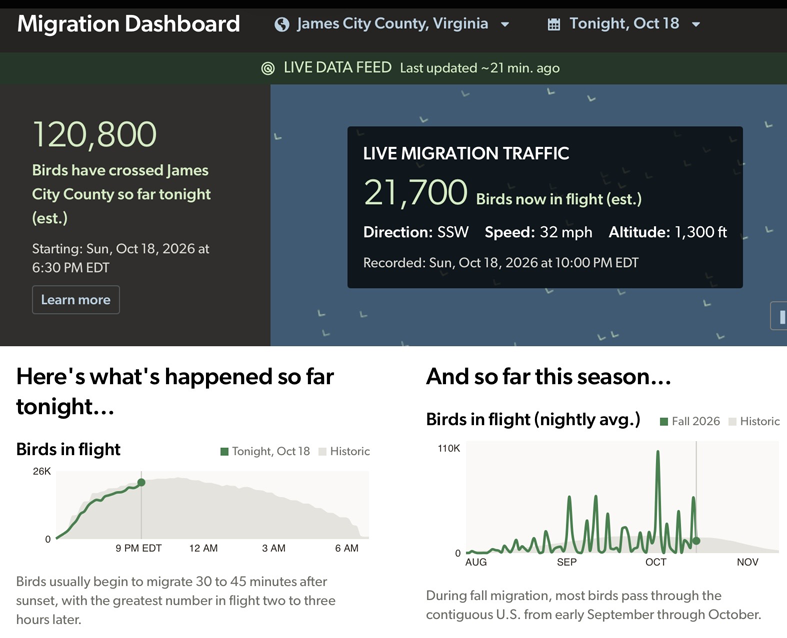
According to radar, 21,700 birds are crossing James City County in Virginia as I write this at 9 PM on an October evening. But 120,800 have passed overhead since they started flying at sunset, and nearly 20 million since the fall migration began in September.
Bird Cast has opened my eyes to another marvel in the night sky. Besides the stars and planets, immense numbers of warm, feathery bodies are passing overhead at this time of year, making their ancient exodus to escape wintry weather and food shortages, using celestial signposts and the magnetic field to navigate, choosing to travel at night, and above warm ground temperatures.
Climate change is already having an impact. A few warblers linger here after summer, while traditional migration routes are threatened as lakes used for stopovers dry out.
Radar provides aggregate estimates from grainy images. It shows the birds’ average speed (35 mph), altitude (3,000 feet), and direction (south-southwest). But it doesn’t identify the species leaving for a winter break in the south or arriving to spend the colder months here in the Mid-Atlantic, such as Yellow-rumped Warblers, White-throated Sparrows, and Yellow-bellied Sapsuckers.
Some birds call in flight: thrushes, certain warblers and sparrows, shorebirds, and, of course, geese. But many calls are high-pitched peeps and whistles, inaudible to us thousands of feet below.
An article in the current issue of Cornell Lab’s Living Bird magazine describes another way to identify nocturnal travelers. Thermal imaging optics, combined with flashlights and high-speed photography, can capture images of birds in flight for identification. This isn’t yet practical for the amateur ornithologist, and care is needed to avoid disturbing the birds.
The purpose of migration is mostly obvious, as is its timing. Birds that fly at night avoid many predators. Hawks and other birds of prey are daytime hunters, conserving energy by soaring on thermals, occasionally diving to snatch prey for lunch.
And so, while we sleep, an immense procession of birds passes overhead, largely unseen and unheard. Thanks to radar, we can now appreciate the scale of this extraordinary movement of life across the night sky.