Of all the trees I have ever seen in Africa the Baobabs are at the forefront of memory.
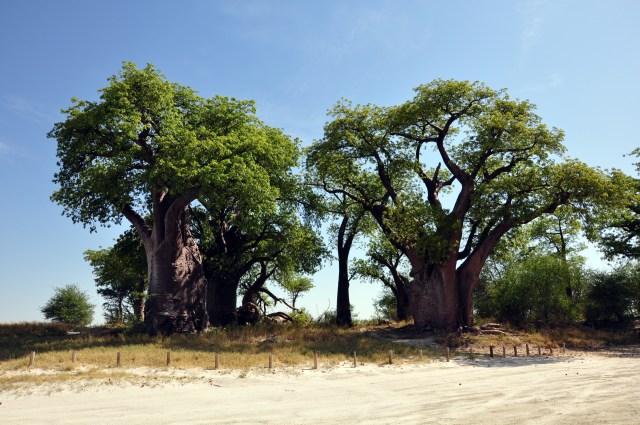
I saw my first specimen in the sandveld of Nxai Pans in northern Botswana. Then we drove to the famous Baines Baobabs. This is a small group of gigantic trees immensely growing on a ridge beside a salt pan. The outlook is like a moonscape. When an ancient lake dried up it created a pan of salty, alluvial soil too hostile for plant growth that glistens under a pitiless sun, and is dry as a bone. The only sign of life is the hoofprints of herds of migrating zebras.
A few years after David Livingstone passed on the way to discover the Victoria Falls, Thomas Baines camped there in 1868. He painted the grove of trees and in 1987, the then Prince Charles came with Laurens van der Post to to set up his easel for a watercolor. The scene had hardly changed in more than a century. A fallen specimen that Baines depicted still lies there, sprouting new shoots.
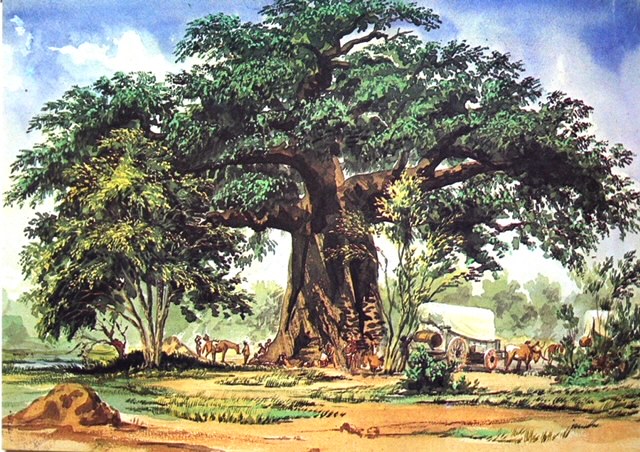
The species can live for over two millennia in the harsh environment, called a “tree of life.” The trunks of large specimens have an average diameter of fifteen feet. They are probably shrinking now from a drought since the rains came late and feebly this year. The heartwood is a soft fiber, useless for harvesting timber stores but a precious store of water sucked from deep underground to preserve them through the long dry season.
As a keystone species it provides food and shelter for many creatures. Baobabs are the largest Angiosperms on Earth called pachycauls (meaning “thick stem”) because their trunks look disproportionately wide for their height. They are frequently visited by pachyderms (“thick skins”). Elephants like to rub against the bark and tear off limbs to suck water when they are desperately thirsty. Yet, the resilient cambium restores the bark even if after girdling.
They had large white flowers with a fetid smell that attracts insects. which, in turn, attract bats that pollinate them. Later in the year, large buff fruit dangle like sheep’s testicles. The seeds embedded in a floury pulp are extracted by Bushmen for painting their arrows with a poisonous alkaloid. The branches provide nest sites for birds, while hornbills find nest sites in hollows. A larger hollow can accommodate a sleeping leopard!
The Bushmen have myths to explain the weird appearance. Deities threw the trees down from heaven to earth where they landed upside down. Livingstone called them carrot trees on that account.
The surface of the trunk is smooth like a beech tree except brown instead of grey. I felt embarrassed in front of my local guide when I saw initials on trees probably carved by a foreign visitor looking like me. However, the defacement is only a scratch on a Baobab that will still reign on the ridge long after we are gone.