Last month I posted about migrating flocks of grackles and blackbirds. Hundreds of them landed, turning the lawn from green to black as they hungrily searched for seeds between grass blades.
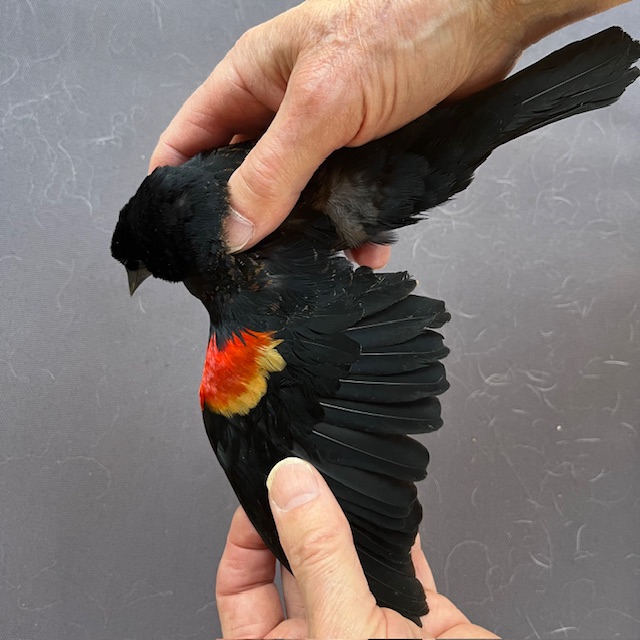
When they flew away, a solitary blackbird still lay on the grass. An hour later it was still there, so I checked it was still alive. Unable to find an injury, I supposed it was stunned by some impact – likely dropped by an attacking hawk since it wasn’t under a window.
It was too weak to fly. I took it indoors to recover in a box with mealworms and water and Lucinda warmed it in a towel against her breast. We earnestly hoped it would recover, and worried through the night.
Why should we care about one in thousands? Among so many, there must be several that never live to see another day. It set me pondering all day.
I thought it was our parenting instinct. We cared for the individual like a vulnerable baby. Or was it more than that?
Was it what psychologists call “the identifiable victim effect?” We respond emotionally to a single known individual, yet care little for the multitude. The one is a unique being that has its own story whereas a thousand birds are abstract, so we perceive them statistically. I felt responsible for it because if I didn’t help, who would? The bird crossed a boundary from its remote life in nature to enter our circle. The flock was not my responsibility.
It is in our nature to love individuals, not populations. Empathy is a moral reflex. We respond more to the image of a hungry Sudanese child on a poster than the thousands of other children that newscasters tell us are suffering at the same time.
There are countless stories and parables that illustrate how our hearts go out to the individual. The Good Samaritan who feels a responsibility to help a stranger. The shephered who leaves his 99 sheep to search for the lost one. Blake and Thoreau wrote about moving encounters with singletons in nature, and so did Emily Dickinson in the Bird Came Down the Walk:
… Like one in danger; Cautious,
I offered him a Crumb …