While observing expressions of public affection and admiration for Queen Elizabeth II from afar, I began to muse about other queens. Queen bees in my hives.
They shouldn’t be called monarchs by any stretch in the meaning of royalty. But I am struck by a correspondence between the late queen and insect queens. The steadfast duty to serve in one great role for society’s sake. Without that service, the institution of a constitutional monarchy or the life inside hives cannot survive.
But here’s a wonder. A queen bee isn’t born from a royal lineage, like the House of Windsor, and doesn’t have a unique genome. She is what she is because the egg that made her was laid in a special cell and workers fed her a special diet as a larva. Any egg can potentially make a queen in the process of supersedure to ensure succession where a queen is failing. It’s more like making a new Dalai Lama (although always male) than the heir to a European throne. It has none of the mystique of a royal family tracing its roots to an ancient founder. The current Lama and Tibetan monks discover his successor as a child and turn him into an extraordinary individual with a momentous life as a spiritual leader and diplomat. Somewhat similar to when nurse bees care for a precious larva in a queen cell.
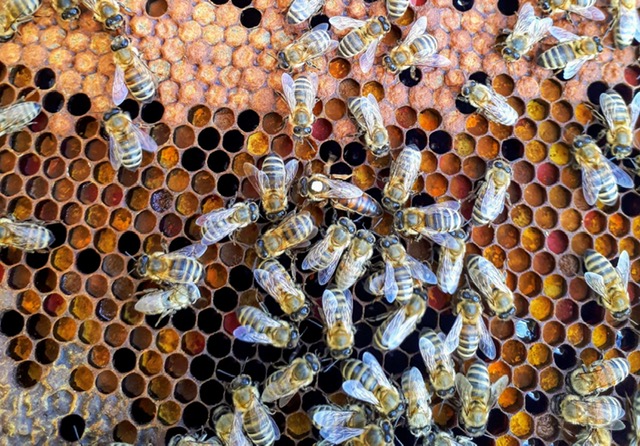
Aside from rambling on about royalty, poring over frames of honeycomb covered in busy insects gives me a cast of mind about the tranquility of hive life. It’s neither feudal nor communist, but still a highly organized community. Individual honeybees don’t have the freedom of solitary bee species, but neither are they stuck at the bottom of a rigid caste system. A new worker bee starts with humble jobs and transfers to other occupations, such as nursing, honey-making and guarding the hive. Finally, she graduates to flying for foraging outside for nectar and pollen. There’s no jealousy or conflicts from competition in the patriotic fervor to benefit the community.
This post sounds anthropomorphic for a biology professor, but I can’t find better words to express the industry of honeybees, which the mind of the hive organizes. They have an admirable society, even if not one we can or want to emulate.