We’re alive within the flames’ bright glow, Dancing, enhancing, flashing in our strife. We’re children of the wood, our names unknown, And like you, we all journey to the afterlife.
Some stand short and hot, while others mellow, The sole distinctions in our fiery tribe Of red, white, blue, and yellow, we bellow, No division, just words to ascribe.
Living like you, we burn the whole day through, Making oxygen and fuel connected. Till carbon in the plasma flows and renews, And that’s how we are, our fate resurrected.
My electronic calendar reminds me it is the autumnal equinox and the first day of another season. Wildlife has its own calendars and clocks. The hummingbirds who pay hourly visits to our feeders didn’t turn up today. I saw only one Osprey flying over Powhatan Creek last week and it has probably left to join others in balmy Caribbean waters. Purple Grackles and Red-Winged Blackbirds are flocking, and other feathers are flying, though mostly unseen.
Bird migration has held me in thrall since senior student days long ago. I gave a nervous presentation to my department about a new Science paper that conflicted with the theories of one of our professors sitting in the front row. We know why migration happens, and expect it will be impacted by climate change, but how birds navigate thousands of miles, sometimes traveling as lone juveniles, is still poorly understood.
If a bird’s brain seems too small, how can an insect’s brain manage the task? We still have Monarchs filling up with nectar from Mexican sunflowers and Lantana. This last generation of the year will head to their wintering grounds in Mexico. To coin an overused word because I can’t think of a bigger one—the feat is AWESOME.
If you are curious about local bird migration, I suggest googling Bird Cast. This tool was created by the Cornell Lab of Ornithology and academic partners using radar technology to detect flocks of migrating birds across the continent.
When I visited the website on September 11, it recorded 546,000 birds crossing my county (James City) the night before. The peak number was 51,000 at 11.10 PM. They traveled at an average speed of 16 mph and at 2,600 ft. Migration mostly occurs between dusk and dawn to avoid predators and rest and feed in the daytime. Only 78,100 birds traveled overhead last night, but migration will continue for many more weeks. Bird Cast doesn’t identify species (pending refinements from AI and machine-learning), but, based on other observations, the flocks probably included warblers, flycatchers, tanagers, orioles, and thrushes.
At this time of plenty, farming communities traditionally celebrated bringing in the harvest. Vivaldi represented it with zest from violins in his suite, The Four Seasons. Birds are busy, too, fattening up before a journey that depletes energy reserves and knowing that staying behind is courting starvation in winter. The violins play a mournful largo for that season when the countryside sleeps and our birds sing to foreign ears.
I make a distinction between two groups of non-native species that settle down and reproduce outside their homeland.
The bad guys include Asian hornets, Burmese pythons, Japanese knotweed, chestnut blight, spotted lanternfly, cane toads, kudzu, and giant hogweed … The list that harms our interests and natural ecosystems seems endless. Human traffic is responsible either through deliberate or accidental transfer of aliens. We don’t notice threats until too late to reverse. Most conquerors of natural habitats arrived after 1900, thriving in new worlds where natural controls of foreign population growth are weak and evolve too slowly. They came hidden in commercial cargo, on the soles of hiking boots, and chosen by well-meaning horticulturists, plant collectors, and others who never imagined a downside.
For example, I see miles of roadsides and nature trails bordered by dense Japanese stiltgrass that swamps native plants. Native grazers, ignore the pernicious weed. This is the season when left unmown, it sheds billions of seeds for germinating next year or lying dormant in the soil for years. That is only one of countless challenges to healthy ecosystems and farms. A recent U.N. report estimates a global annual cost of $423 bn.
We are urged to cultivate native plants. It’s sound advice though few garden centers sell them; some species no longer live where they used to thrive because of the changing climate. It’s easy to feel beaten by aliens spreading across land, river, and sea. As an elder now, I sadly remember things were different when I was a kid. But I have made peace with some non-native plants, pretty good guys that bring more benefit than harm to a garden. Without them many native species would not hold on.
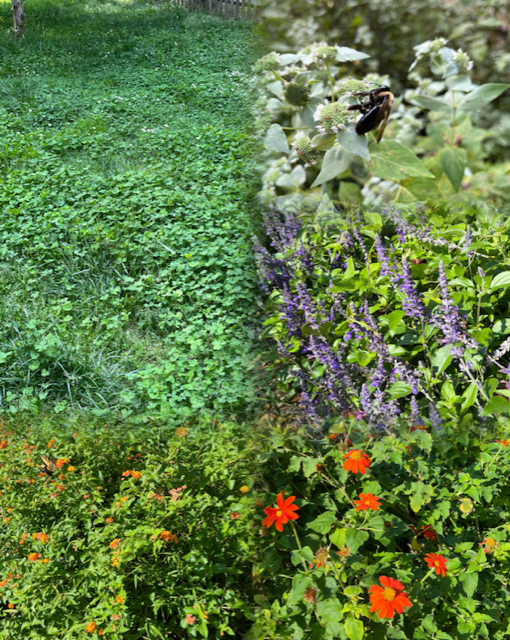
After experiments, I found non-native plants to nurture that are attractive to us and to local wildlife welcome here. Each year gets better. Visitors are delighted with clouds of butterflies and the buzzing of contented bees navigating flowers. In late summer a flock of goldfinches rock on seedheads, and if we attract Japanese beetles, insectivorous birds soon follow!
The composite image shows my top five non-native plants: Mexican sunflowers, Blue Fortune sage, White clover, Lantana, and Mountain mint (native to VA but formerly absent in this district). They spread without my help and don’t aggressively displace our beloved natives. But what would they call us if they could? Worse than the worst, the most invasive species in Earth’s history, spreading on every continent to disrupt the evolved balance of nature.
Excavator transferring rock from a ship on York River
I reported last year about shoring up Jamestown Island to avoid incursions from the James River. Simple measurements with a conductivity meter showed pools across the island are brackish from tidal surges and hurricanes. That explained why only a few relatively salt-tolerant amphibians are present in an environment that is otherwise ideal for them.
The Colonial Parkway is a 23-mile scenic highway connecting Jamestown and Williamsburg on the James River side of the Virginia Peninsula and Yorktown on the York River side. This year it’s the turn of the eroded banks along the York to be reinforced. Engineers have brought in granite blocks for laying along the route. They need a lot of heavy equipment—several large excavators, trucks, and barges moored offshore for a small ship to transfer rock.
It’s necessary work for preserving American heritage but does nothing to mitigate climate change. In fact, it does the opposite and that’s a paradox. As we grasp the seriousness of unfolding crises at sea and on land, the extra fossil energy used to protect nature and property emits more greenhouse gases.
If you go on a road trip through the Appalachian mountains you will see lots of old abandoned houses. I often wonder who lived there and why they left. Please click to view a video of selected photos taken over the past decade with accompanying Old Time music from my friends’ string band. Some of the homes (including the above) have since disappeared.