Baines Baobabs in Botswana

Baines Baobabs, Nxai Pan, Botswana
Baines Baobabs, December 2023

Of all the trees I have ever seen in Africa the Baobabs are at the forefront of memory. 
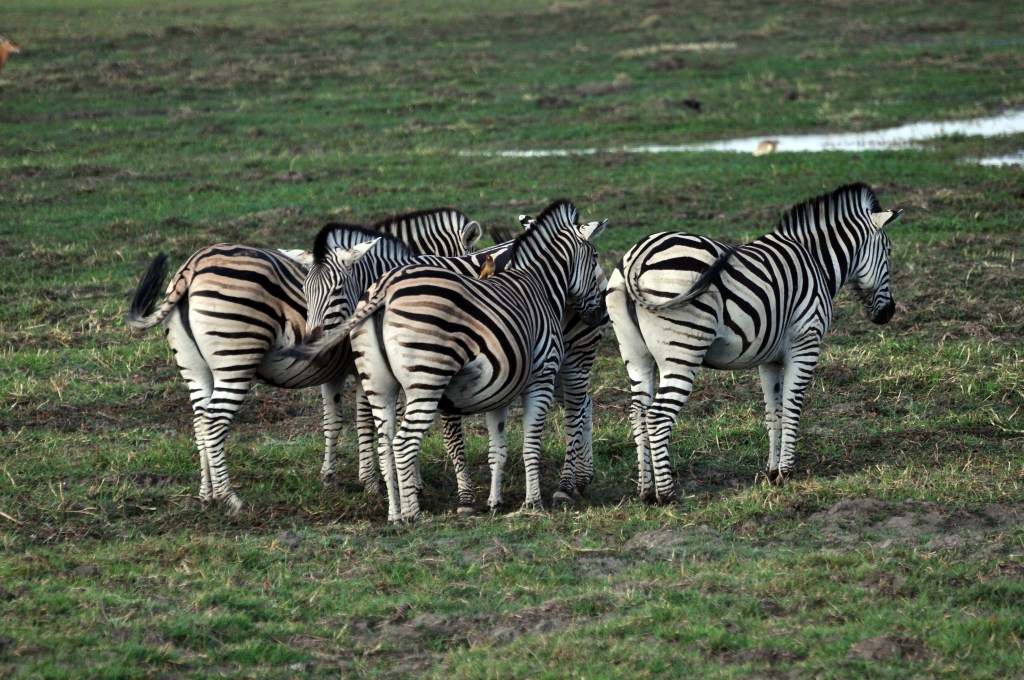
I saw my first specimen in the sandveld of Nxai Pans in northern Botswana. Then we drove to the famous Baines Baobabs. This is a small group of gigantic trees immensely growing on a ridge beside a salt pan. The outlook is like a moonscape. When an ancient lake dried up it created a pan of salty, alluvial soil too hostile for plant growth that glistens under a pitiless sun, and is dry as a bone. The only sign of life is the hoofprints of herds of migrating zebras.
A few years after David Livingstone passed on the way to discover the Victoria Falls, Thomas Baines camped there in 1868. He painted the grove of trees and in 1987, the then Prince Charles came with Laurens van der Post to to set up his easel for a watercolor. The scene had hardly changed in more than a century. A fallen specimen that Baines depicted still lies there, sprouting new shoots. 

by Thomas Baines (1862)
Painted by Thomas Baines, 1862

The species can live for over two millennia in the harsh environment, called a “tree of life.” The trunks of large specimens have an average diameter of fifteen feet. They are probably shrinking now from a drought since the rains came late and feebly this year. The heartwood is a soft fiber, useless for harvesting timber stores but a precious store of water sucked from deep underground to preserve them through the long dry season. 
As a keystone species it provides food and shelter for many creatures. Baobabs are the largest Angiosperms on Earth called pachycauls (meaning “thick stem”) because their trunks look disproportionately wide for their height. They are frequently visited by pachyderms (“thick skins”). Elephants like to rub against the bark and tear off limbs to suck water when they are desperately thirsty. Yet, the resilient cambium restores the bark even if after girdling. 
They had large white flowers with a fetid smell that attracts insects. which, in turn, attract bats that pollinate them. Later in the year, large buff fruit dangle like sheep’s testicles. The seeds embedded in a floury pulp are extracted by Bushmen for painting their arrows with a poisonous alkaloid. The branches provide nest sites for birds, while hornbills find nest sites in hollows. A larger hollow can accommodate a sleeping leopard! 
The Bushmen have myths to explain the weird appearance. Deities threw the trees down from heaven to earth where they landed upside down. Livingstone called them carrot trees on that account. 
The surface of the trunk is smooth like a beech tree except brown instead of grey. I felt embarrassed in front of my local guide when I saw initials on trees probably carved by a foreign visitor looking like me. However, the defacement is only a scratch on a Baobab that will still reign on the ridge long after we are gone.  

Posted in Botswana | Tagged , , , , , | 1 Comment

The Kalahari and Okavango: from desert to delta and drought

Okavango Delta in Botswana, northern Kalahari

My view from a window seat hardly changed on the flight from Johannesburg to Maun in northern Botswana. I rarely saw a farm or lodge in the khaki-colored plains below.
A few gulleys ran irregular courses like the veins on the back of my hands. When filled in the wet season, they drain to rivers that snake away to the Indian Ocean a thousand miles east. Tracks in the sand (hard to call them roads) pointed to destinations over the horizon in lines as straight as a compass bearing. A truck plowing through deep sand created a dust cloud behind, like the wake of a motorboat.
I visited the country in early December when it should have an annual rain quota. Wildlife and farmers depend on it, but the land still looked parched. Waterholes had shrunk to muddy puddles or dried up completely under clear skies in 100-degree temperatures. I imagined people looking up every afternoon, hoping for clouds to appear in billows like the puffy sleeves of a Victorian bridal gown.
A “Horse Latitude” is an odd name. It is a region of high pressure where prevailing winds and the cold current offshore of Namibia keep the rain clouds away. The matter is more serious in an El Nino year. If there is not enough groundwater accumulating at the interface of sand and underlying layers of clay or alluvial soil, the trees will suffer in the nine months ahead that guaranteed dry. Only the original occupants of southern Africa, the Bushmen, know how to survive in a desert. The Batswana people are so conscious of dependence on seasonal rain that they put the word Pula on their national coat of arms and adopted it for Botswana’s currency. Pula means “rain” in the Setswana language.

Coat of Arms of Botswana

On the next leg of my journey, I flew out of Maun, a bustling town in northern Kalahari. Since we didn’t ascend above 5,000 feet, I saw large animals gathering around waterholes. Looking ahead through the invisible propeller spinning at 2,500 rpm on the airplane’s nose I saw the landscape change dramatically from khaki to green, from dry to moist, like a mirage on a torrid day. After journeying for over 40 hours, I knew my destination was near. We circled twice around a dirt runway before landing to check no elephants or buffaloes crossed.
I stepped out on the Okavango Delta—a great wonder of nature—6,000 square miles of wetland surrounded by aridity. This oasis of vegetation attracts some of the highest densities of large herbivores in the world and predators that follow them.
The bowl of land capturing water in the middle of the continent is at the southern end of a branch of the Great Rift Valley where tectonic forces rend a tear in the Earth’s crust. A river from the Angolan highlands crosses national borders to replenish Delta water that evaporates in the heat. If climate change reduces the flow or an upstream government dams the river, the consequent loss of biodiversity will be catastrophic.
I left southern Africa expecting the rains to arrive, if a little late. But, alas, it is in drought. Crops are shriveling, livestock going thirsty, and wildlife roaming for waterholes in Botswana. Malawi and Zambia have declared a state of disaster; Zimbabwe will be next. The United Nations declares populations in these nations are at risk of going hungry.
When I came home to Virginia, I grumbled at the cool, wet spring. I groaned at too many choices for a meal from our pantry and freezer. I know I shouldn’t. I should cast my mind back to Africa.

Posted in climate change, Environment, Wildlife conservation | Tagged , , , | Comments Off on The Kalahari and Okavango: from desert to delta and drought

Seed Time

Growing seeds in trays

Did you have dreams in the sod where you lay,
Of resting in your mother’s pod each day,
Before sleeping through winter’s chill?
And now alone, snug under frost’s still
With wriggling worms for company at dawn,
You wait for the first kiss of moisture drawn
That wakes metabolism in the warming bed,
And bursts your coat with a white rootlet spread
Bristling with hairs, burrowing deep down,
Sucking the goodness around, a crown
Of yellow cotyledons and a shoot
Breaking out, whose spear tip knows its route
Pushing grains aside until breaking free,
To bask in the sun’s rays, oh, such glee
And digging dimples in the seedman’s face,
Your day unfolds with gentle grace.

Most times when I look at a tree, it’s only a tree, but occasionally I see a living being lifting its arms like a shaman in a trance.
Most times when I look at a dog, it’s only a dog, but sometimes I see in its face a dear relative gazing back with a loving smile.
But a seed in my palm is always a seed that never loses its seediness. It reaches back to the first cell, forward to my embryo, and to the uttermost speck of life on the planet in the future.  

Posted in nature, Nature poems | Tagged , , , | 3 Comments

Veronica Roodt: wildlife guide, author, artist

Elephant skull, Moremi Game Reserve, Botswana

A ship’s voyage can be a metaphor for our journey through life. Sometimes ships pass within hailing distance of each other. Sometimes they pass unseen in fog or darkness until sailors learn they missed an interesting vessel from gossip at the next port. This sums up a feeling I had on a visit to the Moremi Game Reserve of northern Botswana.
I traveled with a local guide and camp cook through the Kalahari sandveld into the Mopane forest. It had turned green after seasonal rains and abounded with wildlife. Zebras and Red Lechwe grazed. Vervet monkeys and Chacma Baboons clambered on branches. Lions lazed in the shade until sundown when they began roaring before a hunt. Cape doves and hornbills called from every grove, announcing the breeding season. Life revolves around Africa’s seasons in one of the richest wildlife habitats on Earth, where the Okavango Delta looks from the air like a lush, green mirage hemmed in by arid land.
We often stopped to watch animals at close quarters. One day we paused on the edge of the forest where it meets a finger of the Delta. The guide pointed at a semi-circle of bleached skulls at the base of an ancient tree. Skeletons are common sights, often the remains of kills by big cats, so what was special about these specimens, apart from the carefully laid display? The skull of an elephant, buffalo, hippopotamus, lion, antelope, and more. The guide shook his head when I reached for one of them. I felt as if a museum curator slapped my hand for touching a precious exhibit. But why?
Behind the tree that overlooked a reed bed stretching to the horizon, I noticed a raised wooden deck about 20 by 20 feet square. A human artifact in a protected wilderness is rare. I wish I had taken a closer look or a photograph or asked for an explanation. We returned to camp as the heat became oppressive and didn’t venture out for another game drive until late afternoon.
When I came home to Virginia, I read that an author and artist had lived there. The same as published the field guides I used.

Veronica Roodt was a math teacher in South Africa before guiding visitors in the Kruger National Park and taking her first degree in biology. She moved to Botswana as a young, single woman in the 1980s to devote the rest of her life as a naturalist and talented artist to record the pristine wilderness in and around the Delta. She lived in a tent on the deck almost year-round for 34 years.
In the early years, big game hunters took trophies from this wildlife magnet in the center of the continent. Other hunters decimated the crocodile population for people to flaunt fine leather handbags (the reptiles have recovered). After a hunting ban, tourists come with cameras instead of guns, escorted by guides with local knowledge. But no one had mapped the trails or recorded plants and animals (except the most iconic beasts) until Veronica filled gaps with her beautifully illustrated books for the Shell guide series. She traveled around the region to research the traditional medicines of Bushmen and Bantu tribes. This continued earlier studies for the army in South Africa and Namibia so that troops lost in the bush would know how to survive on native plants. 
Her books are staples for wildlife guides and visitors, as well as the best introduction to the region for field biologists. Perhaps no one knew the ecology of Moremi better than Veronica. How could they without that much immersion in its depths?
Far more than regretting I didn’t explore her camp, I am desperately sorry I missed meeting her by a few months. Our ships passed out of time. How I wish I could have had a lesson on the deck and listened to her stories. Someone found her in her chair, but no longer alive. She was 65 years old. Considering the hazards of living alone in the game park, it is amazing she died there of natural causes but has left a moving image seated in a beloved place.

Posted in nature | Tagged , , , , | 4 Comments

The Mind of a Dog

Golden Retrievers English Cream variety
True companions

If you loved an animal and have felt it loving you back (more than just from trained obedience) you probably wondered how it perceives you and itself.  I long to know what my Goldens are thinking.
 Philosophers have asked that question. I wish Thomas Nagel had chosen his pet for a challenging article he wrote instead of asking What is it like to be a bat? However, the nub of it is about the general nature of consciousness, not the character of bats!
 After skimming the paper, I checked what other philosophers are saying about consciousness. It took me down a rabbit hole to a dark place where there was no general sense of direction and I met strange theories, like epiphenomenalism. The subject attracts thinkers to the hardest problem in biology and psychology. If they are unable to agree about its nature in humans, what hope of understanding animal consciousness?
 At least there is wide agreement today that it exists after long being denied, partly on the authority of Descartes. His dualistic philosophy, now happily in retreat, held that animals are automatons with a body but no mind. It is now respectable in science to admit that all mammals and birds have conscious minds, even squids and octopuses whose nervous systems are organized quite differently, and some advocates add species from “lower” phyla, such as insects. Self-awareness is often tested with a mirror for animals whose primary sense is vision, but I can’t tell if a cockroach is conscious because we step on it first!
 Consciousness is not the same thing as sentience, although they are related. Robots can be sentient but aren’t conscious and artificial intelligence algorithms are smart but emotionally absent. Nagel’s article spurred a prickly debate that continues today. He stirred controversy by claiming that the nature of the mind cannot be understood through reductive materialism alone, which is so successful in other areas of science. The mind presents a unique problem that I don’t mind calling mysterious, or doubly so in animals whose perceptions of the world and thoughts are unknowable.
 The evidence of consciousness in animals gives a rational basis for my affectionate feelings toward furry companions. More than sentimental feelings, our minds connect when they are with me. And acknowledging animal sentience binds our relationship to all mammals and birds and perhaps other creatures to a higher ethical standard than in the past.

Posted in Animalia, nature | Tagged , , , | 4 Comments