Star-struck

Few people are star-struck these days—unless you mean a movie- or rock-star. How could they be when the nightly spectacle is veiled by light pollution?

That expression might strike you as perverse, even as a non sequitur, for isn’t “light” good and “pollution” bad?  In the Bible, people who walked in darkness were the bad guys (them), while the good were in the light (us). In the Land of Mordor, the Dark Lord sat “where the Shadows lie”, far from Bilbo sunning himself at Bag End. Sadly, real human misery is still caused by labeling people as either dark or light.

Since incandescent bulbs were first turned on well over a century ago, darkness is being progressively banished around the world. Hardly anyone wants to go back to when lives were dictated by the dark hours, and our ancestors had to pore over a candle to read, sometimes burning the house down! But lighting is not quite the black and white matter it seems, although it is an uphill struggle to explain.

Something precious that fed the human spirit for eons has been extinguished by universal lighting—a pristine night sky. Few people mourn the loss. Gazing from your window, yard, or a local park in urban North America, Europe, and Japan, you can only see a tiny fraction of the stars and planets that were visible to naked eyes in the past. Two-thirds of Americans now live in places where our own galaxy, the Milky Way, cannot be seen because of sky-glow and air pollution, and the fraction grows as more and more lights go on around the globe. Does it really matter?

Isn’t it another dimension in which we are becoming spiritually disconnected from nature? Richard Louv was thinking of life on our planet when he coined the expression, “nature deficit disorder”, in Last Child in the Woods, and I wonder if we are also impoverished by missing the experience of seeing the wild sky except through the lens of electronic media and science. The philosopher, Immanuel Kant, said, “Two things fill the mind with ever new and increasing admiration and awe … the starry heavens above me and the moral law within me.”

Stars were heavily used as metaphors by writers of the Bible and Quran, but are more familiar today as expressions in conversation and literature than as heavenly bodies in plain sight: how often do you hear star-turn, starlit, star-dust, stardom, star-crossed, Star-Trek, Star-Spangled Banner, etc? Until recently, voyagers used celestial navigation to reach their destination, but a star (read supernova/ comet/ conjunction of planets) can no longer lead the Magi to the manger if it was, say, in Brooklyn.

Detail of Nativity Window. Trinity Church, Boston. Edward Byrne-Jones

Detail of Nativity Window. Trinity Church, Boston. Edward Byrne-Jones

In the past, a night sky studded with stars and planets was familiar to everyone, and those who could interpret mystical meaning in the constellations were hoisted up to become sages. Ever since the Babylonians, people have consulted astrological charts to predict their fate, and farmers and gardeners used the lunar calendar. I read that I should plant onions under a waxing moon and they, like me, are under the sign of Libra.

The brightness of the night sky is reckoned by astronomers on the Bortle scale up to a maximum of 9. Metropolitan corridors, like Washington DC to New York, register 8 to 9, and small developed countries, including England and the Netherlands, are high on the scale even in rural areas. Our small town of Williamsburg in Virginia is 4-5, and most of our National Parks have significant light pollution from the glow of distant cities. National observatories were created in the early Twentieth Century for optical astronomy in dark regions of California, but have had to be moved to mountaintops in Hawaii and Chile.

A perfectly dark sky is hard to find anywhere in eastern North America now, but there is a dark spot rated 1 or 2 on the scale in West Virginia where we have a home in the Monongahela National Forest. The night sky there owes its continuing virginity to a low population density and the fact that most homes and highways are not ablaze with lights. The only places I remember with more dazzling starlight were in New Guinea and Africa, which is still a dark continent and something to celebrate.

If you sat on our deck in West Virginia for half-an-hour after night settles in the forest your eyes would be fully dark-adapted and able to see the faintest celestial glimmers. I recommend sitting inclined on a bank to avoid getting a stiff neck for viewing the azimuth. I’m told that at least 15,000 stars are visible in the Milky Way, plus planets, and other stars and galaxies at distances that defy comprehension. You don’t have to pay or be an astronomer to enjoy this show, although binoculars or, better still, a telescope enrich the spectacle.

Even on moonless nights, there is enough starlight to pick your way along a forest trail or across a meadow, but when clouds are too dense to be pierced by stars or a ghostly moon, it is so dark that you cannot even see your hands or feet. That is Pitch-dark.

The blackouts in European cities during bombing campaigns in World War II and the widespread power outages in north-eastern USA and Canada in 1965 and 2003 were urban lessons in what darkness means. When I lived in a West Yorkshire village the residents refused to allow the council to install street lighting. The main street was pretty dark, but still about 4 on the scale. It is likely, if somewhat exaggerated, that outside lighting helps to deter crime, but the villagers were adamant even during the years when the Yorkshire Ripper prowled the district.

Most people probably won’t object to a darker sky, and some might welcome it. Since thirty percent of outdoor lights point upwards, more directed lighting would reduce sky-glow, save money, and have other benefits. Migrating wildlife is disoriented by nightlights, and perhaps plant growth and even human health are affected. There is increasing evidence that our sleep rhythms are affected by excessive light, although most of it is admittedly from indoor lamps and glaring TV screens and computer monitors, which I am using as I write.

Not many people talk about light pollution though I am not alone because an International Dark-Sky Association exists with chapters in sixteen countries. Perhaps more widespread use of directed lighting will help to reverse sky-glow in future, and janitors will turn off lights in skyscrapers after work. But I doubt that we will ever again hear someone banging on our door like the A.R.P. wardens during the Blitz in London, “Put that light out!”

Next Post: Nose to Proboscis
Posted in Other | Tagged , , , , , | Comments Off on Star-struck

A Scythe for all Seasons

Cyrus McCormick

Cyrus McCormick

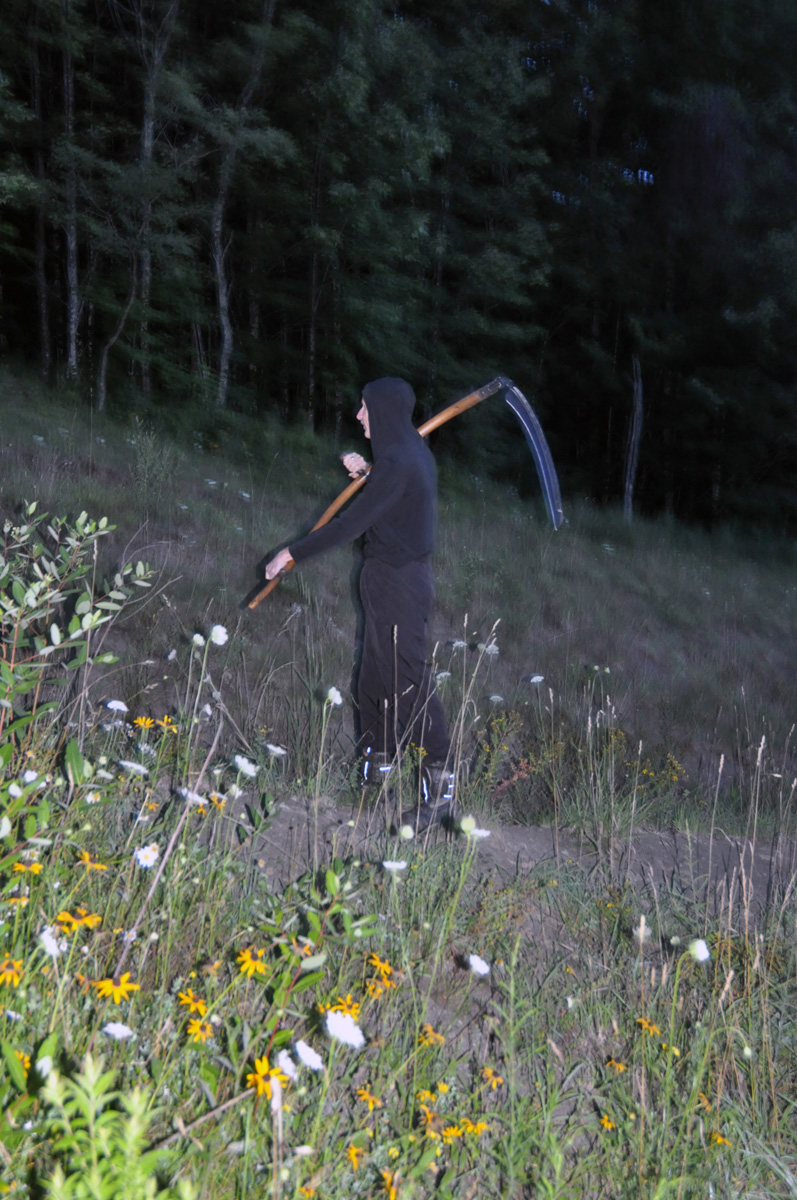
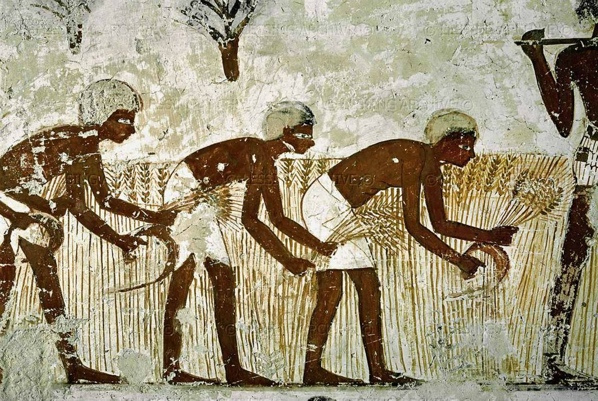
Old Cyrus thought he had killed off the scythe for good when he invented the mechanical reaper. The scythe has mowed hay for fodder and harvested grain for bread since the Roman Empire, and its diminutive cousin, the sickle, was used in the times of Cyrus the Great and the Ancient Egyptians. No one lamented its passing, least of all Cyrus whose patents made him a fortune, and the little factories that manufactured the Anglo-American type closed one by one. Until its resurrection, the scythe only provided service in Reaper stories.

In Terry Pratchett's zany Discworld, Reaper Man takes Windle Poons to his just reward

In Terry Pratchett’s zany Discworld, Reaper Man takes Windle Poons to his just reward

I bought a scythe from an old man for $20. Its blade was rusty and the snath riddled with woodworm, but a grindstone restored a keen edge. After casting it across swaths of stiltgrass, I leaned back to look at the weeds leveled in neat swatches around me, but it was heavy work and the bent snath forced me to stoop unnaturally. I doubt if a farmer who had hung up his scythe in the 19th Century could foresee a time when suburban man might take it down again, except as a museum piece.

Without mechanization, prairie farms would still be tiny, and how would we have harvested enough food for a burgeoning population? Besides, machines liberated field labor for more agreeable pursuits. But scythes are mowing again. They may never return as a tool of a trade, but scythes offer healthy exercise for sedentary suburbanites (instead of pulling levers in expensive sports clubs) at the same time as fresh air and sounds of nature (instead of being drowned out with a smoky, gas-guzzling weed-whacker). Farmers of yore who swayed while singing hymns in little white churches would be amazed to see the new piety of suburban man rolling with his scythe over devilish weeds. But I admit that any virtuous feelings I ever had of being in tune with nature and drawing energy from my silent internal combustion engines (mitochondria) vanished after a half-hour workout, leaving my limbs aching and stiltgrass insolently upright. Were pre-Industrial age farmers Herculean? I hung up my scythe to forget about it.

Never underemployed in this job

Never underemployed in this job

Then I discovered another type of scythe, one that really could sustain virtue—the Austrian scythe! It became my favorite tool. It made me an ardent enthusiast. It gave me a new vocabulary of almost obsolete terms: honing, peening, snath, tang, and chine. Every part and corner of the scythe—from nib to toe—was carefully named by folk for whom it brought home their daily bread.

It is a cool tool but Lederhosen, suspenders, and a felt Alpine hat are not mandatory garb for users. And, being so much lighter than the Anglo-American type, women can swing with it too. The blade is razor sharp, but this isn’t a dangerous tool like a sickle which like its sister, the machete, can accidentally clip a passer-by or even yourself in a weed frenzy. It was never used as a weapon, being too ungainly and designed to be swept like a broom an inch over the ground. My new scythe is a breeze to use since it was custom-made for my height and arm-length. Cut half-an-acre of hay a day? No bother, mate. Cut brush, ditches, even mow the lawn with the grass blade. Piece of cake. The rhythm of the blade swings to a mowing song.agriculture-in-ancient-Egypt5

One man went to mow

Went to mow a meadow;

One man and his dog, Spot,

Went to mow a meadow.

Two men went to mow …

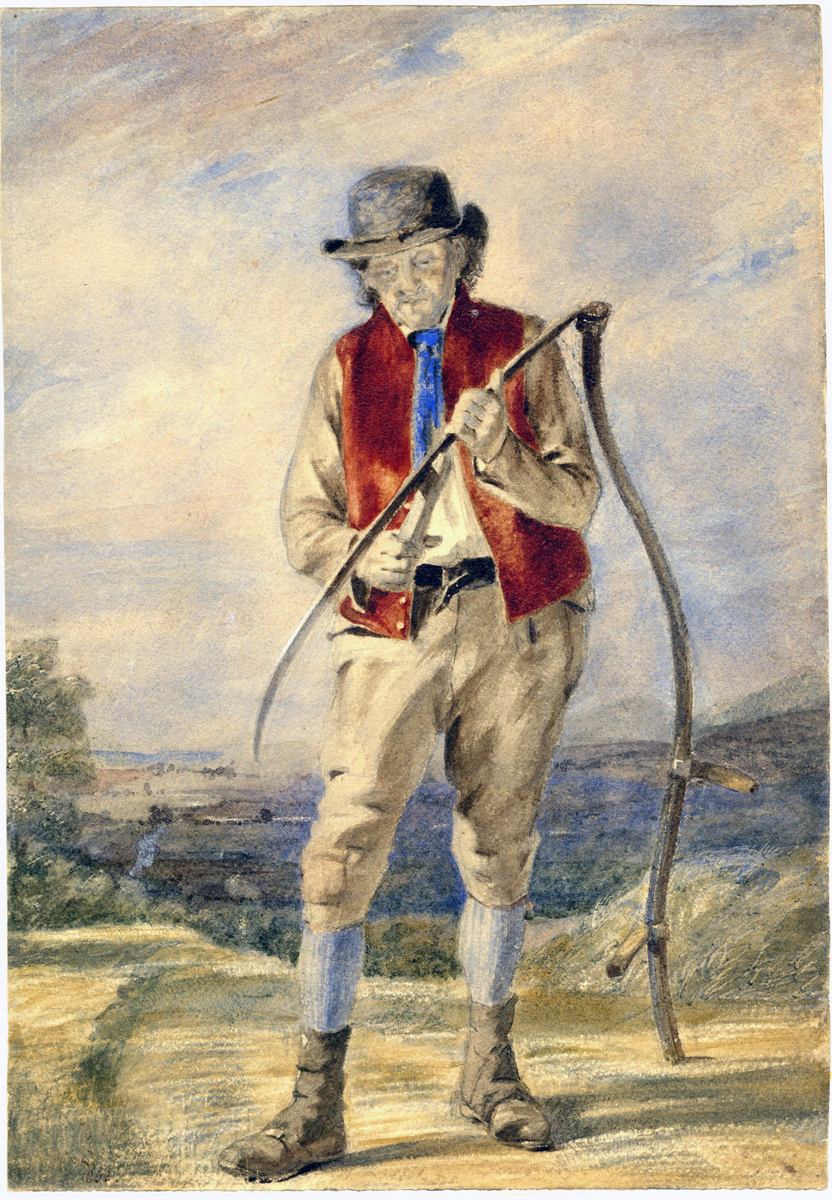
The Scythesman by John Prescott Knight, 1852. Trustees of the British Museum.

The Scythesman by John Prescott Knight, 1852. Trustees of the British Museum.

A new Austrian scythe admittedly costs a tad more than $20, but you are buying something that has been hand-forged by a craftsman after a lengthy apprenticeship in a European foundry going back centuries. The cutting edge is drawn out by hammering on a peening jig, and finished by honing with a whetstone. More than an heirloom, more than a good tool, it is an object of beauty.

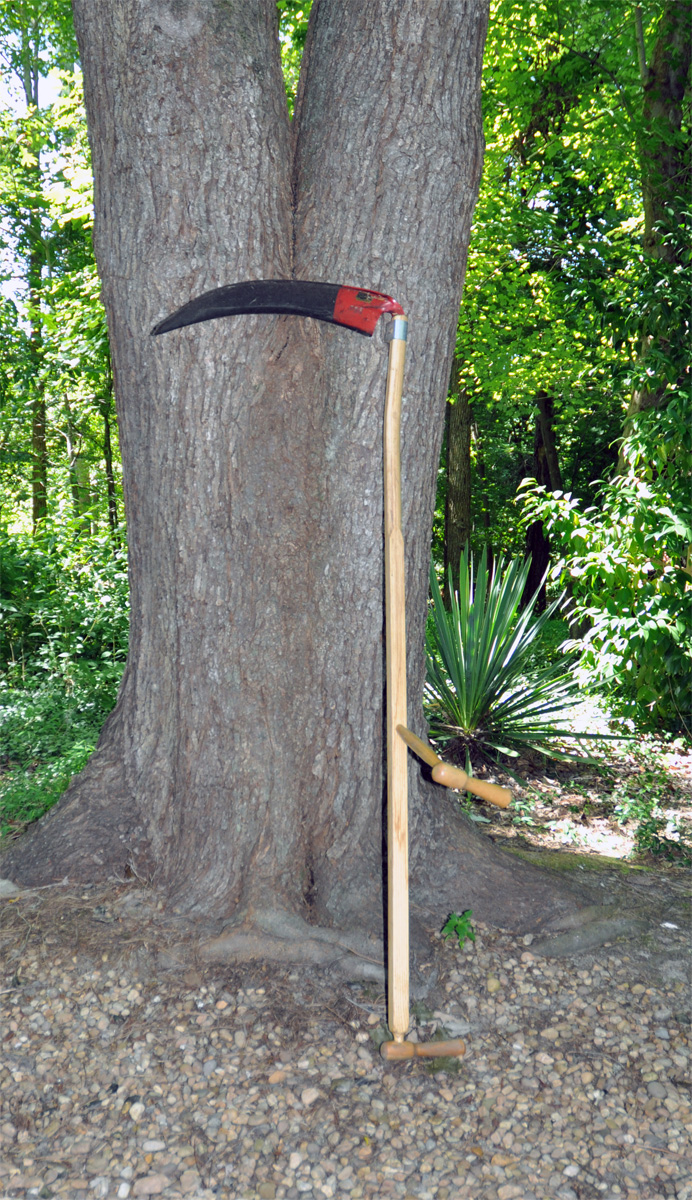
Austrian scythes have a straight snath

Austrian scythes have a straight snath

Modern scything is heading for cult status in parts of North America and Europe, encouraged by associations and competitions that are springing up. Don’t imagine it is the pedestrian equivalent of a quaint steam tractor chugging into a state agricultural show—a fit man can match a motor-mower or weed-whacker in leveling a grass field. Perhaps there is an Olympic sport in the making, though Old Cyrus would shake his head.


***********************

SHARPENING. These scythes should not be sharpened on a grindstone. They were hand-wrought and should be hand-sharpened. While working the scythe the blade is kept keen by regular honing with a whetstone, but eventually its edge is no longer drawn to a thin taper and needs to be hammered out (peened), as I demonstrate here.


Next Post: Star-struck

Posted in Other | Tagged , | Comments Off on A Scythe for all Seasons

Tiny Terrors

Peel back the soft green cover, and you might find menace skulking in a Virginia garden. A neighbor picked up a copperhead by its tail, which turned round to bite him (can you blame it?). Large wolf spiders enjoy nipping me while gardening (so far I have avoided black widows in our wood piles). As for brushes with poison ivy, I lather cortisone cream every week.

But it is not the bigger things that always hurt us most: sometimes we should fear the tiny ones even more (words are like that too.) Yersinia pestis slew more Europeans during the four peak years of bubonic plague than all the swords, pikes, bows and arrows of the Hundred Years War; the smallpox virus slaughtered more native Americans than the Winchester rifle; the Spanish flu killed more people than all the bombs, bullets, and gas grenades in the preceding First World War; and David Livingstone died from tropical diseases, not the mauling from a lion.

Poison ivy- "leaves of three let it be"

Poison ivy- “leaves of three let it be”

After breakthroughs with pencillin, sulfonamides, and new vaccines, there was a short period of medical hubris—it was believed that infectious diseases were in retreat and would soon be eliminated. The dream was quickly scuttled by the arrival of HIV-AIDS and drug-resistant bacilli, and now we have something else to worry about. TICKS.

They were always part-and-parcel of a tramp across a heather moor in northern Britain or through dense underbrush in the mid-Atlantic States. Back in the mid-1970s, I had heard that Rocky Mountain spotted fever was carried by ticks, but it sounded far away and nothing to worry about. Around the same time, there was news of a danger prowling backyards and woods where children play in Lyme, Connecticut. We learned that the new disease rides inside a tick as a spirochaete bacterium, Borrelia burgdorferi. (Taxonomists, please choose more memorable names, like, Lyme horribilis).

The first reports did not sound particularly alarming. The problem was rare and localized, and the symptoms mild. None of this is now true. Lyme took 20 years to reach Virginia and is spreading to all points of the compass and overseas (where it may have originated). We were told that if we removed a biting tick within 24 hours we would be fine even if was infected. If too late, then we were urged to rush to the doctor’s office for a course of tetracycline to stop the infection, whose signature is a bull’s eye rash, fever, and fatigue. Treated in time, we could forget about it—until the next bite. But if untreated, Lyme would likely progress to arthritis and painful joints.

That was the medical consensus, but untold numbers of people whose lives have been wracked with pain and wrecked by permanent tiredness never had a positive lab test result, even if they had good reason to suspect they had Lyme. Perhaps the disease agent had become disseminated to parts of the body that drugs and antibodies hardly reach?  This is where the controversy called “Chronic Lyme” started. When tests are negative (even admittedly poor tests), doctors presume an ailment probably has another cause and are understandably reluctant to start a long course of antibiotic treatment. Those doctors moved by their patients to go against standard medical protocols by providing aggressive i.v. antibiotics invoked the wrath of their own profession. There are many touching stories online of students who had to withdraw from school and adults who quitted work because of a suspected tick-borne illness, and so many more less well-known cases, like a young father we know of who died from complications of Lyme. It is natural to come down on the patients’ side of the argument, especially when they frustrated at being sidelined by mainline medicine and suspected of being malingerers or having a problem “all in their head.” To us, it seemed like a rerun of the doubts that used to surround chronic fatigue syndrome, of which our family has first-hand experience. For her remarkable book, Cure Unknown, the science writer, Pamela Weintraub, dug exhaustively into the science and sociology of Lyme, drawing too from the tragedy it brought to her own family.

Perhaps the storm is beginning to pass since the CDC announced last week that Lyme is an emerging public health crisis that is ten-times more prevalent than assumed because it has been under-reported and under-diagnosed. Every year in the United States alone there are 300,000 new cases, and numbers are probably going to rise.

The deer tick is mainly held responsible for transmitting Lyme, although it is not the only tick that feeds on deer, and deer are not the only animals that infect ticks. Even more complicated, ticks often carry more than one type of pathogenic bacterium, and the deer tick may not even be the worst of the bunch. Not much is plain and simple in parasitology.

Drag for ticks

Drag for ticks

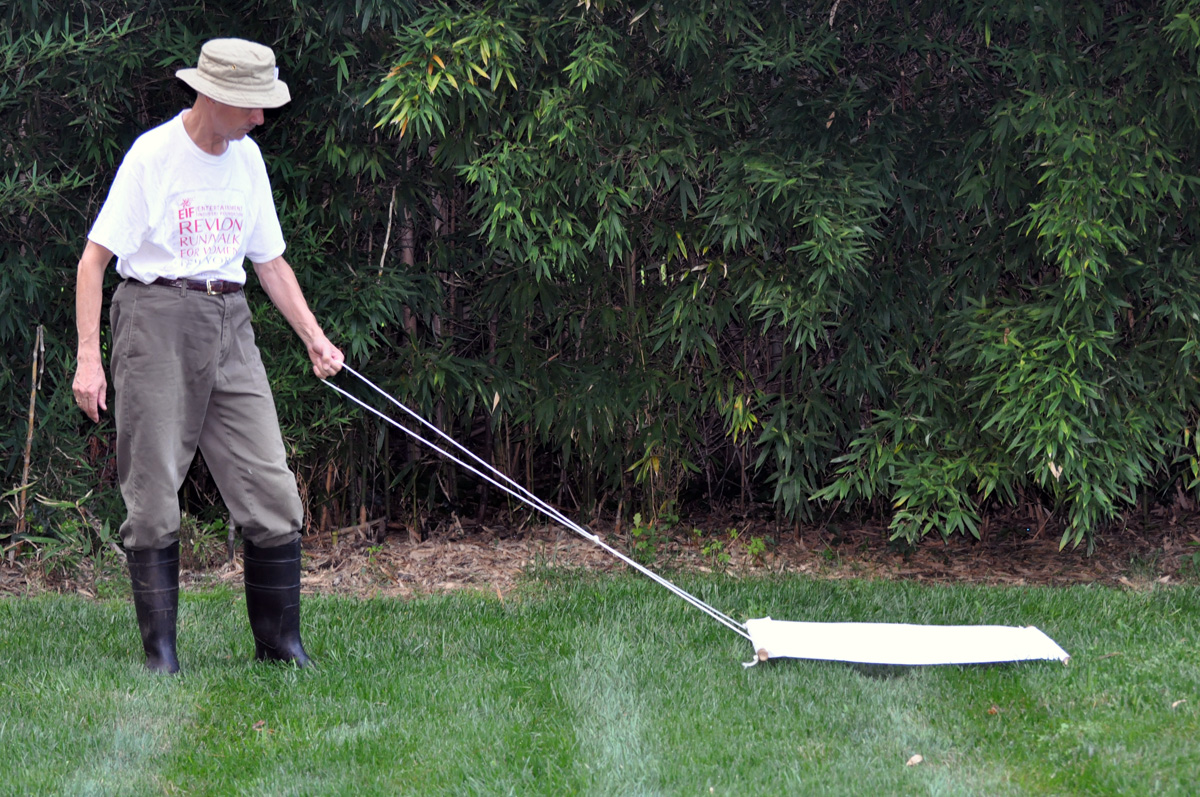
One of my fellow master naturalists had hundreds of ticks on him after hiking in local woods in advance of a school party (the party was canceled). My record is a mere 16 ticks after mowing the lawn. I save them in alcohol until the end of the year when I identify the species to alert me to hazards. A more scientific way of surveying ticks is to drag a cotton sheet across a field or woodland floor, to which they cling hoping it leads to a meal.  Half of the ticks I found in our yard last year were lone star ticks, 10 % were “deer” ticks, 2% were dog ticks, and the rest were nymphs (too small to identify species).

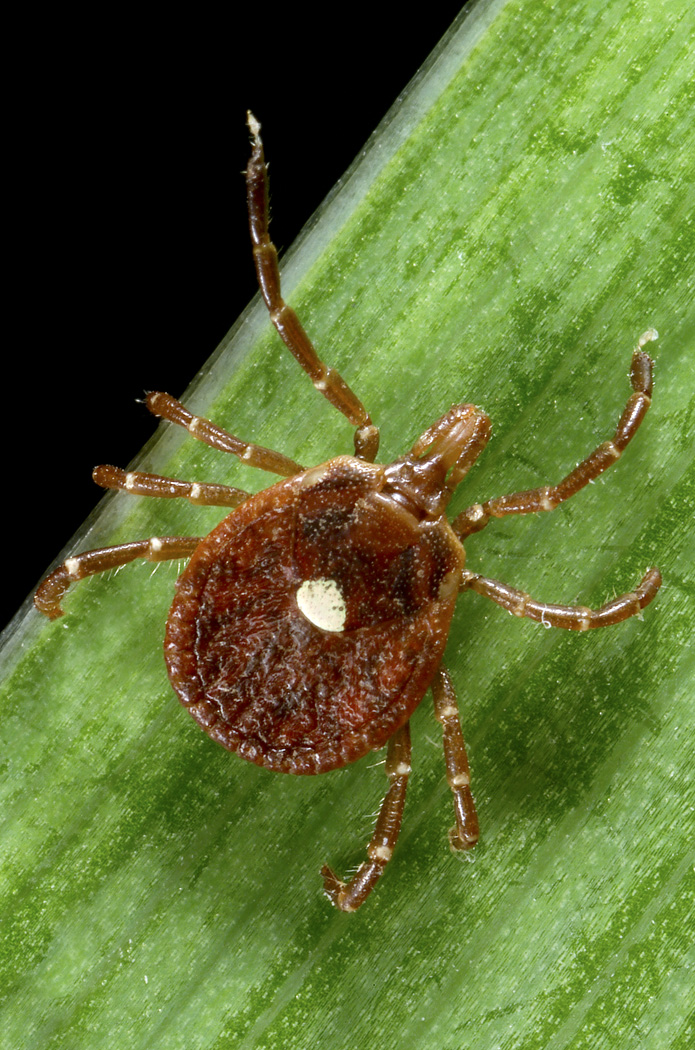
Lone star tick James Gathany: CDC

Lone star tick
James Gathany: CDC

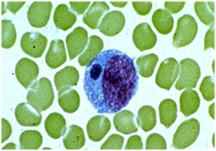
Lone stars are not named for Texas (though they are found there as well) but because the females (the big-eaters) have a single white spot on their shield-like back. They probably don’t transmit Lyme or Rocky Mountain spotted fever, but are vectors of a small menagerie of bacteria, some of which are definitely pathogenic. Ehrlichia chaffeensis causes human monocytic ehrlichiosis in which the first symptoms resemble Lyme (generally without the bull’s eye) with pain, a blunted immune response, and even toxic shock syndrome. Half the cases can be serious enough to require hospital treatment, and according to the CDC the mortality rate peaked at 3.7% in 2003 (close to Spanish flu).

E. chaffeensis inside a white blood cell. CDC

E. chaffeensis inside a white blood cell. CDC

Now the good news is that not every tick is infected, but you never know which ones can be safely ignored. They can however be tested for genetic tell-tales of the bacteria they harbor. At the College of William & Mary, Matthias Leu is leading a study of the distribution of ticks in the Virginia Peninsula and is testing lone stars for E. chaffeensis using an extremely sensitive and specific DNA test (PCR). So far, he has found that almost 10% of the samples were positive for this bacterium, and most of them were found in public parks and recreation areas. Why there?

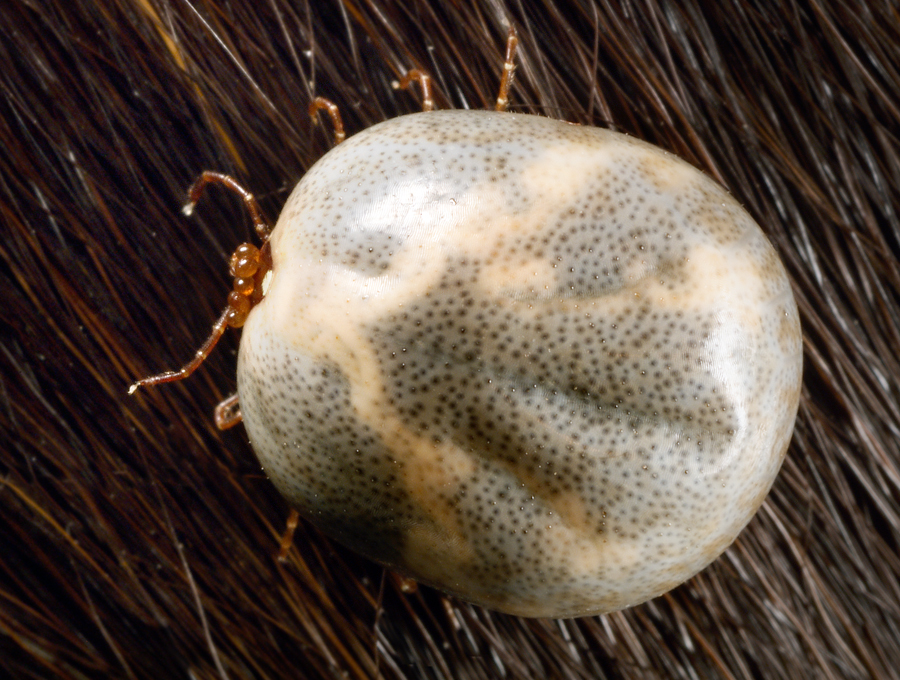
Well-fed lone star tick James Gathany: CDC

Well-fed lone star tick
James Gathany: CDC

He found that in places where ticks are abundant so are the deer, but birds are scarce (they predate ticks). The Virginia Peninsula was originally a blanket of almost unbroken forest, but development is breaking it into small wooded fragments. As more woodland edges are formed, vegetation grows up that deer love. Throughout the East, the white-tailed deer population density has exploded; some biologists estimate there are 10- or even 100-times as many as in pre-colonial times. Not only have developers created ideal habitats for deer, but the major predators have been extirpated, hunting is limited, gardens are salad-bars for deer, and sometimes they are even fed deliberately.

white-tailed buck on the move

white-tailed buck on the move

When deer move into new areas they bring disease with them. Ticks become infected with the disease and the bacteria pass through their life cycle into other mammals, including mice, which become a disease reserve without suffering from it themselves. Setting up tree stands for hunters or bringing back wolves probably won’t make the problem go away. Chickens can help by gobbling up ticks and copperheads by swallowing rodents, but when we started tampering with nature we set in motion ecological changes that are hard or even impossible to reverse.

I wish I could end on a more optimistic note, but in the near future only constant vigilance will provide peace of mind. Those who venture out into woods and gardens during the warm months of the year should cover up with permethrin-treated clothes, but indiscriminate spraying is a bad idea because it kills our good friends, the pollinators. Each of us needs an intimate friend for daily inspections of our crooks and curves that we cannot see for ourselves. Choose someone with good sight because the tiny nymphs responsible for most cases are not much larger than the period at the end of this sentence. Antibiotics used promptly are safeguards, but people who pick up ticks most days can’t use them forever. We need a vaccine, but the only one available is for dogs. Smith Kline Beecham withdrew their human anti-Lyme vaccine years ago after lawsuits claiming it caused arthritis. We may want to knock government down in size, but we need it to step in for vaccine development where big pharma fears to tread.

Next Post: A Scythe for All Seasons


Posted in Animalia, Biomedical | Tagged , , , , , | 2 Comments

Gold in my Garden

Colonial Williamsburg staff in 18th Century garb draw your eye and a fife and drum band may turn your ear, but never on a Saturday morning when a farmer’s market takes over Duke of Gloucester Street. The ancient street is lined with white canvas harboring wooden tables where local produce is on display—fruit, vegetables, eggs, and meat from Peninsula farms; seafood from the Chesapeake Bay; honey from county apiaries; homemade loaves and pies from local ovens. At the center of a vortex of food gathering, a group of Master Gardeners sit like sage Indian chiefs under an awning where they offer advice for people like me who grow their own.

Williamsburg Farmer's Market

Williamsburg Farmer’s Market

Those coming early with swinging baskets will stagger away to the car park under the deadweight of the best meat and vegetables. Late-comers regret their sleep-in when they find only pickings have been left by the early birds, but at least they can enjoy chin-wagging with a stranger and the antics of dogs paraded by owners. A farmer’s market is so much more than buying and selling: it feels cool to be in the throng, and a world apart from joyless tramping around a supermarket. It is a place to stroll and gaze, to pause for the violin outside the Cheese Factory; it is a venue for meeting and making friends in a genteel society. If Thomas Gainsborough could set up his easel in the street, he’d capture a 21st Century version of the gentlefolk in The Mall in St. James’s Park.

Is this the future of food shopping? Are the headquarters of Industrial Foods America Inc. quaking as shop-troops dissatisfied with the victus quo walk the Street in green wellies, baskets raised against agri-business?

Well, not really! Farmers markets and community gardens are growing, but barely 2% of food grown in America is sold locally. Nor are the patrons (“locavores”) a typical cross-section of society. And how could they be when filet mignon sells at $28 and ground bison at $10 per lb? This is not an epicurean revolution, but it is a reaction by consumers who can afford to buy what they believe is more wholesome fare.

It probably is better, depending on how you measure quality, and you have to scratch around like a free range hen to find tidbits of data you can believe in. The food industry, driven by competition and a never-ending reach for higher yields, has transformed farmland and food-processing, and hence what we eat. Food is amazingly cheap, but there is another price—chemical spraying, agricultural run-off, virulent new strains of bacteria, and the obesity epidemic. Despite these concerns, people are becoming more doubtful whether government and nutritionists are effective, or even impartial, watchdogs over our food supplies. Remember their advice to replace butter with margarine, dietary fat with carbs, raw products with nutrient-rich processed products, and their sweet recommendations to enjoy refined sugar and high-fructose corn syrup?

It is a characteristic of most experts that they rarely apologize for blunders, as Michael Pollan points out In Defense of Food, his masterly critique of the food industry. They are also coy about admitting how little we really understand about the relationship between food and health, and a friend who is an authority on vitamins even admitted that it is “kitchen science.” Since Hippocrates advised, Let food be thy medicine, you might expect doctors to be fountains of nutritional knowledge. Don’t believe it. Have you heard platitudes like, “Mr. Brown, you must reduce saturated fat and cholesterol in your diet.” I remember some of my students at the Edinburgh Medical School asking to include more lectures about nutrition in the curriculum, but the faculty continued to serve them gruel, like Oliver Twist. As a physiologist, I ought to know what is best for health, but I simply follow Grandma into the garden.

Food was so much simpler and heartier in Grandma’s day, before it was industrialized and politicized, before drive-in counters and TV dinners, before we were bombarded with food ads and government advice. She enjoyed pulling lettuce and squash in her garden and buying local produce in season from a family-owned store. If it looked fresh, she trusted the rest—after all, who was she to question the quality of God’s bounty?

If dear old Grandma could parachute from her cloud she would be astonished today. Most of the little farms she knew have disappeared, weeds are now scarce in crop fields, fewer animals graze the meadows, stark factory farms and feedlots have sprouted up, raw milk is banned, eggs are sterilized with chlorine, fresh strawberries are available year-round, tomatoes are ripened with industrial ethylene. And if I explained how crops and animals are being genetically engineered, she would call it the devil’s business and ignore protestations that not every technology is bad. Nevertheless, we would agree, and sadly, that beside all those changes a precious culture is vanishing—the family mealtime when both body and spirit were nourished. Repeats of The Waltons are among the last preserves of this ritual.

I wish Grandma could join us on another trip to Polyface farm, which you would call “organic.” It is open for public viewing and the sort of farm that supplies our local market, but it is far away under the shadow of the Allegheny Mountains in the Shenandoah Valley. Rather surprising for a quiet corner of Virginia, the farmer’s voice booms across country. Joel Salatin is an iconoclast rallying troops that loathe the impact of industrialization and government control over local foods and farms. Describing himself as a “libertarian, environmentalist, capitalist, lunatic” would normally discourage me from opening his book, Folks, This Ain’t Normal, but after I had gotten past his rants about politics and the temptation to start up my wood-burning stove, I found the road-map to healthy and enjoyable food quite absorbing, and mostly persuasive. Salatin explains the challenges for small farmers, and doesn’t shrink from saying that we have to pay more for quality. Most memorably, he engaged university chemistry labs to compare his “pastured” meat and eggs with products from a leading company. The healthy differences were so striking that they should provoke a much larger study. Grandma would, of course, just nod sagely. And even if a study showed the nutrient content of, say, supermarket apples was the same as those grown “organically”, she would quip that those in her garden taste so much better.

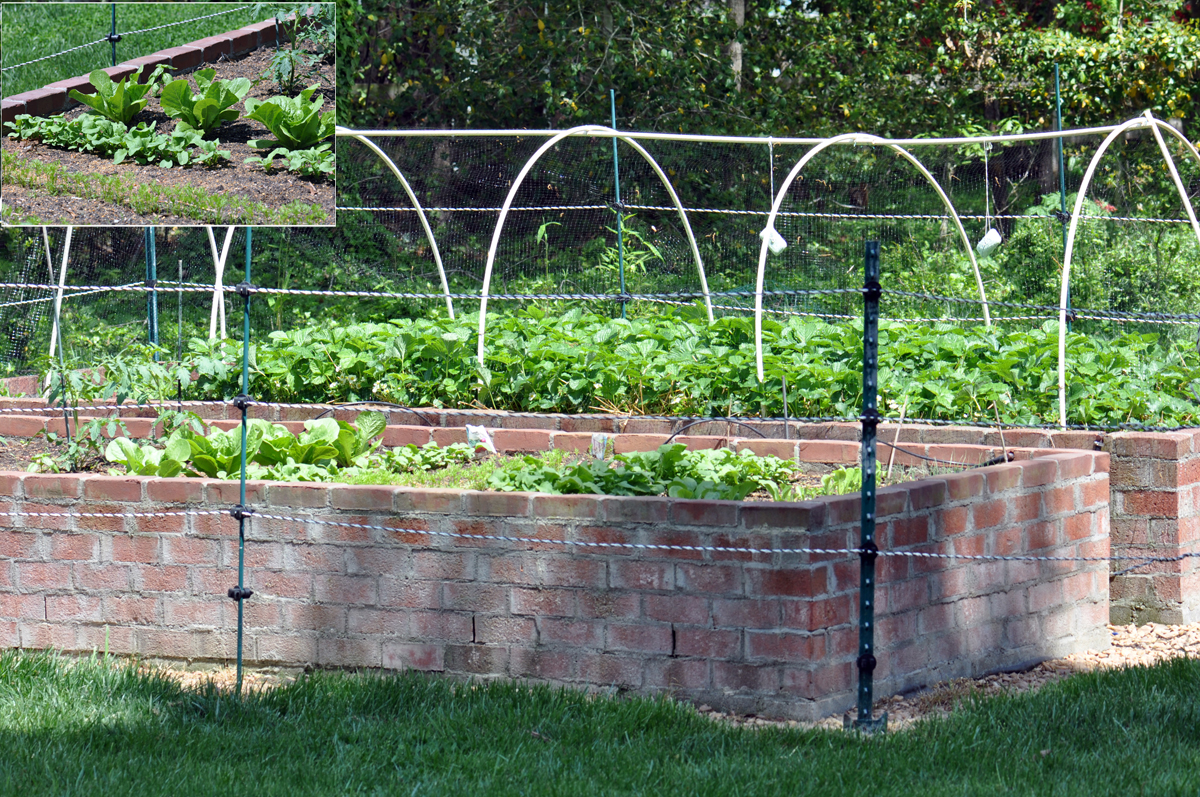
Virginia vegetables sleep better in raised beds

Virginia vegetables sleep better in raised beds

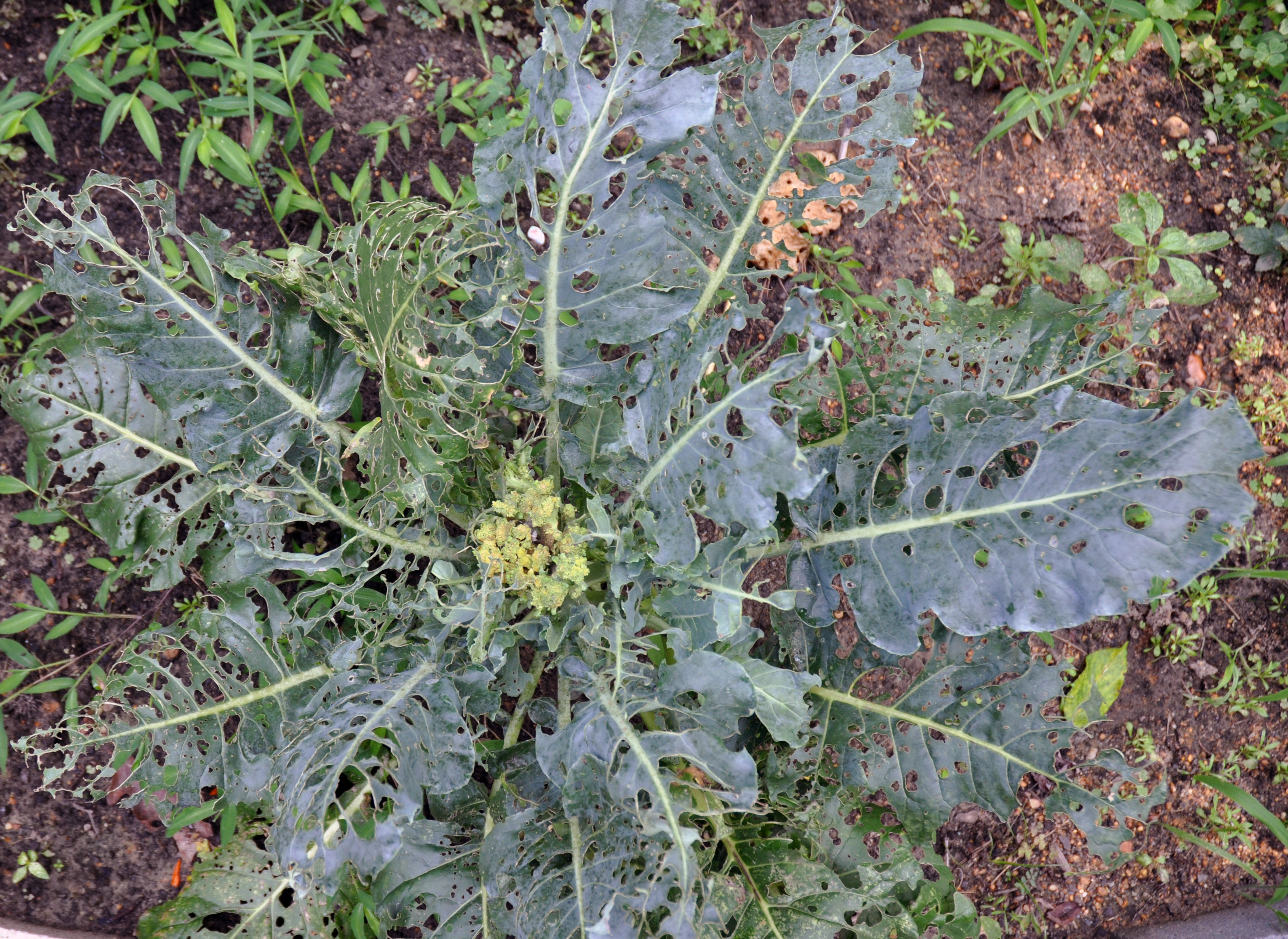
As lads, my brothers and I were encouraged to help tend the garden. Few teenagers today can understand why it never felt like a duty, and in hindsight the contact with nature stimulated a curiosity that led to a job in the life sciences. But the immediate feelings were pure triumph as we hauled in our own, displaying the best in bowls as art objects that would have inspired the Impressionists. More than sweet and splendor, gardening also delivered life-lessons. Contending with heat, mud, and bugs for a reward that is never guaranteed demands hardiness for facing disappointments. It takes bloody-mindedness to grow carrots in Virginia clay, only to find the whole crop rotting in a storage bin. And after weeks of encouraging the broccoli (in whispers in case a neighbor called my wife), it is heart-breaking to discover grubs had visited them overnight, leaving only skeleton stems … Ahhh!

Broccoli tears

Broccoli tears

But the gardener shouldn’t feel crushed for long; he can do better next season, fortified with cabbage wisdom! And, meantime, there is the euphoria of plucking some victories from the earth—vine tomatoes before an invasion of ground hogs, crisp romaine before slugs slime up stems, and fingerling potatoes like yellow nuggets in my dirty palm. Gardener’s who can grow this gold never need buy at a farmer’s market.

A gold-digger's reward

A gold-digger’s reward

Next Post: Ticks and other Terrors

Posted in Other | Tagged , , | Comments Off on Gold in my Garden

Dear Jean

Dear Jean

I couldn’t leave my students to say farewell. Our friends told me it was one of those miserable days before the daffodils bloom along the Cambridge College Backs: Scots would call it a “dreich day”. Pronounced correctly, everyone knows exactly what they mean.

So much water passed under the bridge in thirty years. You’d be amazed to see my hair now—but better a silver noggin than a shiny nut.

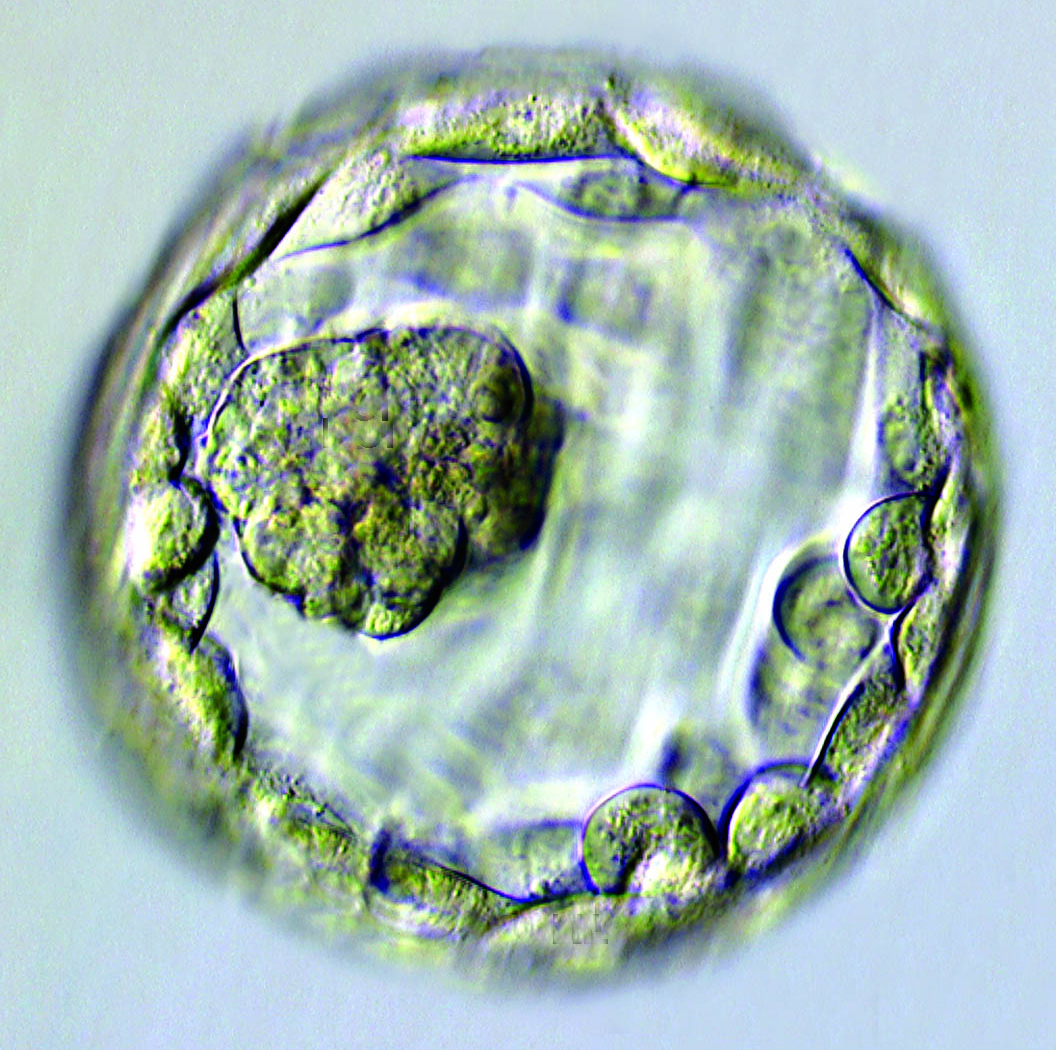
As summer grows old, I’m feeling sentimental and looking back on salad days again. I never forgot the first time you showed me a human embryo. Alive! Gazing down the microscope I needed your help to see the tiny ball of cells floating in a pink ocean of culture fluid. You hovered behind me, probably worried that a green student might spill the precious mite you had just created by in vitro fertilization. It took five more years of struggling research until your breakthrough with the embryo that became Louise Brown. Now there are millions like her.

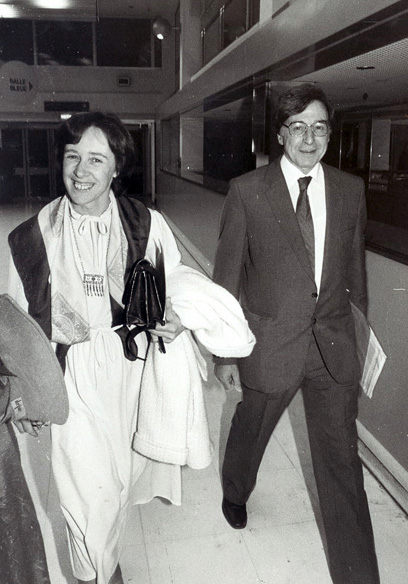
Jean and Bob arriving at Gare du Nord, Paris, for a conference

Jean and Bob arriving at Gare du Nord, Paris, for a conference

Did you ever mind standing in Bob Edwards’ shadow? He was generous with compliments, saluting you as the third pioneer of IVF beside Patrick Steptoe and himself, but as the assistant to a famous scientist and a gynecologist (and being female) you didn’t have much visibility with biographers and the press. The longer you are away the deeper the mystery of your part in the program, and now that both men are gone there is no one left to tell the full story.

Why did you quit nursing? Why did you switch to a lab job for which you were hardly qualified? Of course it wasn’t any ordinary job. Bob’s goal was no less than to forge a medical revolution, and Patrick was aiming to help infertile couples that his profession had virtually abandoned because it had nothing to offer them. Your work was accused of being unethical, “playing God,” and was excoriated in the press, by doctors, and from church pulpits. I wondered what your friends said, what your family thought, and how you coped with it all.

All those struggles were quickly forgotten when it all came right, but then you couldn’t foresee the triumph at the end of the tunnel of nearly ten disappointing years of trials, working long hours and often away from home until Louise was born. Besides the immense challenge of nurturing embryos in the dish and the thicket of critics, you had to glue two different personalities together, for if Bob and Patrick had parted nothing would have been achieved.

I guess you seasoned the setbacks and stresses with humor. I remember you used to laugh when we goofed in the lab, and when you struggled to spell the name of the Philadelphia biologist, Beatrice Mintz, you posted attempts on your bulletin board. It’s funny how trivial things get stuck in my memory. Visitors would remark about your “humor station” before Mintzstepping past to Bob’s office for some heavy scientific discussion. Once when I was sitting in his office soon after Louise was born and you were setting up Bourn Hall Clinic I asked him how he managed to publish his huge tome, said to be the bible of reproductive medicine. He nodded towards your desk, which you leant over, cracking a cheeky smile that was so endearing.

I always knew you had a sterner spirit under the sunny exterior. One day during the public hullaballoo about banning the South African national sports teams from international tournaments I saw you in a heated debate with an overseas visitor who was defending apartheid. Afterwards, I realized you felt the same passion for patients depending on you, and Bob had hired you over more qualified assistants because he saw what you were made of.

I wish I had asked if you ever wanted to be famous. Had you stayed you would have been queen of the realm—earning awards, dinners in your honor, and guest lectureships everywhere. I guess you were happy to be spared that kind of attention, preferring the undisturbed backroom where you could counsel patients and care for their embryos. You were content for Bob and Patrick to be the front men. Bob will go down in history as a scientific pioneer. Patrick passed away too soon to share the Nobel Prize and earn a knighthood, but won’t be forgotten. I’m told that quite a few patients from Bourn Hall still wander across the lawn to stand reverently at his graveside outside the chapel. He’s lying just 15 minutes away from you, but no one makes that journey.

Some of our nurses in America inquired about your story a few years ago. They only knew you were first in the field, but that was enough to create the Jean Purdy Visionary Award. I shared everything I knew for their introductory speech for award-winners, but my knowledge was threadbare and I never managed to find your family to fill the gaps. They have vanished. I found an unrelated woman called Jean Purdy in London; she works as a magician, but you were the real thing. The award was a wonderful naming legacy and I’m terribly sorry that it too has disappeared. You would just put your arm over my shoulder to console me, saying it doesn’t really matter.

If I could go back in time I would love to ask how you felt when you started working with human embryos. The first were experimental because you needed to check they were healthy before Patrick dared to give them a chance of making a pregnancy. I heard you had a devout faith, though I didn’t know your church denomination. Did you ever have qualms about making and destroying embryos? For myself, I believe they deserve respect, but could never understand people who wanted to endow full human rights from the moment of fertilization. Moral philosophers and theologians are still arguing the point, although every nation I can think of has either legitimized IVF or turned a blind eye to the practice. Since your time, embryos have been used to create stem cells for regenerative medicine, which Bob dreamt about half-a-century ago and George W. Bush tried to can a dozen years ago. Although it really started in your lab, I doubt you ever imagined that your work might one day help to cure the incurable. If you read nothing else in this post I would want you to know your endeavors weren’t wasted.

Human blastocyst

Human blastocyst

When I asked a friend at the Hall where I could find you she offered to drive me to Grantchester. I hadn’t visited the village since I was a student. Then I used to cycle over from college or punt on the Granta against the stream, feeling I deserved a drink at The Green Man when I arrived. It was mead in those days. Sometimes I joined students enjoying a cream tea under the apple trees in The Orchard, which is still associated with Rupert Brooke. His patriotic war poems fell out of popularity long ago, but his own tragedy still draws me to his romantic verse, even the schmaltz about his Grantchester home.

The church at Grantchester. Thanks to Kay Elder

The church at Grantchester. Thanks to Kay Elder

And laughs the immortal river still

Under the mill, under the mill?

Say, is there Beauty yet to find?

And Certainty? and Quiet kind?

Deep meadows yet, for to forget

The lies, and truths, and pain? . . . oh! yet

Stands the Church clock at ten to three?

And is there honey still for tea?

The Old Vicarage, Grantchester by Rupert Brooke (1912)

I ask myself why it has taken so long to write to you, and why now? Perhaps Bob’s passing is prompting me (Blog date April 2013). Perhaps news of Louise’s 35th birthday last month nudged me. But I think it is because the book I finished today jogged something in my unconscious. You might have enjoyed the life story of a remarkable but long forgotten New York surgeon.* Had I more data, I might have started your biography next. Stories of people who made a difference but now lounge in obscurity fascinate me so much more than those still celebrated. They resonate with the last lines George Eliot wrote in her tribute to Dorothea, … the effect of her being on those around her was incalculably diffusive: for the growing good of the world is partly dependent on unhistoric acts; and that things are not so ill with you and me as they might have been, is half owing to the number who have lived faithfully a hidden life, and rest in unvisited tombs.

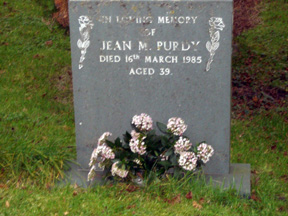
When we reached Grantchester churchyard I could imagine the dreich day when you were laid under the grass beside your mother. It’s a rather unkempt, inauspicious corner with nothing to draw the eye of casual visitors who meander between the stones. Had I been asked to order your memorial I would have insisted on a granite carving, Here lies Jean Purdy, the World’s First IVF Nurse and Embryologist, died 1985 aged 39. But your name painted on a gray headstone is being eaten away by rain and wind, the plastic flowers the most cheerful feature of that bleak spot. Rupert Brooke would have walked over from his rooms at the Vicarage to compose an ode.

Jean's grave

*A Surgeon’s Story by Roger Gosden and Pam Walker will be available on Amazon soon. See Jamestowne Bookworks for news.

Next Post: Gold in my Garden

Posted in Memoir | Tagged , , , , , , , | 4 Comments