Black Bear like a Hairy Bell-ringer

Yesterday was a beautiful experience, but this morning was a revelation.

Shortly after 7:30 am I took my breakfast outside on the front deck, but had to duck down when I saw Sooty already looking for his (hers). He didn’t see me. He came too early for the big feeder to spray a pound of corn and was nosing around for grains left over from yesterday. I snuck inside for my camera and tiptoed outside again in bare feet, but he was leaving the area to wander round the side of the house to our back green at the edge of the woods. That is where I have a small bird feeder for woodpeckers, chickadees, and doves.

The feeder hangs by a coated steel rope between two trees. A basket for seeds and suet dangles half-way across from a pulley and is strung from another pulley fixed to the side of a tree so I can lower it for refilling. It was designed to fool any bear. I knew they had tried to reach it before because there were claw marks on the tree (black bears are very agile), but it was too high and too far across even for an athletic bear to reach.

The feeder is robust and has generally worked well, although it held some mysteries from when I was away. Once, I found the basket broken on the ground, although the horizontal rope was still intact. On a couple of other occasions it was wound over the rope several times and empty. It was not easy untwisting at a height of nearly 15 feet without taking everything down. I wondered if the wind had blown it, but that seemed unlikely in a sheltered spot.

Today, Sooty laid bare the secret.

He nuzzled around near the base of the tree where the pull-rope hangs and is wrapped around the trunk. The doves had already polished off any grain on the ground. I watched as he gazed at the basket so high above, and then reared up on his hind legs against the tree. It was a fine sight and I began snapping pictures through the window. I thought he was going to climb the tree, but, no, he knew a better way.
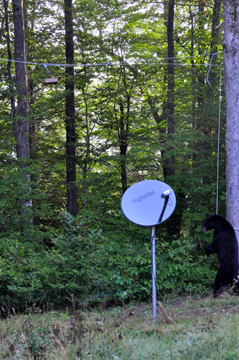
Pulling the rope like a hairy bell-ringer

Pulling the rope like a hairy bell-ringer

He did something that froze me in wonder. While standing on two legs, he reached out a right paw, as I would my hand, to yank on the hanging rope line. The basket jiggled at the other end. He pulled three or four times more until the basket swung 360 degrees over the horizontal rope to dump any contents. All the while he watched the basket intently. When nothing fell out (something emptied it the day before), Sooty repeated the action so the basket swung over again. Then he knew there was point in trying further, and loped off without a breakfast.

The more we learn about animals the more I realize we underestimate them. But I never imagined a bear was that smart. It is surely a trick that has been done before, probably by the same bear, and unlikely to have been taught by another because bears are mostly loners.

Eye on the basket

Eye on the basket

Dogs are smart too, but they are taught their tricks by humans, and the herding abilities of some breeds draw on an old instinct.

The bear had learned by trial and error not to bother climbing, which is so natural for them when gathering food. I guess that on an earlier climb, Sooty had noticed that when the rope moved during his ascent it caused the basket to jiggle at the other end. At some point, he realized that just enough pull , and not all his enormous strength, would bring the reward. I couldn’t have done the job better myself, even if I thought of it.

black bear

Disgruntled departure without breakfast
Posted in Animalia, Nature | Tagged , | 1 Comment

Bearly in Spitting Distance

I had to post this news while it is still fresh in my mind. Around noon today, I decided to take a break from writing and have lunch on the deck of our Allegheny Mountain home. I hoped to see some wildlife.

A pair of hummingbirds was squabbling around the nectar feeder, but the scene was otherwise peaceful. The heads of Queen Anne’s Lace were drooping at the end of their season in the little glade, and beech leaves at the forest edge were still. Only the tops of quaking aspens fluttered in the slight breeze.

I thought I caught a movement in the corner of my eye, but when I turned sharply I only saw the hummers. I went back to my coffee and sardines on toast.

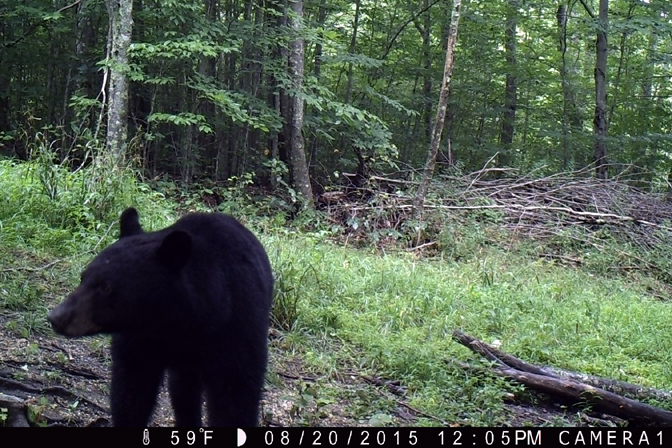
I was still munching when a black form cast across my retina, and looked up. At a measured distance of only 18 feet away, well within spitting distance, was a black bear weighing 250 or so pounds—perhaps the biggest beast I have seen here. How it didn’t see me I don’t understand, unless bears are even more short-sighted than I assumed. He or she was an awesome sight. I was amazed that such a bulky animal could wander so close on a gravel path without making a sound.

Black bear

Sooty bear checks out my camera

It put its nose into the air, but didn’t catch my scent, and then its eyes scanned this way and that, but still didn’t notice me despite sitting directly in its vision without anything between us. I had frozen with my sandiness held aloft a few inches from my mouth, and hoping it wouldn’t notice them!

Black bear

Night-time visitor

After this close encounter, which lasted only seconds rather than the minutes it seemed, the animal sauntered on. I knew where it was going. I had seen it every day since arriving on the weekend, but only through my window and mostly at dusk or later. It goes to find corn under my automatic feeder close-by. My best view was from the downstairs bathroom. It is surely the only shower stall in the county from which you can watch bears, though it’s unnecessary to be bare to enjoy the experience.

I now feel an affinity for the animal I named Sooty, although it doesn’t share my sentiments. On another occasion when it spotted me, it scampered into the woods like a frightened rabbit. But I enjoy the company and fear for its safety. I hope it stays around this refuge and doesn’t bother my nearest neighbors down the valley.

Yesterday, my only visitor of the week arrived to make an indoor repair. He is one of biggest bear-hunters in the county, and he regaled me with stories of tracking down animals as we sat on the deck after he finished the job. But I feel like Sooty’s parent and am keeping mum.


Posted in Animalia, Nature | Tagged , , | 3 Comments

Virginia Nature Journal for July

The Garden of Eden might be a metaphor for peace and, indeed, for the whole world, but today’s gardens are shrunken images. They are lawns to highlight a property; or a pain to weed and mow; or a chance to grow unsprayed fruit and vegetables; or, for flat-dwellers, something strange they don’t want to own. But a garden can be a place of peace for everyone, including city-livers, to connect with nature and for educating children.

Tennyson There are two wonderful local examples in Williamsburg.

Stonehouse Elementary School

This school in James City County started a native plant garden called Habitat in 2004, winning several awards. It is a place where children from kindergarten age through sixth grade have lessons about nature and get involved in garden care.

The garden was originally a barren plot between two wings of a building where turf struggled to put down roots into the baked clay. With the help of volunteers from the Virginia Native Plant Society, a few teachers and parents, and donations from well-wishers, it has been transformed into a rich and diverse habitat.

The project launched with the arrival of truckloads of well-rotted chicken manure and llama poo, which were dug into the ground and covered with mulch to slow erosion and evaporation in baking Virginia summers. The first seeds and small shrubs were in the ground by spring of 2005. All are native species, and most have thrived with the help of human hands and without spraying.

Native plants are more supportive of animal communities than aliens. According to Douglas Tallamy of the University of Delaware: “alien ornamentals support 29 times less biodiversity than do native ornamentals.”

The Habitat at Stonehouse Elementary School

The Habitat at Stonehouse Elementary School

A decade later, it is hard to see any bare ground between May and October. Flowers decorate the top of a multi-story profusion of greenness, and are visited by dancing insects and hovering humming birds. Barn swallows nest in the eaves under a drainpipe, and bluebirds swoop to catch insects. If you separate the foliage you are likely to see scuttling beetles and a praying mantis, and perhaps a frog or even a harmless reptile. None lived there before.

Beebalm burns scarlet, Soldier Mallow towers head-high, and Hoary Mountain Mint hosts nectar-hungry bees. Many other plants are also in full flower, making the Habitat as colorful as any ornamental garden planted with aliens, but it is far richer in life and quite free of poisons. If the leaves of violets, milkweed and Golden Alexander look chewed, we can celebrate the eaters for these are food plants for caterpillars of fritillaries, monarchs, and swallowtails. None of these butterflies were introduced artificially: when their ancestors turned up they made it a home, and for generations to come.

Surely, everyone loves butterflies. Even children growing up nervous of creepy-crawlies will soon offer them a welcoming finger for landing on to become their friend. Children are natural naturalists, and naturally inquisitive about nature. As David Attenborough said to President Obama, the challenge is keeping their interest alive when they grow up.

Williamsburg Botanic Garden

The botanic garden in Freedom Park is mainly populated by native species of the Coastal Plain. There are wetland and meadow habitats for wildflowers and grasses, as well as a green roof pavilion, and a therapy garden. It is a two-acre ellipse open to all ages.

The therapy garden is not like a physic garden of medicinally important species (a good project for the future), but a classroom for children and adults, including people with disabilities. They can get hands-on training for cultivating ornamental and food plants.

It feels good getting hands dirty in dark loam. There is something therapeutic about physically working with nature, and especially a tactile engagement en plein air. Konstantin Levin, a nobleman in one of Tolstoy’s epic stories, became “awfully fond” of hand mowing. He found it was a blissful activity that earned respect from his peasants when he shared in the haymaking.

Tolstoy

The botanic garden has a butterfly garden with a monarch waystation where researchers attach a numbered tag to monarch wings for tracking their migration like bird banding. It draws many butterflies, bees, and other pollinators to suck nectar from the abundant flowers at this time of year. The garden also has food plants for caterpillars of some butterflies and moths, and nearby are stands of oak, birch, and sourwood that are favored by other species.

Never too old to make a new friend

Never too old to make a new friend

Last weekend, the garden hosted a butterfly festival. Hundreds of visitors of all ages, a few in wheelchairs, endured temperatures in the low ‘90s in the long tent so they could walk among the fluttering insects. There were hundreds of specimens from a butterfly farm, including two species of swallowtails, monarchs, viceroys, buckeyes, sulfurs, and painted ladies, and perhaps others I missed.

What a spectacle! How many more human generations will be able to enjoy the more threatened species? It was another garden opportunity against the tide of modern life that alienates us from nature.


Next Post: Mitochondria Matter


Posted in Nature, Seasons in Virginia | Tagged , , , , | Comments Off on Virginia Nature Journal for July

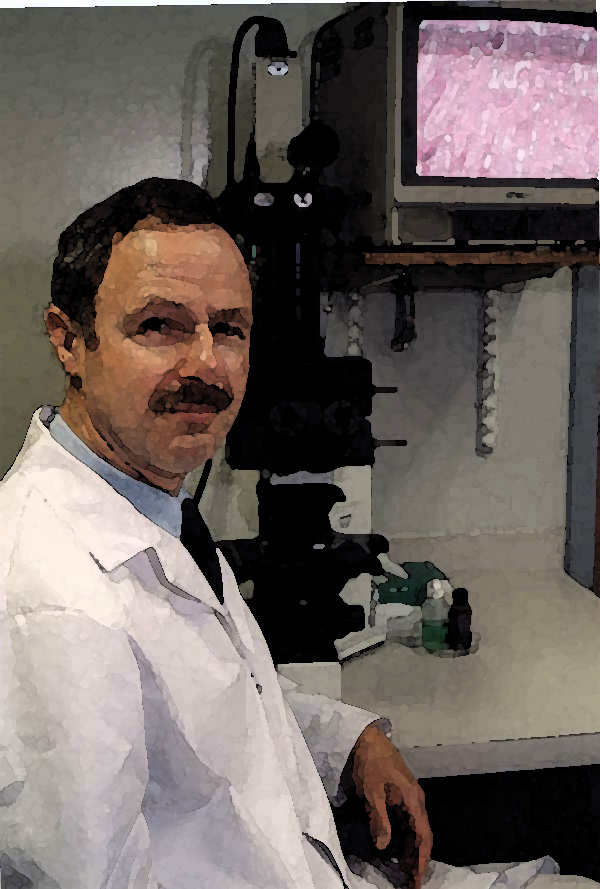
Howard W. Jones Jr., M.D. (1910-2015)

Our dear friend and mentor died today in Norfolk after a short illness. Lucinda and I were able to exchange a few words and smiles with him in the hospital yesterday. He asked how our children are doing—so typical of him.

Howard Jones will be remembered as one of the “Greats” of American medicine because of his pioneering work in reproductive surgery and in vitro fertilization (IVF). He was an inspirational figure for his students and fellows and beloved by everyone who knew him. He had a wonderful blend of humanity, dignity and generosity of heart. Modest and conservative in his own habits, he was indefatigable at work, progressive in outlook and a charismatic speaker. His laugh was infectious.

Some of this character and strength came from his matrimonial and professional partnership with Georgeanna Seegar Jones, a brilliant reproductive endocrinologist. They were a perfect team, sharing an office for most of their careers, co-editing books and journals, and co-supervising junior medical staff and research projects. He said they never had angry words.

Jones Institute

Howard W. Jones Jr., M.D.

Howard was born in Baltimore, Maryland, and graduated cum laude from Amherst College in 1931 and M.D. from Johns Hopkins University in 1935. After military service as a surgeon in France during World War II, he returned to Hopkins where he switched to gynecological surgery and was involved in developing cervical screening services (Pap test) and immortal cancer cells (HeLa cells) from Henrietta Lacks, who was his patient. He remained a surgeon and member of staff at Johns Hopkins until retirement age when they moved to Norfolk and created America’s first successful in vitro program.

When I asked him recently which breakthrough was most important in his career, he replied without hesitation: it was IVF because infertility had been a “great unsolved problem” and the technology has had “a big impact on society.” He became deeply engaged in the ethics of reproductive medicine as an author and committee chairman. Howard and Georgeanna were the sole American doctors invited to Rome in 1984 to advise the Holy See about the new reproductive technologies. I guess that IVF in America was lucky because a controversial technology would surely have drawn greater resistance if it had not been launched by a doctor duo looking like wise and kindly grandparents. Unfortunately, their powers of persuasion did not sway the Vatican, although Howard still hoped for change.

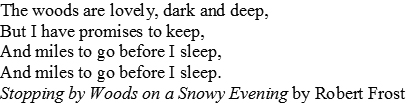
We expected he would lose heart after the death of his beloved Georgeanna in 2005, but he was soon back in his office and flourishing again. New books were published, lecture invitations were accepted when mobility allowed, and young researchers and visitors were welcomed. Work gave meaning and continuity to life, and resonated with memories of his English teacher at Amherst, who wrote:

Robert Frost

The last time I heard him recite the poem was at a conference here in Williamsburg. He was then only 93 years old. We were blessed to have him for more than another decade until he fell ill last week shortly after finishing another book, titled Howard and Georgeanna.

Next Post: Virginia Nature Journal for July

Posted in Biomedical | Tagged , , , | 4 Comments

Trust me, I’m a Scientist!

According to a MORI poll, nine out of ten people in England trust scientists. That’s a higher confidence level than for most professions. Apart from a few bad guys in history and fiction, the public often caricatures scientists as benign boffins with wild hair and white coats who diligently study nature’s most vexing mysteries. Sorry to quash this rosy view.

A Dr. Han of Iowa State University was recently sentenced to nearly five years in prison and a $7 million fine for scientific misconduct. He admitted spiking blood samples with antibodies to make an HIV vaccine look effective. In Japan, a researcher was so ashamed that he hanged himself after a junior researcher was accused of falsified data. The study had claimed to find a short-cut for making pluripotent stem cells in regenerative medicine and was published in a highly reputable journal.

These cases came to light because they were making large and surprising claims. Falsification of esoteric research is more likely to go unnoticed, and years of effort and funding can be wasted when researchers follow a false lead.

A century ago in Britain, the Piltdown Man was alleged to be the “missing link” in human evolution, but it was forty years before the hoax was uncovered and paleontology could reset its course. At the same time in Vienna, Paul Kammerer claimed to support the discredited Lamarckian theory of evolution based on forged evidence from mid-wife toads. He committed suicide. Years later, Arthur Koestler wrote a spirited defense suggesting that a Nazi competitor may have fiddled with the evidence to discredit Kammerer as a Marxist sympathizer.

Most researchers accused of wrongdoing nowadays are young, highly talented and ambitious people striving for recognition. Their watchwords are “publish or perish.” They often work in competitive fields funded by an insecure succession of grants; they yearn for a tenured job with the other rewards that a big breakthrough could give them. Cheating sometimes starts when an unintentional slip-up is followed by a cover-up; sometimes the researchers think they know the answers before the data are in and succumb to a temptation to short-cut by fabricating results. Being first is everything in science, and there are no prizes for being runner-up.

Perhaps there are more cases of fraud in biology and biomedical science than in physics because the research teams are smaller, have less oversight and more liberty for individual endeavor. Besides, modern biology depends heavily on image data which can easily be altered with Photoshop. And lastly there are pressures and temptations when research offers commercial applications and industrial sponsorships.

Once trust is lost, it is very hard to regain; the scientific community treats offenders like lepers, at arm’s length.  No matter how talented the guilty party, no one wants to hire a scientist barred from research grants, which are life-blood for scientists. Unfortunately for those connected in any way with the guilty there is collateral harm even if they are completely innocent.

Trust a scientist!

Trust a scientist!

Sensational cases are much rarer than the tip of an iceberg. Most doubtful science goes unreported, hardly crimes at all but flaws of execution and fallacies of interpretation. Yet, the scale is humungous. A US study in PLoS Biology estimated that $28 billion is wasted annually on biomedical research that cannot be replicated. In an influential paper from Stanford University, John Ioannidis (2005) concluded that “in modern research, false findings may be the majority or even the vast majority of published research claims.” Financial interests, prejudices and fields that are “hot” and “competitive” are common factors in the stock of bad science.

The US Office of Research integrity, the NIH, journal editors and universities have all started to wonder what it means and what should be done. Only the most important findings attract the funding needed for confirmatory studies. Notable papers that can’t be replicated for any reason are retracted, meaning that the journals in which they were originally published disown them and purge them from the electronic record.

To bring these cases quickly to the notice of researchers, a journal editor and a medical journalist have created a blog called Retraction Watch. It is shocking to see 50-60 retractions recorded every month, including some from prestigious journals like Nature, Science, Cell, The Lancet and The New England Journal of Medicine. Neither does research originating in an ivy-clad laboratory guarantee authenticity. Editors who contemplate lowering the critical bar for flashy papers and famous names beware!

I dare say that most retracted papers and others that deserve to be printed with disappearing ink were authored by people who never intended ay deception. Their fault was in the design and execution of the experiment or field trial. The underlying reasons are legion: sloppy methods, data massage, flawed design, small numbers of observations, weak statistics, poor controls, unconscious bias, and attention is now being given to poor quality research materials.

Sometimes a study is hard to replicate because it requires a rare skill, but the excuse is getting weaker by the year as biology depends more on technology to eliminate the human factor. Koestler wondered if this explained why the toad experiments could not be repeated in other laboratories. Or perhaps Kammerer was ahead of his time with inklings of the yet unnamed field of epigenetics, but his story is usually given as a warning against forfeiting scientific trust.

Before admission to most professions, novices are required to swear adherence to an ethical code. Doctors swear “first do no harm;” lawyers recite a long oath upholding the laws of the state; and Roman Catholic bishops vow to be faithful to “the Church and Our Lord.” Unlike those ancient professions, scientists are not required to make any oath, and few attend classes in ethics or the philosophy of science (except perhaps in France). Perhaps they should.  Swearing to uphold an ideal does not guarantee integrity, and there are plenty of malpractice doctors, crooked lawyers and agnostic priests, but it might focus young minds on what science stands for and the trust that the public expects. Surely it is truth in endeavor.

Next Post: Virginia Nature Journal for July

Posted in Biomedical | Tagged , , , , , | Comments Off on Trust me, I’m a Scientist!