Playing Possum

Playing possum is something that Virginia opossums do, but so do some other animals—including humans. But because it can help animals to outsmart a threatening predator, can it save us from a terrorist shooter or a rapist or a grizzly attack? A few plucky people have credited their survival through mass shootings in America and Europe to acting dead.

When the Scottish explorer David Livingstone was attacked by an African lion he tumbled into a delirious, catatonic state that bore a resemblance to death. “(The lion) caught me by the shoulder as he sprang, and we both came to the ground together. Growling horribly close to my ear, [the lion] shook me as a terrier dog does a rat. The shock . . . caused a dreaminess, in which there was no sense of pain nor feeling of terror, though quite conscious of all that was happening.” He survived the ordeal, not because the big cat turned its nose up at Livingstone’s “dead meat,” but after a native teacher came to his rescue.Poem_possum

I was musing about this story after I rescued a toad from our pool. It was a spadefoot toad (Scaphiopus holbrookii), so-called because it has a black, horny spur on each hind leg for digging holes. We rarely see this species because it lives most of the year underground and only ventures out in warm, wet weather.

When I saw it floating with outstretched limbs I guessed it was alive, but after netting it and holding it in my palm it was curled up as if it was dead. Motionless and unresponsive, its eyes were half-closed and both pairs of limbs were gathered in a praying attitude (for a toad). It didn’t fool me, but the attempt might be beguiling to someone who wanted to eat it. So I set it down on a rock beside the frog pond and stood back to watch. Two minutes later an eye cracked open, then a limb extended tentatively, and next it had disappeared into the pond with a fruity “plop.”

spadefoot toad plays possum

spadefoot toad plays possum

I can’t find any reference to spadefoot toads playing dead (scientifically called thanatopsis/ thanatosis), although it has been observed in other amphibians and when I cast a wider search I found examples in a range of animals. Some, like the toad, simply look moribund when threatened, but the hog-nosed snake goes further by emitting a foul odor to repel predators from taking “old meat.” There are sharks, iguanas, fire-bellied toads, cichlid fish, and even spiders that play dead, although in the last case only among males courting a much larger female. Even rabbits will sometimes act this way, although this might surprise people who grew up on a diet of heroic stories about Hazel and Bigwig (Watership Down by Richard Adams). Orcas have no predators so when they are acting dead they hope to trick their prey.

Scaphiopus holbrookii

Back from the dead

It must have taken many generations for these behaviors in toads and other prey species to replace the more natural instinct to fight or run or hide. Evolution comes at a high price of mortality until the hunted have perfected their act for fooling the hunter. But what should people do? Apart from those who play dead as art noir, it’s probably not wise in real life, and the security services don’t recommend we try when in dire straits.

Next Post: Where the Bee Stings


Posted in Animalia, Nature | Tagged , , , , , | Comments Off on Playing Possum

Crazy about Chelonians (Turtlemania)

As I exited our driveway there was a screech of brakes and I had to join a line of stationary cars on the highway. This is an accident black spot. But while waiting for the wail of sirens and flashing lights of emergency vehicles, the lead car in the opposite lane started moving forward. I rolled down my window as it passed and watched the driver curl a grin under his mustache. I wondered about the dark humor and what those ahead of me could see as we crept forward and rubbernecked to the roadside. Soon enough I too was smiling.

Something looking like an upturned brown soup bowl was padding slowly to the safety of the grassy verge. It was a yellow-back slider. Had the reptile been a snake instead of a turtle it would never stop traffic: some motorists would even swerve to guarantee it never completed the crossing. Perhaps it is the strange beauty and harmlessness of turtles that touches our kinder hearts, or maybe turtle dreams because they symbolize good things—fertility, wisdom and longevity.

Rhodin poem

There are twenty-four species of turtles inhabiting Virginia’s waterways and coastline—from the tiny Eastern Musk Turtle (2-4”) to the grotesque Snapping Turtle (18”) to the giant Leatherback Turtle (record carapace length 74”), but only one of them is a landlubber.

Eastern box turtle

Eastern box turtle

When I first saw Terrence on our lawn I assumed he was a pet tortoise that had escaped from a neighbor’s yard, but I was wrong on both counts. He is an Eastern Box Turtle and a wild Virginian. Europeans differentiate turtles and tortoises according to whether they are aquatic or terrestrial, but they are all called turtles in America. I may have been mistaken on another account because I assumed Terrence was male, but I didn’t rudely turn his shell over to examine his plastron. Perhaps “he” is a Teresa.

Updike poem

Terrence seems to nonchalantly trust that his carapace will keep him safe, and only ducks inside for a minute when I hold him or rub his shell. A bony carapace has been a wonderful protector of his tribe for 200 million years, but not any longer since a new predator on wheels arrived on the block. We mourn highway casualties.

Terrence - a curious chelonian

Terrence – a curious chelonian

Perhaps it is their naivety, vulnerability and inoffensiveness that appeals to us, or that innocent head swiveling on its periscope at a dangerous world that makes even aggressive drivers slam on brakes to avoid making chelonian pie. There are few non-furry animals we love more than tortoises/ turtles, especially box turtles and colorful terrapins. Sometimes they benefit from our care, but often they suffer from it. Thousands are legally collected for the pet trade in South Carolina (plus others in Europe), but few thrive in captivity for long, and I regret owning another Terrence when I was a boy.

When I see box turtles I wonder if they will be lucky to outlive me. They have more lives than cats, and are the longest-living animals in the region. Potential centenarians.

You might expect that great longevity will help to preserve the species, but not so—perhaps even the opposite. I mused about the evolutionary trade-off between longevity and fertility in Cheating Time (Macmillan 1996), and a potted story goes like this—

A species living in a protected environment (like a hard shell) or less vulnerable to predation, disease and starvation by virtue of structure and habits is under less pressure to grow up quickly to make lots of babies for perpetuating its kind. It can evolve a strategy of making a greater investment in a robust body that lives longer and matures later, and it doesn’t need to be superfertile to ensure its genes will endure. Mayflies at the opposite end of the spectrum only live for 24 hours as adults, while turtles—well, now you know!

A stretched life plan has served turtles well in the past, and giant tortoises once flourished despite postponing reproduction until around 50 years old. But in the days of ocean exploration and long sea voyages under sail crews took them onboard for fresh meat, and colonists introduced egg-eating predators to their homelands. After decimation their populations have never recovered because their rate of replacement is plodding slow.

Turtle image on St. Helena 5p coin

Turtle image on St. Helena 5p coin

Jonathan is a giant tortoise that was brought from the Seychelles to Saint Helena in the South Atlantic in 1882 and is probably the oldest living reptile. Since he was already mature at capture, he had probably hatched around the year that Charles Darwin sailed in the Beagle in 1831. He now earns celebrity status living in the grounds of the Governor with a personal vet because of the distinction of great age and the threat of extinction for his species.

Believing that box turtles also deserve a special honor, some people have nominated them as the state reptile of Virginia. But when it was put to the vote at the Virginia General Assembly in Richmond, the motion was defeated. A delegate who spoke against the motion declared that any animal that crawls back in its shell at the first approach of danger and yields cravenly to murderous wheels is too much of a coward to represent a state with a proud military history. But if a turtle had made a defense of its kind at the Assembly maybe it would have praised their peaceable nature as a high virtue, and surely the Mock Turtle in Alice would have agreed, for he declared, “we called him tortoise because he taught us.”

Next Post: Is Playing Possum Smart?

Posted in Other | Tagged , , , , | Comments Off on Crazy about Chelonians (Turtlemania)

Down on the Clover Patch

Woe betide the feet that trespass on the hallowed lawns of Oxbridge colleges! But you already know if you have seen Jeremy Irons as a Trinity Fellow nonchalantly striding across the Great Court in The Man Who Knew Infinity (2016). College lawns, golf courses, bowling greens and 40 million acres of American gardens are groomed to degrees of perfection by proud owners and hired lawn companies. The result is a green desert with as much biodiversity as a cornfield, but that is the point of all the effort and expense.

A closely-cropped carpet is no place for bees and other pollinators, something we admire for its greenness and never for fruitfulness. But the original lawns of medieval Europe were never so barren, nor could they have been before chemical fertilizers and powered lawnmowers and aerators. They evolved from meadows in the moist climate that suited them.

When lawns were tended around English manor houses and castles they were mixtures of clover, lily-of-the-valley, wild strawberry, violets, daisies, chamomile, thyme and self-heal among tussocks of grass. All are native plants that grow vigorously without a gardener’s care because they are well-adapted to the environment. Their blossoms used to feed bees before the scythe in midsummer, and some of the broadleaf plants were harvested for herbal remedies. But apart from a few favored grasses, they are marked for elimination in the modern lawn, as the Weed-B-Gon packet advises: “Clover is a perennial weed …” (Scott’s Garden Supplies).

Dickinson poem

The difference between early and modern lawns is like comparing Jackson Pollock’s fractal tracings in his early paintings to the dull murals of Mark Rothko. Didn’t Pollock declare, “I am Nature?”

Few people want a lawn looking early English or like Pollock’s Blue Poles (1952), though most of us admire a wild flower meadow. Perhaps something in between would better satisfy eye and nature— perhaps by encouraging clover in turf, for clover…

Dutch white clover crouches low

Dutch white clover crouches low

… needing no polluting chemicals, provides its own nitrogen fertilizer which improves soil quality,

… has deep roots that require less watering so it stays green even in drought,

… produces pretty blossoms to attract pollinators and doesn’t need to be reseeded,

honey bee visiting red clover… only slowly invades lawns and their borders,

… grows companionably with grasses while helping to squeeze out unwanted weeds,

… doesn’t yellow in our winters like Bermuda and other warm season grasses,

crimson clover is taller for a wilder-look

crimson clover is taller for a wilder-look

… doesn’t brown like grass where pets pee,

… tolerates the shade of trees where grasses struggle to grow,

… and looks lush the year round.

I know gardeners who will huff at this attempt to promote clover, but the monoculture lawn became fashionable only recently and will hopefully yield to esthetics and ecology. Pollock’s Blue Poles was purchased for a modest sum amid much controversy by the National Gallery of Australia in 1973, but it is now displayed in pride of place and worth anything up to $100M. As clover gradually colonizes the lawn I think our garden is going to look a million dollars.

Next Post: Crazy for Chelonians or Loving Turtles too Much

Posted in Environment, Nature | Tagged , , , , | 3 Comments

Dragon Run in a Kayak

Ever dreamt of returning to another era for casting your eyes on celebrities and moments when history was made, but not staying long enough to be risky? Everyone has their favorites, and one of mine is to join Captain John Smith’s crew when they explored the Chesapeake Bay watershed over 400 years ago. I often wonder what it looked like in those days, as I live in it today. His route probably crossed the Dragon Run in the Middle Peninsula of Virginia as he headed for Werowocomoco to meet Chief Powhatan and his daughter Pocahontas. Traveling back in time may always be impossible, but I don’t have to close my eyes to imagine the journey because the Run is one of the few remaining pristine places in the coastal plain that can be explored by canoe or kayak, much as the Mattaponi Indians did for fishing and hunting beaver.

Hiawatha

The Dragon is a ribbon of brown water running through a swamp. Down the centuries it has been lucky to avoid draining, and in recent decades it has been protected, piecemeal, by conservation-minded folk and the Nature Conservancy.  First recorded on maps around 1670, its name has puzzled people ever since. According to one story, plantation owners named it as a warning to slaves who might try escaping across the swamp to free states via the “Underground Railroad.” Perhaps a superstitious belief in dragons deterred them, depending on how awful their circumstances were, but the dangers of getting lost in the swamp were not exaggerated. Even today, it would take a bold soul to cross it on foot, especially on a summer night, but it offers a pleasurable paddle by day in a small party of kayakers. I joined them in April.

A sluggish flow gently carried us downstream so that paddles were used more for steering than propulsion. The channel was barely wide enough to pass other paddlers or to turnaround, and by late May it will be so choked with weed that it is impassable, especially with a low water table. From then until fall the swamp is virtually unvisited, and the rich community of plants and animals return to a peace that is eons old.

Dragon Run

Bald cypresses in the swamp

We glided past bald cypress trees that were already middle-aged when Captain Smith passed this way. Most trees can’t tolerate standing in water for long, but bald cypresses thrive in swamps, perhaps compensating for the low oxygen concentration by growing “knees” above the water level. They are unusual for their family in being deciduous, and on that spring day their bare branches had the first green traceries.  The bole of one tree had a patch of resurrection fern (Pleopeltis polypodioides), which shrivels to limp, brown leaves in times of drought but come back to life when it is wetted, a cycle that can be repeated over and over for a century. Perched on the top of another bald cypress was an old bald eagle’s nest, or as much as a storm had left the distressed owners.

You know when you are in a place that is unspoiled and rarely visited if the flora is overwhelmingly dominated by native species. I hardly saw any aliens. There were royal and cinnamon ferns, fetterbush, featherfoil, rose azalea, pickerel weed, arrow-arum, Virginia blue flag, and so many more, including bloodroot which was harvested by Indians as a medicine. There were plenty of herps too, though we never saw the watersnakes and turtles, lizards and skinks, frogs and toads, and the 90 species of birds, including the gorgeous Prothonotary warbler. Go there in summer if you dare brave the clouds of insects, but that day there were only jewelwings patrolling for prey and freshly-hatched Eastern Tiger Swallowtails dancing overhead. Fifty-five species of fish inhabit the Run, but they didn’t show themselves, and muskrats and beavers dozed in their lodges, digesting the fiber diet they ate the night before.

Middle Peninsula, VA

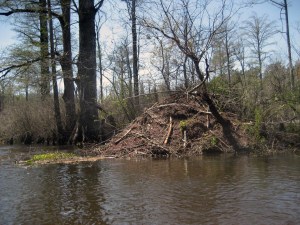
Beaver Lodge on Dragon Run

Dragon Run quickly dams with logs felled by storms and beavers.  A team of volunteers regularly clears obstructions, but the indefatigable works of those aquatic engineers are particularly challenging. The solution to the problem of respecting the beavers’ interests while allowing kayaks to pass was inspirational. The team fixed a wooden board midstream between two posts so that animals could continue to pile logs and branches on either side of them but wouldn’t interfere with the board, which we easily lifted for floating further downstream.

Our hulls frequently bumped over unseen objects, which could have been alarming if we were in alligator country much further south. The water is as murky as brown soup, and for the same reason that it is loaded with organic matter. Although “pure,” meaning free of pollution, it is unwise to practice eskimo rolls there because it is shallow and the ancient ooze below is unplumbable.

Dragon Run is cared for by Friends. All natural wetlands need friends because they are still denigrated for the difficulties of putting them to “use” by developers and farmers, but their virtues as water purifiers, storm buffers and habitats for threatened species is now better appreciated.

A doughty lady at the heart of the conservation program has led paddling parties for years, as she did that day. She must be made of pioneer stock because, even now approaching age eighty, she was our navigator, authoritative naturalist and advocate of wild places. She told me that until very recently she was taking solo tours on the Run to photograph the wildlife at night. I heard she is called the “Queen of Dragon Run,” but in an earlier era she might have been baptized the “Pathfinder” because there could be no one better qualified to lead runaways across the swamp to safety.

Next Post: Clover patch


Posted in Environment, Nature, Seasons in Virginia | Tagged , , , , , , , | Comments Off on Dragon Run in a Kayak

Ghost of the Moa on Sanctuary Mountain (Maungatautari)

We have been tramping up a gently sloping meadow and stopped to gaze through the gloaming at the fuzzy forest border fifty yards ahead. Looking back to the west, afternoon thunder-heads are dispersing into ribbon clouds braided with gold from a sun that has already rolled over the world’s edge. The sky has broken open for the first stars to twinkle and a half-moon to peep out. Lines of hills below look like furling gray waves into the distance, with a dark form lying in one valley like a sleeping giant. Middle Earth is going to sleep as the evening wears on, apart from a few lighted homesteads in the direction of Hobbiton.

The scene wrenches memory back to boyhood days. I would take off after supper with a camera around my neck for flash photography of badgers and foxes emerging from their dens in the twilight. Then, I was headed for a twenty acre “forest” where the orange glow from London never went out at night; now, we stride towards a forested mountain which is disappearing into a primal darkness. Then, it was the North Star I traced from pointers on the Plough (Big Dipper); here, it is the Southern Cross that guides navigators. Then, I used to peer into a village pond for frogs and newts before reaching my destination; now, as I look at the murky giant I remember how it was Lake Karapiro a few hours ago, sparkling in sunshine and from the splash of practicing Olympic rowers.

brown kiwi road signMy son and I have come for the wildlife of the New Zealand night, and specifically for kiwis. We came for prejudice sake, favoring native feather and beak over foreign fur and fang. The closer to the forest the further behind we leave familiar creatures introduced from other lands that have created havoc in the countryside—deer, rabbits, hedgehogs, stoats, ferrets, possums, feral dogs and cats. But when we enter the “Maunga” we will tread the forest lightly, respectfully, even reverentially, as the sole aliens.

Maungatautari became “Sanctuary Mountain” some sixteen years ago when it was encircled by a 47 km pest-proof fence, the longest of its kind in the world. Foreign predators and browsers were eliminated inside the preserve along with as many invasive plants as could be found so that native species could be reintroduced and flourish. For millions of years before humans discovered New Zealand this was an Eden for wildlife and an evolutionary laboratory where strange forms evolved, yet never a serpent. It was an unnecessary luxury for some birds to keep the powers of flight, and gigantism evolved in the absence of large predators except for the Haast Eagle.  But the helpless waddlers and megafauna were under a pressure they could not resist when human migrants started arriving some 800 years ago bringing with them (accidentally or deliberately) a menagerie that drove the moas and other amazing creatures to extinction. Many other endemic species barely hang on today, mostly where predators cannot reach them and their natural habitat survives in the relative safety of offshore islands.

The Maunga was never completely logged, and a good many native trees survive in inaccessible places or by luck. Thankfully there have been beneficent landlords since the days it was owned by a Maori queen, yet the native fauna never fared as well as the flora. At last it is safe to reintroduce some “originals”, such as kiwi, kaka, kokako, takahe, hi-hi, kakariki and giant crickets. I have seen some of them in daylight, but the shier ones only rouse after dark.

Tom is leading me towards a pinpoint of red light in the blackness at the northern entrance to the preserve. He feels for a button he knows will open the security gate so we can step inside a large wire cage and exit into the forest through another gate.

Once inside, we turn on our LED headlamps to look around. The fence is made of wire mesh about 8 feet tall, and there is a thin wire on top suspended by insulators for shocking possums and other agile invaders. To foil the most determined burrower, the fence is buried deep in the ground. I tilt my head to shine light on an information board that explains why and how the Maunga became the first large onshore preserve. It is a story of vision and volunteers to remember when I get home to Virginia.

I am now following the ellipse of light cast by Tom’s lamp on the narrow track. We wind between stands of tree ferns whose fronds lean on long stout stems like enormous fans, and walk under the boughs of unidentified trees (I wonder if any is the famed kauri). None of the trees in this part of the preserve is enormous, perhaps because it was clear-cut years ago and is still regenerating. Elsewhere I have seen some giants, including the rimu which provides nutrient-rich fruit in mast years for kakapo chicks to gorge on. This giant, flightless parrot survives in tiny numbers offshore, but one day this may become its first onshore sanctuary.

The bush grows densely on the rich volcanic soil in an ideal climate, though not as luxuriantly as a tropical forest. We keep to the track and won’t risk getting lost by plunging inside. There are numerous lianas dangling from the taller trees like hawsers dragging from ships in a harbor, and lots of other epiphytes clinging to boles and boughs. As I lean back to throw my light on the underside of graceful fronds of silver ferns I understand why this pteridophyte is a national emblem. It took the darkness for me to appreciate its full beauty, a silver umbrella that could shelter the throne of a South Pacific queen, though New Zealanders rejected it from the design of a new national flag in a referendum this year.

The forest is silent apart from the rattling stream that runs close to the track and an occasional cry as we startle a roosting bird. We stop and turn off our lamps. Although only fifteen feet apart, Tom is suddenly invisible, but I know from experience in woods at night that if we wait for half-an-hour we will be fully dark-adjusted and able to see each other’s ghostly outline and the way ahead, however faintly. But suddenly Tom breaks the silence, exclaiming, “Hey, look!” His night sight is better than mine, but I soon see the amazing spectacle of hundreds of beads of blue-green lights in the bank alongside the track. The word awesome is too hackneyed to express the emotion of being surprised by a joyful sight that was never intended for our pleasure but given abundantly all the same. I feel as if I have parachuted into a movie set where elves have strung fairy lights to guide walkers to a mysterious destination. Perhaps if we hurry we will catch sight of Frodo.

The lights remind me of glowworms I saw while floating through the Waitomo caves. They are not worms, not even beetles, but the larvae of a kind of gnat (Arachnocampa luminosa) that use their lights to attract unwary prey to sticky threads dangling from cave roofs, and like “wreckers” of yore along the English coast. When I turn my lamp on and bring it very close to one of them it fades instantly, and a brown grub comes into view and crawls away.

We have tramped nearly a mile into the preserve without seeing or hearing a kiwi. Tom is confident that they are here but has stopped beside a tall tree to examine a box over a foot long and screwed to its bole at shoulder height. “It’s a weta refuge,” he explains as he twists the outer cover to reveal a narrow passage under the acrylic inner lining. “No one at home,” he sighs. The Giant Weta (Deinacrida spp.) is a cricket 4 inches in length and heavier than a sparrow. I am sorry to miss the largest insect in the world, but he has already switched my attention by crouching to peer into the hollow base of the tree. “That’s huge!” He points from a safe distance at a black tunnelweb spider (Porrhothele antipodiana), and I watch it scuttle out of sight.

If the unexpected is sometimes the most memorable part of a journey, grasping the most anticipated is often the sweetest. We came for brown kiwis which breed here after a century of absence, but there is still no sign of them. I imagine one shuffling towards us like a shaggy specter, too short-sighted to see us and too distracted to bother looking up as it probes for insects and worms with nostrils at the end of its ridiculous beak. There is still a chance of hearing them when females emerge from their burrows or a hollow log after darkness to call their chick to go hunting, but we won’t hear males whistling this long after the courtship season is over.

Brownies are the only kiwis on the mountain, and the commonest of the five species, but nowhere are they abundant. I guess that to encounter one is to feel flung back to an epoch when their cousins roamed here as the avian equivalents of herbivorous dinosaurs, and it makes me sad to think we missed the moas by the blink of a few centuries. Kiwis are the smallest of the ratites, and small is beautiful because it helped them to evade the fate of their giant relatives, which now only live in the imagination or stiffly in museums.

Curnow poem

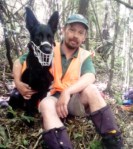
The return of kiwis to the bush is both a triumph and a dilemma for conservation because unless fresh blood is introduced here from other communities their health and reproductive success will suffer from inbreeding. A ranger comes during the breeding season with a muzzled dog whose nose is trained to find their nests. Some eggs laid in the preserve are taken away to incubate in a crèche where young birds are raised for transfer to other havens.Ranger & kiwi dog
The chances of hearing a kiwi tonight are fading and we will soon turn back. We strain our ears now even harder for night sounds and hear a distant, drawn-out “ee-wee” which reminds me of a recording of a weka (a kind of rail). Could we be so lucky to stumble on a rare bird not listed here? Maybe it is only a frog or toad because “Hope is the thing with feathers.” Something is now flying back and forth above us although we only hear it calling “quor-quor,” and because it “comes with gossamer softness” I assume it is the owl morpork.

Peace will reign here again after our last footstep and click of the gate latch. To walk in the woods in darkness is to be a stranger in the domain of secretive creatures that eke out their existence largely unknown and unwatched. Nocturnal visitors never come for hunting or logging, but for watching. And to sit quietly is a far deeper experience than tramping for, as light yields to night, you can feel a progressive absorption with the trees and undergrowth, and a primitive imagination tricks you into thinking you have become invisible, all-seeing, all-hearing.

Perhaps even now a kiwi is close-by in the bush, watching and making fools of us. Next time I will try my luck by watching the path with my back against a tree, just as I did long ago in the badger wood. But wait … I hear something yet, although certainly not a musical voice! A more apt description would be guttural because it sounds like someone is having a painful episode of retching. It is coming again and again, almost monotonously, and further off we can hear another—perhaps calling to the first. Tom is pulling out his mobile phone to check for a 3g signal—it is strong even here. He has found a website with recordings of kiwis and holds the phone between us as we wait for the mp3 to download. Yes, yes, that’s it!

I can now add the kiwi to my list of species encountered in the wild, what birders call a life bird. It doesn’t matter that we won’t see it strutting through the forest as its strange ancestors have done for eons, because its spirit will live in my memory thanks to the Maunga.

Drafted in New Zealand

Next Post: On the Dragon Run with a Paddle


Posted in Animalia, Environment, Nature | Tagged , , , , , | 7 Comments