The last hour of the night seems darkest after tossing and turning to wake from strange dreams with a pounding heart. But there is a spell that can cast off the pall if we listen at an open window in the stillness of a spring morning.
The dawn chorus begins. Not only is there enchantment with the ancient symphony, but moments at peace with nature that help to face challenges of a new day.
The choir begins shortly before light in the east. A northern cardinal chants, wait, wait, wait … chew, chew, chew, chew from a favorite perch in the holly tree. He is joined by the baroque melody of a brown thrasher in a tulip poplar. A Carolina wren poking in a woodpile scratches notes even higher than top E on a violin. They are accompanied by a wood thrush in the back forty playing the flute and a piliated woodpecker drumming a staccato percussion on a hollow tree. The soaring music fades the terrors of a retreating night.
Northern cardinal: courtesy of Inge Curtis
This was a time the birder loved most of all. He rose before dawn to listen to the choir outside and watch for them coming for refreshment to his feeder as the gloaming turned to daylight.
He was old enough to notice the chorus was less dazzling than in his youth, and each year fewer of these friends visited his garden. He nodded gravely at news we have three billion fewer birds in North America today than in 1970, including many common backyard species.
And now the birder has gone, too. “Nothing stays, all changes,” wrote Virginia Woolf. That is a fine maxim for evolution, and a fact we have to accept without consolation.
Spring has not become silent. There are still birds that sing the same songs and as soulfully as ever. But tunes played by fewer pipers or a lonely bugler at dawn are received by those who remember glorious concerts more as elegies now for those we loved and lost.
To Geoff and his feathery friends: Requiem aeternam dona eis. ♬
There’s a family I know in the Allegheny Mountains of West Virginia that has made maple syrup for over a century. As they are now short-handed of youngsters leaving for city work and the retainers get older and frailer, I offered to help this year.
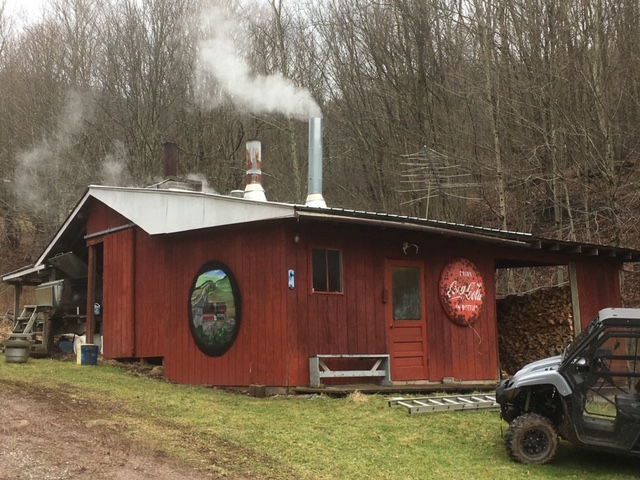
I sat down with Gary in his sugar shack. He is the older of two brothers who manage the operation. They had already checked the network of tubes tapped into sugar maple trees that crisscross the wooded slopes. The sap runs along the plastic channels toward a main line to finally reach a large tank outside the shack.
“In the past we tapped each tree separately,” he told me. “Before we left for school, while it was still dark, we had to bring down heavy buckets full of sap from the woods.”
“I guess winters were harder in those days,” I said. “This is another mild one.”
“Oh yeah. It started snowing in November and the ground was covered until March, even April. Blizzards piled snow high as fence posts.”
His brother Ronnie came inside. As first I didn’t recognize him in the dense steam filling the room.
“Hi. We need the extractor to clear the air,” he said, wafting a hand to clear the fog.
“I’m up for that,” I chipped in. “When your family started making syrup was it to supplement farm income in winter?”
“Not at all.” It was Gary who replied. “What our Granddaddy made was the only source of sweetness for the family. He never bought sugar at the store.”
“Nowadays, we only make it to keep the tradition going, and sales just about cover our costs,” Ronnie added.
Before we fixed the extractor on the tin roof, I brought in some logs from the huge pile they had cut and split last year. It’s cheaper to boil sap over wood fires than use electric or gas heaters. There’s no shortage of wood in and around the Monongahela forest.
Much of their equipment is homemade and looks antique. Harvesting sap doesn’t cost a penny when it runs by gravity and is boiled with local wood, but costly in time and effort. The fluid is fed into a large tank over the first fire which is kept alight around the clock. If it starts foaming Ronnie squirts from a proprietary bottle to raise the surface tension. In the old days they used a piece of bacon. The warmed sap passes to the evaporator, the most modern part of the system, where it bubbles over a second fire and generate clouds of steam. 100 gallons of sap is concentrated to about 2 gallons of syrup. We threw logs on the fires every half hour to keep them hot. Ronnie checked the specific gravity of the liquor with a hydrometer (looking like a long thermometer): the optimum is a narrow band.
It’s obvious when a sugar shack is making maple syrup. While one chimney smokes from a log fire another belches steam from the evaporator. The process runs for up to a month.
I asked Gary to explain the daily cycle.
“Sap don’t flow at night cos of freezin, but starts when it warm up.”
When a tree gets warmer its interior pressure rises and sap flows up the xylem tubes to drip out of holes tapped through the bark, like blood oozing out of a wound. The sugar synthesized in the leaves by photosynthesis the previous summer has been stored in the tree as starch (a polymer of glucose). As spring approaches it is mobilized ahead of the season of growing shoots and leaves, and very slightly sweetens the sap. The yellow-bellied sapsucker knows this too as it drills holes in smaller boughs. When the bird returns it may find an insect in the sticky sap, and enjoy the protein morsel in a carbohydrate sauce in dead of winter.
During cold weather tree roots remain unfrozen and soil moisture is drawn into them by the process of osmosis to generate “root pressure.” Sap rises up the tree in the xylem. That’s the principle, although plant physiology is more complicated. I love to see a family honoring a time-honored process using equipment and principles I can understand in an era when the technology I use is beyond my comprehension. Besides, making maple syrup is a gentle art that does no harm to trees or wildlife.
There’s no other mammal like them. Pangolin, the spiny anteater. They look like dinosaurs reduced to the size of domestic cats, miniature ankylosaurs with armored plates (scales) made of keratin instead of bone with sharp points. They may soon join the big reptiles in extinction.
Today is declared World Pangolin Day by those who care about their fate. I read about them before doing this tiny bit to promote their cause.
Pangolin (courtesy of Pixabay)
These shy, nocturnal animals are found across Asia and in Africa. Eight species in all. Insectivores all. They have a long, sticky tongue for licking up their strict diet of ants and termites, and lacking teeth they grind insect cuticles with stones in their stomach. Evidently capable of long lives, they evolved a slow rate of breeding which makes it hard to restore a depleted population. Captive breeding is not successful.
Besides the threat of habitat loss from forest clearance, they are scooped out of the wild by poachers on both continents, more trafficked than any other wild mammal. In Africa they are bush meat and in Asia an expensive delicacy for the wealthy while the scales are used in traditional Chinese medicine. According to Wildlife Justice, 8 tonnes of pangolin scales from about 14,000 pangolins and worth HK$ 42M on the illegal market were seized in Hong Kong in 2019 alone. An estimated one million animals have been illegally traded in recent years. Unsustainable. The scales that deter natural predators when they roll up in a ball like a hedgehog are no defense against human plunderers.
They are now in the news for another reason. Sold in Chinese markets where wild animals of various species are kept in adjacent cages, a proximity never encountered in nature, they are suspected vectors of the current coronavirus epidemic. If a zoonotic virus jumps species it may mutate in the new host, animal or human, and become more transmissible. Society didn’t learn the lesson of the SARS coronavirus of 2002 when civets in wildlife markets were the probable source of that epidemic.
There is a danger that pangolins will be demonized where human ignorance, profit and cruelty are really to blame. And yet, there are timid hopes that the Chinese authorities in trying to quench this epidemics will close wildlife markets and prosecute pangolin traffickers. Among so many threats and fears in the world, we take comfort in small hopes.
I’m still reeling about our climate crisis/ emergency. We hear the urgency confirmed over and again by experts. Threats imagined far over the horizon that we thought we’d never see in our lifetime are now in plain sight (fires, inundations, etc.). This is probably the biggest shock in my life, and certainly the most momentous.
I am grappling for metaphors of how this makes me feel. I have an old memory of a day walking on the ‘downs,’ the rolling grassy hills in southern England. I headed toward a thin blue-gray line of English Channel on the horizon. The coast was far off but after an hour I had drawn close enough to see choppy waves and white caps. I was eager to watch the tide rolling over the beach and sanderlings snatching a landed morsel by pattering bravely ahead of its foamy front. Still striding on I didn’t realize I was getting close to the cliff edge. There were no cues. I stepped back with a deep breath when I almost stumbled on the precipice and giddily gazed down 300- sheer feet of crumbling white chalk.
Seven Sisters, East Sussex
Likewise, I feel panic about global warming, although my metaphor fails to account for how we can’t step back to resume life as usual, forgetting the brink, as I did after heading back from the downs.
I am now casting around for other memories. When did I become conscious of climate change, and when was I persuaded it was anthropogenic? I ask because people draw a line in the sand at different dates, and some still refuse to. If climate denial is a symptom of a ‘post-truth’ society, it is ironic because science marches with ever greater confidence.
When I checked the history of the greenhouse effect, I found it was known in the Victorian age. Later in the century the Swedish scientist Arrhenius (vaguely remembered from school chemistry) estimated a doubling of atmospheric CO2 would increase average global temperatures by 5°C, not a bad estimate considering the primordial state of atmospheric science. Some 30 years later, a British scientist celebrated the prospect of warming by CO2 emissions because that would improve the dreary national climate! Smog was the greater concern then, although it is evanescent compared to greenhouse gasses.
The winter of 1962-63 was so severe my igloo in our London garden didn’t melt for six weeks. No subsequent year has been so relentlessly cold. In the 1970s there was talk of planetary cooling and a new Ice Age. No more! It was a statistical blip that briefly fooled us about rising trends, like losing sight of the sea for a moment after stumbling in a rabbit burrow on the downs.
By the 1980s there was serious talk about global warming, and I became a believer. I even published my convictions in a Church of Scotland magazine in 1989, the year before the first report of the Inter-governmental Panel on Climate Change. My only satisfaction was the invitation to speak at Women’s Guild meetings at which I showed a home-made model of the greenhouse effect. It was moving to meet elderly women in the audience who worried about our human legacy for the planet; they were streaks ahead of their clergy. I can’t boast of being a pioneering activist because my lifestyle hardly changed. I thought there was plenty of time for society to adjust to a warmer world. No more!
Al Gore did a wonderful service with An Inconvenient Truth. As atmospheric science hardens, most projections in the 2006 film have been confirmed, except the timescale was not pessimistic enough. Probes to measure gases in polar ice recording the fossil atmosphere and in mud cores of ancient lakes to identify prehistoric tree pollen reveal the climate has occasionally changed abruptly in geological history. Instead of centuries or millennia, it can flip from one equilibrium state to another in a matter of decades. This is a tipping point, like a cliff that looks solid one day but tumbles into the sea the next, treacherous to the unwary stroller who thinks the edge is stable and still some way off, until he steps into air.
There were no bees at the hive entrance on mild days last month when I expected to see a few flying to look for flowers. To avoid starvation, I fed them home-made candy, but it was consumed slowly, a bad omen, and there was a minor invasion of ants.
When I inspected the hive last week, I found a few hundred dead bees on the gauze base or stuck to combs. It was very disheartening, again. The colony was strong through the summer after starting as an Italian nuc in late April. There were no signs of hive beetles, mites or wax moths.
Once again, I had to dismantle a dead hive and store frames containing honey, nectar and pollen in the freezer until they are needed by a new colony.
Next time they may be Russians. Honeybees that evolved with tracheal and varroa mites in the Far East are said to be more resistant to these foes. It’s a story of adaptation over countless generations, like the blight that eliminated the native chestnut tree across eastern North America but has co-existed for eons with the Chinese chestnut tree.
The Russians are coming next time
I feel like a farmer who’s lost a cow. I didn’t know my winged livestock intimately, like my dogs, but their loss was more than economic. Visiting their home almost every day, I grew fond of them and gardens close by will miss their services.











 Roger musing about Peace with Nature