Climate Change Sirens

I’m still reeling about our climate crisis/ emergency. We hear the urgency confirmed over and again by experts. Threats imagined far over the horizon that we thought we’d never see in our lifetime are now in plain sight (fires, inundations, etc.). This is probably the biggest shock in my life, and certainly the most momentous.

I am grappling for metaphors of how this makes me feel. I have an old memory of a day walking on the ‘downs,’ the rolling grassy hills in southern England. I headed toward a thin blue-gray line of English Channel on the horizon. The coast was far off but after an hour I had drawn close enough to see choppy waves and white caps. I was eager to watch the tide rolling over the beach and sanderlings snatching a landed morsel by pattering bravely ahead of its foamy front. Still striding on I didn’t realize I was getting close to the cliff edge. There were no cues. I stepped back with a deep breath when I almost stumbled on the precipice and giddily gazed down 300- sheer feet of crumbling white chalk.

Cliffs at English Channel
Seven Sisters, East Sussex

Likewise, I feel panic about global warming, although my metaphor fails to account for how we can’t step back to resume life as usual, forgetting the brink, as I did after heading back from the downs.

I am now casting around for other memories. When did I become conscious of climate change, and when was I persuaded it was anthropogenic? I ask because people draw a line in the sand at different dates, and some still refuse to. If climate denial is a symptom of a ‘post-truth’ society, it is ironic because science marches with ever greater confidence.

When I checked the history of the greenhouse effect, I found it was known in the Victorian age. Later in the century the Swedish scientist Arrhenius (vaguely remembered from school chemistry) estimated a doubling of atmospheric CO2 would increase average global temperatures by 5°C, not a bad estimate considering the primordial state of atmospheric science. Some 30 years later, a British scientist celebrated the prospect of warming by CO2 emissions because that would improve the dreary national climate! Smog was the greater concern then, although it is evanescent compared to greenhouse gasses.

The winter of 1962-63 was so severe my igloo in our London garden didn’t melt for six weeks. No subsequent year has been so relentlessly cold. In the 1970s there was talk of planetary cooling and a new Ice Age. No more! It was a statistical blip that briefly fooled us about rising trends, like losing sight of the sea for a moment after stumbling in a rabbit burrow on the downs.

By the 1980s there was serious talk about global warming, and I became a believer. I even published my convictions in a Church of Scotland magazine in 1989, the year before the first report of the Inter-governmental Panel on Climate Change. My only satisfaction was the invitation to speak at Women’s Guild meetings at which I showed a home-made model of the greenhouse effect. It was moving to meet  elderly women in the audience who worried about our human legacy for the planet; they were streaks ahead of their clergy. I can’t boast of being a pioneering activist because my lifestyle hardly changed. I thought there was plenty of time for society to adjust to a warmer world. No more!

Al Gore did a wonderful service with An Inconvenient Truth. As atmospheric science hardens, most projections in the 2006 film have been confirmed, except the timescale was not pessimistic enough. Probes to measure gases in polar ice recording the fossil atmosphere and in mud cores of ancient lakes to identify prehistoric tree pollen reveal the climate has occasionally changed abruptly in geological history. Instead of centuries or millennia, it can flip from one equilibrium state to another in a matter of decades. This is a tipping point, like a cliff that looks solid one day but tumbles into the sea the next, treacherous to the unwary stroller who thinks the edge is stable and still some way off, until he steps into air.

Next post: Where have all the birds gone?

Posted in climate change, Environment, Other | Tagged , , , , , | Comments Off on Climate Change Sirens

Vanishing honeybee colony

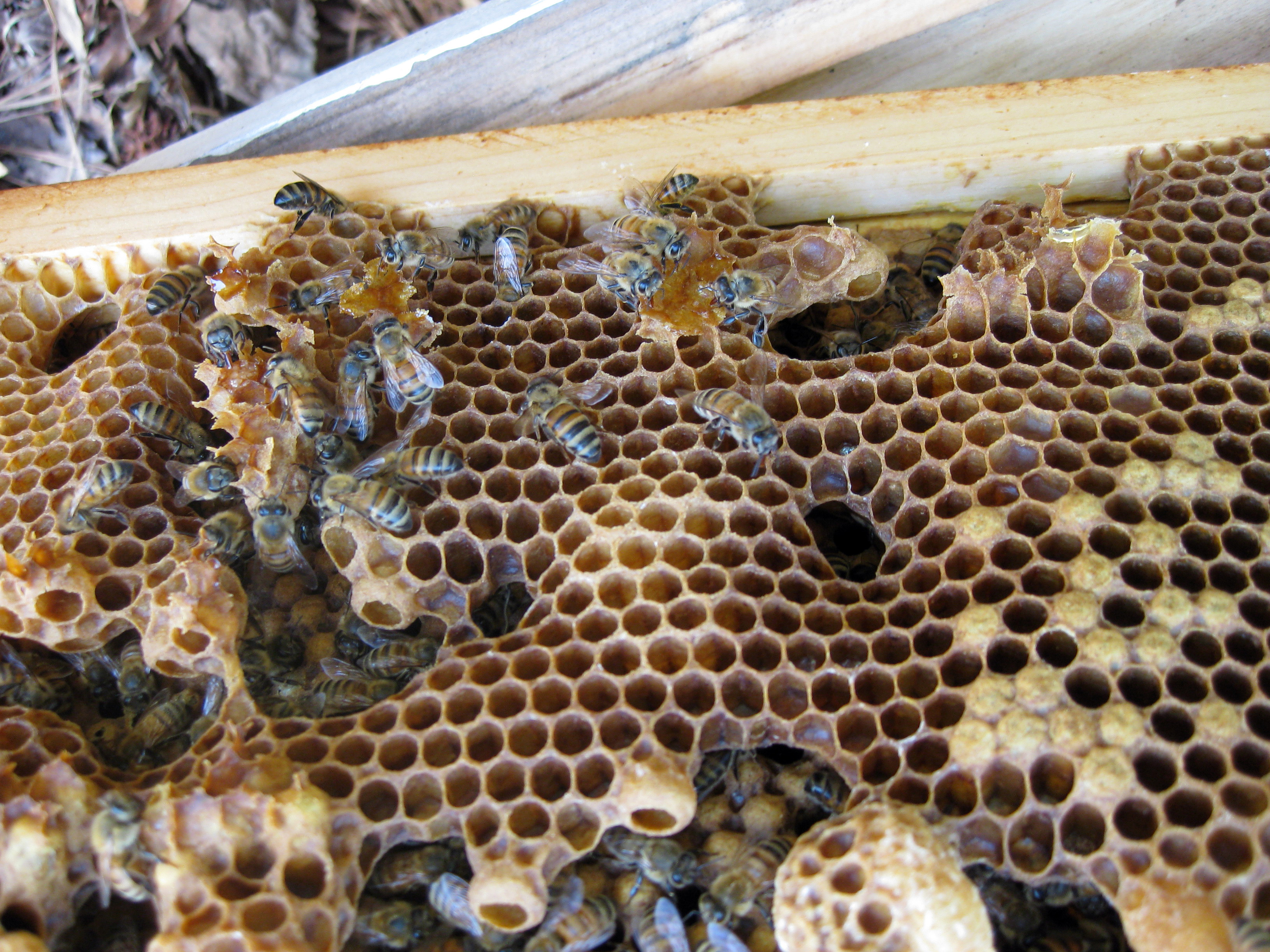
There were no bees at the hive entrance on mild days last month when I expected to see a few flying to look for flowers. To avoid starvation, I fed them home-made candy, but it was consumed slowly, a bad omen, and there was a minor invasion of ants.

When I inspected the hive last week, I found a few hundred dead bees on the gauze base or stuck to combs. It was very disheartening, again. The colony was strong through the summer after starting as an Italian nuc in late April. There were no signs of hive beetles, mites or wax moths.

Once again, I had to dismantle a dead hive and store frames containing honey, nectar and pollen in the freezer until they are needed by a new colony.

Next time they may be Russians. Honeybees that evolved with tracheal and varroa mites in the Far East are said to be more resistant to these foes. It’s a story of adaptation over countless generations, like the blight that eliminated the native chestnut tree across eastern North America but has co-existed for eons with the Chinese chestnut tree.  

Langstroth bee hive
The Russians are coming next time

I feel like a farmer who’s lost a cow. I didn’t know my winged livestock intimately, like my dogs, but their loss was more than economic. Visiting their home almost every day, I grew fond of them and gardens close by will miss their services.

Next Post: A brief history of climate sirens

Posted in Other | Tagged , , | Comments Off on Vanishing honeybee colony

Coping with grief from climate change

Someone I know is undertaking professional training to counsel people about climate change resilience. People who lose someone or something they love to hurricanes, tornadoes and other catastrophes should be offered counselling, of course, and this need is likely to grow as the climate becomes more extreme, which in this area is a threat of more flooding. But I wonder if the counsellor I know will be called on for the psychological effects of climate news and forecasts by people who take warnings deadly seriously even if they have never been personally impacted. I call this climate anxiety.

In a BBC interview this week, David Attenborough said, “the moment of crisis has come …we can no longer prevaricate … we have to change.” He meant carbon emissions, of course. As a much-respected public communicator and naturalist his warning is stark and alarming.

Young people and those yet unborn will live to see the greatest impacts. Symptoms of depression are already on the rise among teenagers (1 in 5 girls in the U.S. in 2017), mostly attributed to online activity and social media, but the statistics are likely to be compounded by apprehensions about how their world is becoming impoverished by climate change as opportunities for concerted political and economic adaptations slip past unclaimed.

“Where there is no vision the people perish.”

Girl grieving on dock
Time to grieve about climate change (Pixabay)

Climate anxiety bears comparison with symptoms of grief when we lose a loved one. Psychologists have divided the familiar kind of grief into five stages, which can be fitted to emotions generated by cares for our beautiful Earth home: 1. DENIAL (weather was never constant and we are currently in a warm phase of a natural cycle). 2. ANGER (climate change is unfair because I haven’t lived long enough to enjoy a prosperous life like the lucky Boomers). 3. BARGAINING (I try to avoid air-travel and buying some foreign goods because doing my bit makes me feel better). 4. DEPRESSION (Every newscast makes me feel more awful and I have nightmares about landscapes changing and species going extinct that rob the joy of living). 5. ACCEPTANCE (OK. I understand large parts of the living planet will die and we won’t halt the process, so I will struggle to make the best of my life).

I admit feeling some of those emotions on different days. I tried consoling myself that “nothing stays, all changes” (Virginia Woolf), considering the five great extinctions before the Anthropocene, and each time evolution roared back with more wonderful living forms. It didn’t work. Perhaps in some far, far off era new creatures will replace those lost, and if humans disappear maybe the next apex species won’t terrorize the earth or will be too dim to invent destructive technologies. But hope doesn’t reach so far ahead.  Coping with environmental grief is is a huge challenge to find personal peace and offer something positive for the spirit of younger generations.

Next post: Vanishing honeybee colony

Posted in Other | Tagged , , | 3 Comments

Growing season extension another bellwether of climate change

The first daffodils of the new year burst into flower in mid-January after a period of mild weather. The buds on some of our trees and shrubs are swelling too, waking up for spring, although they might be nipped by frost this week.

daffodils
Daffodils in January

The weather swings wildly from mild to cold at this time of year in mid-Atlantic states, according to the flow coming from the warm Gulf or frigid Canada. A century of temperature records for the Williamsburg area show huge standard deviations for the interval between last frost of winter and first fall frost. The growing season here is 30 days longer than it was as recently as the 1980s, and the maximum summer temperature in the past couple of decades mirrors the new peaks in national data. A longer growing season helps farmers and gardeners, but for every gain there is a pain—more exposure to ticks and invasive plants, and shrinking habitat for beneficial birds, etc.

growing season and climate change
Extension of growing season in Williamsburg, VA

Next post: Coping with grief from climate change

Posted in Other | Tagged , | 1 Comment

Thank Goodness for Greta

Greta has published a new book. Her first name is all you need to know who I mean … and even that’s unnecessary to recognize the teenager on the cover of the current Time. How predictable that when the magazine made her Person of the Year commentators divided like the fabled sea so the the Children of Israel to could pass. But her passage has been far from smooth or even safe. Many people admire her stoical mien and meteoric rise from a lonely caller for action on climate from the steps of Sweden’s parliamentary buildings to represent millions on the world’s stage. Shameless critics write ugly diatribes, doubtless without reading No One is Too small to Make a Difference (Penguin, 2019). But she joins an admirable tradition of ‘small’ people, like Emmeline Pankhurst and Mohandas Gandhi, harangued for unpopular messages before universal honor.

Greta Thunberg

No matter how sincere a conviction, it is empty without a foundation. Greta earned attention by sticking to science. It is ironic that most climate change deniers are not anti-science, for they embrace its fruits (weather forecasting and electronic media, electricity and air travel, and encourage children to study STEM subjects and acknowledge the benefits of science in countless other ways). Human nature can be puzzling.

Greta writes, “unite behind the science, that is our demand.” The book assumes the authority of careful independent research since humanity has not found a better way to understand the world, make our lives easier, and conquer pain. She urges greater investment in technology for low-carbon economies, wishes for more cooperation and less competition, and hopes for environmental justice and the curbing of habitat loss. None of this is fresh thinking but a young voice must be heard for her generation will live to see how hostile the planet will turn.

The devastating effects of fire I saw recently on Notre-Dame cathedral was an apt analogy for Greta’s speech to the European Parliament. There was a more rapt response and no twitter tantrums there. She said, “I want you to act as if your house is on fire. Because it is.”

Posted in climate change | Tagged | 1 Comment