I have been writing a Substack titled What’s Hot in Fertility? since March 2024. It offers “digestible news and views about reproductive health and science” with excursions into politics and society. If this interests you, please sign up for illustrated posts of about 1,000 words appearing every couple of weeks. Free subscription. I have no intention of monetizing my writing. Find me by googling rogergosden.substack.com Examples of essays:
Embryos and Ethics – when gray matter matters
Reproductive Freedom and Power in Project 2025 – where in the world is America going?
Making Babies on Mars – manifest destiny or manifest error?
Kids and Cats (or Dogs) – kinds of companionship
When Glands Become Killers – cancers of the reproductive system through a biologist’s lens
Godmother of the Pill – Katharine McCormick
Jean Marian Purdy – the hidden life of an IVF pioneer
Coming soon: De-extinction of Iconic Creatures – at or beyond the limits of science
Not much stirs on a sultry afternoon in the Alleghenies. There’s a raven croaking, a Tiger Swallowtail swooping, a bluebottle fly buzzing around in crazy circles. And what seemed at first sight another butterfly, it rises from obscurity on the dirt to hover a few feet up on pale yellow and black wings. Dropping back on the ground, it disappears by folding its colors under brown forewings. Why does a large, juicy insect advertise itself as an easy meal for birds? It is a Carolina grasshopper. Locals call it a locust. It belongs to the family of notorious migratory locusts in Africa (Acrididae). This species has a voracious appetite, as you might expect for an insect 2 inches long with large jaws for chomping vegetation, but it seldom swarms to harm farmland anywhere across its range, which is the entire continent except high elevations. I watched several grasshoppers for 30 minutes, wondering why they beat their wings conspicuously and noisily, making them easy prey for birds. The fliers were males taking courtship dances and vying with each other to attract mates as the larger females watch them perform. Back on the ground, they give chase, but don’t always succeed with a picky female. They reminded me of American Woodcocks, a species I look forward to seeing in springtime. They are perfectly-camouflaged on the ground or lying on a branch, and make a nasal sound on their dazzling courtship flight. This similarity lends new respect for grasshoppers.
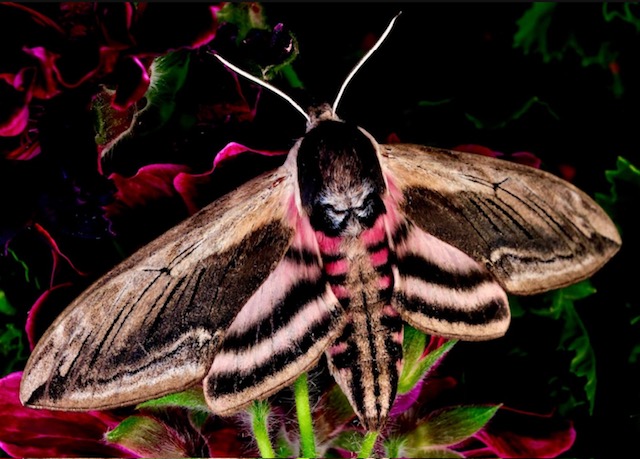
I love this project (click to YouTube). The musician Ellie Wilson worked with Oxford Contemporary Music and scientists who studied biodiversity to transform recordings of night-flying moths into music gently accompanied by traditional musical instruments. Moths are mysterious denizens of the night. Underappreciated compared to glamorous butterflies or beneficial bees, yet they provide pollination services while foraging. There are 2,500 species in the UK alone with only two unwelcome nibblers of wooly sweaters we store in cupboards. Ellie assigned a specific sound motif to each species recorded on a monitor in the field or from tapping their wings inside a glass lamp after getting trapped at a research base on Salisbury Plain, Wiltshire. The composition will have its premier performance on July 5 at the Southbank Centre in London. The team hopes to draw more attention to the plight of nature in the country. Moths are in steep decline throughout their range, like so many wild creatures, but least acknowledged. The music fades toward the end from recordings in a far less biodiverse place: farmland dominated by a single crop sprayed with pesticides.
I have written before about the near extinction of American Chestnuts, called the greatest ecological catastrophe in the eastern forests of America. I tried (and failed) to grow saplings from four nuts received in payment for my article in the American Chestnut Foundation magazine in 2013. The Foundation has made tremendous progress since then, but the unbounded optimism of those days is tattered. The goal is to repopulate forests and parks with blight-resistant chestnuts generated by crossing exceedingly rare American Chestnuts with blight resistant Chinese Chestnuts. By repeatedly backcrossing hybrids with Americans, the saplings will become more American in successive generations, and more resistant by selecting specimens testing negative for blight. The theory is sound, and the latest generation is more resistant but not completely. Plant geneticists aim to identify the genes responsible for Chinese immunity. That knowledge will improve screening and reinvigorate the transgenic program at the State University of New York where saplings did well in labs but failed to thrive in field trials. The Foundation has achieved another kind of success that bodes well for breakthroughs in research. It has cultivated enormous public interest and sponsors despite chestnuts passing out of living memory. I know few people who remember stories told by grandparents or great grandparents about the bountiful trees dominating their forests, providing tasty nuts for them, hogs, and wildlife, also producing beautiful timber that doesn’t rot. I imagine when my generation was young a few of us saw hulking skeletons of the former four billion trees up and down and astride the Appalachian Mountain chain. They probably thought it was past time to restore them, like the extinct passenger pigeon. But today, as we face even more tumultuous environmental challenges, there is energy and urgency among people of all ages. The chestnut is an icon for this movement, and its recovery is far more likely than bringing back the wooly mammoth and dire wolf. I look out for chestnuts on forest walks in the Allegheny Mountains. Occasionally, I find a few leaves on a stem sprouting from roots that survive where an old stump rotted, but are soon struck by blight. But last week I checked a fine specimen in a friend’s backyard. Standing over ten feet tall, it is covered in foliage and even has flower buds although unable to produce nuts because the species depends on cross-pollination. The branches will canker in late summer, as they do every year, but spring growth is a sign of how nature struggling against the odds needs our care and ingenuity to reverse the harms we have done knowingly or out of ignorance.
I have posted articles about reproductive medicine, science, and population on Substack at What’s Hot in Fertility? since the spring of 2024. And shortly I will launch new literary work on my Personal Substack at https://gosden.substack.com/p/welcome-to-my-personal-substack. I hope you will opt for a free subscription: my writing will remain unmonetized.
This is a portrait of my close companions. Ben and Reg lie quietly beside my desk where I can lean down to stroke them. It sometimes helps to overcome writer’s block!











 Roger musing about Peace with Nature