My swimming pool has a thin green carpet. The fish and frog pond is choked with weed and slime. Even sugar water in the hummingbird feeder turned cloudy in 24 hours. What’s going on?
Now I’ve lit my pipe let’s start the inquiry, Dr. Watson. Does the water have a common source? Is it polluted?
Yes and no, Holmes. The water originated from our faucet, but we didn’t spread fertilizer in the garden.
Hmm. Tell me, then, what can make stuff grow quickly in water?
My dear Holmes, I’m reminded of rapidly growing dead zones in the Bay during summer, though the tides were ‘red’ with algae, never green. But if I have the same problem at home the answer must be phosphate.
Congratulations on your deduction and commiseration with the slimy state of your water. Now give it a test.
A combination of colorimetric and laboratory tests confirmed high levels of phosphate in samples from all three sources, but even higher straight out of the tap people drink from. In excess of 4,000 parts per billion, exceeding the sanitation capacity of free chlorine in the pool. How so, when only <100 ppb from the garden well and rainwater barrel?
Remember Flint, Michigan, in 2014? The city managers (that’s what they call them) switched the water supply to save money. Instead of the Detroit river where phosphate was added they drew from the Flint river which has only a low natural level.
Phosphate is added to domestic water supplies around this country, Britain and others included, to avoid poisoning children in homes that still have lead plumbing. It reduces lead in drinking water by coating pipes. Few people seem to know or ask what’s in their water. Phosphate isn’t mentioned in the James City County Water Quality Report, although plenty about bacteria.
Like other living organisms, bacteria need phosphorus to grow, and some kinds are able to liberate more from insoluble mineral. The municipal answer to lead provides more food (PO4) for bacteria and algae to grow, and that consequence is fixed by pumping more chlorine in our water.
Holmes didn’t seem worried about drinking our local water (or that in Baker’s Street, London). He is glad of a generous helping of phosphate in his diet to top up his hydroxyapatite and ATP reserves, but spurns colas supercharged with phosphoric acid for the sake of his brain.
Bird-lovers and conservationists waited anxiously if a colony of some 25,000 seabirds would adopt an alternative base for breeding in May 2020. The south island where they nested for years was paved over in the winter of 2019-20 for a $3.8 bn expansion of the Hampton Roads Bridge Tunnel in Tidewater Virginia. The Commonwealth government approved as a new sanctuary Fort Wool, a deserted manmade island and former naval battery. But would the birds come if they never used it before?
They did. We expect another successful year for terns, gulls and skimmers, some not so abundant as this Common Tern. Hopefully, they will continue to breed there and feed for decades to come in the rich waters not far off the shipping lane of the Norfolk naval base.
Deer came in the night to crunch the corn, a wild turkey arrived at breakfast to nibble wheat berries, and a raucous family of ravens cleared the rest. I rarely wait long for something interesting to turn up in a stone’s throw from my front step.
But I hadn’t heard baying for a long time and felt irritated at the breach of peace on Memorial weekend. I grabbed my camera and binoculars, leaving coffee to go cold on the deck, and ran into the trackless forest strewn with boulders under Middle Mountain that lately wore a green mantle.
After nearly a mile of making a beeline I slowed to approach the hullabaloo. All the while I thought about the mama bear and cubs caught in my game camera a couple of nights earlier. Did they hang around? If so, had they become quarry for West Virginia hunters?
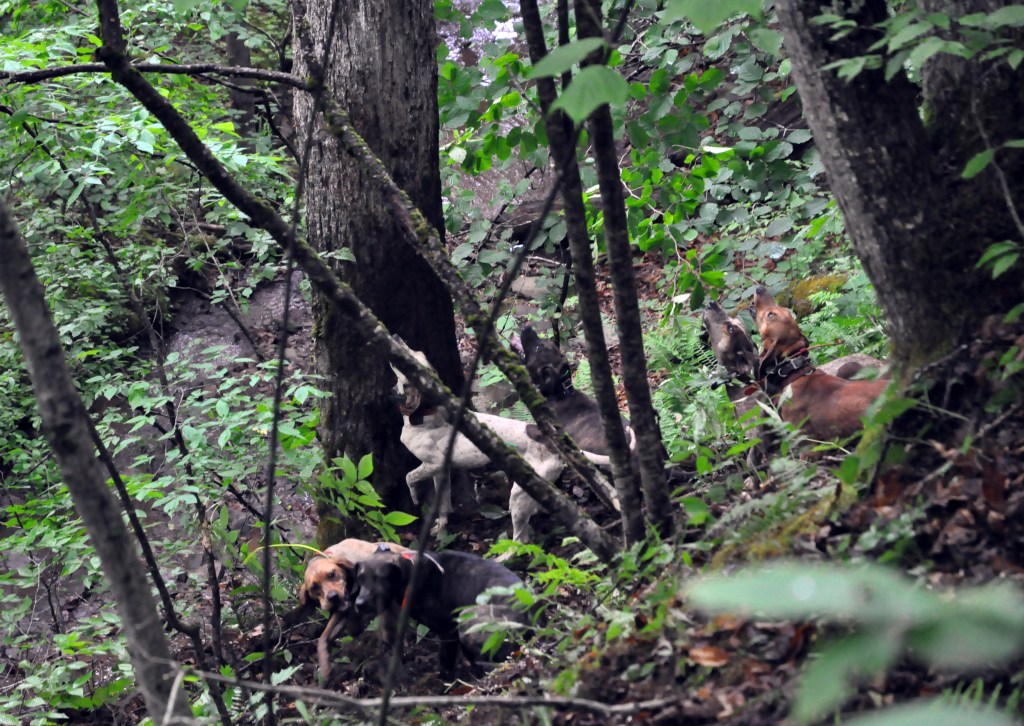
Bear hounds go crazy having ‘treed’ the bear
Closing in, I spotted a pack of nine hounds jumping and howling around the base of a tall maple tree, their eyes fixed on the canopy. Each dog weighing about 40-50 pounds was colored a mixture of brown, black or white. Most too intent on their goal, a chestnut one with its tail wagging attached itself to me, jumping up to lick with a lolling tongue. It might have made a fine pet, though none of mine ever had ribs I could count when its chest expanded with deep breaths. The others were equally lean. Each had three collars, one strapping a small black box with a 9” aerial.
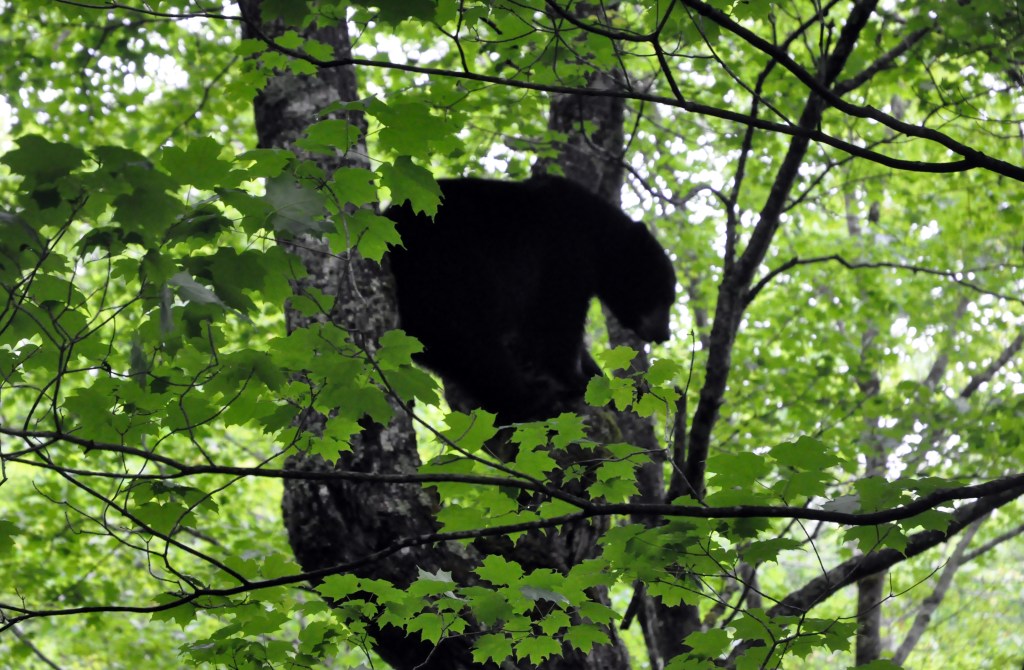
I leaned back to gaze fifty feet up to the first fork where a black form moved. I tried to shoo the dogs but nothing distracted their obsession. I even pushed them aside to stand with my back to the bole but they treated me as part of the tree, landing muddy paws all over me. I never saw a more frenetic scene in the woods, and clambered up a bank, sapling by sapling, to avoid the maddening noise I feared could aggravate my tinnitus.
At the top I had a clear view of the bear. It looked down, often shifting its position. I decided to wait until the hunters arrived, guided there by sound and radio transmitters. This is not the hunting season but I’ve heard that armed men are occasionally tempted to shoot. The nearest dwelling is 2-3 miles away (except ours), and only a couple of wildlife law enforcers in a vast county.
An hour later, two men arrived carrying orange dog leashes and a heavy bag. No firearms. They startled me as I didn’t hear movement through the understory. If I surprised them, it didn’t show when they found me petting the dog and watching the melee below. I wonder if they assumed I came out of curiosity to see a ‘treed’ bear and approved of hunting with dogs. Only half true. The second half I kept to myself to avoid confrontation, as in politics when I know neither I nor my opponent will concede, instead reserving expression for the ballot box or in writing to try to influence policy. Even more important when meeting rifles and crossbows in the woods. A number of states have banned hunting with dogs but the tradition persists as a fiercely defended right in parts of Appalachia.
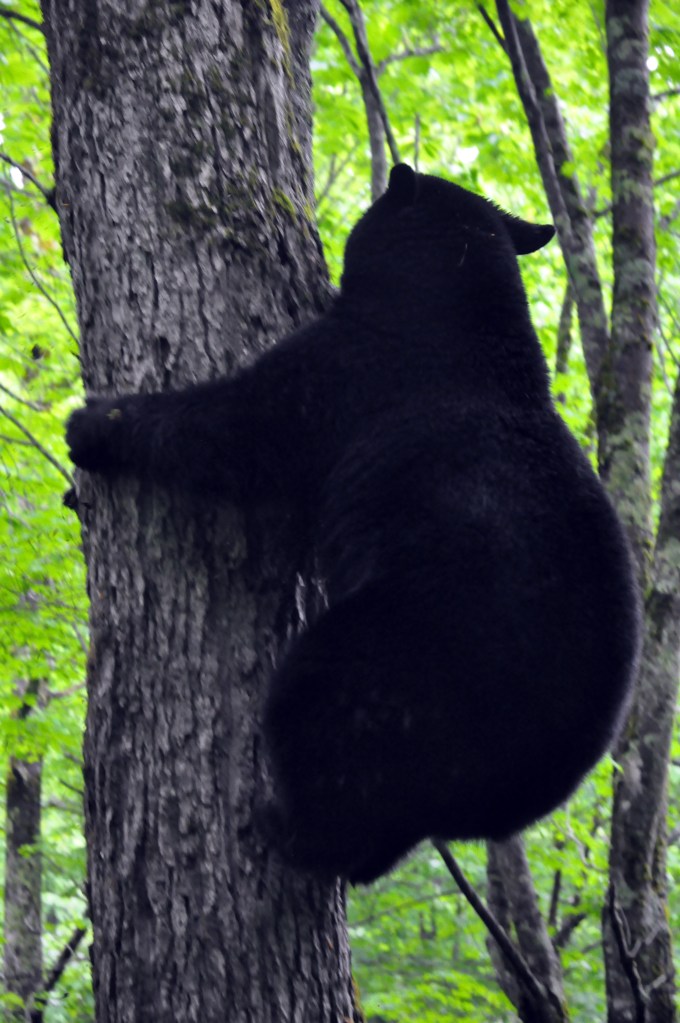
We watched the bear for several minutes, photographing it from different angles. It had a long pale nose and glossy black coat; at around 300 pounds one of the largest I’ve seen in those woods. I thought it looked more handsome and noble than any of us standing there on two legs or four.
The men rounded up the dogs, tying them to branches. One tapped the base of the tree with a heavy branch and when broken he bashed vigorously with a rock. I asked the other what he was doing.
“It’ll bring the ‘baar’ down. Dunno why but perhaps vibrations make ‘im think the tree’s unsafe.”
After several minutes the bear slid under the bough. The man moved away. I pointed my camera half way down the long trunk, my finger ready on the trigger.
I’ve seen bears clamber down in panic when I stumble on one feeding in the canopy. It reminds me of a fireman sliding on a pole to an emergency. I only had time for two clicks before he was on the ground, galloping along the stream bed.
Relieved to see him get away safely, I asked the men how far they had to walk the dogs back. I knew they must have driven to the nearest point in a truck with a kennel in the bed, an odd vehicle on first encountering one.
“Not yet. Dogs need more training.’
That was the hardest moment to suppress an objection. The poor creature was already terrified. It had run ahead of dogs without inflicting a terrible injury on any of them, easily done by one swipe. Each dog released in turn dashed after the bear.
The woods around me fell silent again. My return journey started by losing grip on a branch to slide on my buns down the bank muddied by recent rain until stopping in the stream bed. I felt angry for being clumsy and frustrated at powerless to protect the old man of the woods. I wished him well.
Half-an hour later at the house I heard distant baying again.
Last week Great Blues and now great whites, colonial nesters in the same locality. The Great Egret is a summer resident that catches the eye in flight, its extraordinary long neck folded behind a dagger beak and legs stream behind.
‘Have your cicada’s broken ground yet?’ I need to tell people that our last big bug year was 2013. Brood X is now emerging in north-eastern and mid-western states but the nearest to us in Tidewater is northern Virginia. Frustrated I don’t have a report this time, I am republishing a post from eight years ago:
Back in 1996, Bill Clinton was still in his first term of office, Charles and Diana agreed to divorce, the Unabomber was apprehended, and Ella Fitzgerald died. That year I hadn’t yet dreamt of moving permanently to North America: I was living in Yorkshire where mad cow disease seized the headlines. While so much history has flowed since, Brood II cicadas were all the while sucking tree roots in secret while waiting for the calendar to flip over to 2013.
I first encountered the brood a couple of weeks ago at a rest area on the I-64 west of Richmond. The first thing travelers noticed after stepping out of their cars was a chirping racket from every direction. I had heard them once before when a 13-year brood of cicadas emerged near home in 2011. This year it is the turn of the 17-year ensemble to sing.
For a few weeks every 17 (or 13) years local residents have sleepless nights. The noise can be as loud as a passing truck, and 90 decibels is a level the Occupational and Safety Administration warns against exposure for more than 8 hours a day to avoid hearing damage. Not being respecters of regulations, male cicadas chirp round the clock.
They are among the great wonders of the insect world, but not just because they have one of the longest life cycles. A question that intrigues me is how they manage to coordinate mass emergence. When ground temperatures rise above 64 °F (18 °C) in the Year of the Brood, the fossorial nymphs start to burrow upwards, breaking the surface first at the southern edge of their range (North Carolina) and progressively towards northern limits (Connecticut). Soon there are incalculable billions above ground, more than a million per acre, but during intervening years you are unlikely to see any (except perennial species). So precise is their timing that local residents can plan when to be away on vacation in 2030 for the next big pulse.
They look scary and are the biggest of their kind at an inch-and-a-half long. Their eyes bulge red and wings and legs are striped orange. Through transparent wings you can see a black cigar-shaped body. A bug in a zoot suit, they have a marvelous name, Magicicada septendecim.
I was a member of a naturalist group heading to a wildlife center in the Blue Ridge, but the cicadas in the car park were the most memorable sight of the day. Believed to be a bad omen, superstitious colonists wrongly assumed they were the same as locusts in the Bible that predicted in the Book of Revelation: “Then from the smoke came locusts on the earth …” I guess that every 17 or 13 years there were fiery sermons from the pulpit about the seven last plagues of Armageddon.
For all their fearsome appearance, they are harmless, neither biting nor stinging, and don’t munch vegetation like true locusts. They cause minor tree damage from “flagging” (browning) during nest-building, but are otherwise rather beneficial. Soon after mating and egg-laying the adults die, providing food for critters and fertilizing the soil. Afterwards, the only remaining cicadas are immature “instar larvae”. These nymphs fall out of the tree canopy and those that avoid predation burrow underground to find a juicy root to suck on … and on … and on until the calendar turns.
For the most part, the distribution of broods doesn’t overlap, although they evolved from a common stock a few million years ago. Today there are 15 broods in North America, twelve with 17-year cycles and three with 13-year, and you won’t find them anywhere else. Of the 3,000 species of cicada worldwide, only seven have periodic behavior.
We watched hordes lumbering up tree trunks and walls; saw many flying unsteadily like old flying boats, often crashing into branches or to the ground where robins pounced. For a small bird, a cicada is hamburger-sized (and just as nutritious), so the diners were soon sated. Everywhere across the hard-trodden ground there were holes, about ten to the square yard and a little larger than from earthworms. These were burrows from which they recently emerged, and scattered nearby were transparent brown shells (exuvia) which they had worn for years underground.












 Roger musing about Peace with Nature