This fine fellow sat on a wooden post for a portrait. Never long out of sight in the skies around here, Blacks are the more sociable of the two species of vulture. With a poor sense of smell compared to Turkey Vulture cousins it makes sense to have more eyes on the ground for scarce carrion.
A wake of vultures (nice collective noun for a bird clothed in black who pores over a cadaver) is reluctant to leave a meal when disturbed, for example, by traffic passing close to roadkill. Although their appearance, habits and smell are repellant to most people, they do a fine job clearing flesh that would go putrid and grow pathogenic bacteria that can harm later diners with less acidic, and hence less sterilizing, stomachs.
You don’t have to be born on one to love islands, though I have a double reason, born on an island off another island.
A BBC article about a young couple settling on the Isle of Rum brought back fond memories of staying there for a couple of nights some years ago with a family member. It is the largest of the Small Isles in the Inner Hebrides with a northerly view of Skye’s Cuillin Hills.
Alex and Buffy were chosen from a list of applicants to join the community of about 30 residents. They sought a change in life, and what a change from Bristol, England! Roaming for days in wind and rain over 40 square miles you may never meet another soul, though plenty of wildlife. Red deer and feral goats on the boggy land; white-tailed and golden eagles overhead; otters, dolphins and whales from the shoreline.
Life isn’t so hard as for crofters in the past, who lived in ‘black houses’ until 19th Century landowners turfed them out for more profitable sheep and deer (so-called Highland Clearances). Not even Rum is off the Net nowadays, though off the Grid. There are compensations for leaving conventional jobs, pubs and supermarkets. Fresh air, exercise, no crime and something new and interesting on every hike. Creature comforts can be enjoyed, nestled in a new ‘eco-house’ with scrumptious home baking according to their Instagram blog.
George Orwell chose a hermit life on the island of Jura to the south for writing his novel 1984, but you don’t need to be a self-employed writer or artist to live on Rum. Paid and voluntary work are available for the tiny community and nature conservation.
My first sight of the island was from camp near Arisaig in 1971. We saw a mountain dome 30 miles out to sea in one of those glorious but rare Highland sunsets. Decades later I stayed on Rum at Kinloch Castle, perhaps the most eccentric stately home I ever visited.
Built by an English industrialist who bought the island for recreation, he rests in a mausoleum modelled on a Greek temple, planted incongruously in wilderness overlooking the ocean . His son built the castle in 1900, creating an opulence he couldn’t afford after the 1929 Crash. It had golf and tennis courts, grew hothouse fruit, and had heated ponds for turtles and alligators. Extensive gardens were cultivated by a gang of men said to be paid to wear kilts. I remember the walls of the dark wainscoted hall where majestic heads of deer hung among portraits of the less handsome Bullough family. Painful to see skins of big cats spread on the floor.
After the folly, the island was sold to the Nature Conservancy around 1957 and is now owned and managed by NatureScot to protect internationally important habitats. Among the natural treasures is the Manx Shearwater colony nesting in holes atop a mountain. Perhaps the largest in the world at 100,000 pairs they are at sea most of the year, and in the breeding season only venture back from fishing to their burrows after dark because they are vulnerable to predators.
I climbed to their redoubt, arriving around 11 pm, an hour before complete darkness at that latitude in midsummer. Nothing stirred until midnight when weird croaks from their catacombs alerted me. Then ghostly birds flapped around silently, even in arm’s reach. With an LED headlight I could get inches away before they flew, fearless as they hadn’t seen humans all year.
Some memories never fade, like the first sight of an isle bathed at sunset or the last sight of a Manxie at midnight.
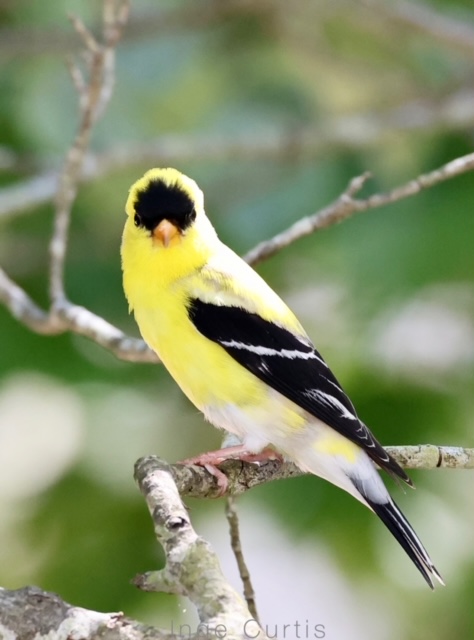
Not hard to imagine a common ancestor of American and European goldfinches managed to make the hazardous passage across the Atlantic to found a colony on the other side that evolved different colors over time. A single member of the European species was recorded here in 1999, although possibly released or escaped from captivity.
They are common, with similar habits and belong to the same genus. But of the pair the American deserves the name as breeding males are cloaked in canary yellow and sooty black, whereas Europeans have only a yellow flash on the wings. Both delight the eyes, twittering with apparent joy as they pluck seeds from flower heads, deserving the collective noun, a charm of goldfinches.
Photo: Annapurna range (Giacomo Berardi, Unsplash)
I confess to be an inveterate obituary hawk. The ‘vet’ bit in inveterate is telling as my compulsion comes with the territory of the latter half of life.
I don’t scour obituary columns for names I know or like or love, or even for people whose behavior I despise, for (the bell) “it tolls for thee”. Obituaries pack the history of a whole life into a tiny capsule and occasionally one captures my attention so vividly I hunger to know more and feel sad to miss the subject’s acquaintance.
I never met Sunderlal Bahuguna and didn’t even know his name until he died from covid-19 on May 21, 2021, at the age of 94. What drew me to his story by Hridayesh Joshi, a Mongabay journalist who knew him, was the transparent goodness of a life dedicated to caring for an environment that his people in the Himalayan foothills loved and needed to thrive.
As a bright and educated Indian, he gave up a potential career in parliamentary politics to serve his home district. As an early environmentalist he had a great impact nationally, even internationally, yet acclaim didn’t go to his head. He remained modest and credited much of his achievement to his wife.
As a young man he became a devout follower of Mahatma Gandhi, which says much about his character and lifestyle. He went on long marches, fasted to make public protest, fought against ‘untouchability’, and practiced non-violent activism against political and commercial oppressors of his people and the forest.
For many years he led the Chipko movement against logging companies whose depredations threatened fragile ecosystems around local communities. He organized protests against the Tehri Dam project (largest in India) for displacing of thousands of people from homes and affecting a watershed feeding the sacred Ganges.
The Chipko movement began in the 1970s in the hills of Uttarakhand, a famous destination for Hindu pilgrims and site of the 1968 Beatles Ashram. It started when local women opposed loggers by literally hugging trees (Chipko=hugging). The expression tree-hugger is often pejorative in the West, but only ignorance of its solemn history covers that shame.
Three centuries ago, hundreds of Bishnoi people, most of them women, obstinately resisted the felling of trees in their district to clear land for a new palace. They were massacred. In the end, the maharaja relented and canceled the project. The martyrs helped to inspire a modern movement of forest guardians that wins more sympathy by the year.
In his later years, Bahuguna-ji looked like a brown Santa Claus, a genial figure of gentle temperament. He practiced what he preached by living simply and sustainably, even giving up a rice diet because paddy fields use a lot of water.
We may wonder how a modest exterior with little worldly ambition can make a difference today, though he didn’t achieve all his goals (the Tehri Dam). But he had a facility for mingling care for human welfare with respect for what science knows, driven by a great fire of determination in his heart.
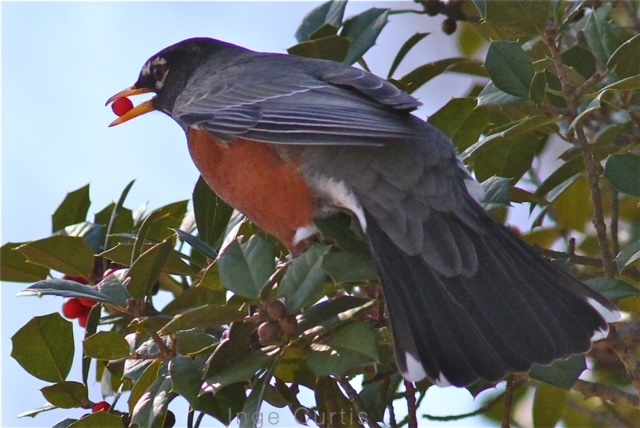
Early colonists in North America who felt homesick called some of the birds they saw by the names of those they grew up with 3,000 miles away—blackbirds, goldfinches, robins, et cetera—although not necessarily related and have different habits and songs.
Take, for example, the American Robin. It belongs to the thrush family whereas robins across the Pond are insectivores, more closely related to the nightingale (both formerly classified as thrushes). It’s a bigger bird than the European and has an orange breast instead of red (hence in Germany Rotkehlchen, France rouge-gorge, and Britain robin redbreast). Both are fairly trusting of humans and abundant in gardens and parks. In Britain, the robin became associated with Christmas, often featuring on greeting cards (see Christmas Birds in Archive for December 2013).










 Roger musing about Peace with Nature