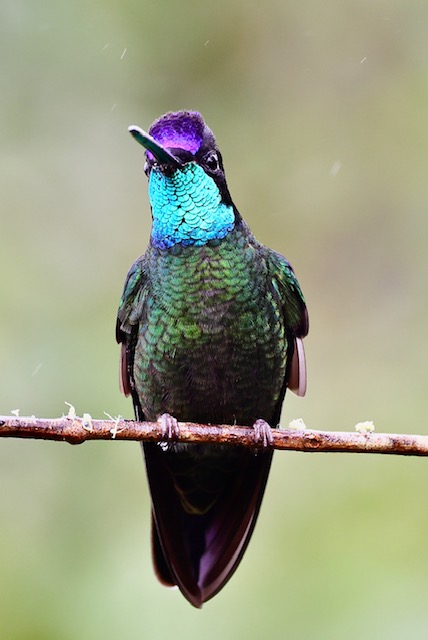
Just as the most famous sultan of the Ottoman empire, Suleiman the Magnificent, was known by different names according to region, the formerly named Magnificent Hummingbird is called Rivoli to the north of a boundary between Nicaragua and Costa Rica and Talamanca to the south (now split into separate taxa).
Not easily mistaken for other hummers, it is one of the largest with a 7” wingspan. The male has an iridescent blue-green throat gorget that serves as a brilliant flag to show his worthiness as a suitor or warn off competitors.
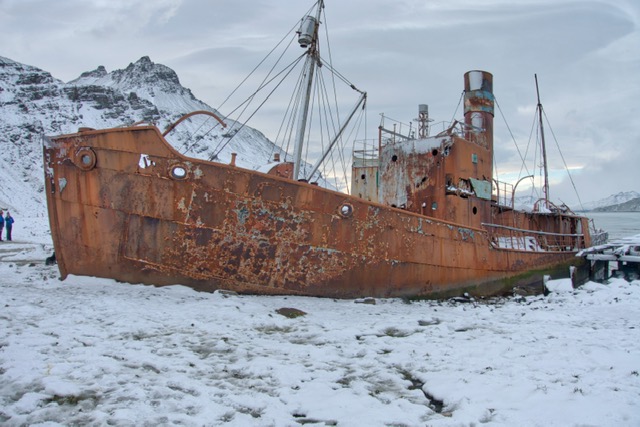
Former whaler at Grytviken. Richard Meyer: Unsplash
There’s something about being island-born that calls you back, even if delivered there by accident (instead of London).
Gazing from a mainland shore, if I see an island I feel drawn to visit and savor the mystery. It is Avalon guarding King Arthur’s bones; it is Ludovico Einaudi’s Islands. Some I have known harbor memories of medieval monks living in caves, others are cities for nesting seabirds, while my island is sandcastles on the beach and flying kites on top of the ‘downs’. But not all are so idyllic.
Gruinard off the west coast of Scotland was a no-go island for 50 years after the government contaminated it with anthrax spores in a wartime experiment to develop a biological weapon. And Lundy off the north coast of Devon used to be a base for Barbary pirates. Both have lost all traces of dark history.
Not so for South Georgia, a 100-mile-long streak of mountain in the South Atlantic. It was a refuge for Ernest Shackleton’s crew after an epic voyage when pack ice crushing their ship close to the Antarctic continent forced evacuation by rowboat across the Southern Ocean in 1916. One of the most remote places on earth and associated with polar exploration, it is in fact only 54°S compared to Edinburgh at 55°N.
Between 1904 and 1965, some 175,250 whales were processed at Grytviken and other locations. Ghosts of that industry are strewn around the stations: rusting tanks, boilers and hulls of whaling ships. Thankfully, today there is no more gore, litter of bones or stink of boiling blubber.
It wasn’t the rise of oilfields that put whaling out of business but the tapering of stocks. Hunting became highly efficient by arming harpoons with a grenade. Imagine the outrage today if hunters blew up hippos, the closest living relatives of whales, which I vouch are not as smart as whales and their relatives.
What went on far from home and under the waves took a long time to wake public sensibilities. Since the 1980s we have a commercial whaling moratorium that is now generally observed, except for two nations, and just in time to save species from extinction.
Given a chance, nature can come back and as bountiful as ever. Islands offer outstanding opportunities for conservation. Images of Grytviken flicker between the ruin of former industry and vitality of rewilding. Rookeries of four species of penguins exist in greater densities than anywhere else on earth. The sky is full of the cries of seabirds and thousands of albatrosses nest on the hilltops. Fur seals and elephant seals bask with their pups on the beaches, fearless of humans they seldom encounter. Offshore, humpback, fin and blue whales blow spouts of water and dive unmolested. What a draw for a naturalist who delights in wildlife on the rebound.
To visit South Georgia would be like going home as it is a British territory. But despite the pull of another island to check off my list, it will only exist for me in pictures and imagination. Apart from a tiny staff in the summer months, the only visitors are from an occasional cruise ship stopping en route to the Antarctic. They step on shore for a few hours, which is no way to get a feel for an island still healing. Do we always have to intrude on nature and leave our mark?
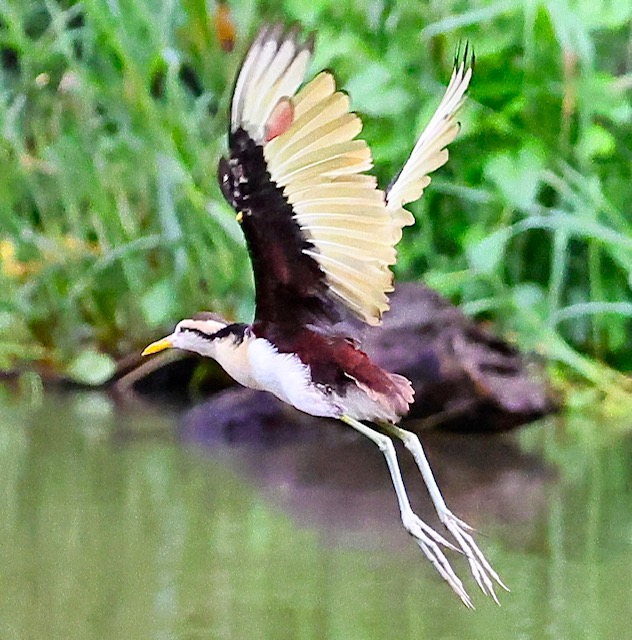
The Northern Jacana is a pheasant-sized waterbird with long toes for walking on lily-pads. Found in Mexico and occasionally in Texas, there are other species in the tropics in the New and Old World.
Females are larger than males, a clue to behavior uncommon in birds (phalaropes an exception). Polyandry. Each female acquires a small ‘harem’ of males who make separate nests for her to lay eggs and they take care of them and the chicks. This is simultaneous polyandry as opposed to sequential polyandry in which a female mates with a series of males.
In rare cases where a female takes over the territory of another female, an emptied nest suggests that she destroyed the eggs or chicks. If corroborated, this is the first bird species in which the female practices infanticide as a reproductive strategy, and comparable to male lions who kill cubs not related to them when they take over a pride.
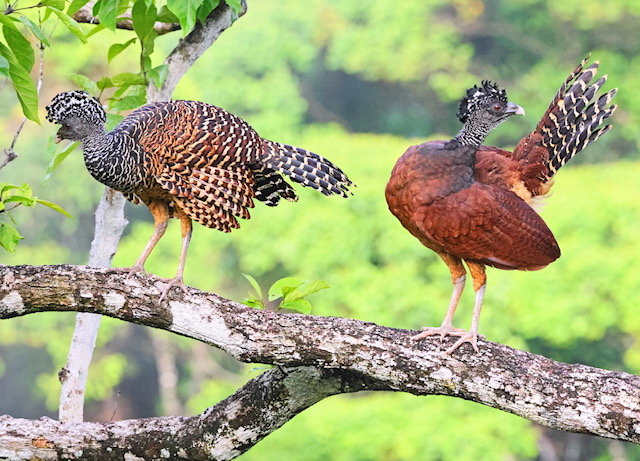
This is a species I may never see in the wild but grateful for this wonderful image of two female Great Curassows in the jungle of Costa Rica. It introduced me to a whole new family, including cracids and guans, as exotic as they sound.
Found throughout Central America and into Mexico, these wild turkey-sized birds are uncommon, not surprising considering adults carry up to 10 lb of meat. Females occur in three morphs, which can merge where they overlap, and those pictured here are the barred variety. Males are different, black with a curly crest and yellow knob on their beak, they care less for camouflage than swanky looks. They are monogamous, but that’s not necessarily characteristic of large, shy birds as we will see when the Northern Jacana appears on a post.
Watching sparks fly in the night around a scout camp fire, we often burst into song. One of our favorites was the graveyard song, called the hearse song in other versions. One of the stanzas goes:
The worms crawled in and the worms crawled out
They crawled in thin and crawled out fat
Your eyes fall in and your teeth fall out.
Your brains come tumbling down your snout.
Ooh__________ Ahh__________, etc.
In those days, most British funerals were burials in a churchyard. The ceremony, funereal dress and manners gave us the creeps even before we imagined decay in the coffin. There were hundreds of ancient monuments in our parish graveyard, each marking a place where flesh and bones turned to dust since medieval times.
There was nothing cheerful there and plenty to feed our ghoulish imagination. On our way home from scout meetings, we often detoured to dare the youngest recruit to dash through the yard on his own in the dark. The white face back at the gate and breathing hard should have made us feel guilty of hazing, but all went home happy after treating the victim to fish and chips.
We heard Roman Catholics refused to be cremated and thought the funeral pyres India a weird Oriental practice. But no more. Cremation is now the norm in many Western countries. The ceremony, if you can call it that, has a clinical atmosphere, but the ashes are more practical for the family who may not be around to care for a burial plot. It seems progressive, except for the pollution from crematoria and huge amounts of wood needed for Hindu pyres.
When you reach a certain age and no longer ignoring longevity, you leave instructions for your body in a will, which forces consideration of the options. While cremation is still king, environmental concerns lead some to choose ‘green burials’ or even burial at sea. Last week, I read that Archbishop Desmond Tutu chose aquamation. I had to Google a word I should I have known because I was a boy aquamater.
As a naturalist-undertaker, I brought home dead rabbits, voles, snakes, etc. to my mortuary in the shed to immerse in concentrated sodium hydroxide. In a few days, the soft tissues dissolved for flushing down the drain. The washed and dried bones were allowed indoors where I tried to articulate skeletons with wires.
This is the same process of aquamation, or alkaline hydrolysis to be scientific. It is regulated by law in North Carolina, though not yet in Virginia. I don’t regard the disposal of dissolved tissue as any more disrespectful than letting it rot or burn. The crushed bones can be kept in an urn, as are those of the archbishop, said to be placed in an honored place behind the pulpit of his cathedral. With minimal pollution and costing less than alternatives, it seems a way to go.








 Roger musing about Peace with Nature