World Honeybee Day at a Meadery

Silver Hand Meadery, Williamsburg, VA

Plans for the morning were interrupted when I heard the Silver Hand Meadery in Williamsburg was filling glasses for all-comers this morning. And why? It’s World Honeybee Day on the third Saturday in August. The calendar event has gone international since 2009 for celebrating the benefits of pollinators and the only kind that manufactures sweet liquid gold.

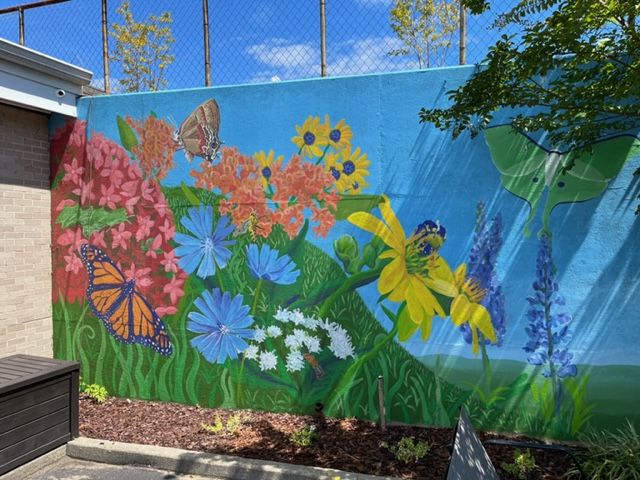
There was more to attract attention than the chink of glasses in a small crowd gathering to start the weekend with “Cheers!” A beautiful mural stretching yards along a wall leading to the front door was unveiled by the meadery’s owners. It is as colorful as a children’s picture book, full of bright flowers, bees, and butterflies under a blue sky. The artist Emma Zahren-Newman titled it: “The Flight of the Honeybee, circa 1622.” Why the date? It is reckoned to be the year when the Virginia Company of London shipped honeybees to the Jamestown colony, then only 15 years old and barely hanging on after starvation and a fractious relationship with local Native Americans.

Although many native bee species exist here, they were probably the first honeybees introduced to North America. Evidently, they didn’t do well in this climate at first, but they followed the westward march of the frontier as European settlers grew new crops that depended on the services of Old World insects then and ever since.

Posted in Bee-line, nature | Tagged , , , , | 1 Comment

Night Flight

Barth Bailey (Unsplash)

Do you fly at night sometimes? I flew in my dreams last night with arms outstretched for gliding over rooftops. I didn’t see any birds although on landing back in reality in the morning I learned that an estimated 10,400 birds had flown across James City county overnight. They headed ESE at an average speed of 14 mph.

The fall migration begins in August for some birds, including green herons, yellowthroat warblers, and the scarlet tanagers that were featured in last week’s post. Normally active by day, they migrate at night for safety. The numbers passing through surged between 10 and 11 pm, flying at 1,500 feet, although nocturnal migrants sometimes fly up to 10,000 feet to save more energy.

I checked other counties I know. Over 64,000 birds flew SSE down the Appalachian chain at around 3,000 feet across Pocahontas county, WV. If you live in the United States, you can check the spring and fall migrations in your country from radar records at The BirdCast Migration Dashboard.

Posted in Birding, nature | Tagged , , | Comments Off on Night Flight

Scarlet Tanager

Scarlet Tanager
Photo: Inge Curtis

Spotting a Scarlet Tanager in the upper story of an Eastern Forest transports me to the tropics. And it is a tropical forest dweller in our winter months.

Our Northern Cardinal is almost as rosy and House Finches a bit less. Their red plumage is thought to come from carotenoids obtained in the diet (originally beta-carotene, the abundant precursor in plants—think carrots). Since tanagers are mostly insectivorous and insects have a lot of carotenoids, there is an easy explanation for why tanagers are bright red, except for an awkward fact.

While cardinals remain much the same color the year round, male Scarlet Tanagers are much less rouge when they go south, although they still have black wings and a black tail. They look like female tanagers, olive-yellow. Their diet is still based on insects in the tropics, so that is unlikely to account for the change. Since their testosterone levels plummet to female levels after the breeding season, does that suppress gene expression in the liver where carotenoids are converted to pigments (by p450 cytochrome enzymes)? Please enlighten me, readers.

Posted in Birding, Inge Curtis birds, nature | Tagged , , | Comments Off on Scarlet Tanager

Appreciation of James Lovelock (1919-2022)

Ozone hole shrinking in the southern hemisphere (NASA, 2021)

Did you ever regret you hadn’t met someone after hearing it was too late? I did today. James Lovelock was one of my scientific heroes. He died on Tuesday at age 103.

I knew people who worked with him at the Medical Research Council in London in the late 1950s. His research on cryopreservation laid foundations for freezing tissues, sperm and human embryos for in vitro fertilization technology. I wrote about this contribution in the biography LET THERE BE LIFE (2019). With hindsight, I am sorry I didn’t reach out for his personal recollections when I interviewed other pioneers for the book. Perhaps I felt too timid to approach a saint.

He didn’t receive universal acclaim for his theories and projections for the global climate. But I admired his courage to be an outsider and able to admit a mistake. Taken as a whole, his works have had immense impacts for science and society.

After prestigious institutions in Britain and the USA, he set up a private laboratory for independent research in a barn close to the county line between Cornwall and Devon. It was a fitting place for a man who began life in a humble home and as a Quaker when careers in British science were hard to pursue without a privileged background for attending university.

He was as much an inventor as a scientist. After pioneering cell freezing in London, he turned to atmospheric research and, then, to environmental science. His electron capture detector became the go-to technology for monitoring atmospheric pollutants, such as chlorofluorocarbons (from refrigerants). CFCs were ‘eating’ the atmospheric ozone layer that shields life from ultra-violet light. Detection of the ozone hole earned Nobel Prizes for two chemists. The Montreal Protocol of 1987 that banned CFCs is a model for global environmental policy.

Lovelock became widely known for the Gaia hypothesis (named after the Greek god for Mother Earth). He regarded the Earth’s atmosphere as a self-regulating whole that maintains homeostasis by feedback between the atmosphere, oceans and life forms, by analogy with physiology. Critics asked how such a state could have evolved through natural selection of countless species (the major forces being phytoplankton, grasses and trees). Nevertheless, the idea is influential and embraced by environmental activists.

Although he declared himself a ‘Green’, he was too much his own man to mind standing outside the mainstream. He ridiculed renewable energy sources now heavily invested by governments and advocated nuclear energy instead. Time will tell which is the better policy, if not already too late for a tipping point in global warming. He persuaded me that the time for sustainable development (i.e., ‘growth’) is past and human society needs to concentrate on resilience and preserving biodiversity.

James Lovelock deserves a seat in the pantheon of environmental guardians.

Posted in climate change, Environment | Tagged , , | 2 Comments

Epitaph to a Dog

Lilah (Golden Retriever, 2010-2022)

We released Lilah today, sending her along the path ahead of us. “You can run to the end and wait for us there!” The path feels empty without our companion, her coat shining white and golden and tail wagging to share joy and unconditional love.

The epitaph on the tomb of Lord Byron’s dog, Boatswain, captures a tribute I wish I had written of her.

‘Near this Spot are deposited the Remains of one who possessed Beauty without Vanity, Strength without Insolence, Courage without Ferocity, and all the virtues of Man without his Vices. This praise, which would be unmeaning Flattery if inscribed over human Ashes, is but a just tribute to the Memory of Boatswain, a Dog who was born in Newfoundland May 1803 and died at Newstead November 18th 1808.’

Posted in Animalia | Tagged | 6 Comments