Not much stirs on a sultry afternoon in the Alleghenies. There’s a raven croaking, a Tiger Swallowtail swooping, a bluebottle fly buzzing around in crazy circles.
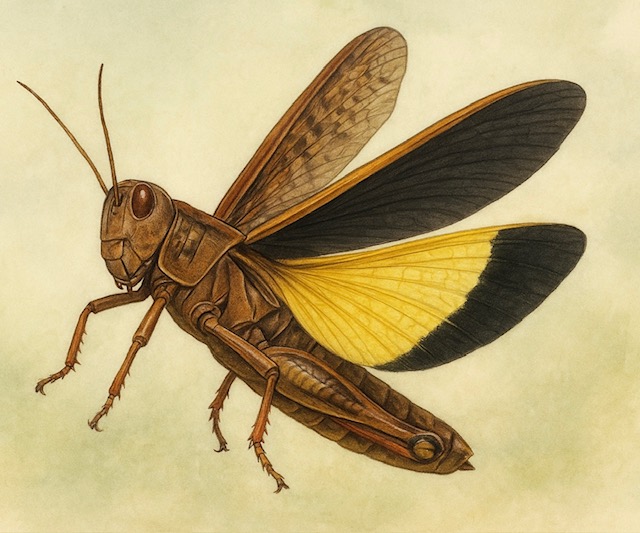
And what seemed at first sight another butterfly, it rises from obscurity on the dirt to hover a few feet up on pale yellow and black wings. Dropping back on the ground, it disappears by folding its colors under brown forewings. Why does a large, juicy insect advertise itself as an easy meal for birds?
It is a Carolina grasshopper. Locals call it a locust. It belongs to the family of notorious migratory locusts in Africa (Acrididae). This species has a voracious appetite, as you might expect for an insect 2 inches long with large jaws for chomping vegetation, but it seldom swarms to harm farmland anywhere across its range, which is the entire continent except high elevations.
I watched several grasshoppers for 30 minutes, wondering why they beat their wings conspicuously and noisily, making them easy prey for birds. The fliers were males taking courtship dances and vying with each other to attract mates as the larger females watch them perform. Back on the ground, they give chase, but don’t always succeed with a picky female.
They reminded me of American Woodcocks, a species I look forward to seeing in springtime. They are perfectly-camouflaged on the ground or lying on a branch, and make a nasal sound on their dazzling courtship flight.
This similarity lends new respect for grasshoppers.