“Thud.”
The sound came from somewhere near our front door. Dull and hollow, not like the sharp knock of knuckles on wood. I knew what it meant.
Peering through the window, I saw a feathery body lying below.
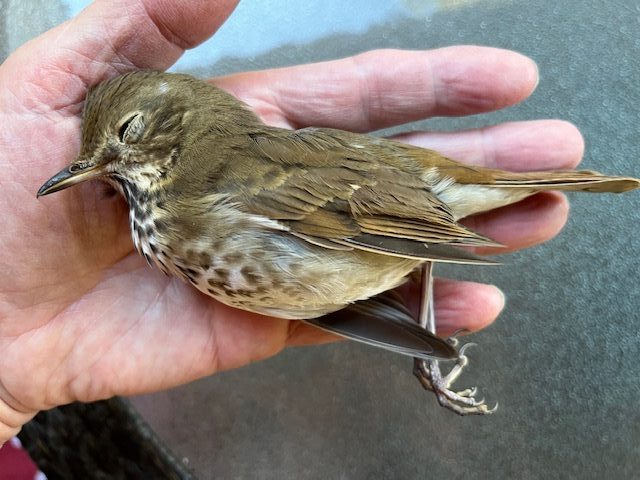
It was still warm when I picked it up, but that wouldn’t last. Its head flopped over. The impact had probably broken its neck.
To call it beautiful is an understatement. Its plumage was olive-brown from head to tail, without the reddish tail feathers of a Hermit Thrush and a breast marked with dark streaks. A pale eyebrow above each eye and pinkish legs helped me identify it as a Northern Waterthrush. Despite the name and looking like a thrush, the casualty was a member of the warbler family.
It wasn’t a familiar garden resident. Northern Waterthrushes are long-distance travelers that fly south after breeding in the northern forests. They favor dense cover, often close to streams and creeks, where they hunt insects and other invertebrates, characteristically bobbing their tails as they strut around. After the summer in northern States and Canada they move to warmer regions in the Caribbean and Central America, even as far as South America.
Most of them have passed through Virginia in September or October. This straggler may have lingered here in the mild fall weather, replenishing the fat reserves it burned on the journey for the next stage of its journey.
Migrants need places to rest and refuel. Our garden might have seemed a promising stopover. Fallen leaves we never bag for disposal provide habitat for invertebrates, which our visitor may have been hunting close to the house.
I suspect something startled the bird, perhaps a Red-shouldered Hawk that often causes panic at the bird feeder. Perhaps it flew through what appeared to be a gap in the vegetation, but was an illusion from glass reflecting daylight and a garden scene. There was no way through.
Songbirds generally migrate at night for safety. But they get disoriented by lights left on in and around tall buildings. Window strikes also happen in broad daylight, often at ordinary houses like ours.
The scale of the tragedy is staggering. More than a billion birds are estimated to die annually from collisions with buildings in this country alone. Some are killed instantly; others recover after being stunned only to die later from their injuries.
Decals and screens on our windows didn’t save this bird, although others may have noticed warnings in time.
Examining the little traveler in my hand made me determined to improve notices for birds scouting around the home. It had survived the hazards of migration—weather, predators, and exhausting its energy reserves—only to meet its end in a garden we try to make a haven for wildlife.