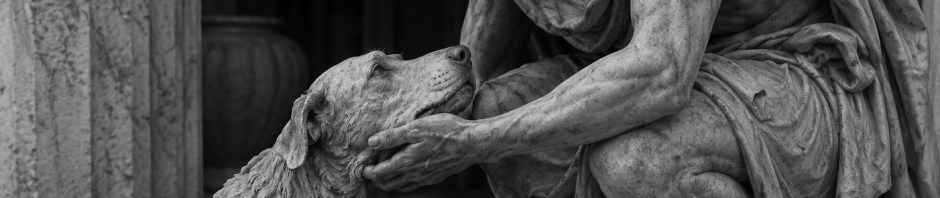
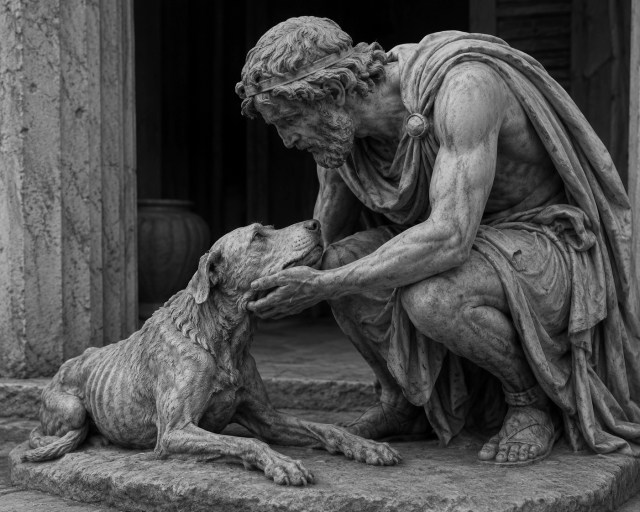
There is no more tender moment in The Odyssey than when old Argos greets his master, who returns home in secret after two decades away at the Trojan War. You don’t have to be a dog lover to be moved by the scene, nor a literary scholar to recognize a passage of extraordinary genius.
After battling monsters, enemies, and temptations, Odysseus finally reaches Ithaca disguised as a destitute beggar. Through his own fatal errors, he has lost every one of his companions and returns alone. He comes incognito to reclaim his kingdom and be reunited with his wife and son after his palace has been overrun by arrogant suitors competing for Queen Penelope’s hand.
As he approaches his home, Argos struggles to raise himself from the manure heap where he has been abandoned, neglected, and covered with fleas.
“He wagged his tail and dropped both his ears, but he no longer had the strength to move towards his master.”
Odysseus instantly recognizes his old hunting dog. Fighting back tears, he cannot show affection lest he betray his carefully concealed identity.
Dog and master mirror one another. Their days of glory as hunter and warrior are long behind them. Both bear the weight of age, hardship, and loss. After a brief reunion seen by no one else, Odysseus follows his former swineherd into the palace, while Argos quietly dies, having lived just long enough to see his master return.
The image of a faithful dog patiently waiting for years has lost none of its emotional power after nearly three millennia. Anyone who has been greeted by a dog at the front door after even a short absence can understand why this episode still resonates so deeply.
The contrast is striking. Most of the human inhabitants of Ithaca have abandoned hope that Odysseus will ever return. His household has fallen into disorder, his wealth is being squandered, and his authority mocked. Argos himself becomes a poignant symbol of the neglected kingdom—once noble, now left to decay, yet still capable of recognizing its rightful master.
Reading this episode again for the first time since boyhood, in Emily Wilson’s magnificent modern translation, reminded me why Homer remains timeless. My anticipation for Christopher Nolan’s IMAX adaptation next week is immense. If he does justice to the meeting between Odysseus and Argos, I suspect I shall struggle to keep a dry eye.
Image credit: AI-generated illustration.







 Roger musing about Peace with Nature