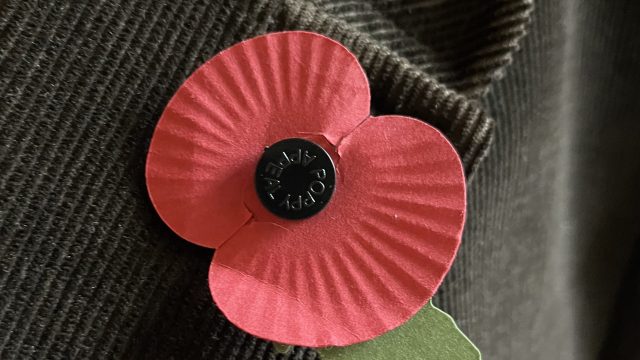
This week you can tell a Brit from the red poppy worn on his or her lapel. Today, I was a lone poppyist in the congregation for a Veterans Day service in the graveyard of Grace Episcopal Church, Yorktown. There are 107 graves from seven American conflicts, including two British burials. The last battle of the first war ended nearby in 1781.
We grew up wearing poppies on Remembrance Day (the British name) and looked undressed without one. We stood at town memorials with veterans of World War 1 and World War II. All have since passed away and fewer descendants mark November 11, although never-ending wars somewhere in the world since 1945 is surely another reason.
The poppy is an apt symbol, but the real flower is too delicate and short-lived to wear. But their seeds are resilient, shooting up to flower abundantly in disturbed soil. A fluttering mass of scarlet is a head-turner. The poem Flanders Fields launched the poppy as a symbol of public mourning.
In Flanders Fields the poppies blow
Between the crosses, row on row …
John McCrae, a Canadian doctor, composed it in the First World War. Poignant for me because my great uncle Leonard Saunders emigrated to Canada, dying at Passchendaele in 1917. A hundred years after McCrae was a pathologist at the Royal Vic, I joined the faculty. I often visited McGill’s Osler Library during my time in Montreal where you can see on exhibition the original poem he sent to a friend from the Front.