The Mind of a Dog

Golden Retrievers English Cream variety
True companions

If you loved an animal and have felt it loving you back (more than just from trained obedience) you probably wondered how it perceives you and itself.  I long to know what my Goldens are thinking.
 Philosophers have asked that question. I wish Thomas Nagel had chosen his pet for a challenging article he wrote instead of asking What is it like to be a bat? However, the nub of it is about the general nature of consciousness, not the character of bats!
 After skimming the paper, I checked what other philosophers are saying about consciousness. It took me down a rabbit hole to a dark place where there was no general sense of direction and I met strange theories, like epiphenomenalism. The subject attracts thinkers to the hardest problem in biology and psychology. If they are unable to agree about its nature in humans, what hope of understanding animal consciousness?
 At least there is wide agreement today that it exists after long being denied, partly on the authority of Descartes. His dualistic philosophy, now happily in retreat, held that animals are automatons with a body but no mind. It is now respectable in science to admit that all mammals and birds have conscious minds, even squids and octopuses whose nervous systems are organized quite differently, and some advocates add species from “lower” phyla, such as insects. Self-awareness is often tested with a mirror for animals whose primary sense is vision, but I can’t tell if a cockroach is conscious because we step on it first!
 Consciousness is not the same thing as sentience, although they are related. Robots can be sentient but aren’t conscious and artificial intelligence algorithms are smart but emotionally absent. Nagel’s article spurred a prickly debate that continues today. He stirred controversy by claiming that the nature of the mind cannot be understood through reductive materialism alone, which is so successful in other areas of science. The mind presents a unique problem that I don’t mind calling mysterious, or doubly so in animals whose perceptions of the world and thoughts are unknowable.
 The evidence of consciousness in animals gives a rational basis for my affectionate feelings toward furry companions. More than sentimental feelings, our minds connect when they are with me. And acknowledging animal sentience binds our relationship to all mammals and birds and perhaps other creatures to a higher ethical standard than in the past.
Posted in Animalia, Nature | Tagged , , , | 4 Comments

All That Breathes

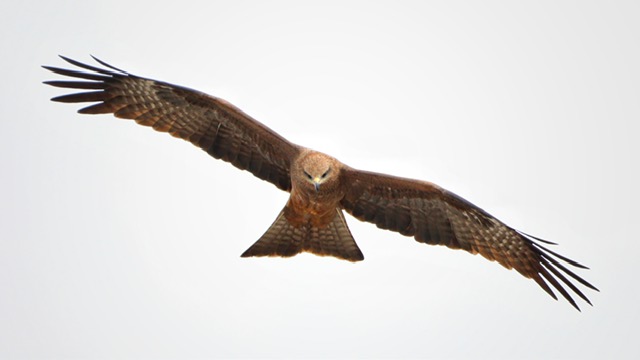
Black Kite
Black Kite. Rahul Viswanath (Unsplash)

I’m not a movie buff, but occasionally something I see stirs me to make a recommendation. When I woke about 30,000 feet above the Congo, I scrolled through a list of movies to entertain the rest of my flight. The cover image of a bird caught my attention.
 There are many fine documentaries about wildlife, but the award-winning All That Breathes renders with subtitles a story of bird conservation like a visual poem. To a background of slum-dwelling and ethnic tensions in New Delhi, two Muslim brothers are saving Black Kites brought sick or injured to their “clinic” in the world’s most polluted city.
 Since Indian vultures were unintentionally decimated by exposure to a veterinary drug that persists in cattle carcasses, the kites have filled the vacant niche. Scavenging helps to eliminate rotting food in mountainous landfills that would otherwise be a human health hazard.
 Up to twenty or more casualties are brought to the brothers’ hovel every day where they apply splints and potions, caring for them until they fly again or die. Their dedication is inspiring, more so because they weren’t discouraged by the circumstances of their lives or the lack of training in avian medicine. Their reward was to see birds soaring over the city again, a symbolic meaning for them and service for all in an interconnected world. 

Posted in Birding | Tagged , , | Comments Off on All That Breathes

A Hardier Zone

USDA Plant Hardiness Zone Map
USDA Plant Hardiness Zone Map 2023

The USDA updated the Plant Hardiness Zone this week, changing our zone to 8A. This is an example of how climate change is affecting gardens and farms throughout the country. We didn’t need a government to tell us. Record temperatures are announced in the national news and we feel the change.
This corner of south-east Virginia has been in Zone 7B for longer than I have lived here. Weather stations across the nation, including the local one in Wakefield, have recorded increases in minimum winter temperatures, which now stands at 10-15 degrees F. (-12.2 to -9.4C.) in our district. We have merged with neighboring North Carolina, which is still in Zone 8A.
Re-zoning inevitably lags after the facts. We haven’t had a bitterly cold winter for a long time. Moreover, plants we were advised are too tender to survive here now throw up green shoots in springtime.

My favorite is Lantana, a shrubby plant that dies down to the ground in the fall. Shoots appearing in May produce by late June waist-high leafy branches with abundant buds promising flowers to attract butterflies and wild bees in the summer. Even as I write this post at Thanksgiving, Lantana is still flowering outside. It seems as if our district has migrated to a milder place 100 miles further south, but of course, it’s the climate that has shifted. What are the implications for the distribution of wildlife? Will I live to see us join Zone 9, like Georgia, where they grow bananas?

Posted in Nature | 2 Comments

The State of Drought

Drought Monitor for Virginia

“Drought—what drought?” That was a typical response to my question before this week’s news of wildfires in Virginia and the Governor declared a state of emergency. I’m sure farmers, beekeepers, gardeners, foresters, and firefighters have worried for weeks, if not longer, about the lack of rain. The difference in perception depends on how close we live to the soil. I noticed a deficiency before my garden well ran dry and a blanket of fall leaves crisp as cornflakes and far more flammable.

I understand puzzled reactions while lawns remain green, and we haven’t had a hose-pipe ban yet. The drought is less severe here than in Shenandoah and north-west of the state. Besides, plants are getting some relief on dewy mornings and there’s less evaporation than in July and August.

A drought can be overlooked until it becomes severe from creeping forward slowly and having impacts that vary with soil type, plant species, and temperature. For the same reason, climate deniers take cover when a sizzling summer is followed by a wet autumn and/or a chilly winter.

Rising sea levels and melting glaciers are undeniable evidence of global climate change whereas the weather is debated more, sometimes hotly. What is normal? Are memories of idyllic summers spent on the beach and winters sledding in our youth our baseline? Most people prefer a plain plus or minus answer whereas it comes down to probabilities (plenty of scope for politically motivated interpretation).

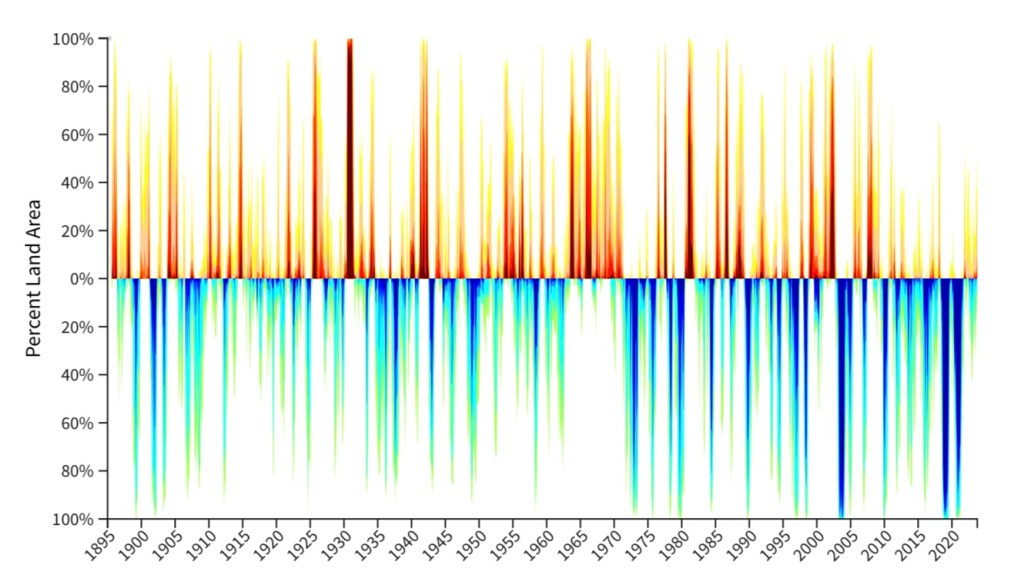
The US Drought Monitor keeps an archive of dry and wet periods since records began in 1895 (and from 400 AD based on dendrochronology). The dark red spikes on the graph for Virginia represent intense drought, and the reciprocal navy blue spikes show extreme wetness. The range between extremes is huge, and much greater than the famously damp UK climate (though recent storms begin to undermine its reputation for moderate weather).

Anthropogenic impacts on climate are reckoned to be notable after 1950. The graph doesn’t reveal much difference to my eyes. An algorithm using the raw data is needed to check if the pattern is random or has a subtle periodicity.  

Posted in climate change, Nature | Tagged , , | Comments Off on The State of Drought

Poppy Day

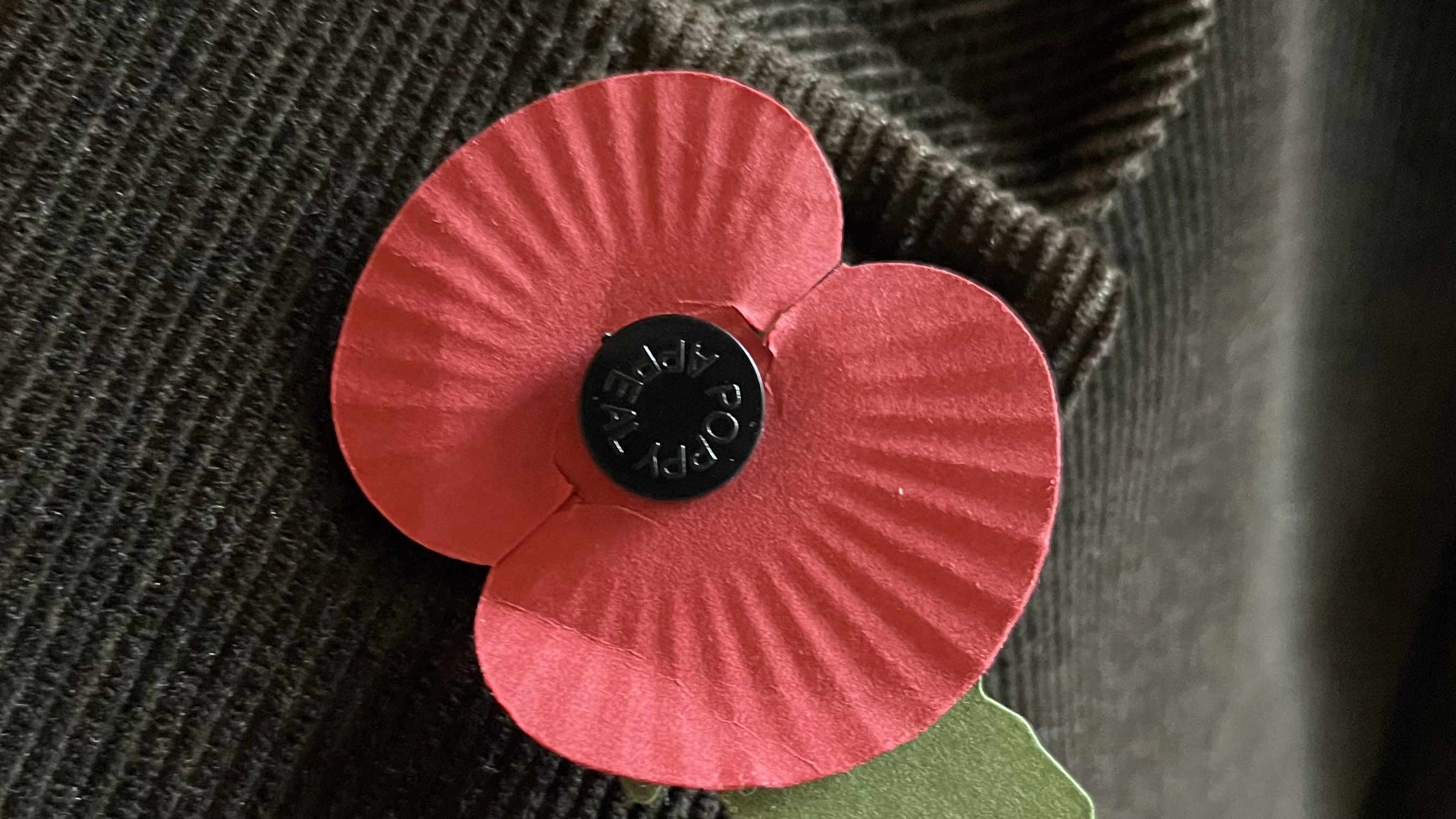
Poppy for Remembrance Day

This week you can tell a Brit from the red poppy worn on his or her lapel. Today, I was a lone poppyist in the congregation for a Veterans Day service in the graveyard of Grace Episcopal Church, Yorktown. There are 107 graves from seven American conflicts, including two British burials. The last battle of the first war ended nearby in 1781.
We grew up wearing poppies on Remembrance Day (the British name) and looked undressed without one. We stood at town memorials with veterans of World War 1 and World War II. All have since passed away and fewer descendants mark November 11, although never-ending wars somewhere in the world since 1945 is surely another reason.
The poppy is an apt symbol, but the real flower is too delicate and short-lived to wear. But their seeds are resilient, shooting up to flower abundantly in disturbed soil. A fluttering mass of scarlet is a head-turner. The poem Flanders Fields launched the poppy as a symbol of public mourning.
In Flanders Fields the poppies blow
Between the crosses, row on row …
John McCrae, a Canadian doctor, composed it in the First World War. Poignant for me because my great uncle Leonard Saunders emigrated to Canada, dying at Passchendaele in 1917. A hundred years after McCrae was a pathologist at the Royal Vic, I joined the faculty. I often visited McGill’s Osler Library during my time in Montreal where you can see on exhibition the original poem he sent to a friend from the Front.

Posted in History, Nature | Tagged , , , | 1 Comment