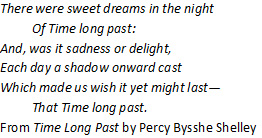
Time Long Past

“Christmas comes round faster every time, Roger, and the years go by more quickly when you get to my age.” Grandma’s warning was also the annual refrain we heard from a lot of older folk as we grew up, and now as we climb into her years we nod agreement.

The end of a year is when time tends to assault our thoughts. It doesn’t, of course, really change outside of Dr. Who’s TARDIS, but the perception matters for every time traveler, and is more urgent when there are fewer miles ahead than in the rear-view mirror of your life.

Shelley

As a perception problem, it’s more the territory of psychology than physiology or physics, and psychologists have had plenty to say about it. For one thing, they found that Eastern and Western cultures agree that time seems to speed up with age, although I would love to know if primitive (I prefer the “primal”) societies share the experience.

ClockOver a century ago, William James suggested time steps into a gallop because there are fewer memorable events or milestones ahead for marking the course of our lives—first day at school, graduation day, first kiss, first job, etc. By analogy, we lose sense of distance traveled on a road trip out of a city when the mile markers peter out in the countryside.

It may have been true in Victorian times that the years seemed to become more “hollow and collapse,” but I think the theory of collapsing time is bunkum now: our lives are rarely static at any age, as long as we are in sound physical and mental health. We dash through torrents of change (“firsts”) in family life, the workplace, and where technology, economics and politics impact our lives. We never reach a slow, meandering river before advanced age.

Psychologists have other theories for time. Some suggest it’s all about the choice of metaphor, that young people may represent time with ones that are more static (e.g., a calm ocean) than their elders (e.g., a speeding train). Others say that our false perception is simply a result of time getting progressively shorter as a fraction of our lives.

But a large study in Germany in 2005 found rather little evidence of any relationship to age, and those who said that time was going fastest admitted feeling under more pressure. Perhaps the mystery largely boils down to lifestyle. I have even heard children say that time is going too fast for them, and they have never been under more pressure to achieve goals and fill schedules. They have fewer empty hours than in my day, which I spent “wasting time” birding in the woods, and when they break from structured activities their brains often feverishly turn to games and social media on their phones and tablets. They keep the pressure on their fingertips.

I hear the poet who dreamt of dwelling in a small clay and wattle cabin to stretch time among the bean-rows and bee-hives.

Yeats poem

As I send this greeting to readers I hope they chill-out during the holiday season and at every other opportunity, so they can report a year hence that 2016 came round more slowly!

Next Post: We’re all Cousins in the Same Family

Posted in Memoir | Tagged , , , , | Comments Off on Time Long Past

The Strange Tale of a Chimera

The Chimera had a serpent’s tail with the head of a lion and a goat on its monstrous body. That was a Greek myth, but real-life chimeras exist. They originate from the blending of cells from two fertilized eggs into a single body.

A chimeric man was identified in California recently after undergoing fertility treatment with his wife. She received intra-uterine insemination (IUI) with his sperm for a gynecological problem: it was successful and they had a son. There was nothing unusual in the case until a routine blood test revealed the boy had a blood type that didn’t match either parent. But how could a third party be involved in his conception? Since there was no doubt that she was his biological mother (no mix-up in the birthing center), the husband opted for a paternity test using a buccal cell sample.

It didn’t match his boy, even after retesting. Had the clinic accidentally mixed up his semen sample with one from another patient going through the service on the same day? Technocuckoldy happens.

The couple’s next stop was the office of a geneticist, before consulting their lawyer.

The geneticist suggested they send saliva samples from both dad and son to a personalized genomics company (23andMe.com). When the data came back the story suddenly changed from alarming to interesting.

The DNA of man and boy was a 25% match, not the 50% expected for normal paternity. Taken at face value, the result suggests the boy was a grandson or a nephew of the man instead of his son. But dad really was his biological parent because when his semen was carefully analyzed 10% of his sperm corresponded exactly to the boy’s DNA. The rest was from an unknown relative! There was a similar mix of origins in the man’s buccal sample, and probably in other parts of his body they didn’t test.

The geneticist deduced that the man was harboring cells originating from a twin brother who had vanished before birth. Dad was a chimera. Cells from his moribund twin had colonized his testicles when they were sharing a womb and became spermatogonia for making sperm after puberty.

Chimerism sounds strange and deeply abnormal, but it is a natural phenomenon. In a few species it is a normal process, even a necessary one. Perhaps the weirdest example is the deep sea angler fish, the one with gaping jaws and a dorsal fin modified like a fishing line that serves as a lure for prey. Those are the females. The males were overlooked for a long time because they are tiny. Instead of mating in a conventional way (perhaps they don’t dare), they become absorbed into a female’s body after fusing with her. It is not a final death for a male because his blood vessels join up with hers, enabling some of his cells to survive, including the all-important sperm cells. The female becomes a chimera after receiving the male fertility transplant, which enables her to be self-fertilized.

Strictly speaking, anyone who receives a transplanted organ or bone marrow from a donor is a chimera. But in mammals most chimeras originate from sharing a placental circulation in pregnancy, and this occurs regularly in marmoset monkeys. In cattle it can have biological consequences.

Freemartin cows were recognized as far back as Ancient Rome because they are sterile, which is bad news for farmers. The 18th Century anatomist John Hunter realized they only occur when a female calf has a twin of opposite sex. Conceived as genetic females, freemartins are affected by hormones carried over from blood circulating in their male sibling. Male fetuses have much higher levels of testosterone and AMH, hormones that masculinize the body and cause the uterus to shrivel.

Cross-circulation rarely causes these effects in other species, although in humans it accounts for some rare intersex abnormalities, and can create nutritional deprivation in a twin with a shared placenta.

We used to make chimeric mice with four genetic parents for tracing cell lineages during development. When an 8-cell embryo from a black x black mated mouse and one from a white x white mating were “unshelled” and fused to make a single large embryo, the pup born after transfer to a surrogate mother was piebald. Chimeric pups were sexually normal with a few exceptions that were either intersexes with a testis and an ovary or had an “ovotestis.” Although fusion was almost 100% efficient in the Petri dish, the shell (zona pellucida) prevents chimerism at early stages of pregnancy in women by covering sticky surfaces that might cause embryos to adhere to each other or dangerously attach to the wall of the fallopian tube during passage to the uterus. Human-animal chimeras are now hot in experimental biology, but that’s another topic.

In Aldous Huxley’s Brave New World, human freemartins created at the Hatchery were not chimeras but made by a purely chemical process. These low caste females were sterile, asexual women with beards. The history of using physical differences to debase or abuse people is old and agonizing, but chimeras have avoided that fate and I have never even heard the name used as an insult. That’s because they generally go unnoticed until a genetic test reveals more than one zygotic origin in the same individual, or a striped pattern of sunburn raises a question of why the skin cells were differentially sensitive to u-v radiation.

Chimeras are more common than we realize, and I even wonder if I am among their ranks. I heard that I had a vanishing twin, although that doesn’t necessarily imply I am like the man at the California clinic who is carrying cells from a deceased fetal twin. Nor is that remote possibility something I worry about, and it wouldn’t give me the creeps even if I had brains cells from a brother or sister fetus. Fetal cell transfer is no more spooky to me than an organ transplant, and a good deal more natural. But the fact of a vanishing twin sometimes causes me to muse how my life would be different if he or she had lived.

Next Post: Mighty Mitochondria


Posted in Biomedical | Tagged , , , | Comments Off on The Strange Tale of a Chimera

Chimps Head for Retirement

In 1871, the now-extinct Hornet magazine published a cartoon of Charles Darwin looking like a human-ape chimera. It was not meant kindly.

Charles Darwin

The Hornet Magazine

We might suppose that progressive Victorian thinkers would have embraced chimps, gorillas, orangs, etc. as newly-found cousins. Perhaps some did, but lonely captivity in bare “prisons,” laboratory experimentation, and hunting continued.

It takes a long time for ingrained attitudes about the “beasts” to change, even when evidence mounts about their cognition and suffering. It’s ironic that medical research which adopted apes for human ends has raised appreciation of them as sentient beings that insists on a higher ethical standard of care not much different to what we demand for ourselves. Jane Goodall, the foremost chimpanzee expert and advocate, urges, “Surely we should treat them with the same consideration and kindness as we show to other humans; and as we recognize human rights, so too should we recognize the rights of the great apes?”

There was a recent instance of how attitudes are changing when the head of the NIH announced that the last 50 chimpanzees in federal laboratories will be retired to a sanctuary for the rest of their lives. The published reasons for freeing the chimps was utilitarian and couched in unemotional waffle (“the need for research has essentially shrunk to zero”), but I’m sure that public opinion influenced the policy. Pictures of apes in cages, separated from their babies, and communicating with people in sign language open our hearts to them as we see more of us in them and vice versa. We are unashamedly sentimental about our pets, and why not for our simian cousins too? This might sound surprising coming from a writer who sometimes used animals in research (never primates), but it’s not shameful to admit a change of heart. The treatment of animals as only subjects of curiosity, cuisine and companionship can evolve to something greater, although I can’t say how far the ineffable feelings can go.

The reason why animals, even apes, never deserved the protection of legal rights was, of course, because they are not human. They don’t have a brain and moral law that in our own estimation justified us as their emperors. The difference between Us and Them is that we regard ourselves as a benevolent species, for that’s what humane means. What a shocking self-deceit!

Most Victorians, irrespective of whether they believed the Creation Story or Evolutionary Theory, thought our species was destined to rule the Earth. The Darwinian revelation that we are a Johnny-come-lately species didn’t puncture that mental outlook, and modern ecology has struggled to fix a truer and more sustainable perspective against the resistance of economic and political forces. The justification for using and abusing animals was the same as that for the mistreatment and malice of other ethnicities of our own species—they were all dehumanized.  Lately, I have been musing when the divorce with nature began.

A new breed of eco-theologians, including the late Thomas Berry, admit that the three great monotheistic religions unconsciously helped to vindicate brutal treatment of animals and careless stewardship of the environment. When people lived much closer to the land as a source of production, there could be greater feelings of unity with the rest of creation, and less hubris exploiting its “goods.” The natural world was a divine revelation that preceded the Scriptures. Still today, some native religions teach that the land and its inhabitants, plant and animal, are sacred, and the sacrifice of an animal taken in a hunt was a sacramental act for some North American Indians.

If I try to pinpoint a time and place in history when Western attitudes changed I choose Medieval Europe. As a devotee of Aristotle, Thomas Aquinas taught that humans stand at the apex of nature’s hierarchy, owing no special moral responsibility to animals, which are only instruments for our use. When the Black Death arrived a hundred years later, killing a third to a half of the population, the church tried to soften the horror of temporal existence and the hard Augustinian doctrine of a broken world by focusing the minds of the faithful on the permanent reward of peace in heaven. With eyes fixed on such a great hope why should anyone bother about the Earth and its creatures? Wasn’t the great lover of creation, Francis of Assisi, just a sentimental monk?

Although the tide of faith started ebbing in the Enlightenment, attitudes towards nature and animal life remained harsh. The wild woods, mountains, and oceans, and the creatures they harbored were dangerous, not precious gifts. Beauty and its ally, security, lay in the towns and cities, and urbanization increased the drift from old feelings of communion with nature. Materialism and its goods had arrived. Pressed to choose a historical figure to represent the changing secular attitudes it’s hard to beat Descartes. He drew a metaphysical gulf between Mind and Matter. Since animals were assumed not to have a mind or self-consciousness (now repudiated), they were regarded as biological machines, mere matter not calling for special care.

The promotion of a bunch of chimps to a gentler life as senior citizens is a tiny example of how public sensibilities have evolved, although there is a long way to go before deep-seated religious and secular assumptions are replaced with more open and enlightened feelings that can bring us closer to our spiritual Earth home. We can expect to see more controversy and struggles over our management of animals—for food production, sporting entertainment, medical research—and I have no idea where they will end. But a quotation from Henry Beston holds a guiding light for me. He was a friend of Rachel Carson and like another temporary hermit in Massachusetts, Henry David Thoreau, he spent a solitary year in a cabin, but beside the ocean instead of a pond. He wrote in The Outermost House:

We need another and a wiser and perhaps more mystical concept of animals. Remote from universal nature, and living by complicated artifice, man in civilization surveys the creature through the glass of his knowledge and sees thereby a feather magnified and the whole image in distortion. We patronize them for their incompleteness, for the tragic fate of having taken form so far below ourselves. And therein we err, and greatly err. For the animal world shall not be measured by man. In a world older and more complete than ours they move finished and complete, gifted with senses we have lost or never attained, living by voices we shall never hear. They are not brethren, they are not underlings; they are other nations, caught with ourselves in the net of life and time, fellow prisoners of the splendor and travail of   the earth.

I guess old Darwin would have shared those feelings and welcomed the belated rediscovery we are making of caring for our real home, this shrinking world with its creatures whose destiny is more completely in our hands than ever. He might have enjoyed seeing his caricature in magazines, believed there was dignity in a hairy pelt, and reflected on Francis’s dream of an Earth family—Mother Earth, Brother Wind and Air, Sister Water, Brother Donkey, Brother Chimp, Brother Darwin.

Next Post: Sperm reveal Human Chimera

Posted in Animalia, Environment | Tagged , , , , | 1 Comment

Glycerinate Fall Leaves

Here’s a cheapskate suggestion for decorating the table at Thanksgiving or giving at Christmas to people who have everything. Fall leaves!

While other families in the neighborhood are filling bags with leaves from their yard for collectors to cart away to the dump, I am spreading them evenly into the flower beds to save the cost of mulch, but I bring the most colorful and perfect specimens indoors.  Southern red oak, tulip poplar, dogwood, beech, and sweet gum—all changing through a spectrum of bright colors, and each keeping to its peculiar schedule.

Wouldn’t they look great in a bowl on the festive table if it was possible to stop them curling, cracking, and crumbling? It is, in the twinkling of an eye.

  • Dilute a bottle of glycerin (glycerol) from the pharmacy with tap water in the ratio 1:2
  • Pour the fluid into a tray for soaking the leaves
  • Flatten the leaves with a weight (like a matching tray)
  • Allow them to soak for a week or so
  • Pour off the fluid and dry the leaves on paper towels
  • Voila!Glycerinated fall leaves-small

The glycerin helps to preserve the leaves, and makes them supple. They should last until springtime when delicate, lime-green beech leaves attached to their branches can be gathered for glycerin treatment. That makes a cheerful decoration for the fireplace when it becomes vacant after the winter, and is a recipe I learned from a country gardener. Mum’s the word.

Next Post:Chimps Head into Retirement

Posted in Environment, Seasons in Virginia | Tagged , | Comments Off on Glycerinate Fall Leaves

Inferno in Indonesia

Indonesian forests are burning. It happens annually, but this time the inferno is far worse. On some days, the fires evolve more carbon into the atmosphere than the whole of America (whose economy is 20 times larger), and the smog and haze have spread beyond neighboring countries to Thailand and the Philippines. Yet, as George Monbiot the environment correspondent for The Guardian newspaper points out, this catastrophe gets scant attention in the media, and is a long way below pronouncements by Donald Trump and European debates about standards for sausages.

As peat dries out in forest swamps drained in the Suharto era, it catches alight easily and smolders underground, even for years. That incendiary program, combined with clear-felling for logging, slash and burn farming, and palm oil plantations, is sending to extinction some of the richest habitats in the world where orangutans, gibbons, sun bears, pangolins, and other endangered species dwell.

When Alfred Russell Wallace visited in what was then Dutch New Guinea in 1862, he thought the astounding biodiversity was safe forever: Nature seems to have taken every precaution that these her choicest treasures may not lose value by being too easily obtained in the roughest terrain (The Malay Archipelago). A century later I remember hearing in our geography class that the jungles of Indonesia and Brazil are so tenacious that we can never degrade them. Those pages in my school notebook should be tossed in the fire.

The fires are especially aggressive this year because of the El Niño effect. As Pacific currents change periodically there is a see-saw impact on rainfall—less in normally humid Southeast Asia and more for parched California this winter.

The last strong El Niño in 1997 helped farmers in California to produce bumper crops. I was visiting Indonesia. From my seat in a Garuda flight from Java to Irian Jaya, I wrote in my journal before landing at Sentani:

When I woke at dawn we were flying through canyons of pink and grey clouds, and I will never forget the first thrilling sight of the coastline. This was a land from which travelers brought home tall tales of head-hunters, gigantic crocodiles and belligerent cassowaries. I pressed my forehead to the window to scan the terrain. The mountain summits were hidden under white bouffant hairdos from which long green saris of tropical forest trailed to the lowlands. As we descended, I could see brown rivers tumbling down steep gradients and over waterfalls before transforming into snakes weaving through coastal swamps to die in the Pacific Ocean. The largest was the Mamberamo River basin, which drains one of the last unexplored tracts of rainforest on earth, where new species of birds-of-paradise, frogs, butterflies and palms have been discovered…

The whole archipelago of Indonesia looked like a jewel from the air, and I anticipated a paradise on earth. The coastal plain was still lush, but when I reached the Highlands they were dry, the staple crop of sweet potato had failed, and people were dying of famine. Observing an ancient superstition in times of drought, they had lighted smoky fires to make clouds for bringing rain.

But they never sparked any great conflagration because they understood their environment, and the print of their bare feet on the earth had always been light.  It took the years of commercial and often illegal forest clearing to create conditions for infernos in Irian (now called West Papua), as in Borneo (Kalimantan) and Sumatra.

Irian Jaya, West Papua, Indonesia

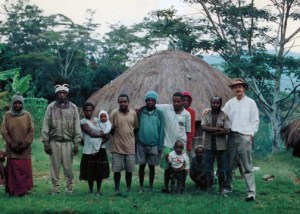
Papuan friends in the Highlands. Hungry but not scorched in 1997

A change from authoritarian to democratic rule in the past two decades hasn’t stopped the burning or the burners, and responsible stewardship of a wonderful archipelago seems beyond the reach of a feeble government and the new president, who graduated in forestry science. A better prospect for rooting out corruption and prodding a cataleptic government is coming from outside, through boycotts of products from Indonesian forestland brought by neighboring countries, and hopefully India and China will add their influence. Iya nih!

Next Post: Human chimera

Posted in Environment | Tagged , , , , | Comments Off on Inferno in Indonesia