Two Beekeepers in the New Zealand Bush

Honey is almost emblematic of New Zealand, like surf beaches, kiwis and hobbits, and Winnie the Pooh would drool thinking about it.  I leaped at the chance to spend a day with a professional beekeeper whose hives are in the bush for making Manuka honey.

We left home in the dark at 6 AM for a short drive to Steve’s depot where he picked up a portable incubator containing several dozen queen bee cells. He is passionate about the industry in which he has worked for over a decade, learning the ways of honey bees on the job. There is a Honey Research Center at the University of Waikato in Hamilton, but there are no professional qualifications for beekeeping, which is surprising for an industry so vital to New Zealand’s agriculture.

His firm has six fulltime staff plus a few students who are hired during the busy summer months, and that is how Steve got involved. Cambridge Bee Products currently manages around 5,300 bee colonies, and expanding. As a backyard beekeeper in Virginia I gasped at the scale, but evidently his company is far from the largest in the country. The industry is thriving and, compared with other sectors of agriculture including dairy, it has never suffered a recession. His company barely meets demand for its finest product—Manuka, the most highly prized honey in the world (see previous post) which, in good years, is more than 70% of his harvest, and 95% of which is exported.

The roads were wet from overnight rain when our truck pulled into his depot. Parking space was limited beside a forklift truck and the neat piles of Langstroth hive boxes and barrels containing 300 kg of honey when full. In the dim light I couldn’t see an alarm system, but the property had to be secure because I had seen the firm’s honey for sale in a local health food shop at over NZ$100 per kg. A quick calculation estimated that each barrel of the best grade is worth tens of thousands of dollars, though middlemen and retailers take a large bite of the raw value.

The honey harvest is brought to the premises from remote parts of the North Island. Manuka honey is certified by the UMF Honey Association to guarantee authenticity and grade it for quality because many brands contain only a fraction of the active product while others are fraudulently adulterated with cheap honey or syrup.

Barrels of honey, hive boxes and ingots of beewax

Barrels of honey, hive boxes and ingots of beewax

Inside the warehouse ranks of orange barrels and colorful hive boxes rose to the roof. The boxes were made by the staff from pine boards treated with a non-toxic preservative and paint; they have a lifespan of around 20 years in the field. In front of them large yellow bars were neatly stacked like gold ingots at Fort Knox, but weighing a mere 6 kg. They were pure beeswax extracted from old honeycomb for making candles and other molded products.

Honey is the company’s main business compared with big bee firms in America who make most of their income from pollination services for farmers by migrating thousands of hives around the country to crops as they blossom in turn. Only for a few weeks do some of Steve’s hives stand in fields for pollinating kiwi fruit, avocados and blueberries, and none of those crops produce quality honey.
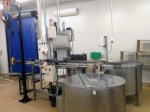
Comb decapper and two honey extractors

Comb decapper and two honey extractors

I followed Steve into the honey production plant through a series of adjoining rooms to admire his automated equipment. Backyard beekeepers extract honey with heated knives to decap comb, but it’s a slow and messy process. His first machine decaps in seconds by piercing the comb with arrays of short spikes mounted on a metal plate that precisely match the centers of cells across the frame. Afterwards in groups of eight, frames are loaded into stainless steel extractors to centrifuge the honey to the sides where it drains for collection. The honey is then heated in a large vessel to kill yeast or other cells that might be present before filtration and storage in barrels. At the final stage a machine automatically fills bottles with 250 or 500 or 1,000 g of honey, and even puts on lids and labels.

I liked the clean facilities and that nothing was wasted. Frames were recycled about every five years with a fresh plastic base coated in wax for the bees to draw. Honey residues were collected as sticky molasses for farm animal food, the wax was extracted in a larger melter, and any comb that remained was used as fertilizer.

After the tour I was eager to meet the rest of the team who live in bush country north of Lake Taupo. It was getting light outside when we hopped back in the truck for a two-hour ride.
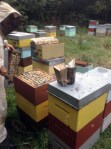
Hive-ho in a bee yard

Hive-ho in a bee yard

The hives were stationed in groups of two or three dozen in glades that he called “yards,” and out of sight from thieving eyes on country roads. Hive robbing and vandalizing happens. He lamented that at one time there was an unspoken gentleman’s agreement not to place hives within a kilometer or two of a competitor, but as profit attracts courtesy retreats. ‘tis often so.

The bee yards were chosen for local abundance of tea trees which provide the nectar for bees to convert into Manuka.  Steve groaned that too many trees are torn down by landowners who think they are eyesores and don’t realize or care that bees make a precious product from them, like turning base metal into gold. Of course, they never feed exclusively from tea trees, and the grade of Manuka depends on the location and season. The coconut-scented yellow blossom of gorse attracts insects in early spring, and purple heather feeds them at the end of the summer. A long blooming season offers a wide menu in the bush, but the rewa trees stand out for their fabulous red flowers for bees to drink from deeply.

When we arrived at the first yard, the hives looked pint-sized with only a brood box or no more than one super on top. Had I come before the honey harvest in January they would have been piled shoulder high with supers heavy in comb. A super full of honey can weigh 35 kg, enough to coin a name for a medical syndrome, “Apiarist’s Back.” I was too mortified to describe our tiny harvests.

We donned bee suits and started inspecting each hive in turn. Removing the galvanized roof and inner cover exposed the ends of nine full-sized frames, and encouraged a few guard bees to fly out to inspect us. The brood boxes had a couple of small entrances the size of a ten cent coin and stood on stout wooden frames with a wire mesh floor which was left uncovered year round.

Nice frame

Nice frame

As I probed Steve for statistics I wondered how kiwi apiaries can be so productive and colony losses so slight, rarely exceeding 10% a year. Could weather and climate be partly responsible? I was surprised that the climatic zone was not much different to ours in Tidewater Virginia (8 cf. 7b), because our summers are hotter and more humid, while our winters are longer and colder. Since his winters are almost frost-free, nectar flows for much longer and colonies only need feeding for 2-4 weeks if at all. Another factor I considered was the advantage that his colonies have out of range of sprays and other hazards in gardens and farmers’ fields. Then I thought about the lower load of parasites and diseases in a clean environment, although I was surprised how many of them have already reached New Zealand. American (though not European) foulbrood is there, I saw silken evidence of wax moths in some boxes, and that great foe the vampire mite, Varroa destructor, arrived in New Zealand over 15 years ago. Australia is the only country with a major honey industry free of mites, although it had a close call last year when dock officials in Brisbane found bees infested with them in a shipment of goods from Malaysia. It’s only a matter of time before Aussies share our woes. But we saw very few mites that day, which he credits to formic acid pads laid under inner covers and oxalic acid which he sprays through entrance holes. Both of these treatments are considered natural, and they don’t persist in honey or wax. Hive beetles were absent, but robbing bees and wasps sometimes stripped a hive, but that’s a universal problem. When I asked him about colony collapse disorder and killer bees, he nodded to acknowledge that it is a big issue in other countries.

I came away with the impression that no single reason explained the health and productivity of bees in New Zealand. There were additive advantages of a better climate, fewer parasites and less pollution. He didn’t and couldn’t make frequent inspections like we do, but was anxious to breed beneficial traits, by which he meant productive queens and docile worker bees.

His hives are re-queened annually and the company buys genetically superior queens every year from a specialist breeder who uses artificial insemination to guarantee the character of their progeny rather than leaving fertilization to the vagaries of a nuptial flight. In the field, bees hybridize with unknown drones, but he like to see more Carniolan character: “The blacker the better.”

We visited the yards not for mere inspection but to re-queen and split hives to make nucs for new colonies. Delicate queen cells that had been warming in an incubator plugged in the truck and protected inside conical plastic jackets were now placed inside hives, one or two per frame. “Sometimes by chance I see a resident queen,” he told me, “but I can’t go through every hive so they all get a potential heir or two to fight it out until the fittest survives.”  Weak colonies were ruthlessly culled, much like a farmer might eliminate animals too sick for veterinary care. I reflected on the pains we take to save a colony from fading away until I remembered the number in his care.

It seemed odd to split hives in late summer when we schedule it for springtime to avoid the risk of swarming and in time for nucs to establish while nectar flows. But he used a familiar procedure, transferring four frames from active colonies to each nuc box, including eggs, nectar and pollen, plus a shower of worker bees. He worked fast, watching the sun’s arc because he wouldn’t return to the yards for months.

End of the day

End of the day

This work quickly filled the air with thousands of angry bees that a smoker didn’t pacify. I took the precaution of wearing gloves, but Steve had bare hands. He worked more nimbly with uncovered fingers, even if they were crawling with bees. On the ride home I mentioned I had seen him rubbing his wrist. “Did you get stung?” I asked. “Na.  Maybe only ten today.” That reply reminded me of another plucky New Zealand beekeeper, and who first scaled Everest.

After we returned home to Cambridge I had much to think about. How to apply some of the practices I had to our modest endeavors? What is the future for bees in a changing world, and will they hold out longer in New Zealand and Australia?  And I was also thinking about the remote Blue Duck Station close to the pristine Whanganui National Park. That is where he keeps the most productive hives, and some of those yards are accessed by helicopter. I am already savoring that visit for next time.

Drafted in New Zealand

Next Post: Ghost of the Moa

Posted in Bee-line, Environment | Tagged , , , , , , , , | 4 Comments

Is there Manuka Honey for Tea?

When Captain James Cook anchored in New Zealand after a long voyage across the Pacific Ocean he was probably dying for a cup-of-tea. It was already a popular drink in England by the 18th Century when he sailed from Whitby, and a pot of tea warming in a brown betty is still a familiar sight in Yorkshire. I remember people brewing it for hours to make a really strong cuppa, extracting enough tannin to cure a deer hide.

brew a cup of tea

my Brown Betty

The native people he encountered persuaded him to try making “tea” from the spiky leaves of a scraggy tree called Manuka in the Maori language, which his sailors named the tea tree (not to be confused with the Australian tea tree from which the famous oil is extracted). I too was missing Yorkshire tea on my latest visit to New Zealand and wanted to try Maori tea for myself. After brewing a bunch of dried tea tree leaves for an hour, the water turned faintly orange and developed a citrus fragrance. If appearances could be trusted, the “tea” was promising, but I hadn’t reckoned on a bitter assault of my palate by the terpenoids. Perhaps that experience hurried Cook home for his brown betty.

Tea tree (Manuka)

Tea tree (Manuka)

The tea tree might have remained in obscurity after Cook’s experiment because, apart from a seasonal show of white or pink blossoms, it is an ugly shrub. But sometimes there is great virtue and fortune hiding beneath an unattractive exterior. Someone noticed that nectar collected by honey bees from tea trees makes a highly distinctive kind of honey, which has become the most prized in the world. It looks like mud in a bottle or spread across a slice of toast, and most unappetizing compared to the clear and syrupy product in your grocery store. It tastes oily or earthy and lacks the intense sweetness that characterizes most honeys. It is so expensive that Tesco supermarkets in the UK lock it inside security boxes with alarms to thwart shoplifting. As caviar is to shrimp and vintage Burgundy is to a cheap Cab, manuka is to “garden” types of honey. It is gooey gold, as rare as the ore itself.

The reputation of Manuka honey forges past scientific and pecuniary caution like most other supposed health products, and goes even further. Some people speak of it reverently as if it is holy water. There is no doubt that it has antimicrobial activity, but regular honey has plenty from its peroxide and high sugar content from which it earned a reputation for wound healing even in ancient times. But it possesses other pharmacological properties that are unique and may make it superior for attacking bacteria and fungi. At least some medical professionals are convinced, because medical grade Manuka honey is used in wound dressings (it stings). But most people purchase it because they enjoy a spoonful as a treat, or to impress their guests with a luxury product going up in smoke after spreading it liberally over barbecued fish, or for treating a skin eruption or warding off a gastrointestinal devil. Manuka enjoys a high reputation because it is a product of the relatively clean New Zealand environment where it is harvested from hives deep in the bush far from crop spraying.

It is la crème de la crème for New Zealand beekeepers and their most valuable “crop” which they must guard against fake products because it is as vulnerable to fraud as a Vuitton or Gucci handbag.

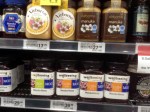
Some cheaper Manuka honey mixes on NZ grocery shelves

Some cheaper Manuka honey mixes on NZ grocery shelves

As a natural product honey can never be guaranteed to be uniform or from a “pure” source. Bees have favorite food plants but a colony visits a range of flowers which vary during the flying season. Manuka is not in flower all the year round, and the properties of its nectar vary between seasons, sites and specimens. Every batch of honey is different, and therein is a dilemma for beekeepers preserving the quality and reputation of their product, and for customers who don’t want to be scammed.

Of course, you can be sure that honey marketed as Manuka at unbelievably cheap prices is unbelievable, but beyond that the customer has to look for an official sign of authenticity. There are plenty of brands labeled Manuka that honestly declare the fraction of the whole, but according to what I heard over 80% of that advertised as the genuine thing in Asia is adulterated with regular honey or syrup.

Beekeepers go to great lengths to protect their industry. One firm I know safeguards its product by bottling and labeling the entire harvest on its own premises. It is also licensed by the Unique Manuka Factor Honey Association which is a guarantor of quality after testing three compounds that account for some of the non-peroxide antimicrobial activity. Genuine products can be recognized by the UMF® label, and are rated for quality up to 20 (rarely available). UMF is the “official” standard, but customers are confused by ratings from an independent company which uses a different scale. In one airport shop I saw a kilogram bottle rated at MGO 800+ which is roughly equivalent to UMF 20. By the way, it cost NZ$800!

You might think the best test of Manuka in honey is the proportion of pollen grains from the tea tree. Unfortunately, the related Kanuka tree is also a favorite food plant of bees, but it has almost indistinguishable pollen and it doesn’t produce such a valuable crop of honey.

The UMF laboratory tests three compounds, including methylglyoxal (MGO) which is given the most credit for healing properties since it kills bacteria long after peroxide activity is degraded by catalase activity in human tissues. There little MGO in fresh honey, but it builds up during storage as the concentration of dihydroxyacetone (DHA) declines. DHA is the second compound tested for UMF. It is used elsewhere as a fake sun-tanning agent and I guess contributes to the browning of proteins in Manuka honey.

Beekeepers can’t sleep peacefully after their products pass the UMF test because MGO and DHA can be bought as pure compounds for adulterating “garden quality” honey. When I checked with an American chemical company from which I used to obtain lab supplies I could buy quantities of both compounds for a few hundred bucks, enough to fool labs of tons of honey. The industry is aware that a cat-and-mouse game may already be in play with fraudsters and is looking for more robust markers. Gas chromatography-mass spectrometry can generate a molecular fingerprint of honey samples which should be foolproof. The equipment tests far more markers than can easily be added and requires technical expertise, but the expense will eat into profits. The tea tree produces a wondrous honey, but it comes at a high cost and bitter taste.

Auckland Airport

Medicate with Manuka! (Auckland Int. Airport)

Posted in New Zealand

Next Post: Two Beekeepers in the New Zealand Bush

Posted in Bee-line, Environment, Health, Other | Tagged , , , , , | Comments Off on Is there Manuka Honey for Tea?

Frozen Eggs Perks as Policy

Ashton Carter announced the Pentagon will make a bigger commitment to family-building for people serving in the military. The package includes new benefits for maternity leave and child care, and even a pilot scheme for egg and sperm freezing. The news is less surprising since Facebook and Apple rolled out a policy of offering $20,000 perks to young employees for defraying the costs of egg banking, which amount to >$10,000 per cycle + annual storage fees.

The aim is to retain highly-trained staff from leaving early to start a family. Most women are aware that their biological clock starts to wind down from around age 30, long before the average age of menopause. Egg banking is portrayed as fertility insurance, but is it just a lottery?

egg freezing

Eggs come in from the cold

The first freezing trials with human eggs were far less successful than with embryos. Since they are delicate single cells, their survival is all-or-nothing, whereas embryos afford to lose one or two cells from the bunch. Fewer than half were surviving in the 1980s, and very few of them made babies with IVF. Even more alarming was the evidence that chilling damages apparatus in eggs on which the chromosomes “dance” during cell division, putting babies at risk of birth defects from the wrong number of chromosomes. Many labs besides our own tried to improve results, but the breakthrough came with vitrification, which turns cells into a glassy solid instead of ice. Masashige Kuwayama at the Kato Clinic in Japan perfected the method. It involves ultra-rapid cooling in a highly concentrated solution, similar in some respects and different in other ways to making smooth ice cream. Like home-made ice cream, vitrification is not a technically sophisticated process, but it demands expertise of the technician who, working under a microscope, mounts each egg in a minute droplet for plunging into liquid nitrogen. I wonder if a technique that depends so heavily on operator skill in an unregulated environment can produce consistent results across clinics.

Egg banking emancipates fertility preservation for women, whereas men have had sperm freezing since the 1950s. The original rationale for banking was to help young women preserve their fertility from the sterilizing effects of high-dose chemotherapy and radiation. It also helps women to have genetic children after a hysterectomy, although a surrogate must then be commissioned to carry the baby. Before egg banking there was embryo freezing, but that requires IVF and therefore a male partner, or ovarian tissue freezing, which we developed as an alternative technology and is still used for child patients. One of the great advantages of freezing eggs versus embryos is that there are fewer issues surrounding the disposal of surplus eggs because they carry less moral gravity.

Although egg banking has been a bright hope on the dark road through cancer treatment, it is now embraced by far greater numbers of healthy women. This is being encouraged by perks from employers and lauded by media reports and TV. As if that publicity was not enough, clinical providers are heavily invested in advertising. I am told that business is booming, and more and more fertility clinics want some of the action.

But pause to consider the “customer.” I think that word is more apt than either patient or client, because these women are seeking treatment for a non-medical condition (aging) and from for-profit clinics. More and more fertility clinics that started as private medical practices are becoming absorbed into big business. I suspect these entities are now looking less and less like a familiar medical environment and more and more like normal commercial operations.

And who is the typical customer? She is a professional or businesswoman in her 20s or early 30s who dares not step off the career ladder during her most fertile years, or perhaps she hasn’t found a Mr. Right yet. There are other reasons, but a common conflict is between biological imperatives and social pressures. Employers are slowly recognizing this dilemma, but the answer they provide (if any) is technology instead of a better deal for women’s careers. Consequently, the average age of motherhood is rising, and already passes 30 at the birth of the first child in several countries. Men are luckier, although fresh mutations are more common in older sperm.

What price would you pay for a child of your own? There’s the nub of it. Fertility treatment involving IVF is unaffordable by most couples on low incomes, and those who can afford egg banking to delay family-building are investing in uncertainty. As this is a new technology there are very few centers with enough data to provide a reliable estimate of the chances of pregnancy with banked eggs. A British authority (HFEA) reported that up to 2012 there were only 20 babies born from 160 treatment cycles, and the US registry (SART) announced 162 live births in 2014, a success rate of 1 in 5 cycles. We await updates.

Success can never be assured. Since the chances with one batch of eggs are unlikely to be high, multiple rounds of treatment (i.e., more eggs) are required, and preferably collected at very young adult ages. Can you think of another product costing as much with so little security? Would you buy a new car or boat from a dealer without a guarantee? Would you dare commit thousands of dollars to a lottery? The reason that people will spend so much on fertility services, even taking out large loans or remortgaging their home, is because having a baby is a life event. Nothing compares with it.

This cautious post may seem surprising from someone who spent his whole career in reproductive technology and biology. Egg freezing is, of course, a wonderful breakthrough which I welcome unreservedly for patients needing emergency fertility preservation, but to others I say let the buyer beware.

Posted in New Zealand


Posted in Biomedical, Fertility | Tagged , , | Comments Off on Frozen Eggs Perks as Policy

No Sex Please, We’re Bananas

That’s a problem for our banana-munching republic. Sex was suspended for banana cultivation long ago, and the price we will pay is a Bananageddon. Here’s why.

The plant is propagated vegetatively and cannot produce seeds because it is genetically triploid. Two sets of chromosomes in a diploid plant are company, but three is a crowd because the threads of DNA get tangled and can’t segregate into equal halves to make haploid germ cells in male and female flowers. The vast banana plantations in the tropics are genetically identical clones, and the lack of diversity in these monocultures renders them vulnerable to pests that can evade their natural defenses.

There is only one kind of banana in the marketplace today, and its existence is threatened by the fungus Tropical Race Four whose hyphae kill after growing into the plant and cannot be eradicated from the soil. It has devastated crops in Asia and Australia because farming practices are so intensive, providing no physical or genetic barriers to the spread of disease. When it begins to rampage across the growing regions of Latin America bananas at 60 cents a pound will be a memory.

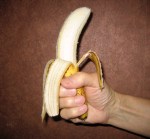
We have bananas

We have bananas

The fruit we love dangles on the thread of a single variety, whereas the many kinds of apples-Granny Smiths, Golden Delicious, McIntosh Red, etc- are begotten from sexual unions and seed dispersal. Until sixty years ago the Gros Michel was the big banana, with a less attractive name than the Cavendish which is currently the reigning monarch of the bunch. I am told that the Gros was the more tasty of the two, although I can’t remember because I was too young, being born around the year 10 BCE (Before Cavendish Era). When Gros plantations came under attack by an earlier disease, the Cavendish was planted as a substitute because of its greater resistance, but now it too is under a threat.

The Cavendish is an aristocratic banana. Sometime in the 1830s it was grown on the estate of the Duke of Devonshire of the Cavendish family, whose stately home is the famous Chatsworth House in Derbyshire.  The 6th Duke recognized an outstanding talent in his boy gardener, Joseph Paxton, who designed the greatest greenhouse in the world for his master, and which became the inspiration for his plan of the Crystal Palace at the Great Exhibition of 1851. Sir Joseph, as he later became, was one of the most ingenious men of the Victorian Age, and all because of the Duke’s trust and confidence.

One of his claims to fame was to grow in his greenhouse the variety of banana that now adorns our fruit bowl; as a young man, Joseph never asked what bananas could do for him, but asked what he could do for bananas. The Cavendish is his gift to the world, and it is a shame that the Devonshire family motto can’t be changed from Cavendo tutus to Deus nisi quod fixa (meaning God save the banana). But I digress…

In the past few weeks, banana biologists have announced the genome sequence of their fruit. The Bananome will enable them to peel open the fruit for genetic engineering to confer resistance to specific diseases and boost its nutritional bounty, perhaps by augmenting vitamin A whose deficiency still causes blindness in children. We will then have to choose GMO bananas or have no bananas, but genetic engineering will be fruitless unless vegetative propagation is bypassed for making new cultivars. To straighten our banana troubles we need to suspend cloning in this Brave New World long enough for a bunch of native plants to have wild sex.

Next Post: The Dark Side of Physics and Biology

Posted in Biomedical, Nature | Tagged , , , , , , | 1 Comment

If Snow be Black

After last week’s monster storm that left Eastern USA snow white, the snowbanks slowly melted into pools and streams. But what if snow were black? The Bard liked nature the way he saw it, but he loved to mock our conventional sense of color.Sonnet #130, ver#2

Casting back to Physics 101, I remember learning how experience tidily lines up alongside theory. Dark surfaces feel hotter than light ones as they don’t release energy so efficiently, and dark roofs and asphalt are heat sinks making urban centers several degrees warmer than outlying countryside. There is little advantage in a black roof for absorbing heat when it is snow-covered, but a white roof in summer can significantly reduce AC bills by reflecting the sun’s rays.

Standard white paint reflects 80% of solar radiation, whereas standard black has only 5% reflectivity. The thermal emissivity of asphalt and snow are similar, but the solar reflectance index from combining reflectivity and emissivity is theoretically 100 for white versus 0 for black. Some difference!

Snow be black

Snow be black

Instead of sprinkling salt to lower the freezing point of your icy path, test whether powdered black carbon (soot) melts ice faster by absorbing heat than leaving it untreated. Almost unnoticeable traces of black carbon can have noticeable effects. Consider the melting of glaciers, which started accelerating in the Alps in the second half of the 19th Century. This was originally blamed on climate change (temperature and precipitation), but a recent model from measuring ice cores predicts a better fit to the fallout of black carbon in the Industrial Age. The Alps are encircled by cities that industrialized early and depended on burning dirty coal.

Weathermen who speak of ‘black ice’ know that it is, strictly speaking, science fiction. It’s very hard to imagine how atomic bonds would be bent to abolish the reflective properties of ice, at least in the universe we know. But who knows? Nature looks stranger every day we look closer. Black holes look black because gravity captures light from escaping. Both black coal and transparent diamonds are from carbon, not paradoxical but a discovery that would have humored Shakespeare.

If snow was not white, our world would be hotter, have higher sea levels, different fauna and flora, and no snowmen on Christmas cards. According to that incurable optimist, Dr. Pangloss, “It is demonstrable that things cannot be otherwise than as they are; for as all things have been created for some end, they must necessarily be created for the best end (Trans. Candide). But Tom Torrance, a theologian famous for embracing Carl Barth and Niels Bohr, once reminded me that we live a contingent universe, and ought to be thankful for this one and not to be born somewhere much stranger in the multiverse. Yes, let snow be white.

Next Post: Dees Bones Gonna Walka Round

Posted in Environment, Nature | Tagged , , , | Comments Off on If Snow be Black