Lady Marion Fraser

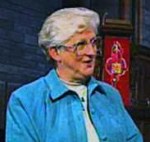
A light went out in Scotland on Christmas Day. Marion Fraser passed away. In a cynical age we have low expectations of “virtue” in our public figures whose ranks often seem unattainable except to those with the privileges that come from wealth and connections. We put more faith in the life stories of humble achievers like Dorothea of Middlemarch, the “invisible” heroine of George Eliot’s novel which closes with the most moving and beautiful tribute in Victorian literature. Marion had the same pure qualities and desire to make the world a better place, but without Dorothea’s disadvantages in marriage because she wedded one of the finest men in Scotland. It was inevitable that she would rise from her middle class roots in Glasgow to VIP status.

Marion Anne Fraser, LT (1932-2016)

Marion Anne Fraser, LT (1932-2016)

I first met her thirty years ago when she joined a subcommittee of the Kirk’s Church & Nation committee, which then had a greater voice in public affairs before the Scottish Parliament opened for business in 1999. We had an interesting membership from across Scotland. There were many good men in the group (few women), a few activists who tried to turn the subcommittee into a political pulpit, and I suspect one or two from remote parts of the Highlands who came for the shopping opportunities on Princes Street after meetings. I was the convener not because I was qualified in any way (I was a physiology lecturer at the University), but chosen by default because no one else volunteered. I thought Lady Marion was appointed as a decoration because of her title and marriage to the man who then ran the Scottish Office of government. I was never more mistaken.

We were commissioned to publish reports on the state of Scotland’s housing and prison service. She was one of the few who joined us on field research around the country, including the infamous Gorbals slum in Glasgow and maximum security prisons where we met with officers and notorious inmates. For someone with the genteel background of a music teacher she was amazingly at ease in every type of company, but underneath we saw a steely determination to improve the lives of ordinary folk.

Her wisdom and energy didn’t go unnoticed elsewhere. She was in demand as a director of numerous organizations, institutions and charities across Scotland, even representing the Queen on one occasion, and came to international notice as chair of the board for Christian Aid, which took her on arduous foreign tours to see the charity in action. The Queen appointed her in 1996 to Scotland’s Order of the Thistle after the Queen Mother and as the first non-royal lady of that ancient and noble Order. But she was still the same modest Marion after a meteoric rise in public esteem and attention. If you bumped into her you might assume she was a kindly older lady like any Mrs. Smith or MacDonald you might meet in the street.

She would laugh if I told her she reminded me of a bearded wizard. The Shire looked up to Gandalf who cast a wise and caring eye over the hobbits, and although he went away on a journey they never felt he was really gone. Marion left us in her 84th year, a ripe age for anyone but too soon to lose a precious soul in unsettled times.

Next Post: Autumn Leaves have Fallen

Posted in Memoir | Tagged , , , , , , , | 2 Comments

How British Dentists Created Heavy Metal Generation

At my first dental examination in North America the Montrealer with a deep knowledge of the ethnography of decay leaned back from my chair and holding his pick aloft declared, “You have British teeth.” His tone was grave, like a race horse owner looking an old nag in the mouth. My heart dropped because I expected the consultation would confirm my pearly whites were pristine, and when he saw my puzzled look he shook his head. “You were unlucky to grow up in the nadir of British dentistry.” Ugh, he spoilt my day.

After I left his office I cast back to the medical and dental services of my schooldays in the London Borough of Bromley. I rarely visited those halls of humiliation and horror. Boys took off their shirts to line up in the gymnasium for a stethoscope and vaccination. Finally, the school nurse tugged at the waistband above our fly for a cold hand to reach down to check our pinkness, leaving us wondering if her scribbled notes would reach the headmaster if she found something amiss. But our greatest dread was the dental checkup which came round every six months, but mercifully that interval was much longer in childhood than it seems now. Our parents never understood our hostility to these appointments because they grew up before the National Health Service was founded in 1948 and were treated, if at all, in  private clinics. Most people in those days opted for extraction as the cheap option for toothache.

Dental caries was prevalent even in prehistoric times, and a rough diet rapidly wore teeth down until softer foods were eaten in the modern age. But at the end of the Victorian Era caries exploded five-fold after refined sugar entered the diet, including Her Majesty’s whose very sweet tooth enjoyed Battenberg cake, Victoria sponge and Osborne pudding at tea time. Toothache was just a fact of life that had to be shrugged off, and dentists kept their pliers handy like carpenters pulling nails.

I remember family members from that generation leaving their dentures in a fizzy glass of Steradent when they retired to bed. One of my “aunties” had all her teeth extracted by age 16 because she was terrified of the slow, wobbly drill operated by a foot treadle. She had a wonderful smile that was credited to an old Vulcanite denture she had worn for decades. There were no X-ray machines in dental surgeries, nor were surgical gloves worn, nor did boiling sterilizers sterilize, and nothing droll about treatment except the chuckles from laughing gas. A dentist who worked in Glasgow in the early 20th century recalled half his patients over twenty didn’t have any natural teeth, and fathers sent daughters to him before their weddings to have teeth replaced with dentures “so their future dental healthcare needs wouldn’t be a burden on their husbands.”

After 1948 my boomer generation faced a new breed of dentist that was transitioning to the challenges of a nation whose dental care had been neglected except for the few who could afford private treatment. In the first 9 months of the NHS they were swamped with requests for 4.5 million extractions and the million full sets of dentures ordered ran the national supply dry. Restorative dental work suddenly came into its own, but conservative dentistry was not yet in our vocabulary, and we never heard of teeth magically whitened with paste or straightened with a brace, and anyway they would never look cool in my class.

This won't hurt, I'm a British dentist

This won’t hurt, I’m a British dentist

There was no shortage of dental work, but a national shortage of practitioners lasted for years. In 1958 the teeth of only 5% of 12-year-olds were free of decay, a record low point and down by three-quarters on the war years when sweets were scarce and it took a generation to reverse the statistics.  Matters would have been better if we had fluoride in toothpaste or in drinking water in some of our cities, and I don’t ever recall advice about dental hygiene and cutting down on sticky foods and sweets except from mother. But a dentist needs tooth decay for work, like his carpenter friend who needs rotting boards.

We were told we lived in a golden age of dental care, and the mantra rang musically over and over “drill and fill.” Dental surgeries had high-speed drills, mercury amalgam and novocaine. It was, however, tricky for a boy to accept analgesia in case a limp lip betrayed a lack of courage to classmates who would taunt him mercilessly. And no matter how heavy the treatment we couldn’t expect to be mollycoddled with sympathy from our parents and grandparents who had lived through greater tortures in world wars.

The two certainties in our lives were corporal punishment and dental care, and it is hard to say which was the crueler. Dentists were sharp-eyed like woodpeckers and always found something to drill, if not two or three cavities, and filled them as fast as we could jump over a horse in the gymnasium. I am talking of either high skill or reckless driving, perhaps because the man was impatient for the next case trembling outside in the waiting room. He often shouted at me “Keep still, boy!” while leaning over my squirming body in his electric chair with his drill whining like a mad hornet inside my quaking mouth. I didn’t have to wait long holding my breath until he paused to suck out the gritty dentine with a long tube like a lamprey.

Dentists complained they were overworked but in truth it was in their interest because the NHS paid them a piece rate (per procedure), which they claimed was a pittance. A dentist had to be productive to make a good living (mine drove a sexy Jensen), but it was a miserable occupation to work on boys like me, only relieved by thoughts of the happy hour with the carpenter over a pint in the George and Dragon. While British shipbuilding, mining and car manufacturing were heading for extinction, dentistry continued to hum and sales of mercury had never done better since Victorian times. With so much heavy metal in our heads it is a wonder that our jaws didn’t fall slack under the extra weight.

While he was drilling we saw out of the corner of an eye an assistant pouring liquid mercury into a pot of powdered metals to make amalgam to fill the holes. I once asked him if the mercury would harm me because we stopped rolling beads of mercury in our palms from broken thermometers when we learned the Mad Hatter’s story.

alice

The dentist replied memorably with total silence. Perhaps he meant “You insolent boy!” or “He’s an idiot.”

How times have changed. The Day of the Dentist is no longer dreaded and my amiable provider in Virginia takes time to discuss conservation, crowns and cosmetics. Many people reach adulthood today without any cavities thanks to fluoride and dental hygiene. Surely British teeth can now be redeemed from their blackened reputation?

I was musing how dentists have navigated progress towards the perfection of national dentition without making themselves redundant. They shrewdly responded to the growing public pride in a perfect smile, and as British dentists migrated into the private sector like their American cousins they have shown greater business acumen than physicians or surgeons. No matter if caries becomes extinct or if stem cells are used to regenerate new sets of teeth they will always find a reason to be needed. I knew a Scottish farmer whose friend desperately wanted to save his pet sheep that was getting weak when its teeth wore down and could no longer eat a natural diet. The vet had no answer, but his dentist offered to make a set of dentures for the animal. Dentists are an enterprising bunch.

One legacy hangs over from the bad old days—mercury. My dentist is itching to drill and replace it with a modern resin. It’s nice work for him to brush off his old drill, and ought to please the patient, but this one is stalling with questions. Is the replacement less durable? Will I absorb more mercury vapor from drilling than if good amalgam is left alone? By keeping mercury in my head am I saving the environment, at least until the day when it blows off the smoke stack at the crem?  While I continue to ponder an answer I remain one of the heavy metal generation.

Next Post: Autumn Leaves have Fallen

Posted in Health, Memoir | Tagged , , , , , , , , | 3 Comments

Forest Bathing

If we can bathe in sunshine or in glory or in misery, why not in a forest? I didn’t invent the expression: it’s from the Japanese (shinrin-yoku) who believe time spent in nature boosts health. Most people agree that gulping fresh air on a forest walk or on a mountain or beside the sea is beneficial, although there is little scientific evidence to support the belief. Perhaps that disconnect shouldn’t surprise us in an era when beliefs often trump facts in national debates and people still turn to quackery and naturopathy to cure their ills. But the idea seduces me. Breathing pine-scented air and inhaling the “sighs” of vegetation along a trail is more than engaging; it resonates with a belief in “biophilia,” that despite our retreat to urban living we have not lost an inborn sympathy with mother nature and need to spend time with her.

West Virginia Pocahontas County

The Elk Valley, Monongahela Forest, WV

Our remote ancestors regarded the outdoors otherwise. They crouched in caves and huts to shelter from the elements and large predators, and the Brothers Grimm played on primitive fears by inventing menaces prowling in the Black Forest. We may be alienated from nature by modern living, but it is now regarded more as a kind mother than a cruel step-father, even while it still harbors dangers. Forests are called lungs of the world, and even if we never visited the tropics we know they throb with biodiversity we need to survive. We are told that bathing in the bosom of the plant kingdom, where our ancestors spent their days, restores health and well-being, but it doesn’t need to be a forest. It can be a garden, woodlot or urban park will do, and immersion should start in childhood (Last Child in the Woods by Richard Louv).

We now live mostly indoors which is a novelty in human history, but no English word describes it. The closest I can find is the Japanese hikikomori for people whose lives are spent indoors mostly around movies and the Internet, although this word often refers to recluses rather than the general habit I have in mind.

After musing about these words I wondered if my belief in the healthy outdoors was mere wishful thinking, based on quasi-science. Hocus pocus. Of course, walking is an exercise proven to promote health, but that wasn’t the evidence I was seeking because an ardent hikikomori can take exercise in a gym with barely any exposure to outdoors, and even then to a polluted street. I wanted more evidence of forest bathing to justify what my gut told me, although I knew that a negative result would not diminish my pleasure. I found a trio of factors: Bugs, Ions and Oils. I remember them by the acronym BIO, although I found that lends far more biological authority than warranted by the data. This is what I learned.

Bugs. We are more likely to be caught indoors by a bug like staph, strep, tubercle bacteria or by one of the host of viruses and allergenic molds, and other hazards exist there too, including carbon monoxide, radon, toxic vapors and smoke from fires and tobacco. Since Ms. Nightingale started throwing hospital windows open we accept the virtues of fresh air, but outdoor air isn’t empty ether even deep in the countryside where it still swarms with microbes and spores, exposing us to 2,000 types a day according to one estimate. Most of them are benign, but are they good like the country folk who offer a friendly handshake and refreshment to hikers? I read that inhaling bugs in country air can boost our microbiome, the vast community of commensals in our bodies that is now touted as a touchstone of health. I wish it were true, but the claim stretches credibility as much as homeopathic medicine. The evidence is as microscopic as the microbes.

Ions.  I also read that woodland air and sea air zap microbes in the way that air ionizers and ozone generators are claimed to cleanse homes, offices and hospitals, but it’s a false parallel. These devices are not necessarily safe because ozone can be hazardous to breathing, and so fresh air is safer because the concentrations are far lower, and below the threshold for killing bugs. Besides, the old story about the smell of ozone at the beach is a myth, and a meta-analysis in BMC Psychiatry (2013) failed to trawl from multiple studies any hint of association between charged ion concentration and mood, sleep or anxiety.

I was losing hope in BIO when I reviewed the last factor in the trio.

Oils. Air is wonderfully scented by terpenes and other odoriferous oils in groves of pines, firs or cypress. These oils are called phytoncides because they are plant vapors with antimicrobial activity. They serve plants by inhibiting molds that would otherwise cause rot, and they make fruit and foliage less appetizing to herbivores. Garlic and tea tree oil are familiar domestic examples of phytoncides. Unfortunately for the hypothesis, the concentrations of phytoncides likely to be encountered on forest walks are far too low to eliminate bacteria and spores, unless you spray the air with a bottle of Pine-Sol.

This quick survey of the literature confirmed the doubts I began with, so I cast around for another explanation before abandoning the notion of forest bathing.

I wondered if the sight of green vegetation was the key. Green is close to blue in the spectrum, beloved by artists and interior decorators for pacifying our emotions, and just might account for some of the benefits of light therapy for the winter blues (Seasonally Affective Disorder). If green is naturopathic, does it follow that people who can’t see the color (deuteranopia) have poorer health? I found evidence for this wild hypothesis in old clinical studies where patients lacking the retinal pigment for green were more likely to have bipolar disorder. But this connection with mental health was weak, and it can be explained not only by the inability to see green fields and luxuriant foliage but more likely by another gene that is closely linked to the pigment gene on the same X-chromosome. Another dead end!

Perhaps there is no physical basis for forest bathing, leaving the explanation all in the mind. Maybe the uplifting feelings we get from gazing at nature affect the endocrine and autonomic nervous systems to reduce stress and anxiety, and the beauty of nature distracts us from worries carried from home and work. Dr. Roger S. Ullrich published a study over thirty years ago that lends some support for a psychosomatic explanation. He monitored two groups of surgical patients who were comparable in every respect except one: they were either recovering in rooms with windows overlooking a blank wall or had a view of trees and other vegetation. Those who could see a more natural landscape were released earlier from hospital, needed less analgesia and had fewer post-operative complications. The windows were closed and the indoor environment was controlled so the difference outcomes were not explained by outdoor air. His research, which has influenced hospital design in many countries, began inauspiciously when he was bed-ridden as a teenager and often looked out at the lone pine tree outside his window.

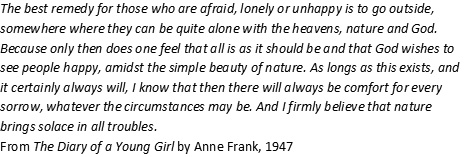
Anne Frank was also confined to home as a young person, but for a very different reason. She often gazed out her window at the large chestnut tree in her street in Amsterdam. She couldn’t go for a forest walk but the tree connected her to nature and raised her spirits.
annefrank

Perhaps forest bathing is no more, and no less, than a soulful experience, and we don’t need bugs, ions and molecules to account for it. It’s not a new explanation, and John Muir wrote about it long ago: “Nature’s peace will flow into you as sunshine flows into trees. The winds will blow their own freshness into you, and the storms their energy, while cares will drop off like autumn leaves.”

Next Post: British Dentists created Heavy Metal Generation


Posted in Environment, Health | Tagged , , , , , , , , | 3 Comments

The Berkeley Thanksgiving

It will be missed by no one on this side of the North Atlantic that Thanksgiving Day 2016 falls on Thursday. Yet, some Virginians mindful of another tradition already had their Thanksgiving a fortnight ago. They resent the hegemony of Massachusetts for the celebrated day because historical records prove they have precedence.

Thanksgiving memorial plaque

Thanksgiving memorial plaque

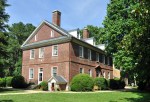
The claim originated in a 1619 voyage of 36 men onboard the Good Ship Margaret out of Bristol, England. It was a tub of only 35 feet, somewhat shorter than twice the length of my office at home, and yet it sailed across a stormy ocean for ten weeks to the Chesapeake Bay. After the last storm had flung itself on the vessel, the exhausted mariners steered it into the King James River to anchor off the appointed land, which became known as the Berkeley Hundred and is today the Berkeley Plantation.

The ship’s master, John Woodlief, had returned to England after surviving the Starving Times of 1609-10 at Jamestown Fort, some 25 miles downriver. It says something about him that he left home comforts to go back to the Virginia wilderness, and when he

Berkeley Plantation House

Berkeley Plantation

returned he was wiser than on the 1607 voyage which conveyed a mixture of idle gentlemen and press-ganged paupers, neither of whom were well-prepared for the rigors ahead. He recruited craftsmen with skills needed in the fragile colony they would help to build. His ship was filled to the gunwales with clothes, kitchen utensils, tools, weapons, Bibles and beads to trade with Indians, and a great many groceries—8,000 biscuits and loaves, 160 lb butter, 127 lb bacon and horsemeat, 60 bushels of peas, 20 bushels of wheat, 6 tons of cider and 5 ½ tons of beer (healthier than water).

The sponsors in London instructed Woodlief to hold a solemn service of thanksgiving as soon as they arrived at their destination. The prepared formula read: “We ordain that this day of our ships arrival, at the place assigned for plantation, in the land of Virginia, shall be yearly and perpetually kept holy as a day of Thanksgiving to Almighty God.”

Another Good Ship Margaret arrives November 6, 2016

Another Good Ship Margaret arrives November 6, 2016

A manuscript recording their voyage and first thanksgiving was lost until Dr. Lyon Tyler of the College of William & Mary rediscovered it in an old archive called the Nibley Papers in the New York Public Library. Virginians like to point out not only their claim for primacy, but that Thanksgiving Day was first instituted as an annual religious observance, unlike the one-off feast enjoyed by the Pilgrims at Plymouth, MA, with their new buddies from a local Indian tribe. Unfortunately, the Berkeley rite stopped after an Indian Uprising in 1622 until 1958 when the current owners of the property reinstated it.

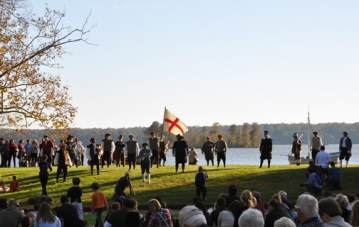
The Berkeley Thanksgiving was celebrated this year on Sunday November 6. Large numbers of families spent most of the day at the estate under blue skies because the Indian summer was pushing back the advance of fall. Below the old plantation house in a

Re-enactors who struggled to sound English

Re-enactors

meadow that rolls down to the waterside, there were games for families, food and craft stalls, replica encampments, a corn maze, candle dipping and doll making, parading and dancing, music and magic. We watched a re-enactment of Captain Woodlief and his men landing from a replica of the good ship and giving thanks for a safe passage. Nearby, Indians cheerfully stomped a Friendship Dance to the rhythm of drums, although I wondered if their ancestors were horrified to see Englishmen on their turf. The crowd joined in the Pledge of Allegiance (hand on heart), sang the National Anthem and, finally, the history of Berkeley was retold by the present owner and one of Woodlief’s descendants.

Even a cynical observer of seasonal festivals would agree this was a happy scene of people united in pride for their country and history. Who could imagine under that blue sky there were dark thoughts lurking behind smiles? But soon after we went home we cast votes in the General Election, which beat down memories from two days before and replaced beautiful unity with ugly partisanship. Something to think about when I say:

happy-thanksgiving-typography-black-no-background-2400px


Posted in Memoir, Seasons in Virginia | Tagged , , , , , , | Comments Off on The Berkeley Thanksgiving

Carving for the Ages (Petroglyphs)

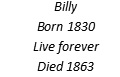
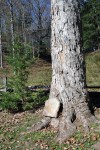
A slab of yellow sandstone larger than a dinner plate lay at the foot of an old maple tree close to a woodland trail in the Allegheny Mountains. The shadow of an inscription on its flat face made me pause for a closer look. It read:

billymemorial

There are several hundred cemeteries dotted across the county, but few of them are “official.” The county resists zoning laws, so private landowners can bury the dead in their own backyards. Casualties of war, especially the fallen enemy, were not always honored with ceremony or laid in consecrated ground but rolled into a hastily dug grave where they moldered from anonymity to invisibility. But if the memorial stone marked Billy’s grave, he had not been buried carelessly.

Federal troops were known to be stationed there during the Civil War. Probably they were involved in the fierce engagement with the Confederate Army at Droop Mountain in November of that year that swung in their favor. Perhaps Billy was mortally injured in the fight, or maybe he died of measles, which was claiming victims in both armies.

soldiers-gravestoneTo examine the lettering on the hard stone, which was probably made with a knife point, is to realize this was a tenderly made memorial amidst so much suffering and misery. Billy has long gone out of memory, and would have disappeared from notice if his platoon merely tied two sticks to make a wooden cross, but carving a rock gave the young man a greater longevity, at least in name. Had the inscriber chosen a softer rock, like my father’s first headstone, it would not be legible for long, but deep gouges in the stone preserved Billy’s biosketch for 150 years.

On an ancient route across a rocky plain in Anatolia, and near the town of İmamkullu, a Hittite paused to carve a boulder over 3,000 years ago. The images are worn but you can see a princely soldier and a god, as well as incomprehensible hieroglyphs. Petroglyphs are found the world over from prehistoric times, and if you want to leave a memorial to posterity never leave it in ink or paint, but carve it on rock. Hard rock!

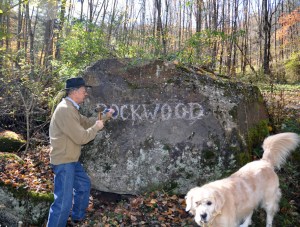
I mused about Billy’s gravestone while I chipped away at a boulder on our property, some twenty miles across the county. It’s hard to explain the impulse for my first rock carving, although the boulder offered a flat, vertical surface decorated with several species of lichens with a mossy seat on top. It is beautiful, and it was irresistible even for a virgin of the rocks.rockwoodcarving72dpi

If I was an accomplished rocksmith with time on my hands I might have carved a noble, sphinx-like head of a Shawnee brave, because this was the tribe’s hunting ground. My ambition was far more modest, the mere cutting of eight letters under the eye of James Alexander Thom, a family member who carves wood when taking time out from writing historical novels. I won’t add my signature or even my initials, preferring the carver to remain anonymous and somewhat mysterious like Billy’s inscriber.

When the cerebral effort of design is finished and the repetitive work of execution begins, a different part of the brain seems to kick in. As the rational region relaxes, the imagination can take over for dreaming to the noisy accompaniment of chipping. I wonder if anyone will stop to ponder the inscription in future centuries and millennia? I guess they might need a translator to read the word, “ROCKWOOD.” And I try to imagine what will those people will look like and how much the environment will have changed. The struggle to look forward probably stretches the imagination as much as when they try to look back at me, or I try to picture the Hittite.

When I returned to Billy’s gravestone I met the landowner Tom, whose family has lived on the mountain since they came as pioneers in 1830. He restores old log cabins transplanted on the back of a big flat-bed truck from across the Alleghenies, even as far away as Pennsylvania. Billy may have known one of the cabins because it used to stand on Droop Mountain. They are far more comfortable after renovation with a new tin roof and stone chimney than for the families who built them, and make attractive rental properties for visitors. Few cabins survive on their original sites because wood quickly rots when they are no longer cared for and the roof falls in, whereas castles and cathedrals quarried out of rock in the mother country of Tom’s ancestors will endure for eons. Without conservationists like him there would be fewer testaments to the lives of struggling pioneers.

After chatting about how the logs were cut and chinked, I asked him about the memorial stone on his land. I could tell from his changed demeanor that he had news. “It’s not the original! After lying there so long, someone stole it fifteen years ago.” He found a stone to replace it and carved the tribute to Billy from memory. “It’s a pretty good replica,” he told me.

The memorial says something about the carver again, the second time around, but I blush at the notions expressed sometimes about Appalachian mountain men by ignorant outlanders. As an afterthought Tom said, “It’s a pity it wasn’t too big to be carried away,” which brought my boulder to mind.

Next Post: Thanksgiving at Berkeley Plantation

Posted in Memoir | Tagged , , , , , , , , , , | Comments Off on Carving for the Ages (Petroglyphs)