The song of Magicicadas

Magicicada
Thirteen-year brood of a Magicicada species

If you hear ringing in your ears this month it could be the chorus of millions of cicadas, so don’t worry about getting tinnitus!
The last time periodical cicadas emerged in southeast Virginia was the spring of 2013. See the blog archives for the post I wrote at the time (“Seventeen-year anniversary”). I wondered then if I would live to hear the event repeated in 2030, but the species distribution map is wrong. It shows the thirteen-year brood expected this year would be west of Richmond, but it is here too.
Males have been singing on warm days in the tree canopies for a week and will continue to the end of their lives, another week or two. Birds are feasting on cicadas easily caught when the meaty insects launch from branches like slow-flying gliders. Soon the ground will be littered with their corpses and fertilize the soil.
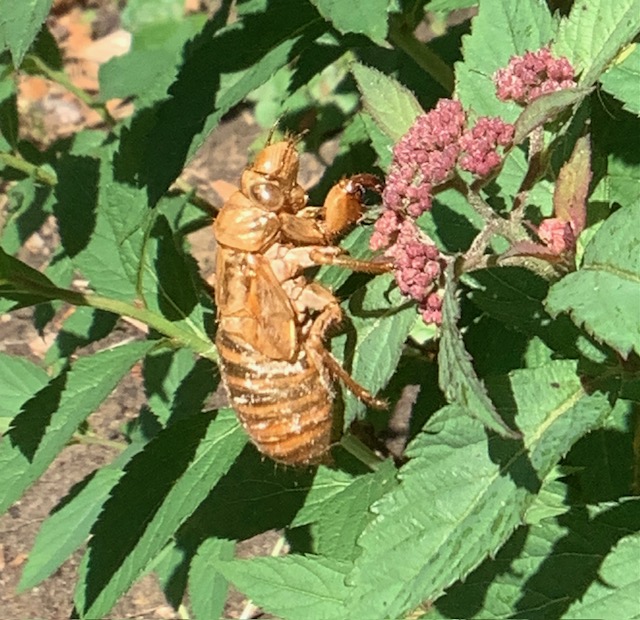
They might hold the record for the briefest adulthood as a percentage of lifespan (0.3%). Hatching from eggs laid in the treetops during the 2011 courtship, nymphs fell to the ground where they dug furiously with relatively huge front legs before predators could get them. They found a root of a tree to tap sap for nourishment as we tap maple tree trunks for making syrup. They continued sucking for more than a decade, shedding their exoskeleton each time they outgrew it and replaced with a new chitinous shell. The fifth stage has emerged above ground en masse with amazing synchrony. They crawl up a plant or vertical surface to halt a couple of feet above ground. Then the thoracic shell segment splits open for the adult cicada to emerge. After drying its wings it looks for the rest of its clan with big red eyes.

Magicicada
Hatched stage V nymph

They are singing heartily in every direction today. I heard people grumbling about the constant noise although I only recorded 60 dB compared to a big diesel truck on the highway nearby that makes nearly 90 dB (on a logarithmic scale). I will never complain about a marvel of nature.

Posted in garden, Nature | Tagged | 1 Comment

Kalahari Camp Cooking

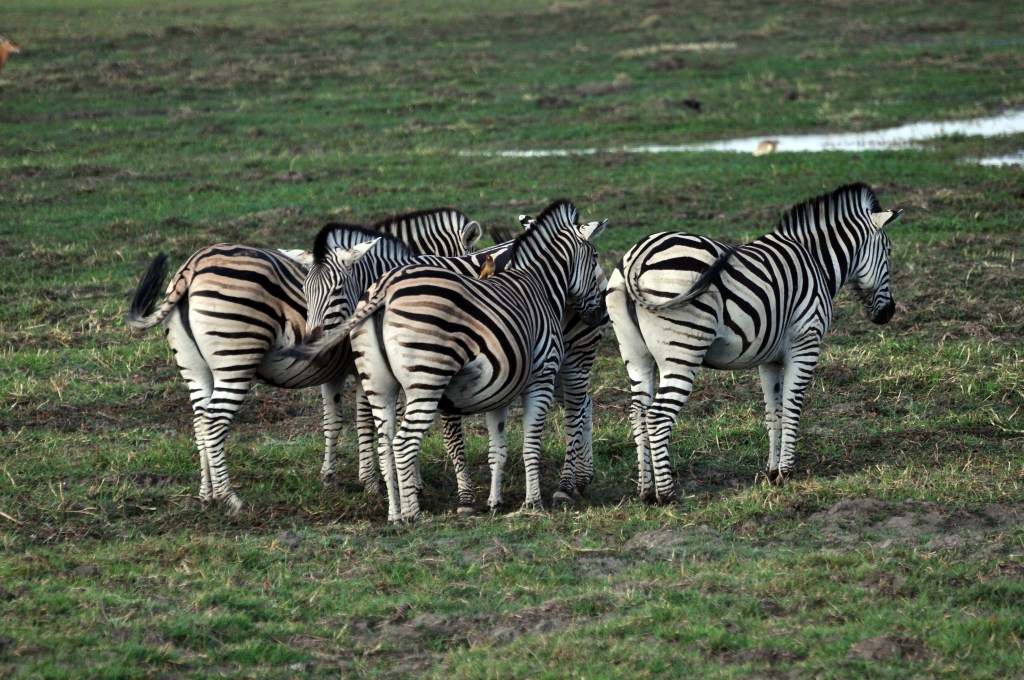
Zebras
Zebras in the Okavango Delta

I was more lucky than shrewd in choosing to visit the northern Kalahari and Okavango Delta in Botswana at the start of the wet season and shortly before Christmas 2023. Mobile safaris organized by Penduka normally take up to nine visitors, but when I turned up the company didn’t cancel a party of only one! What a privilege to go on a private safari, staying for a few nights at each of four sites in the bush with an expert guide and camp staff all to myself. It only rained at night, a syncopating patter on the canvas. Kenny the camp’s cook prepared meals to the standard of a fine restaurant on open fires.

The team kept the campsite as pristine as we found it but the aromas from cooking food attracted wildlife. Without a fence to deter them, an Elephant barged past one day, a Spotted Hyena sniffed around my tent while I lay in bed, a cocky Pied Crow stole two eggs, and a scorpion dashed around our feet under the table. Fortunately, no lions though we heard them roaring a quarter of a mile away after dusk.

Posted in Botswana | Tagged , , | 1 Comment

Elephants and US

African elephant in Okavango Delta
Elephant in Okavango Delta

There is something magisterial about the biggest living things on Earth. We are the most intelligent, the most prolific, and the most polluting species but we don’t tower in height over everyone. We look up at some animals and plants while they look down on us.
I regret we missed the iconic megafauna that became extinct in the late Pleistocene era. Modern humans arrived a day too late on a geological time scale. I mean woolly mammoths and mastodons, dodos and moas, giant sloths and dire wolves. But I’m thankful we have a few survivors, mostly oceanic leviathans and two species of elephants.
Does any other creature look as imperial as an elephant? They fascinate us and our children fall in love with them from picture books and the telling of stories, particularly in India. At the zoo, we cannot pass the elephant enclosure without stopping. The perfume of aromatic manure guides us by the nose more surely than eyeing a signpost. There is only one grotesque aspect of elephants—a trophy head with tusks hanging on a wall.
I recently had the thrill of watching hundreds of wild African elephants in their northern Kalahari homeland. They barged through dense bush, like bulldozers and pulled down trees faster than a chainsaw before dining on foliage. They hung around waterholes to suck gallons of water and sprayed dirt on their backs through multifunctional trunks. Family groups marched at a stately pace across the veld in disciplined lines, keeping to the narrow tracks made by generations of heavy feet compressing the sand. My local Penduka guide regarded them respectfully, and so we backed off when they flapped their ears at us. Last month, an angry elephant killed a tourist in Zambia by overturning her vehicle.
Their distrust of human beings is understandable. We imperiled them by poaching, trophy hunting and anthrax from livestock farming. These threats remain but their numbers have rebounded since banning ivory sales and hunting trophies. Botswana’s government should be praised for beefing up anti-poaching units. However, it has resumed issuing hunting quotas since 2019 in response to complaints about an elephant population explosion, now estimated at 130,000, more than in any other country.
The President of Botswana receives complaints from rural people whose livelihoods and even lives are lost from trampling under big beasts. But consider the elephants’ point of view. The finest remaining wilderness is under pressure for agriculture and who can resist the begging image of a hungry child? Partly from their habitat shrinking, powerful animals are losing their fear from habituation, which leads to conflict with humans. I admit foreign visitors like me are part of the problem. Do we love wildlife too much for its good?
Mr. President faces a dilemma. Selling licenses to hunters helps to control the elephant population and top up the Treasury’s coffers. On the other hand, African wildlife has influential foreign advocates who condemn trophy hunting and might boycott safaris where the grisly business continues. He offers surplus animals to neighboring countries and makes an idle threat to send thousands to Germany. Why doesn’t he imitate the Kruger National Park in South Africa where an immunocontraceptive program controls the elephant population?
The mission of preserving biodiversity in pristine lands gets tougher from the direct and indirect impacts of spiraling human numbers. That problem has gotten a lot worse since the 1960s when the United Nations raised publicity. Ironically, Western countries are becoming more pronatalist from worrying about the demographic shift that projects a deficit of young people to support aging populations in the future. Developing countries rankle at criticism and rightly point out that wealthy countries are mainly responsible for plundering natural resources. Politicians grapple with national priorities or bow to resistance.
Meanwhile, elephants will always be elephants and we will decide their fate in our interests. Tant pis! They wouldn’t present such a problem if they weren’t so large, but if we genetically engineered mini elephants as replacements would they inspire as much awe in children at the zoo?   

Posted in Botswana, Wildlife conservation | Tagged , , , , | Comments Off on Elephants and US

Baines Baobabs in Botswana

Baines Baobabs, Nxai Pan, Botswana
Baines Baobabs, December 2023

Of all the trees I have ever seen in Africa the Baobabs are at the forefront of memory. 
I saw my first specimen in the sandveld of Nxai Pans in northern Botswana. Then we drove to the famous Baines Baobabs. This is a small group of gigantic trees immensely growing on a ridge beside a salt pan. The outlook is like a moonscape. When an ancient lake dried up it created a pan of salty, alluvial soil too hostile for plant growth that glistens under a pitiless sun, and is dry as a bone. The only sign of life is the hoofprints of herds of migrating zebras.
A few years after David Livingstone passed on the way to discover the Victoria Falls, Thomas Baines camped there in 1868. He painted the grove of trees and in 1987, the then Prince Charles came with Laurens van der Post to to set up his easel for a watercolor. The scene had hardly changed in more than a century. A fallen specimen that Baines depicted still lies there, sprouting new shoots. 

by Thomas Baines (1862)
Painted by Thomas Baines, 1862

The species can live for over two millennia in the harsh environment, called a “tree of life.” The trunks of large specimens have an average diameter of fifteen feet. They are probably shrinking now from a drought since the rains came late and feebly this year. The heartwood is a soft fiber, useless for harvesting timber stores but a precious store of water sucked from deep underground to preserve them through the long dry season. 
As a keystone species it provides food and shelter for many creatures. Baobabs are the largest Angiosperms on Earth called pachycauls (meaning “thick stem”) because their trunks look disproportionately wide for their height. They are frequently visited by pachyderms (“thick skins”). Elephants like to rub against the bark and tear off limbs to suck water when they are desperately thirsty. Yet, the resilient cambium restores the bark even if after girdling. 
They had large white flowers with a fetid smell that attracts insects. which, in turn, attract bats that pollinate them. Later in the year, large buff fruit dangle like sheep’s testicles. The seeds embedded in a floury pulp are extracted by Bushmen for painting their arrows with a poisonous alkaloid. The branches provide nest sites for birds, while hornbills find nest sites in hollows. A larger hollow can accommodate a sleeping leopard! 
The Bushmen have myths to explain the weird appearance. Deities threw the trees down from heaven to earth where they landed upside down. Livingstone called them carrot trees on that account. 
The surface of the trunk is smooth like a beech tree except brown instead of grey. I felt embarrassed in front of my local guide when I saw initials on trees probably carved by a foreign visitor looking like me. However, the defacement is only a scratch on a Baobab that will still reign on the ridge long after we are gone.  

Posted in Botswana | Tagged , , , , , | 1 Comment

The Kalahari and Okavango: from desert to delta and drought

Okavango Delta in Botswana, northern Kalahari

My view from a window seat hardly changed on the flight from Johannesburg to Maun in northern Botswana. I rarely saw a farm or lodge in the khaki-colored plains below.
A few gulleys ran irregular courses like the veins on the back of my hands. When filled in the wet season, they drain to rivers that snake away to the Indian Ocean a thousand miles east. Tracks in the sand (hard to call them roads) pointed to destinations over the horizon in lines as straight as a compass bearing. A truck plowing through deep sand created a dust cloud behind, like the wake of a motorboat.
I visited the country in early December when it should have an annual rain quota. Wildlife and farmers depend on it, but the land still looked parched. Waterholes had shrunk to muddy puddles or dried up completely under clear skies in 100-degree temperatures. I imagined people looking up every afternoon, hoping for clouds to appear in billows like the puffy sleeves of a Victorian bridal gown.
A “Horse Latitude” is an odd name. It is a region of high pressure where prevailing winds and the cold current offshore of Namibia keep the rain clouds away. The matter is more serious in an El Nino year. If there is not enough groundwater accumulating at the interface of sand and underlying layers of clay or alluvial soil, the trees will suffer in the nine months ahead that guaranteed dry. Only the original occupants of southern Africa, the Bushmen, know how to survive in a desert. The Batswana people are so conscious of dependence on seasonal rain that they put the word Pula on their national coat of arms and adopted it for Botswana’s currency. Pula means “rain” in the Setswana language.

Coat of Arms of Botswana

On the next leg of my journey, I flew out of Maun, a bustling town in northern Kalahari. Since we didn’t ascend above 5,000 feet, I saw large animals gathering around waterholes. Looking ahead through the invisible propeller spinning at 2,500 rpm on the airplane’s nose I saw the landscape change dramatically from khaki to green, from dry to moist, like a mirage on a torrid day. After journeying for over 40 hours, I knew my destination was near. We circled twice around a dirt runway before landing to check no elephants or buffaloes crossed.
I stepped out on the Okavango Delta—a great wonder of nature—6,000 square miles of wetland surrounded by aridity. This oasis of vegetation attracts some of the highest densities of large herbivores in the world and predators that follow them.
The bowl of land capturing water in the middle of the continent is at the southern end of a branch of the Great Rift Valley where tectonic forces rend a tear in the Earth’s crust. A river from the Angolan highlands crosses national borders to replenish Delta water that evaporates in the heat. If climate change reduces the flow or an upstream government dams the river, the consequent loss of biodiversity will be catastrophic.
I left southern Africa expecting the rains to arrive, if a little late. But, alas, it is in drought. Crops are shriveling, livestock going thirsty, and wildlife roaming for waterholes in Botswana. Malawi and Zambia have declared a state of disaster; Zimbabwe will be next. The United Nations declares populations in these nations are at risk of going hungry.
When I came home to Virginia, I grumbled at the cool, wet spring. I groaned at too many choices for a meal from our pantry and freezer. I know I shouldn’t. I should cast my mind back to Africa.

Posted in climate change, Environment, Wildlife conservation | Tagged , , , | Comments Off on The Kalahari and Okavango: from desert to delta and drought