Tillage, Cover Crops and Soil

Every episode of an old TV series opened with people staring at an object streaking across the sky. One man called it a bird, another a plane, and finally a smart-ass proclaimed, “It’s Superman!” No one said it’s Clark Kent!

I was musing how differently we perceive the same thing. I imagine folk gazing at the uncultivated strip on our land saying it is an eyesore, others a haven for wildlife, and gardeners thinking it is a wasted opportunity to grow food. To my mind it was a chance to sow wildflowers, and I imagined the following summer a mosaic of blue cornflowers and yellow Rudbeckia with bees hovering overhead. So I asked a neighbor to plow the strip before I scattered seeds on the freshly turned dirt. I worked to create a nursery of beauty but an ugly bed of cudweed was born that blanketed the ground so no “virtuous” plant could penetrate. I now realize the compacted soil we turned exposed buried weed seeds to light and oxygen so they could germinate.
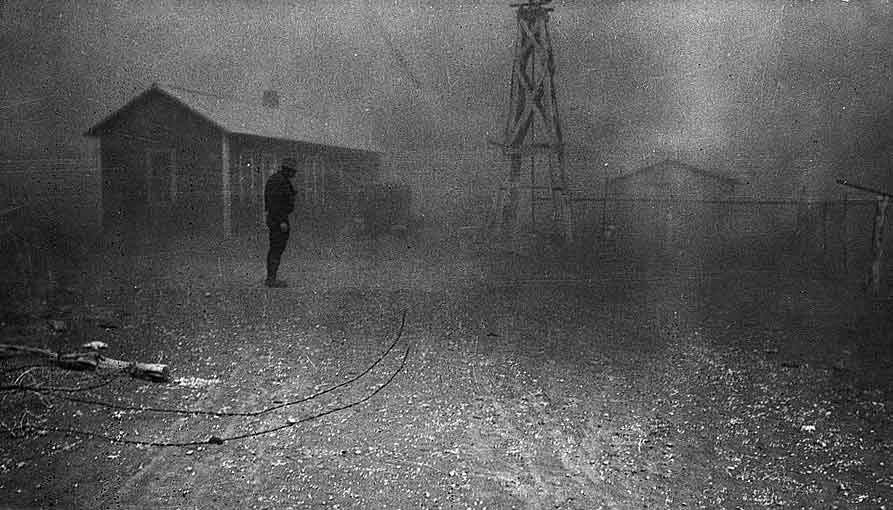
Dust storm in NM 1935 by Dorothy Lange. U.S. Farm Security Admin. Public domain

In the way that broken dreams can be instructive, I started to think afresh about plowed farm fields, how the neat rows of mounds and furrows from the hedgerow to the horizon appeal to my sympathy for geometry. Perhaps the Ohio farm agent Edward H. Faulkner loved the tidy appearance of fields left brown and vacant from winter to spring, but at some moment in his life the image jarred. Perhaps it was the memory of farms in the Mid-West and in Grapes of Wrath country further south where the topsoil was blown away in the Dustbowl that stirred him as a younger man. Maybe he pondered the benefits of leaving the land idle for which FDR’s New Deal compensated farmers with $2 an acre. I wonder if he cast back in his imagination to the lush native grasses of the original prairies that used to anchor the soil against storms and floods until they were plowed by settlers hungry for land who brought farm practices that had served their ancestors well in past centuries in Europe but were not such a good fit to prairieland.

Faulkner suspected soil erosion wasn’t so much caused by relentless forces of nature like climate hostility and grasshopper plagues as by deep plowing. Perhaps gentler tillage with a new tool or no turning of the soil would protect the land without diminishing the harvest. When he published the Plowman’s Folly in 1943 he was ridiculed, and like a good many other pioneers had to wait for his prescience to be honored.

Topsoil is a thin, fragile crust on the earth. Without soil and the fertility it harbors this would be a barren planet, so its care is a supreme responsibility. But as human populations shift from rural living to cities we seldom, if ever, think about it.

The USDA estimates we lose three tons of topsoil per acre annually, and at that rate we only have enough to support present agricultural practices for another sixty years (Scientific American, Dec 4, 2014). The public and environmental health costs of soil erosion are amounting to $45B every year. Of course, soil is regenerated naturally, but very slowly depending on the landscape and climate and at the oft-quoted average rate of one inch every 500-1,000 years. We can’t wait for nature to correct our errors and must work with her.

There were always reasons (if little scientific evidence) for deep plowing, but gradually no-till practices have caught on and swept into the organic farming movement. What Faulkner didn’t know is that soil has a much deeper structure than is visible in its “horizon.” Every handful contains immense tangles of almost microscopic fungal hyphae that build pipelines around and even inside crop roots for a relationship that benefit both (The Progressive Farmer Feb 2017). By disrupting and burying the network, plowing delays its regeneration.

Sowing a cover crop to clothe the land between harvest-time and spring also helps to reduce erosion, but offers other important benefits. Annual clover and rye grass sown among stubble residues provide soil anchorage, extra nitrogen from root nodules, conservation of moisture, and even affects the microclimate. In the south of France researchers found that by increasing infra-red radiation cover crops keep local temperatures cooler by up to 2° C. on hot days, despite the countervailing effect of reduced evaporation (PNAS 2014).

All-in-all, the farm revolution is helping to reduce soil loss, chemical fertilizers, weeds, and tractor pollution. This started me thinking about my garden, for aren’t gardeners little farmers mimicking agriculture, and isn’t the garden fork a substitute for a plow? My experiment with plowing had been a failure, but it jolted me into letting land be. What’s sauce for the goose is sauce for the gander, and I didn’t need more convincing to retire from digging.

My cover crop, February 2017

The experiment is still underway. Last fall the raised beds were given a shower of compost over crop residues, and without breaking soil structure I poked drainage holes with a rebar before sowing a cover crop. In previous years after leaving the soil naked all winter it quickly hosted a bed of weeds, but this year the clover and rye grew so thickly they blocked weedlings completely. I mean completely! By February I was ready to kill them off under a black tarp and dig the green manure lightly into the soil after it turned yellow before planting vegetables. The proof will be weighed in June and July, and in pounds of tomatoes and beans instead of tons of corn and soybean. An experiment is like a day at the races, because you can’t count on winning. Gardeners are hardy types like farmers because they live hopefully and consign the history of bad harvests and outdoor labor to some dark cave of the mind.

Next Post: Is the Dismal Swamp still Great?
 

Posted in Environment, garden | Tagged , , , , , , , , , | 3 Comments

Rabid Groundhog Attack


If you started to read this post because the title promised the sort of droll tale you expect from John Cleese or Stephen Fry I’m sorry to disappoint you! It’s a story about a gentle dog walk that turned into a rabid animal attack.

You might ask how I knew it was rabid. Was it tested for the rabies virus? [No] Have I encountered a rabid animal before? [No] I only had symptoms to go on, as well as familiarity with normal groundhog behavior. They often visit our yard to check if the veggie garden is ready for a nocturnal raid, but whenever I encounter them they run, and always in the opposite direction. So, what happened this morning?

I let the two dogs off the leash in a large meadow bordering the historic area of Jamestown Island, which we visit most weeks of the year. While the dogs were scampering a hundred yards ahead I noticed a large ball of brown fur in the grass and wandered over to examine it. I assumed it was a dead animal that scavengers hadn’t found yet, because I passed two dozen black vultures gorging on the carcass of a road-kill deer thirty minutes earlier.

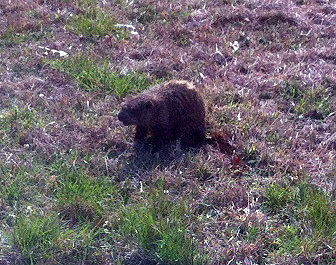
Groundhog ready to charge

When I was less than six feet away and bending over for a closer look at the body it suddenly unrolled and sprung to its feet in obvious fury, baring its incisors and making a strange gurgling sound. It was a large groundhog in a very bad way. Its coat was unkempt, not sleek from grooming, and its short tail looked like a chimney brush instead of a bushy duster. This groundhog had been fighting.

I expected it would run away but it ran at me, nipping at my loose trouser leg. It was crazy! When I stepped back it came again and again. I started to run until it flagged, and then stopped to take its photo with my cell phone from a cautious distance. It was a pathetic sight, and if there was a heavy object at hand I would have killed it humanely.

I hurried over to warn the ranger station, passing dozens of kids who had poured out of a bus to tour the historic area, but first I gathered and leashed the dogs. Had they encountered the beast I would be telling another story because one or more of our trio would have been bitten.

This first encounter with a symptomatic rabies victim will remind me in future to beware of mammals behaving uncharacteristically, and I mean any mammal because all are vulnerable to rabies.

Next Post: No-till and Cover-up

Posted in Animalia, Nature | Tagged , , , , | Comments Off on Rabid Groundhog Attack

Hellbender

Sounds like a rock group, but hellbenders are mute, cryptic, and uglier than any band! I imagine some American pioneer naming them after turning over a rock in a mountain stream and recoiling in horror at the sight of something looking like it crawled out of H***. But hellbenders are among nature’s innocents (despite their jaws) and, like the Elephant Man, they should draw our sympathy because we, too, would want to hide under a rock if we had the ugliest mugs in the world.

Credit: Pearson Scott Foresman (Public domain)

A hellbender’s body extends two to three feet behind its slimy head, sprouting two pairs of stumpy legs before reaching the tail. They live in rivers like the Greenbrier and Cheat in West Virginia that drain pristine water from the mountains and harbor the diet of crayfish (“crawdads”). Hellbenders are giant salamanders, and the Appalachian mountain chain is the redoubt of more of their species than anywhere else in the world, over seventy in all, mostly small, dainty, and colorful.

I have never found a Big Sal under a rock, but Nick and Tim grab one on their excursion to West Virginia in this video.  They are slippery characters that are best left alone like other protected species with dwindling numbers.

Elk River, WV. Hellbender homeland

Hellbenders like a quiet life, but their home stretches can quickly change temper after a storm, turning a gentle stream into a raging torrent that tosses slimy torsos against rocks, crushing and tearing their flesh. And yet deep skin wounds almost never go septic in salamanders because they evolved ways of repairing traumas and consequently live for 30 to 50 years, longer than almost every other animal in the forest except some large birds.

A family of small peptides called defensins help to protect them against infection by latching on before bacteria, fungi and viruses snuck into cells. We, too, have defensins for boosting our innate immunity by drinking our mother’s milk during the most vulnerable weeks of our young lives.

There are related peptides encoded in our genome, but they are shams because their pseudogenes have premature stop codons that produce truncated peptides that don’t work for us throughout life. Perhaps they were useful long ago, but we now depend on cells in the immune system to guard against microbes, and for the past eighty years have counted on the penicillin family when needed. I say “past” because overuse of these drugs is creating microbial resistance that could turn us back to the pre-antibiotic era. If defensins help to preserve salamanders in a turbulent environment perhaps we can synthesize analogous molecules as backups for penicillin.

These four-legged aquatic animals with a long tail look too alien to inform medical science, but their body plan and tissue architecture are not so foreign to our own. There is one huge, enviable difference. They have an amazing ability to regenerate amputated limbs that we lost way back in evolution along with the services of some defensins. If we could mimic their biology millions of patients could throw away prosthetic hands, arms and legs, and repair damaged internal organs by drawing on the regenerative potency that rests unbidden inside our bodies.

When part of a salamander’s body is lost a blastema forms at the site of injury containing stem cells and other cells that lose their specialized character as they ready themselves for a reconstruction job. Careful anatomical studies have shown that when limbs are regrown they become perfect copies of the originals. This process fails in us because of an absence of blastemas and scar tissue getting in the way.

But we are getting accustomed to surprises in biology, and there are grounds for hoping that the plasticity of cells can be harnessed one day for regenerating our bodies. If you see a salamander squatting in a glass tank in a lab you may think it is a scientist’s pet or a grotesque throw-back to the Cretaceous Era, but perhaps you are looking at the future, at something that will help to improve human lives, and revise your judgment of the beasts from Hell.

Next Post: Cover Crop and No Till

Posted in Animalia, Nature | Tagged , , , , , , | 1 Comment

Autumn Leaves have Fallen

I remember leaves falling precipitously in Quebec during September when the sugar maples create a blazing mosaic of gold and ruby on forest floors.  But the first snow blots over the colors as it quietly descends layer on layer with few melts over the next months. But here in south-east Virginia fall doesn’t arrive until late October, and then comes on hesitantly, one tree species shedding after another until Christmas, and snow is a stranger.

bronte-poem

Fall is the first love of Quebecoises, but they have more passionate ardor for the first cold kiss of winter when their skis are brought down from attics to wax for the slopes and forest trails. Virginians love their long colorful season, although if you ask gardeners you might hear them groaning.

Lawns turn from greens to browns, and flower borders from dainty asters to crinkly blankets. It is the time to pull rakes out of garden sheds and turn on leaf blowers, which will roar for weeks around the neighborhoods. The red oaks keep their canopies until shortly before Christmas, and if I go outdoors after a windy night I have to tramp through leaves deep and crisp as cornflakes after a tremendous dump. Then the rake comes out again.

I estimate over 50 million leaves fall on our property. Only beech stays covered until spring buds nudge them off. Every species has its reason, except the human kind which has a perverse attitude to leaf fall.

Although the season is now long past, serried ranks of 40 gallon plastic bags still wait at the end of driveways to be carted off to the county dump. Trash to most people, they are bags of treasure to me.

The first neighbor looked puzzled when I asked for his bags, and then curled a smile. “Why sure. Go ahead and take my other trash and a dead animal too.” I didn’t ask others after that. I just threw their bags on the back of the truck, hoping they would be pleased to see an empty driveway.

The leaf thief

The leaf thief

I brought home 75 bags of dry leaves which, on average, weighed 40 lb (18 kg) for a total of some 3,000 lb or 1.5 short/ US tons (slightly less in Imperial tons). Wondering how many leaves I collected, I counted a sample of 1,000, which weighed about 1 lb. According to rough estimates, my haul rounded up to 3 million leaves, but that didn’t include the countless number I raked in the yard. According to an agronomic library used by the Druid’s Garden to estimate chemical composition, I brought home 1,500 lb carbon, 48 lb calcium, 30 lb nitrogen, 7 lb magnesium, and 3 lb each of sulfur, potassium, and phosphorus. Why, you might ask would a leaf millionaire want more? And what makes him a scavenger?

Taking away leaves has the same impact as cropping. It depletes the topsoil of precious minerals and removes carbon captured by trees during the warm months. Returning their goodness replenishes the soil by making chocolate humus. It avoids the need to buy chemical fertilizers to feed the ground and mulch to protect flower beds because dry leaves look attractive, and of course natural, in a woodland garden.

In the right places they are beneficial in every way, and over time they restore soil fertility where it was impoverished by hungry crops, like tobacco which was grown here as a former plantation. Leaves that are not spread around are pressed into leaf bins and baskets to make leaf mold, but they are placed far from tree roots that would try to suck out the nutrients. Black walnut is the only unwelcome species because every part contains toxic juglone.

If practical arguments leave you cold then consider picking a leaf for meditation. To paraphrase William Blake’s Auguries of Innocence: “To see a world in a bunch of leaves, And heaven in a green leaf…” Leaves capture carbon, exhale oxygen, transpire water, recycle minerals, provide food and shelter for the “little creatures who run the world” (E.O. Wilson), and of course they feed nations with nutritious chow and inspire us with color.

Next Post: My Hunt for a Hellbender

Posted in Environment, garden, Seasons in Virginia | Tagged , , , | 2 Comments

Look like a Wild Turkey

I want to look like a turkey. Don’t misread me. I want to look like one, not look like a turkey. The eyesight of wild turkeys is superior to every other inhabitant of eastern forests with the exception of raptors and vultures, and probably three times as acute as a human hunter with 20/20 vision.

Little details that don’t get our attention matter to turkeys. They notice a trivial silhouette that might betray the ears of a lurking coyote, or the metallic ring pointing out of shrubbery 100 yards away that could be a shotgun barrel. They might even notice an unfamiliar blue flash on a hunter’s camouflaged jacket who didn’t realize that detergent containing optical brighteners leaves fluorescent traces that are noticed by quarry with sharp eyes at the blue end of the spectrum.

Where Wild Turkeys safely graze

Where Wild Turkeys safely graze

But when I look peep through a window to watch a gang of turkeys feeding at our sanctuary area it’s not only their visual supremacy I admire but how acutely they take in their surroundings, as of course they must. If we were a prey species we would not last long in the woods, having lost or forgotten the craft of “looking out.” When I saunter along a trail I have less than half a mind on my surroundings, being either engaged in conversation with another hiker or lost in private thoughts. If this is true of a naturalist I guess it must be general. What do I miss on a hike—a rare bird or butterfly, a glistening stone or weird mushroom, a trail of beaten grass or an intriguing dollop of scat? How much richer the experience if I looked harder, saw more, mentally engaged my surroundings; how many more critters and stories could I bring home if I saw the signs? My eyes focus on the next footfalls and anything beyond a few yards is a forgotten blur. I might notice more if I were a blind man accustomed to using sharp ears.

sabrina-carpenter

This lack of attention is even more wretched in town than in the woods. Some writers break from their desk to have a smoke: I go out for a walk to mentally work through a tricky paragraph or overcome writer’s block. Without a dog guiding me on a leash I might bump into a post from somnolently gazing at my feet pacing the sidewalk.  There is an element of courtesy in this dream-walking because I can’t be accused of looking nosily in the windows of houses or at people on their porches. But I wonder how much interesting stuff I miss by not looking out, stuff that might feed a writer’s fancy, and there was never a better opportunity for spying on eccentricity than when I walked to work along First Avenue in NYC where so many strange birds make their nest.

This musing threw me back to memories of when I was a Boy Scout. The scouting motto is Be Prepared, but there is another—Look Wide. Even after all these years it is hard to keep a lookout, requiring a disciplined act of concentration like keeping a stiff back instead of slouching like many other tall people.

The founder of the scouting movement Lord Robert Baden-Powell wrote: “Look wide, and even when you think you are looking wide—look wider still.” Our favorite scout activity was the Wide Game in which half the troop was sent into the woods as hiders while the rest waited fifteen minutes to go after them as seekers. It honed our powers of observation, skills that Baden-Powell brought home as a colonial army officer from the Matabele and Boer Wars.  They are not so much valued today except by hunters and search-and-rescue squads, and society might be approaching a nadir as we focus on smartphones and tablets, seldom casting aside to everyone and everything around. We look narrow.

I suspect professional artists look differently. I never looked as carefully at objects than when I dabbled in painting. In a Norwegian study tiny cameras were used to track eye movements in trained artists to compare with a group of non-artists (Perception 2007; 36:91-100). They were asked to look at a scene or a picture and then look again more intently to remember it. The non-artists quickly focused on the chief features—a house, a person, an animal—and their attention didn’t wander far for long. The eyes of artists, however, tracked back and forth, up and down, scanning the entire field and following the shapes, forms, and colors. Their look was not strongly focused on the main subject, and they remembered details better. They look wide.

We expect artists to be better observers of nature, but I was surprised when I read that minor visual disabilities are more common among art students. Stranger still, Rembrandt’s self-portraits seem to depict a man with cross eyes (strabismus), which would have impaired his depth perception. Perhaps I now understand why I was taught in art classes to close one eye when drafting a picture. It helps pay attention to the details of the subject as well as frame a picture with two-dimensions from three.

That brings me round to wild turkeys. They are strabismotic because their eyes are on the sides of their head, and they gain a penetrating impression of their surroundings by constantly rotating their heads through 360 degrees. Turkeys teach me to look, but I stop at rubbernecking.

Next Post: Last of the Autumn Leaves

Posted in Animalia, Environment, Nature | Tagged , , , , , , , , , , | Comments Off on Look like a Wild Turkey