The Peril of Faith in a Net-Zero Target for Carbon Emissions

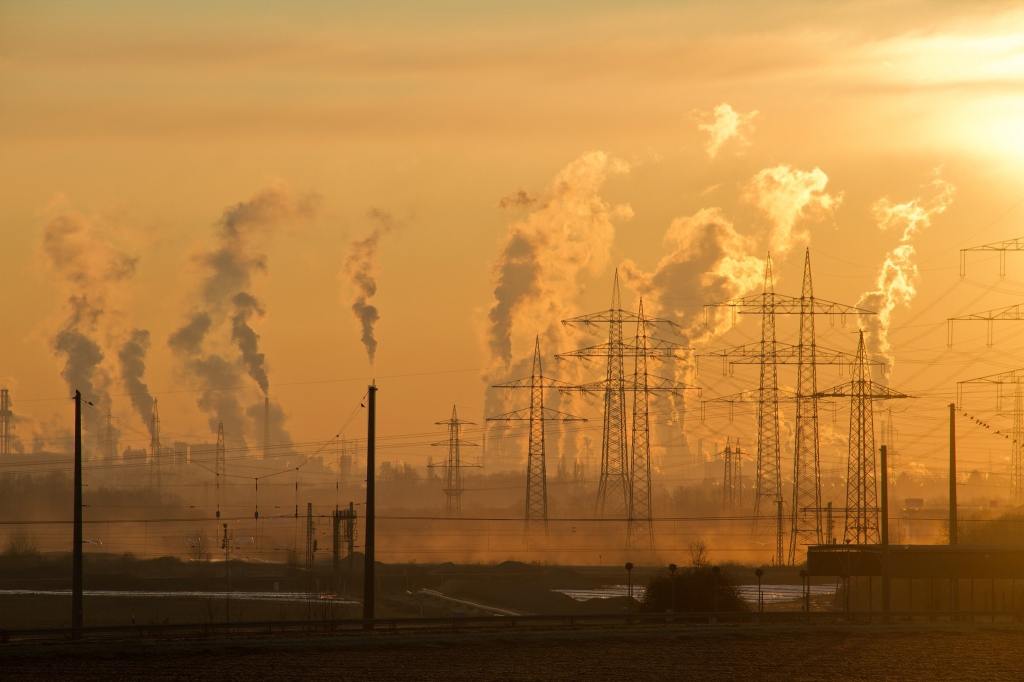
Global warming from power stations generating electricity
Photo: Anon. Pixabay, CCO. Electric Towers during Golden Hour.

“… Our goal to achieve net-zero emissions by 2050 …” Joe Biden (Reuters, February 23, 2021)

A laudable goal reinforced by the President this week on Earth Day. However, the same day, three leading climate experts writing in The Conversation (US edition) condemned ‘net zero’. Of course they weren’t recanting global warming as an existential threat. They fear by putting off to a future gamble what needs to be done today we will lose the race to rein in average global temperature rise by < 2ºC. False hope in unproven technologies promised ‘just over the horizon’ encourages CO2 emissions to soar from business as usual.

Commentators have welcomed the frankness, though one admitted that few people, even those who deeply care, will read a lengthy article. He recommended reaching people through bullet points. I therefore wrote the summary below, hoping to be faithful to the authors while acknowledging I am no expert.

  • James Hansen (NASA) testified to the US Congress in 1988 that greenhouse gas emissions from human sources were already warming the planet
  • Faith in technological salvation has continued to diminish the sense of urgency, postponing solutions to the future
  • The polemical mantra is we can burn now (fossil fuels) and pay later, trusting the ‘wisdom’ of the market
  • From the 1990s, elegant computer models attempt to project emissions from investments in new technology with links to impacts on economies. Testing scenarios in silico (e.g. planting trees, carbon sequestration) offer quick and cheap projections compared to real-life simulations. They continue to be a bedrock even as successive hopes have dashed
  • The first hope: plant trees, though we can’t plant enough in the world to sink all the anthropogenic carbon and the attempt would harm biodiversity and food production
  • The second: improved energy efficiency with a gradual switch from coal to gas (+ nuclear) has hardly shifted the ascending curve
  • The third: carbon capture from power plants with storage underground, a great concept though exceedingly costly to scale up (admitted at Copenhagen Summit 2009)
  • The fourth: a combination of burning wood and farm waste plus carbon storage was a principled achievement for climate justice at Paris 2015, but is it workable?
  • The fifth: direct capture of atmospheric CO2 but only been achieved on a small scale in practice
  • The sixth: geoengineering by injecting sulphuric acid into the stratosphere to reflect back solar radiation, but what could be the unintended consequences?
  • Beautiful in theory, but can a computer algorithm match the deep and dynamic complexity of social and political realities across the globe?
  • The 1992 Rio Summit was supposed to kick start mitigation, but since then, instead of stabilizing, atmospheric CO2 has risen by 60%

The emperors of technology have no clothes. Among the many problems facing humanity, none requires more urgent attention than warming of our planet that is happening too fast for the biosphere to comfortably adapt. Net-zero policies are focused on reigning in emissions targeted to some wobbly date in future. Meanwhile, precious time is lost with irreversible damage to ecosystems.

The authors give stark advice: “The only way to keep humanity safe is immediate and sustained radical cuts to greenhouse gas emissions in a socially just way.”

Go, go, go, said the bird: human kind

Can’t bear very much reality …

T.S. Eliot: Burnt Norton

If Eliot meant we can’t imagine a world without us, perhaps this poem also speaks to our inability to grasp a world molded by global warming, so utterly beyond our comprehension yet one that generations to come must endure.

Posted in climate change, Environment | Tagged , , | 2 Comments

Carolina Wren

Carolina Wren

This girl looks coy with closed eyes but is probably acting. Carolina Wrens pair the year round and may be faithful to the same mate for years, up to a maximum recorded lifespan of 7 years. Great songsters for their size, we can watch them at close quarters as they are not so flighty as larger birds, provided we don’t startle them.

They aren’t fussy about a nest site, which is usually in a cavity below shoulder height and sometimes in brush piles, which this untidy gardener provides abundantly. The nest is a woven dome of grass and stems with a softer lining and even fanciful decoration (aluminum foil, polythene, etc.).

dummy nest of wren

After attaching an opaque plastic bottle to a tree I was glad to find a wren’s nest inside. But after a fortnight it is still empty, probably a dummy made by a Carolina or House Wren. There are several explanations why they make dummy nests, but my favorite is that a wise male lets his wife choose the furnished home she prefers.

Both kinds of wren live in this yard, surprising since they are boisterous birds and similar habits make them competitors. (RG)

Posted in Inge Curtis birds, Nature | Tagged , , | 1 Comment

We were Pleistocene Predators

Lascaux caves
Photo: Jack Versloot: Lascaux II (prehistoric prey animals). Creative Commons

As natural is a word with a vast definition, diet is one with almost unlimited scope. Hence, the exploration of a natural diet as the touchstone of optimal health is but a Grail quest.

The omnivorous diet of the San and Hadza interest us because modern hunter-gatherers are largely spared the common degenerative diseases afflicting West and East. They gather wild berries and nuts, hunt insects and small game, not the kind of fare that interests most of us, though nutritious. But do they represent a nutrition that molded our biology and genetics that we ought to imitate today?

Let’s look back in prehistory to when humans were evolving from apes, before they lived in degraded environments. We have lost an immensely rich megafauna that offered humans meaty meals. In a recent review, Tel Aviv researchers conclude that through most of the Stone Age we were apex predators and hypercarnivores (meaning >70% meat).

That we are flesh-eaters by nature (sic) can sound scandalous, implying we are not only responsible for the ongoing Sixth Extinction but a previous one in the Paleolithic era as well. Homo species probably carried as much responsibility for destroying biodiversity as climate change (perhaps more), causing mammoths, aurochs, saber-toothed tigers, cave bears, and other charismatic animals to vanish. I feel even more persuaded after my single experience of practical paleontology cleaning bones of a local Mastodon: our geologist, Jerre Johnson, declared it was killed by hunters.

The first hominids were primary vegetarians, like their ape antecedents. Before we emerged as a distinct species, our lineage was represented for a couple of million years by Homo erectus. By the Upper Paleolithic, a few tens of thousands of years ago, they helped to make large game scarce. We had to switch to a mixed diet of hunting and gathering, fishing and domesticating animals for meat and milk. The hunger for greater food security triggered the first Agricultural Revolution, and crop farming was so successful it created a population boom with social changes we still grapple with.

So, what is the evidence for carnivory? The authors reviewed 25 factors, including genetics and physiology, ecology and paleontology. Here are a few memorable examples, not just from gut and metabolism.

  • A highly acidic stomach adapted for killing bacteria in stale meat and carrion is absent in obligate plant eaters.
  • An adaptation for high fat consumption and insulin resistance
  • Micronutrients from animal sources (vitamin B-12 a top example)
  • Higher ratio of the length of small intestine to colon
  • Changes in masticatory apparatus and salivary enzyme genes for starch digestion
  • Endurance running and excess sweating for catching swift prey
  • Ability to throw weapons forcefully and accurately (chimps and gorillas can’t throw 100 mph fastballs)

Charles Darwin believed changes in diet shape evolution, famously illustrated by Galapagos finches. Maybe it’s hard for vegetarians and vegans to accept we are still adapted for a low-carb paleo diet, but our evolution creeps slowly because of long generation intervals. Eating mostly plants is no longer just a personal preference or from concern about animal welfare, but a virtue for lowering our impact on the environment. We never worried before about going against the grain by denying our nature of two feet on the ground when we wanted to launch into flight and space. Neither should we now.

Posted in Nature | Tagged , , , , | Comments Off on We were Pleistocene Predators

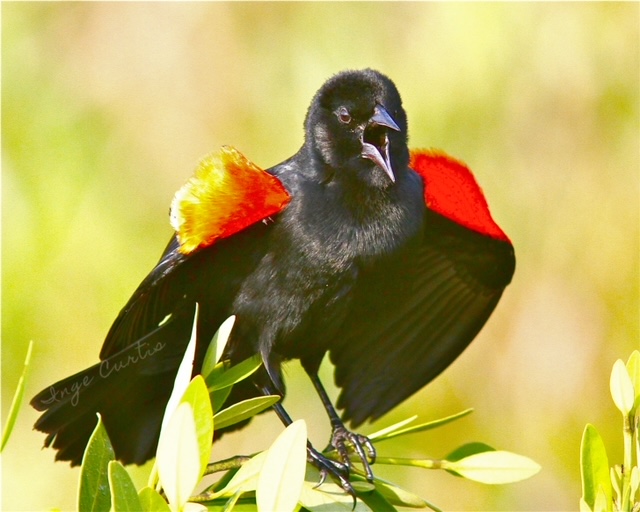
Red-winged Blackbird

Red-winged Blackbird
Photo: Inge Curtis

Seen locally the year round, Red-winged Blackbirds gather in flocks in winter. Occasionally an all-female flock dives into the garden to frenetically peck for seeds until disturbed when they storm off. Sometimes the females are mistaken for immature starlings or sparrows because of their brown stripes, but the male is distinctive in his glossy black plumage and flashy red and yellow epaulettes. They have started to sing again but can’t make musically liquid notes for long before descending into gurgles!

As the breeding season approaches, they split up and leave fields and gardens to set up territories in the saltmarshes nearby. The appearance of these dandies evolved to attract the ladies, polygamous as they are, but their colors also serve as warnings. They are fearless driving off predators near their nests and even ‘bomb’ humans who venture too close.

Posted in Inge Curtis birds | Tagged | Comments Off on Red-winged Blackbird

Waldeinsamkeit

Yellowstone National Park
Photo: Yellowstone National Park (RG)

Is there anything about the pandemic that hasn’t been said a hundred times already? It is no secret that one of the healthiest places to rest from screen fatigue and lockdown lethargy is outdoors.

People have rushed to national and state parks and to the coast for a dose of ‘nature.’ Take, for example, Yellowstone National Park. Gate registrations of recreational vehicles surged every month in 2020. In the peak month July 2020, 365,937 were recorded compared with 320,464 12 months earlier. When this post goes out, I too will be breathing mountain air, except in the ‘Mon.’ Phew. That feels better!

Seeking peace through a mindful stroll among trees has a long history among forest-loving Celtic people and forest-bathing Japanese. So important is it in Germany that a new word was created by conjugating two unrelated words, for which the language has a facility. Waldeinsamkeit (forest plus loneliness/ solitude) captures an entirely positive feeling with no English equivalent.

Nothing green and vegetable is more loved than a tree. Perhaps because we venerate their long lives—counting rings and planting saplings to memorialize life events. Perhaps out of gratitude for what they provide—permaculture food and the most versatile material for crafting our needs. They keep on giving: hardly something we can boast. It’s hard to imagine a civilization emerging without them or human beings even evolving. Weren’t we molded from the genome of an arboreal ape?

To go to the woods and forests is to go home, as if on a family visit to a third parent. They grew deep roots in mythology and religion. The Druids had their sacred groves and other cultures cherished the Banyan tree, Bodhi tree, and Christmas tree as symbols of growth, decay and renewal. Dryad spirits of the woods populate poetry and literature while Tolkien’s Ents guarded the forest. And, despite casting off superstition in the modern age, the mystique endures through scientific discovery of the wood wide web in which vibrant communities connect tree to tree and tree to fungus and microbe.

Recent best-selling books about trees or set in forests add to a perennial genre: The Overstory, The Hidden Life of Trees, Game of Thrones, etc. Children’s books too: The Magic and Mystery of Trees, The Tree Lady, etc.

I close in contradiction. One of the goals of going outdoors is to leave paper and screen behind, but hurry home to one of the finest short stories for children and adults. The Man Who Planted Trees by Jean Giono is an inspiring story of a shepherd living as a hermit in the desolate mountains of Provencal. He transforms the landscape by planting acorns that grow into a forest. A CBC cartoon movie narrated by Christopher Plummer and available on YouTube captures the story beautifully of how an unselfish activist can make a difference for humanity and the environment.

Posted in Health | Tagged , , | 2 Comments