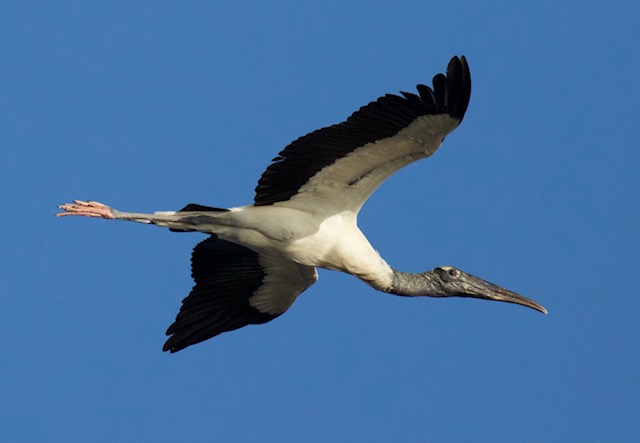
Compared to the handsome storks of Europe in Hans Christian Andersen’s story and those that carried us in a natal cradle, American Wood Storks look like old countrymen with bald, wrinkly heads exposed to too much sun. A featherless head is more hygienic for dipping into muddy wetlands, the same as for vultures bobbing in rotting carcasses. Storks and vultures are far more graceful in the air than on the ground, often circling in the same thermal.
Wood Storks are rarities in Virginia, but found year-round in Florida and other south-eastern states during migration. Inge saw this one in Texas.
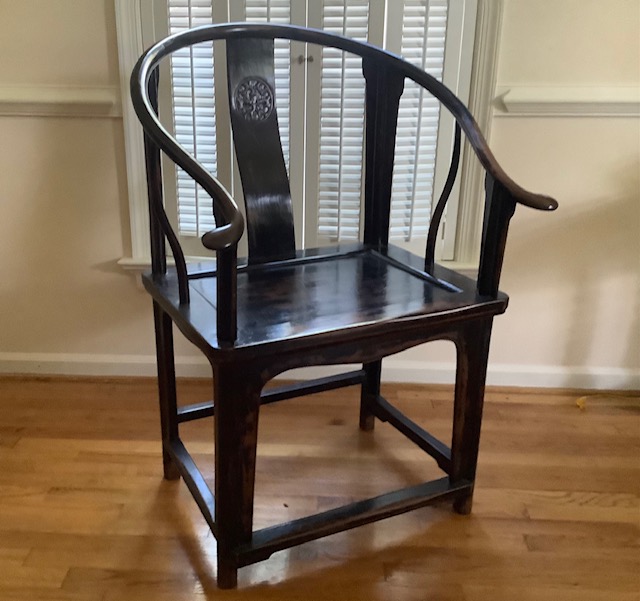
After more than a century, lacquer has cured on this Chinese ancestor chair
A week after nightly creaming my face and arms with hydrocortisone I’m still itching. Each exposure makes the reaction worse next time. A few people, including our gardener, are lucky they don’t react to poison ivy, nor wildlife or pets protected by hair or feathers. Even after cautiously walking on a woodland path or weeding, the unwary can become victims simply by cuddling a canine companion who brushed against a vine.
Poison ivy is not strictly a poisonous plant although the allegation is rooted in the scientific literature as it belongs to the genus Toxicodendron, along with poison sumac and poison oak. The allergic irritant in its leaves, stem and root is urushiol, which presumably evolved to deter to grazing animals (and gardeners). I read that trace amounts exist in mango skins. Eek!
So potent is the oil that when microscopic droplets penetrate the skin, Langerhans cells recruit ‘armed’ T-lymphocytes to fight the invader. The process kills cells as collateral damage and causes blistering, swelling and a blazing red rash. As a slight consolation, my palms and soles never react because they have thicker layers of keratin.
Wakened at night by the urge to scratch, it’s hard to find a polite word for the irritant, but urushiol has a larger story. Once used in herbal remedies when plants were the basis of the pharmacopeia, it still finds a place in traditional Chinese medicine. Its anti-tumor properties encourage researchers to overcome insolubility in water to create a medication for testing in the body. I doubt they will find volunteers for a clinical trial !
Urushiol research is mostly based in Asia where it has long been used as a lacquer for furniture and other wood products. It is collected from lacquer trees, like tapping maple trees or rubber trees. The name of the tree in Japanese gave urushiol its name. Painted in thin layers, it oxidizes and polymerizes to a hard, stable coating.
If your arms become inflamed after resting on a table made in China, it wasn’t your mom’s scold that came back to haunt you from breaking domestic etiquette. The lacquer may not have cured completely.
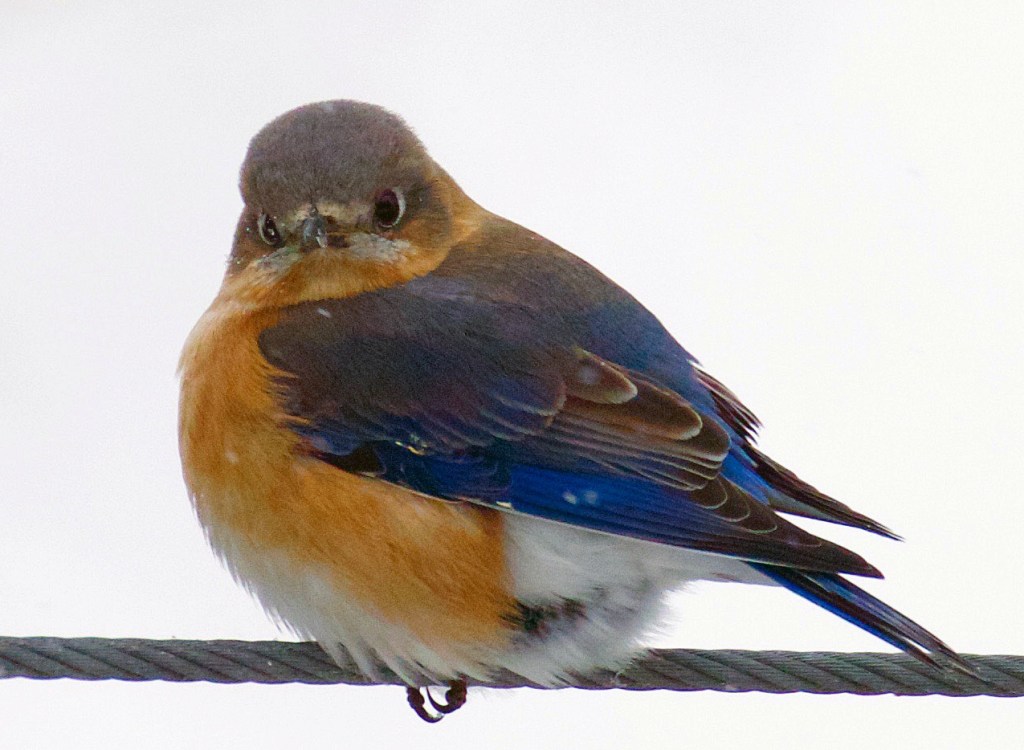
One of our most popular residents, there is even a Virginia conservation society dedicated to Bluebirds. Someone who grew up locally told that they were uncommon when she was a child. Fifty years ago these cavity nesters had trouble finding holes for homes, but hundreds of nest boxes are now stationed around the district, many of them monitored weekly in the breeding season by Master Naturalists.
Our bluebird trail of about two dozen boxes fledged 103 Bluebirds this summer (plus 28 Tufted Titmice). No wonder we often hear them twittering from perches on branches and power lines where they cast eyes down for an insect or a juicy berry in winter.
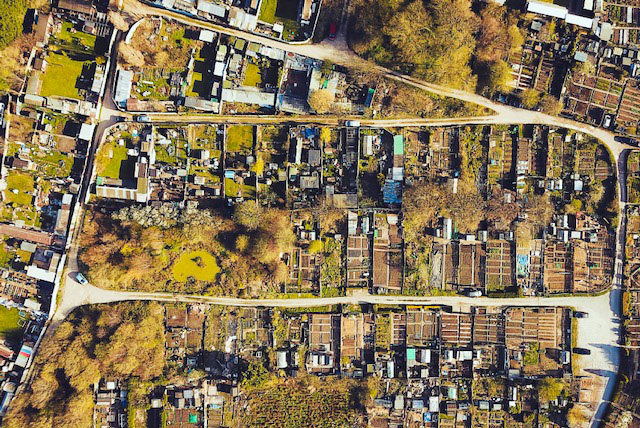
Drone view of allotment in the Wirral, UK (Phil Kiel: Unsplash)
I suspect former neighbors laughed from behind half-drawn curtains: “There’s a weird gardener next door who toils in the midday sun.” But I didn’t care, wearing my green hat with pride and careless if anyone thinks I’m a throwback to rustic ancestors.
Most people had a vegetable plot before the Industrial Revolution sucked them into grey cities. In medieval times, the manor divvied out strips of land for serfs to cultivate. It wasn’t gardening for recreation. Each acre provided crops to feed a family member, mostly in grains and legumes, and no space for daffs and mums in hunger times.
After the collapse of feudalism and expansion of urban living, people lost their country gardens. The prosperity that later nourished expansion of suburbs provided smaller plots, mostly for recreation and never intended for subsistence. Victory Gardens were a brief exception, but after World War 2 the loam mostly returned to lawns and flower beds. Developers earned more profit from larger houses on smaller lots. Gardens mostly served as curbside appeal.
The retreat from gardening in the 1950s and 60s was like the withdrawal from music-making around the family piano in the parlor. People had more options than grubbing in the yard on weekends or after work, while TV and record-players replaced the playing of instruments at home. Although both accomplished amateurs, our parents never made music when we were growing up. We had no pressure to learn, and our fine piano formerly played by professionals at the BBC was given away. No one thought it odd because that was the fashion and ‘progressive.’
So many pianos became redundant that piano smashing contests were held at English village fetes. Instead of fingers playing melodies of Liszt and Chopin, sledgehammers rang down on busted springs and shattered keyboards. Years later, I noticed more children having music lessons and heard it was hard to find a cheap second-hand piano. Something counted as redundant in one era may become appreciated again in another, like antique chamber pots that also went under the hammer and now prized as dainty flowerpots or for fragrant pot-pourri.
Gardening has also become resurgent, driven by appetites to grow-your-own organic food and maybe encouraged during lockdown in the pandemic. But the smaller gardens boast timid ambitions that end at the neighbor’s fence, and people in city blocks have no green space to call their own. That’s a pity when the benefits of gardening for physical and mental health are appreciated more than ever.
Some people enjoy community gardens that exist in many countries, although the distribution is spotty and only benefits the neighborhood. In Britain they are called allotments. Each lot is rented from the council by a local resident in a relationship you might call an update on lord of the manor versus serf!
Unfortunately, 80% of allotments disappeared in the past century by turning green space into concrete and asphalt. The recent upsurge in demand for them is unsatisfied. Waiting lists crawl as occupiers cling to their space until death or a job move parts them.
Turf wars spring up when councils want to sell the land for a pet project or to developers. The ranks of protesters who proclaim rights to the bounty of open land and take the moral high ground for a locavore diet are (maybe) the first signs of a peasants rebellion since 1381.
Councils look to their supporters. Some citizens regard ragged rows of crops in allotments as eyesores and don’t understand gardeners passionately gossiping about their brassicas over cups of tea in tumbledown sheds. But society’s divisions can be healed and suspicions overcome through peace offerings. My neighbors never gave a strange look again after I offered fresh, home-grown vegetables and honey.
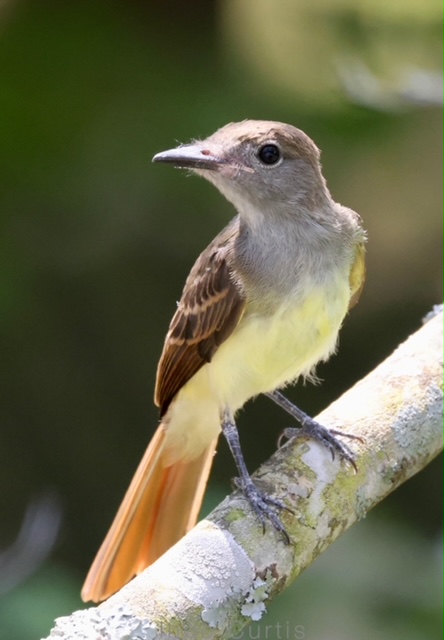
Flycatchers are allies of those who loath mosquitoes and blackflies without spraying their yards. This handsome bird is found east of a north-south line splitting the North American continent in half, and projected to lose western territory and perhaps gain some in Canada from climate warming.
Since the related Eastern Phoebe flicks its wings like common flycatchers in Europe I wondered if other tyrant flycatchers, including this Great, behave similarly. Apparently not. I can’t explain the nervous twitching, evidently not strictly linked with flycatcher habitat or habits.
Perhaps, like me, you wonder where the name ‘tyrant’ comes from for American flycatchers. I can’t explain that either, except to say the distinguished Irish naturalist Nicholas Vigors coined the family name Tyrannidae.







 Roger musing about Peace with Nature