Peppa Pig has missed a vocation

Large White Pig (Yorkshire)
Large White (Yorkshire) pig (Pixabay)

Starved of spicy stories or constipated by covid, the British media wrote about Prime Minister Boris Johnson’s bad hair day. In a speech to business leaders, he lost track of the message and, presumably to preserve poise, he ad-libbed about Peppa Pig World.

The pink cartoon character has become wildly popular. A child’s father told the Guardian newspaper how young superfans rushed to meet Peppa in an Hampshire amusement park, looking like an audience with the Pope. Peppa is an English creation but has become a worldwide phenomenon, nowhere more popular than in China where 2019 was the Year of the Pig. A porcine celebrity was as unheard of as a pig that can fly. No longer.

Turning animals into cuddly cartoon characters helps to forget the reality of real lives under domestication and in factory farms. Millions of pigs are raised in climate-controlled sheds, never seeing sunlight before reaching their destiny as chops and sausages. Is there a more ignominious end for a beast credited with superior intelligence to dogs?

I admit complicity and guilty feelings when chops sizzle on my grill from an animal I never knew but who, under different circumstances, might have become a beloved pet (not indoors). Our ancestors probably had the same ambiguous feelings. Where I grew up, families used to keep a pig given a Christian name and fed on kitchen scraps until sentiment evaporated in the autumn when the slaughterman drove up. When I used to visit a slaughterhouse to collect research specimens, I closed my ears (eyes and heart too) to the heavy slump after the bolt shot. After casual flirtation with vegetarianism, my carnivorous appetite restored.

Our relationships with animals wheel between affection and respect versus insouciance and far worse. Dogs are man’s best friend, yet no other animal receives more abuse at home. A donkey carried Jesus into Jerusalem, but countless numbers suffered in mines and as beasts of burden. A conservation symbol and most popular wild animal in Britain, yet badgers are shot, gassed, and even baited with dogs in illegal pits. I could go on … except to add that it matters not just for the sake of fellow creatures but because culprits of inhumane treatment are more likely to be cruel to children and spouses as well.

Toxic masculinity (not exclusively male) is often responsible for violence against vulnerable creatures. It erupts from poor anger control and frustration, treating victims no better than other property and to remind them who is boss.

Matters are not so bad now, thanks to legislation bolstered by science that reveals even invertebrates can feel pain (see post on lobsters). We pay more attention to the welfare of pets than herds or flocks of animals. Compassion is diluted by number. We prefer not to think too deeply that meat, eggs, and dairy produce, neatly wrapped and hygienic, came from sentient creatures raised and sacrificed for us under conditions we tacitly accept.

Perhaps that distance explains why (I’m told) Peppa Pig eats bacon without a pricked conscience. Sad to think the iconic pig works only as an entertainer and has missed an opportunity to teach animal welfare to children.
Posted in Animalia | Tagged , , | Comments Off on Peppa Pig has missed a vocation

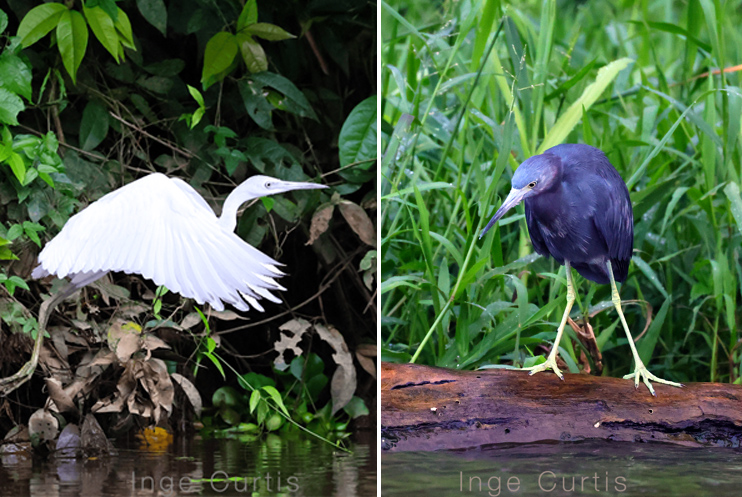
Little Blue Heron

Little Blue Heron
Inge Curtis

At one time, the Little Blue Heron was a common wading bird in the Coastal Plain and Eastern Shore, but it has been in steep decline since the 1950s (from habitat loss?). Local birds leave our area after breeding to spend the winter in warmer climes. This duo may have arrived in Costa Rica a few weeks ago from the USA.

I am puzzled by the striking change from white in juveniles to blue plumage in adults. The color of other blue birds I know (e.g., Indigo Bunting shown recently) is created by refractive interference of light, not from pigment. Has the fine structure of barbules in feather vanes changed with age? Surprising if so. The adult shown here looks bright blue, although I’ve seen other images in which adults are purple-maroon on head and neck and dark slaty-blue on the back, so I’m not sure.

Posted in Inge Curtis birds, Nature | Tagged , | Comments Off on Little Blue Heron

King Vulture

King Vulture

This image arrived last week from my friend in the jungles of Costa Rica. King Vultures are so spectacular they look photoshopped (I promise this picture isn’t). Kings weigh up to 8 pounds (3.7 kg), the largest vultures on the western continents, except for condors. That may account for a royal name, though they look to me like Walt Disney characters.

Uncommon in Central America, they have a range extending to Argentina. Since this group lives north of the equator they qualify for our gallery of North American birds.

I read that their sharp senses often find carrion before other scavengers, but their beaks aren’t strong enough to rip open the toughest hides. While they wait for butchers to arrive with sharper tools, they enjoy nibbling eyes for hors d’oeuvres, said to be highly nutritious!

Posted in Birding, Inge Curtis birds | Tagged , , | Comments Off on King Vulture

Ring-necked Duck

Ring-necked Duck
Photo: Inge Curtis

Ducks are back to spend the winter on the coast and inland waters around here. Teal, Shoveler, Canvasback, Scaup, Eider, Bufflehead, etc., and Ring-necked Ducks like this pair.

A compact little diver that prefers ponds to open water. It is misnamed because it doesn’t have a prominent white ring around its neck like a pheasant (the chestnut band is only visible on a bird in the hand).

Posted in Birding, Inge Curtis birds, Nature | Tagged | Comments Off on Ring-necked Duck

Ride the King Tide

Powhatan Crook, James City County, Virginia

I never saw water so high in Powhatan Creek. Living in Norfolk, Virginia, I occasionally encountered flooding in my neighborhood after exceptionally high tides or a nor’easter. I’d drive through inches of water to my driveway which rose to a high and dry house, avoiding the need for flood insurance. Other homeowners weren’t so lucky, judging by whirring sump pumps in basements. The problem doesn’t disappear with the tide because tender garden plants are harmed by immersion in salty water.

Apart from the notoriety of New Orleans below sea level, Hampton Roads, the Eastern Shore, and the Middle Peninsula are most at risk from sea level rise (aggravated by sinking land on the Peninsula).

“The total area at risk in coastal Virginia is 424 square miles in 2040, 534 in 2060, and 649 in 2080. The total length of potentially affected roadway is 545 miles in 2040, 972 in 2060, and 1762 in 2080. The total number of buildings potentially affected is 30,795 in 2040, 57,740 in 2060, and 111,545 in 2080.  Those alarming projections are from a recent Commonwealth inquiry, but records back to 1950 show a rise of over a foot already.

Besides periodic threats from storms and hurricanes, there are king tides from the alignment of gravitational forces of sun, moon, and earth. They are higher than spring tides, which recur monthly (not seasonally as the name implies).

In November 2017, we volunteered for a citizen science project in which 500 people monitored the king tide using GPS. Data were recording by pressing a button in a phone app every few steps along the water’s edge. The immense database improves projections of areas at greatest risks of inundation.

A king tide peaked at 1.00 pm on November 5th this year. It offered a rare chance to kayak a swamp at the head of Powhatan Creek. A modest adventure, winding between bald cypresses and avoiding submerged obstacles, we penetrated a full quarter mile beyond the usual limit, wondering if sea level rise will make it routine in a few decades. We had to keep an eye on the tide before it receded or we risked stranding in a bog that could even swallow waders.

Posted in climate change, Nature | Tagged , , , | 1 Comment