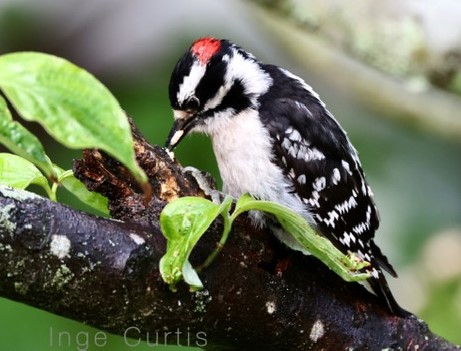
These cute warblers are resident in this region year-round but seen more often in fall and winter when more northerly breeders join their brethren in this warmer clime. As they feed on seeds instead of insects, they don’t need to migrate further for wintering in the sub-tropics.
European Starling murmuration (James Wainscoat: Unsplash)
The United Nations estimates that our population reached 8 billion this week. In 1900, it was 1.6 billion but by the turn of the 21st century, we had grown to over 6 billion. That is nearly 2 billion more mouths than only 22 years ago and the graph is still rising. Meanwhile, most wildlife populations across the globe are plunging. There’s a connection and it’s called the Sixth Great Extinction.
It is harder to estimate populations of birds than terrestrial animals, but North America alone is reckoned to have 3 billion fewer birds than 50 years ago. Seventy species out of a total of over 500 are thought to be close to a tipping point, meaning the threshold for sustaining their presence.
The Cornell Lab for Ornithology released a tool this month that maps trends in the abundance of birds from 2007 to the present. The data were provided by citizen scientists through eBird and mapped in 27×27 km squares (roughly the area of a small county). Birders and gardeners have noticed fewer birds in their localities, especially “common” birds, and this impression now has numbers. Typing the name of any species prompts the map of North America to show the trend in blue boxes for an increase, red for a decrease, and white where it can’t yet be determined with confidence.
I tested the tool for the mid-Atlantic region where I live. The good news is that geese and swans have increased spectacularly, and waterbirds and ducks are doing well too. The protected status of wetlands where there is less pollution and human disturbance is probably responsible.
There are reassuring trends for some raptors (eagles, owls, and the Red-shouldered Hawk) as well as for vultures and ravens. The Pileated Woodpecker, Carolina Wren, Wild Turkey, and Ruby-throated Hummingbird hold up well too.
But the news overall is bleak. Insectivorous species are down from a loss of habitat and prey, a large group that includes warblers and swallows. American Robins and Gray Catbirds are declining, but whatever is responsible hasn’t affected Northern Cardinals that have overlapping habitats. Hearing American Crows every day, I am surprised they are in decline, and will likely appreciate them more if they become rare!
We can do little about the rising human population, but every landowner can help to mitigate the decline in birds by making their property a friendly habitat. This should be easier because few birds are regarded as pests. Many are beautiful and some provide services we appreciate. Farmers can leave field margins fallow for foodplants and insects to thrive. Roadside verges and hedges should be mowed and pruned after the breeding season and boring roundabouts planted with wildflower seeds. Gardeners can set aside corners of their yard for nature to creatively flourish, often as beautiful as a tidy flower bed. Our individual efforts seem paltry against the scale of the problem, but taken together they amount to an area much larger than nature preserves.
If I am around in another 15 years, I am confident of seeing more blue boxes than red on the eBird map if we manage the land differently.
We heard a different owl calling in the woods behind our home today at twilight, not the familiar sound of Barred Owls. It hooted softly, as a tiger might purr to itself, watching a herd of antelopes. It was the so-called Tiger of the Woods.
Click for hooting
Great Horned Owls visit us in the fall but are never heard here in other seasons, although a pair nests in late winter only two miles away on Jamestown Island. They are our largest and most ferocious raptors. Although birds (including other owls), small mammals, and reptiles are their normal fare, they aren’t fussy about what they eat and will tackle prey larger than themselves. Bring your cats and small dogs indoors at night if you hear muted hooting after dark.
Superyacht resembling one owned by a Russian oligarch
As world leaders prepared for COP27 in Egypt, the acclaimed French economist, Thomas Piketty, warned in Le Monde, “It is impossible to seriously fight climate change without profound redistribution of wealth.” He echoed an earlier UN report.
There’s a vicious cycle in which people who are already disadvantaged are disproportionately affected by climate change as they suffer from more inequality. The political headwinds have been going against the socio-ecological left that advocates wealth redistribution. Nationalist governments rise and even Lula’s agenda will be strained by gusts from Brazilian agribusiness interests.
I guess the wealth gap between the super-rich and the rest of humanity is greater today than ever. Piketty blames the Great Recession of 2008 and Covid for widening the gulf. To give it perspective, imagine if a nation the size of Switzerland (8 million and only 0.1% of total humanity) owned 20% of the world’s wealth (equivalent to a year of global GDP). Narrower differences in prosperity have sometimes sparked violent revolutions in history, so we hope for a peaceful transition to greater social justice.
Climate change impacts everyone, but the wealthiest enjoy outsized shares of the world’s goods and are least affected. They can escape disasters in their superyachts and private airplanes to other penthouse suites or chateaux adorned with rare artworks and rest secure with investments spread wide and hidden. The poor are stuck in situ and migration is getting harder for them.
The top benefits for the poor and middle classes from redistributing wealth are education, health, and housing. Investing in human capital will enable them to benefit from clean energy and climate mitigation and reduce their risks from pollution and dangerous occupations. And as child mortality falls in the poorest countries, the incentive to have large families will wane faster.
Unfortunately, Professor Piketty isn’t attending COP27 although he has probably made these points in his chapter of Greta Thunberg’s new climate book.
Robert Morris operating at Bellevue Hospital, NY, c. 1895
The Long Stillwater is a chapter Robert Morris, M.D. wrote to celebrate a love of nature from a trove of memories. Stillwater is hardly a dictionary word, but it made sense yesterday as I floated on a mirror-perfect patch of still water on the inside bend of Powhatan Creek. A few yards away, tidal water surged upstream to revisit saltmarshes to a terminus in a swamp of bald cypresses. Morris wrote:
When a man retires from the swift rapids of an active professional life he arrives at a long stillwater, but the banks of that stillwater are so alive that his days continue to be brimful. Unlike Gibbon who felt desolate after completing his history, the doctor goes on, for medicine has been collateral to many other interests which were always in the clover field just over the fence. I look forward with almost boyish eagerness to new work and playtime to re-read the old classics and to enjoy choice literature, and time to live in the out-of-doors. I shall stalk the moose and bear, not with a gun but a camera. Now I can go when the Red Gods call.
He must go ― go ― go away from here! On the other side the world he’s overdue. ‘Send your road is clear before you when the old Spring-fret comes o’er you, And the Red Gods call for you!
Several years ago, I left a determined bass of violent nature and fancy greenish luster under a crawfish bank in the swift-running waters of the upper Mississippi. I know just where he is this very minute, and I can now go back to him and cast a black raven fly into that white foamy eddy. When corn is in the shock and autumn leaves are falling, Lou Smith and I shall climb over the frosty top rail of a shaky old fence just before sunrise to hear a woodcock go twittering up through the alders. I know an inlet for safe anchorage by the sea where halyards will slap against the mast and the boom will bump, bump, bump while surf is roaring and growling on the outer bar and brant geese go filing overhead.
The saddle will creak monotonously on my broncho as I plod hour after hour through scattered mesquite and cacti in the overpowering, awe-inspiring silence of the desert. Once more, I may enjoy the fragrance of sage brush after a rain and see the ocotillos in bloom with no more hurry than that of a Navajo Indian when he feels like resting. For companionship in the desert, I shall choose a friend for whom hardship is nothing but a diversion.
Then back perhaps to Eastern Canada, where all is green when it is not blanketed with snow. From somewhere among the tangled viburnums and blue Clintonia berries two white-throated sparrows will sing to me and my companion in clear tones in clean air. The wind will be moving in the forest, and gold flakes of sunlight will filter through the birches to the mossy logs. A hermit thrush will send tones of spiritual ecstasy ringing through the silence, modulating from minor key to major key and back again, while evening lights fall slanting through the somber tops of pointed spruces. And neither my companion nor I shall speak, for we have learned that “music begins where words end.” And when the grandest of all music, that of storm, is approaching, I shall go forth to meet it, high up among the crags and peaks.
How I love a storm! The wind slowly dies, and an ominous quiet settles down over motionless gray lichens. From out of the west, bold rolling heads of cumulus come marching with martial front into the afternoon’s clear blue heaven; volume crowding volume, on they come! The sky darkens and blackens. In massive majestic motion, the heavy clouds sink lower than the crags. Darkness is everywhere. My fingertips tingle with electricity for a moment. Suddenly, there is a brilliant flash of startling light; then a devastating crash makes the solid rock quiver under my feet. Reverberations go bounding along in diapason from canyon to canyon—grand organ pipes of nature. Thundering echoes roll on in deepest bass. On to distance, distance, distance—lost! A momentary hush of ponderous quiet, as the affrighted air stands still before the next, the impending crash.
Jove’s message is delivered and his heralds rapidly disband into vast loose volumes of nimbus, shot through and through with long shafts of crimson and titanic fan rays of deeper red. Bright sunshine lights the evening sky once more and high peaks glow, but soon long shadows creep down to darkening vales for night and deeper dark. ‘Tis then I am the mountaineer, and yet at times, when all is still, I seem to hear loud surf—but that is only memory for one who loves the sea.
Extracted from A Surgeon’s Story. The Autobiography of Robert T. Morris. Compiled and edited by Roger Gosden and Morrris’s granddaughter, Pam Walker (2013)