The Long Stillwater

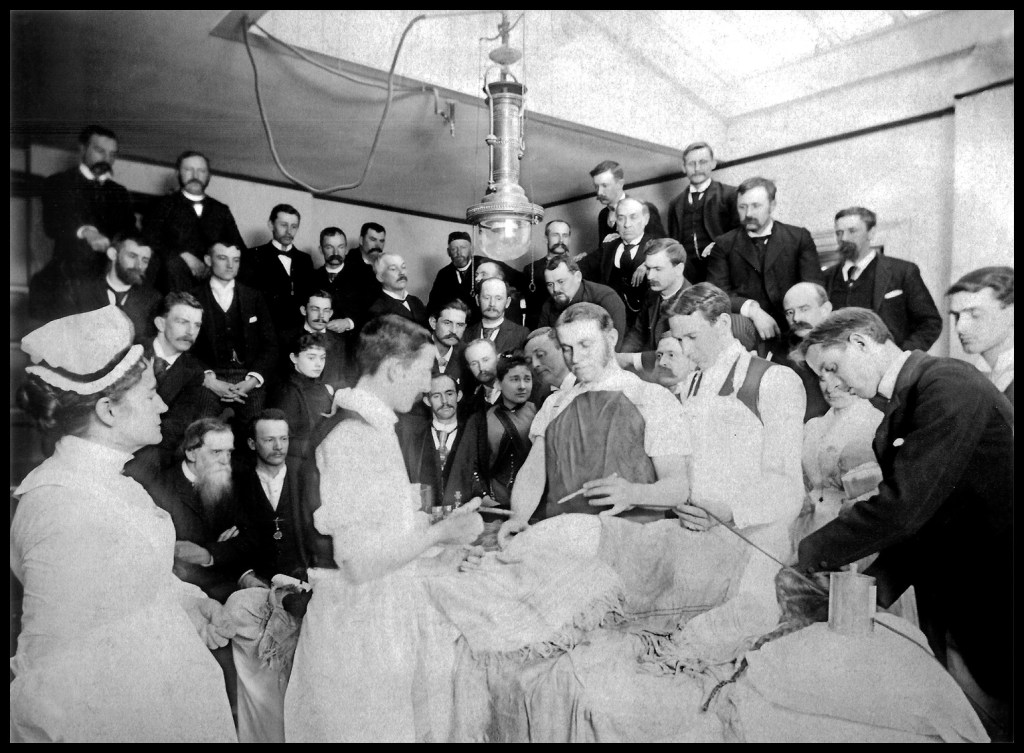
Robert Morris surgery at Bellevue Hospital, NY
Robert Morris operating at Bellevue Hospital, NY, c. 1895

The Long Stillwater is a chapter Robert Morris, M.D. wrote to celebrate a love of nature from a trove of memories. Stillwater is hardly a dictionary word, but it made sense yesterday as I floated on a mirror-perfect patch of still water on the inside bend of Powhatan Creek. A few yards away, tidal water surged upstream to revisit saltmarshes to a terminus in a swamp of bald cypresses. Morris wrote:

When a man retires from the swift rapids of an active professional life he arrives at a long stillwater, but the banks of that stillwater are so alive that his days continue to be brimful. Unlike Gibbon who felt desolate after completing his history, the doctor goes on, for medicine has been collateral to many other interests which were always in the clover field just over the fence. I look forward with almost boyish eagerness to new work and playtime to re-read the old classics and to enjoy choice literature, and time to live in the out-of-doors. I shall stalk the moose and bear, not with a gun but a camera. Now I can go when the Red Gods call.

He must go ― go ― go away from here!
On the other side the world he’s overdue.
‘Send your road is clear before you when the old Spring-fret comes o’er you,
And the Red Gods call for you!

Several years ago, I left a determined bass of violent nature and fancy greenish luster under a crawfish bank in the swift-running waters of the upper Mississippi. I know just where he is this very minute, and I can now go back to him and cast a black raven fly into that white foamy eddy. When corn is in the shock and autumn leaves are falling, Lou Smith and I shall climb over the frosty top rail of a shaky old fence just before sunrise to hear a woodcock go twittering up through the alders. I know an inlet for safe anchorage by the sea where halyards will slap against the mast and the boom will bump, bump, bump while surf is roaring and growling on the outer bar and brant geese go filing overhead.

The saddle will creak monotonously on my broncho as I plod hour after hour through scattered mesquite and cacti in the overpowering, awe-inspiring silence of the desert. Once more, I may enjoy the fragrance of sage brush after a rain and see the ocotillos in bloom with no more hurry than that of a Navajo Indian when he feels like resting. For companionship in the desert, I shall choose a friend for whom hardship is nothing but a diversion.

Then back perhaps to Eastern Canada, where all is green when it is not blanketed with snow. From somewhere among the tangled viburnums and blue Clintonia berries two white-throated sparrows will sing to me and my companion in clear tones in clean air. The wind will be moving in the forest, and gold flakes of sunlight will filter through the birches to the mossy logs. A hermit thrush will send tones of spiritual ecstasy ringing through the silence, modulating from minor key to major key and back again, while evening lights fall slanting through the somber tops of pointed spruces. And neither my companion nor I shall speak, for we have learned that “music begins where words end.” And when the grandest of all music, that of storm, is approaching, I shall go forth to meet it, high up among the crags and peaks.

How I love a storm! The wind slowly dies, and an ominous quiet settles down over motionless gray lichens. From out of the west, bold rolling heads of cumulus come marching with martial front into the afternoon’s clear blue heaven; volume crowding volume, on they come! The sky darkens and blackens. In massive majestic motion, the heavy clouds sink lower than the crags. Darkness is everywhere. My fingertips tingle with electricity for a moment. Suddenly, there is a brilliant flash of startling light; then a devastating crash makes the solid rock quiver under my feet. Reverberations go bounding along in diapason from canyon to canyon—grand organ pipes of nature. Thundering echoes roll on in deepest bass. On to distance, distance, distance—lost! A momentary hush of ponderous quiet, as the affrighted air stands still before the next, the impending crash.

Jove’s message is delivered and his heralds rapidly disband into vast loose volumes of nimbus, shot through and through with long shafts of crimson and titanic fan rays of deeper red. Bright sunshine lights the evening sky once more and high peaks glow, but soon long shadows creep down to darkening vales for night and deeper dark. ‘Tis then I am the mountaineer, and yet at times, when all is still, I seem to hear loud surf—but that is only memory for one who loves the sea.

Extracted from A Surgeon’s Story. The Autobiography of Robert T. Morris. Compiled and edited by Roger Gosden and Morrris’s granddaughter, Pam Walker (2013)

Robert T. Morris
Posted in Memoir, Nature | Tagged , | 2 Comments

Scavengers in my Yard

Black vultures

Deer munch on our flower borders, strip foliage to head height, and rub bark off trees with their antlers in the rutting season. We grumble yet feel sad coming across a beautiful animal that died on our property after a road accident. We often find only their bones.

I rarely need to bury a carcass because scavengers soon arrive to devour all the soft tissues. Sometimes, we have more than a dozen Black Vultures crowding over it. It’s not a pretty sight and the stench of the birds can drive you back far more than the corpse. I can walk within a few feet without disturbing them because they have little fear of humans, being protected under the Migratory Birds Act. And why should I scare them away when they provide a free service?

Posted in Birding | Tagged , | 2 Comments

Last Flight of the Marlins

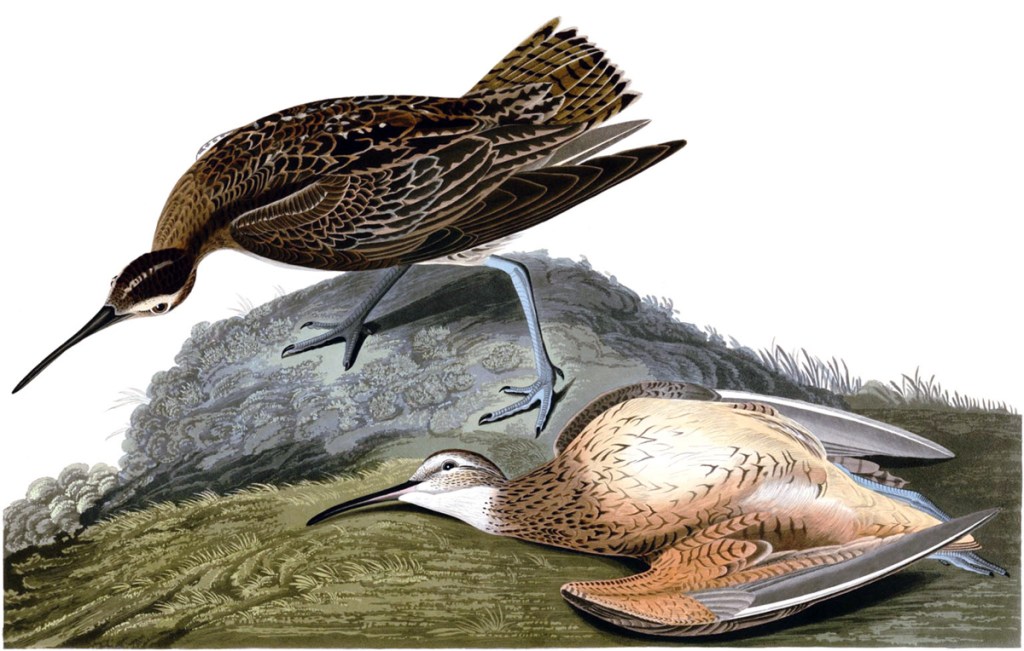
Eskimo curlew
Eskimo Curlew. From Audubon’s The Birds of America

Memories of the Canadian wilderness forty years earlier were still sharp in Dr. Robert Morris’s mind as an old man in the 1930s. A pioneering New York surgeon, he was also a distinguished naturalist, horticulturist, and poet.

One day in August when standing on a bold crag in the mountains of Labrador, I listened to the lilt of marlins almost out of sight in the clear blue sky and leaving that day for Argentina on a non-stop flight. A whale was playing in the distant sunlit heaving sea that sent but a passing puff of its thunder up to the heights where I stood. The heavy rumble of a sundering iceberg moving in colorful majesty and flashing dignity down its lane of deep ocean current could not drown out the exultant note in voices of carefree birds that were bound for somewhere of joyful memory for them. The thought was so overwhelming that I sat down on the soft white caribou moss and began to pencil in my notebook some lines that were later published in Surgeon’s Philosophy. I had to stand up to finish the note feeling reverence for a scene that made sitting down in its presence a profanation. In an atmosphere so clear that one could look straight up to infinity the birds rose high before heading south. They became mere specks in the sky and were then lost to view while their voices still came faintly back. The measure of the lines corresponds to that of the wingbeat of the birds otherwise I could not have remained in tune with nature.

So faintly, yet clearly, one almost says “nearly,”
The silvery lilt of a light floating marlin; two
miles toward God while the world whirls beneath him.
He stops not for rain, nor for mountain, nor falcon,
from Labrador coast to the Argentine highland.
“This evening I’m Southward, tomorrow returning;
Missouri, Alberta, wherever you see me, don’t mind
what the wind is. You’ll know it’s fair weather—
and always good going for those who fly high enough.
Send up a greeting; but, no! I won’t hear it,
for voices of men cannot reach to my roadway.
So lift up both hands as a sign that you see me,
and down through all cloud and I’ll send a clear sky note.
Oh, silvery lilt of the light floating marlin!

When men’s hands point toward him, they’re lifted up toward Heaven. On the homeward bound steamer from the North that year a group of travelers in the cabin asked me to read extracts from my notebook, but these lines to the marlin seemed to have been “written for myself only.” No one referred to them in the subsequent conversation that evening, but there were plenty of questions about wolves and bears. In the audience, there had been a rough old, seasoned captain who sailed the seven seas on roving commission. He had recently lost his ship in the ice and was getting himself and survivors of his crew back to a port. Next morning, he stopped me as we were passing on the deck, and said, “Them words that you read about the doe-birds (marlins) last night was about right. I wish you would let me see that log of yours again if you don’t mind.” He had doubtless put many a cask of stewed doe-birds in his larder aboard ship, and I was astonished at any sentimental interest in the big gentle birds as it came from that old salt.

Perhaps I was one of the last men to witness a flight of the marlins that were so delicious for the table. Subjected to murderous massacre at both ends of their flight and on the spring return journey by way of the Mississippi Valley they melted away like the passenger pigeon, and only a little later on.

[Until the end of the Nineteenth Century, the Eskimo Curlew (Numenius borealis) was one of the most abundant shorebirds in North America but overhunting drastically reduced its numbers to presumed extinction. Fred Bodsworth published a fictionalized story about the species, Last of the Curlews (1954), made into an animated film for children that won an Emmy award.]

Extracted from A Surgeon’s Story. The Autobiography of Robert T. Morris. Compiled and edited by Roger Gosden and Pam Walker (2013)


Robert T. Morris
Available at Amazon and from booksellers
Posted in Birding | Tagged , , | Comments Off on Last Flight of the Marlins

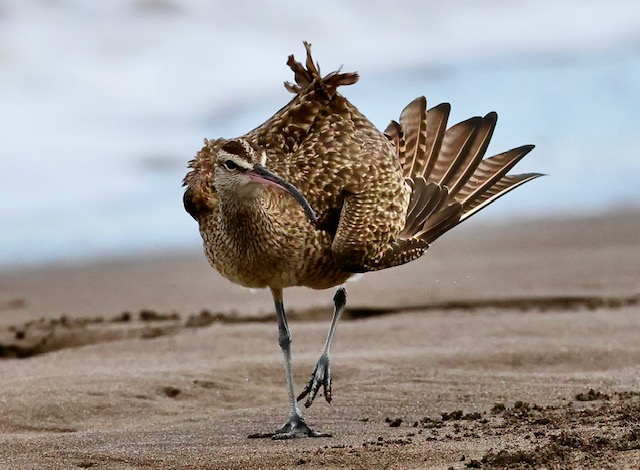
Tracking Whimbrel

Whimbrel on the beach
Photo: Inge Curtis

An elegant shorebird with a lovely piping call of the wild. After they leave their breeding grounds in the tundra,  Whimbrels stop to feed on fiddler crabs in the mudflats of the Eastern Shore of Virginia. By October, they leave here for wintering grounds in the Caribbean basin and South America. The journey is thought to be along the Western Atlantic Flyway with other shorebirds, including Red Knot.

Dominion Energy is planning to build wind turbines about 23 nautical miles off our shores as a major contribution to reducing greenhouse gas emissions. To study the risks for migratory birds, the Nature Conservancy and the Center for Conservation Biology have attached GPS transmitters and altimeters to 15 whimbrels this year for mapping their route(s) on fall and spring migrations. Planners will be relieved if the birds avoid the wind farm and fly higher than the towering turbines.    

Posted in Inge Curtis birds | Tagged , , | 1 Comment

Jamestown is drowning

Jamestown Island
Erosion control on Jamestown Island, VA

Historic Jamestown celebrated Archeology Day today with various events and demonstrations to make history seem more authentic. Artifacts discovered on the island in the past 30 years give glimpses of how the first English colonists lived before they moved to higher ground in 1699 to make Middle Plantation their new capital (Williamsburg). Today’s program discussed the people (Native Americans, Whites, Blacks) and their occupations but nothing about the hydrology that dominates and determines who can live there.

I was reminded of the island’s fragility this summer when drawn to the James riverbank by a loud noise. Workmen were loading blocks of granite from a barge to build higher defenses from inundation.

The English colonists arrived at the worst possible time in 1607. A serious drought lasted from around 1606 to 1612, the driest years in eight centuries. The James River was much lower than today without refreshing rain in the watershed. The water at Jamestown was more saline, around 16 ppt compared to a tidal range of 3 to 10 units today (and 35 at the river entrance).  The drought offered a slight compensation by encouraging the spread of oysters further upstream for human harvesting.

Measuring the conductivity of ponds across the island, I found the water remarkably salty everywhere. The low-lying island is probably washed over by occasional hurricanes. That helps to explain why there are fewer amphibians than expected (few species tolerate salt). The environment is getting more hostile from sea-level rise.

If Archeology Day is still held at the end of this century it will be sad. Island visiting will be virtual because the excavated and reconstructed sites, including the original fort, will be underwater by then. Children who came today should keep their photos for their grandchildren to see and sigh.

Posted in climate change | Tagged , , , | 3 Comments