Not Mastodon the heavy metal band from Atlanta, but a heavy, leathery mastodon from Virginia. It is the first found east of the Blue Ridge. A local bricklayer was hunting on private land one day in 1983 when he found a strange object near a muddy creek. As he couldn’t identify it, he asked the geologist Jerre Johnson who realized it was the tooth of an elephant. An elephant in America—had Barnum & Bailey’s Circus been in town? But this animal was quite different to African and Indian elephants today, from a line that became extinct about 11,000 years ago. They are related species, but mastodons split early from a common Proboscidea ancestor, presumably trekking across a land bridge between Asia and Alaska ahead of mammoths that came later.
The private owners of the land forbad excavation, but when they sold it the new owners gave permission for excavation by Dr. Johnson, now Emeritus Professor at the College of William & Mary. He led a dig involving dozens of volunteers, including archeologists, Eagle Scouts, and many members of our chapter of the Virginia Master Naturalist program. It became a triumph for citizen science.
A breakthrough came after ten days of fruitless digging when the dirt started to yield its fossil treasure, including more teeth, ribs, limb bones, and broken tusks seven feet long and six inches wide at the base. The beast was old judging by its molars which were worn down by a rough diet. This was not a grazing species like modern elephants, but a browser of tree branches and leaves.

A tusk in protective plaster
Fossils in the coastal plain are not living matter turned to rock, they are the real thing. In eroded outcrops of this region, you can find strata of mussel shells inches thick. They look as fresh as if they were washed up from the rivers or Chesapeake Bay by recent storms, but may be a few million years old. Likewise, we had real mammoth bones, not rocks, although they no longer had the gleaming white freshness of shells. Dr. Johnson distributed them for his volunteers to wash and dry, and I was given a hefty chunk of what I guessed was the head of a humerus. The tusks were coated in plaster to protect them on their journey for display at the Virginia Living Museum (humorists take note), but unfortunately not enough of them were preserved for assembling a skeleton.
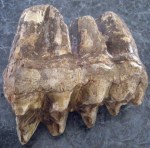
See the nipples on the molar
I was curious how mastodons got their name. Was it from the huge muscles needed for mastication? When the first fossils were discovered two centuries ago they mystified geologists who called the new species, ‘Incognitum.’ It was the French geologist George Cuvier who coined the name mastodon, although this was later dropped by taxonomists for the more ponderous, Mammut americanum. I previously blogged about the curious names chosen for new animals to science, sometimes they are more whimsical than biologically meaningful. Cuvier chose mastodon, which means ‘milk tooth,’ because the crowns of the molar teeth looked like nipples. You can see on this picture why he chose a quirky name. The teeth don’t resemble those of any other kind of elephant, extant or extinct, which is why they can tell a mastodon from a mammoth.
The discovery was so unusual that it interested the Smithsonian Institution and the Washington Post. One day soon, carbon dating will reveal the fossil’s age, and perhaps museum conservators will deduce whether score marks on the ribs were made by the claws of a saber-toothed cat or a dire wolf.
We know that mastodons died out at the end of the last Ice Age with other megafauna, but was their extinction caused by climate change or Clovis hunters? I guess it was an irresistible convergence of the two, which are the same threats facing elephants today and so many other species of animals and plants. Central Africa has lost 100,000 (64%) to poachers and habitat loss in the past decade alone. I missed live mastodons in our town by a whisker of geological time, and dearly hope that future generations will have more than elephant bones to marvel at.
Next Post: Why bats scare us