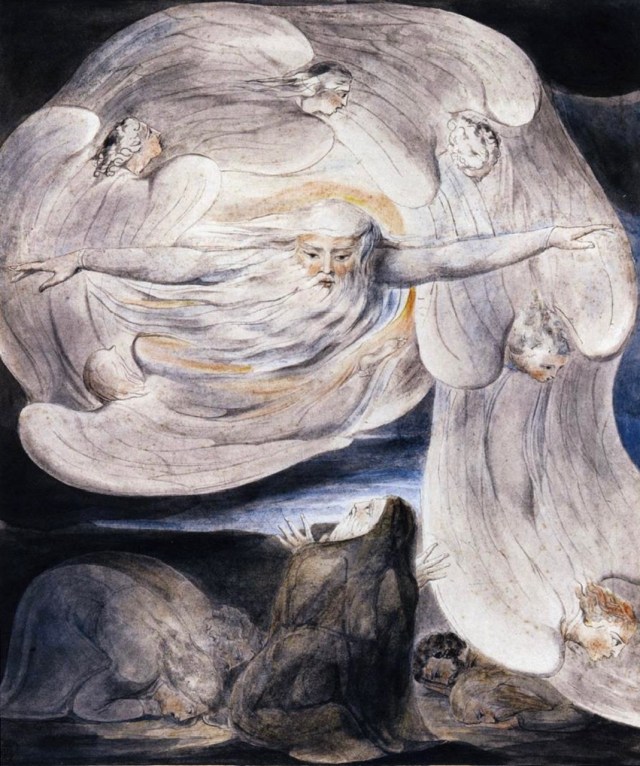
William Blake was a poet, painter, printmaker, mystic, and, I vouch, a protoenvironmentalist. His painting: Job Confessing his Presumption to God, who answers in a Whirlwind, represents the crisis of his life. Job had a great life with his large family and immense possessions until he lost everything. The folktale is usually taken as a parable that questions God for allowing suffering (or letting pesky Satan loose), but it can be read another way.
Job regards himself as an entitled master of all he owns. As a righteous man, he deserved it! But God, speaking out of the whirlwind, asks (in other words), “Where were you at the Big Bang, the Age of the Dinosaurs, and the start of the Agricultural Revolution?” Job is depicted as the shrunken figure crouching under the Godhead.
If Blake could look down from heaven today, over two centuries since the paint dried, he would see colossal results of arrogance as the species that regards Earth as its dominion despoils it in a blink of cosmic time.