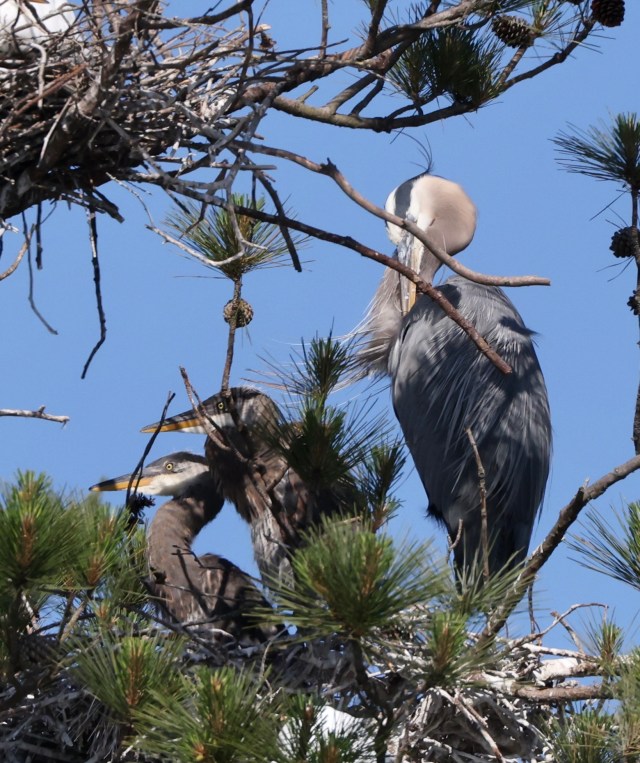
Great Blue Heron
Photo: Inge Curtis

Normally solitary, I see Great Blues poised on the banks of saltmarsh, staring into the creek at a respectful distance from the next neighbor. Occasionally one lands by our pool, as statuesque as the artificial kind sold as pool decoration.

They can’t stay solo, of course, and are in pairs for the breeding season. Pairs congregate to make twiggy nests in the tops of trees called heronries or rookeries. Rooks are familiar birds in the British Isles and Europe, a relative of the carrion crow with a pointy white beak and mask. They remind me of pictures of medieval plague doctors. One of the first signs of spring is the cawing of rooks around the rookery, repairing old nests in tall beech trees.

For all their glamor, Great Blue Herons don’t have a beautiful voice, making a hoarse croak when disturbed at fishing. Uncommon in the past, they are doing well now. In 1964 only five colonies were known in the Coastal Plain of Virginia, rising to 203 and about 9,136 pairs according to a 2003 survey.
THE NEWSLETTER, ON SUBSTACK

Enjoyed this essay?

Join me on Fertile Ground: occasional essays on nature, science and medicine, sent to your inbox.

More to read

Girdling the Maple

Girdling the Maple

Consider the consequences if your largest blood vessels were coursing under surface of the skin instead of deep inside the body. I know it’s hard to imagine. But if the aorta ran the length of your back, branching out to

Read essay →
Scarlet Tanager

Scarlet Tanager

Spotting a Scarlet Tanager in the upper story of an Eastern Forest transports me to the tropics. And it is a tropical forest dweller in our winter months. Our Northern Cardinal is almost as rosy and House Finches a bit

Read essay →
Dog Smart

Dog Smart

“I used to think my human was smart, but I now realize he only looks that way. I know I shouldn’t be anthropomorphic about one I’m particularly fond of.”  **************************** Did you ever suspect that dogs often turn out looking

Read essay →
Scroll to Top